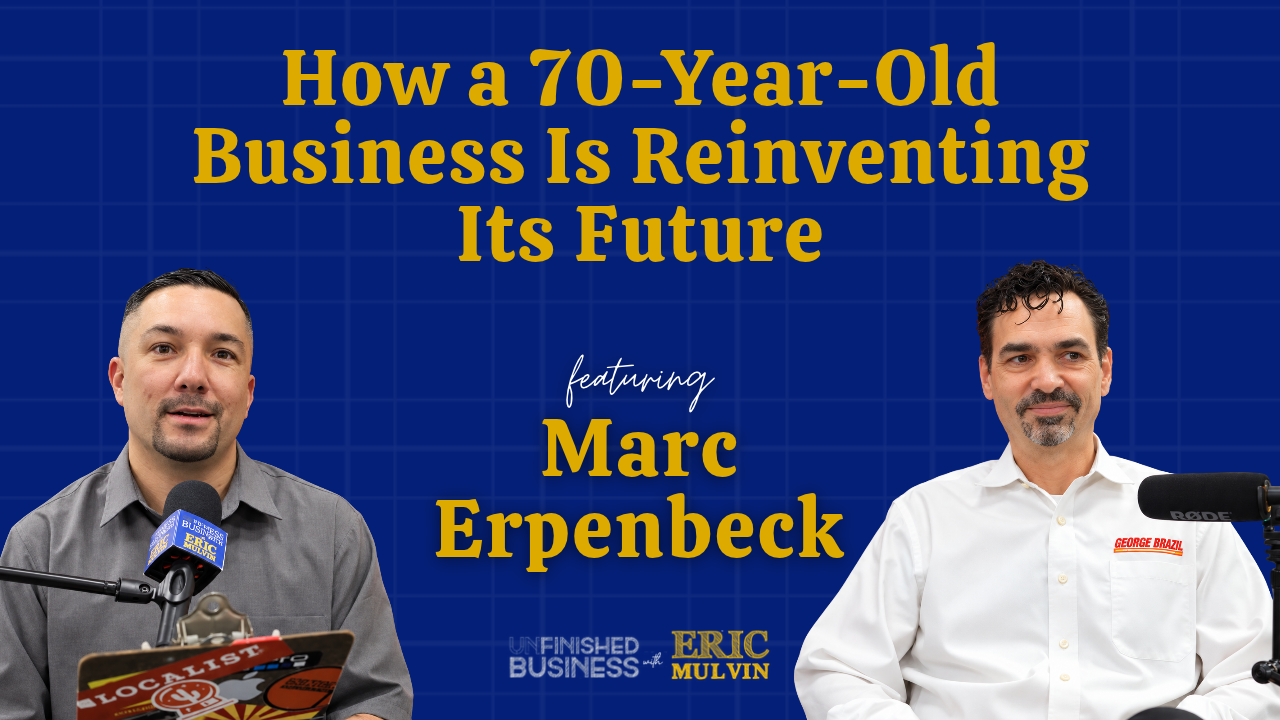
[Vistage Series] How a 70-Year-Old Business Is Reinventing Its Future | Marc Erpenbeck




What does it take to protect a 70-year business legacy while preparing for a future shaped by AI, private equity, and changing customer expectations?
In this episode of Unfinished Business with Eric Mulvin, I sit down with Marc Erpenbeck, President of George Brazil Plumbing & Electrical, to talk about his journey from engineering and law to leading one of Phoenix’s most recognized home-service companies.
Marc shares why he chose to transition George Brazil into a 100% employee-owned business, how that decision affects company culture and customer service, and what it means to build a company that can thrive beyond its current leadership.
We also explore how AI is changing the skilled trades, why businesses need to rethink how customers find them online, and Marc’s unique approach to using AI for better decision-making.
In this episode, we break down:
- How Marc went from engineer to lawyer to company president
- Why George Brazil transitioned to employee ownership
- The differences between employee-owned and private equity-backed businesses
- How ownership can influence accountability and customer service
- Why employee training remains central to the George Brazil legacy
- How AI could transform plumbing, electrical work, and customer support
- Marc’s approach to using AI personas and challenging AI-generated answers
- Why customer complaints are opportunities to build trust
- How AI is changing online search and business marketing
- The importance of family, growth mindset, and human relationships in leadership
If you’re a business owner thinking about succession planning, a leader building company culture, or an entrepreneur trying to understand how AI will affect your industry, this conversation offers practical lessons from someone navigating all three.
Watch the full episode on YouTube or listen to Unfinished Business with Eric Mulvin on your favorite podcast platform.
Episode Highlights
00:00 – Introduction to Unfinished Business Podcast
03:08 – The history of George Brazil and its influence on home services
07:14 – Marc’s journey from engineering and law to business leadership
09:40 – How Marc became President of George Brazil
15:16 – Succession planning lessons from personal experience
18:25 – Why employee ownership became the right path
22:48 – Private equity versus employee-owned home-service companies
26:31 – Why George Brazil prioritizes employee training
35:41 – Could AI eventually replace plumbers and electricians?
42:30 – How Marc uses AI personas to challenge business decisions
53:38 – How AI is changing Google search and customer discovery
60:22 – Handling customer complaints and rebuilding trust
About Marc Erpenbeck
Marc Erpenbeck is the President of George Brazil Plumbing & Electrical, a Phoenix-area home-service company with roots dating back to 1955.
His career spans civil engineering, construction management, and law. After graduating from Arizona State University’s law school in 2000, he practiced construction and environmental law in Phoenix, where he first met George Brazil as a client.
Marc became President of the Phoenix business in 2013 and later became its majority owner. Drawing on his personal experience with business succession, he led the company’s transition to a 100% employee-owned business through an Employee Stock Ownership Plan (ESOP) in 2024.
Under his leadership, George Brazil serves more than 13,000 service agreement members and was recognized as one of Arizona’s Most Admired Companies in 2025.
Marc’s approach to leadership emphasizes employee development, accountability, customer trust, continuous improvement, and protecting the company’s long-standing commitment to quality service.
Connect with Marc
Company: George Brazil Plumbing & Electrical
Follow Unfinished Business with Eric Mulvin
Instagram: https://www.instagram.com/bizwitheric/
Facebook: https://www.facebook.com/profile.php?id=61560126743830
TikTok: https://www.tiktok.com/@bizwitheric
YouTube: https://www.youtube.com/@BizWithEric
LinkedIn: https://www.linkedin.com/in/mulvin/
Powered by Pac Biz Outsourcing
Pac Biz Outsourcing helps NEMT, software, and eCommerce companies scale dispatching, customer support and back-office operations with dedicated teams in the Philippines.
🌐 Learn more: https://pac-biz.com
📩 Email: info@pac-biz.com
🎧 Podcast: https://yourunfinished.biz
Transcript
Eric Mulvin: 00:00
Welcome to the Unfinished Business Podcast. I’m your host, Eric Mulvin, and this is a show where we sit down with CEOs, leaders, visionaries, and creatives who are out changing the world through their business, through their leadership, through their organization, or through their creativity. Because it doesn’t matter who you are or what you’ve accomplished. Even someone out there like Joe Burroughs still has some unfinished business. I know he definitely has some unfinished business. And so we explore those stories here on the show, Unfinished Business with Eric Mulvin. This episode is brought to you by Pac Biz Outsourcing. At Pac Biz, we help e-commerce, software, NEMT, and taxi businesses outsource their back office and customer support tasks with a dedicated team in the Philippines. These people out there handle calls, emails, tickets, and all kinds of back office support so that you could focus on your business. For example, one of our clients saves over $600,000 a year by switching their dispatching and back office tasks to Philippines Pac Biz teams. So if you want to learn more about working with Pac Biz outsourcing, please visit our website pac-biz.com to learn more or give us a call Monday through Friday during business hours at 480-771-3009. My guest today is leading one of Arizona’s most established home service companies into its next chapter. As president of a 70-year-old A plus BBB accredited plumbing and electrical company, he leads an organization serving thousands of families across the Phoenix area. The company is now 100% employee-owned, serves more than 13,000 service agreement members, and was recognized as one of Arizona’s most admired companies in 2025. His leadership philosophy combines a builder’s mindset with a focus on transparency, accountability, customer trust, and developing employee owners into leaders. And in an industry where private equity and consolidation have become increasingly common, his company has chosen a different path, staying locally operated and investing in the long term in its people, customers, and community. Today we’re talking about employee ownership, protecting a 70-year legacy, building a culture of accountability, earning customer trust, and creating a company designed to last. Please help me welcome the president of George Brazil Plumbing and Electrical, Marc Erpenbeck. Welcome to the show, Marc.
Marc Erpenbeck: 02:49
Thanks, sir.
Eric Mulvin: 02:51
So I think if you guys are watching, we got a lot of folks in the Phoenix area, but then there’s people all across the country, uh, and maybe all over the world that are watching. So for the people at home that might not be familiar with George Brazil, just give a little background on what uh what that company is.
Marc Erpenbeck: 03:08
Yeah. Um, so George Brazil himself founded it in 1955. Uh he was originally a little bit in new construction and uh eventually realized that new construction wasn’t where he wanted to be. So he created a um home service, like service and repair company, uh originally just uh air conditioning and plumbing. George himself was a plumber, um, came over and so by the late 70s, early 80s, he was really ramping up what he was doing, primarily out of California. In California, he had started, gosh, over 20 locations, uh, had expanded into uh Arizona, Nevada, uh, Oregon, and all the way up to Washington. Um, and then had kind of uh I’d loosely say franchise, but not exactly. He gave some locations to some of the plumbers and uh electricians or air conditioning techs to open their own location with kind of him giving them the advertising and ground rules for what that was. And so uh in 1990, um, they opened the one that’s in Phoenix, which is the one that I now am running. And so George was one of the major founders in the home service industry. So uh him along with Frank Blau and about eight other gentlemen uh started what was then called Contractors 2000 and is now called Nextar. Um in additionally, he started a couple of other best practice organizations in the quality um service contracting trades uh as well. And so he was kind of the person who created um kind of the box truck, you see, kind of the the picture behind you, um, really into doing those kind of things, red carpets, booties, uh a lot of the things that you see now that have just become standards within the industry really originated uh by George Brazil himself.
Eric Mulvin: 04:51
That’s amazing. I didn’t realize that he was such a pioneer in the space. So before him, there wasn’t was it just a bunch of little independent businesses?
Marc Erpenbeck: 04:59
And there was a lot. There wasn’t really anything in the home service trades. Um, because it’s service and repair, so even like um when you go and you get a training and you you go get a license for plumbing, it’s a four-year program. But if you go and you look at like into the actual training modules, I think only like 16 hours of the four years is focused on service and repair. So there really hasn’t been a whole lot of training or focus directly within that service and repair and being invited into somebody’s home. A lot of times, just generally becoming a plumber, you know, or an air conditioning tech or an electrician was just generally taught, but it could be new construction, it could be service and repair. And so George always thought it was super important that people understand the difference between them because it really is a very different circumstance of having open walls where you’re just laying pipe down, right? And there’s doing it consistently, as opposed to showing up at someone’s home where it’s hidden behind the walls. Maybe there was do-it-yourselfers, maybe it’s been over a long period of time, you’re dealing with spouse, kids, dogs, you know, who knows what. So a little bit of a different circumstance. And so it definitely is a is a different trade in many ways, even though they share the same name.
unknown: 06:06
Cool.
Eric Mulvin: 06:06
And I think for people in Phoenix, uh, a lot of people might be familiar with uh the with with the trucks and seeing George. I think people might be surprised to know that he’s an actual person, that he really existed and uh and not a fictitious character there.
Marc Erpenbeck: 06:22
Yeah, no, no. George George definitely existed. Um, you know, he was uh we’ll probably get there, but uh I met George uh when I was a lawyer uh is is one of my clients. And so um George is a fascinating man. And for what it’s worth, the uh the man that you see uh on the George Brazil truck is actually not George, it’s uh two people that he put together. So it’s one person’s body and one person’s head that he kind of did in the 80s, kind of before we had kind of uh the digital software to be able to do that. But uh yeah, that was the uh the idea behind his uh logo of the guy walking.
Eric Mulvin: 06:54
Cool. And you touched on it a little bit. Um it I think is an interesting story, especially for the people um watching. You know, there’s a lot of people that maybe are thinking about wanting to get into business, either starting their own, you can get into franchising, you could you could buy a company. And uh now you were not in the plumbing space before you got into George Brazil. Like some people might be in the industry, maybe their parents were plumbers and now they’re in it, but for you, no, right? Not at all.
Marc Erpenbeck: 07:21
Well, you know, a little bit. Um, so um I grew up in Kentucky, and um, there my grandfather had started um Urban Bank Construction Company. And so my dad was uh architect uh there and became president of that company. But my dad was a licensed plumber and electrician. And so uh young, I had worked uh either engineering with my dad or my uncle, or in a little bit in the construction thing where he he kind of had that plumbing electrical stuff. From there, I I went to school as a civil engineer. I was in construction management and structures, and so I worked for three three to four years uh doing design of hydroelectric dams and tunnels and sewer systems. Um then I was doing that for uh out of Chicago, but it was for places all over the world actually, and then some local things too in Chicago were my primary things where I was construction manager. From there I transitioned to law. And so uh in 2000 I attended law school here at or graduated from law school here um in Arizona at ASU and then uh was became a lawyer um in construction and environmental law at a big law firm um here in Phoenix. And that is where I met George. Um George had a couple of issues that popped up trying to resolve them basically some water-related damage that happened from some air conditioning units and needed some help. So um that’s how I was initially introduced to him.
Eric Mulvin: 08:42
Cool. So there was a thread, a common thread of this uh construction building kind of background and uh yeah.
Marc Erpenbeck: 08:50
A little bit. I mean, you know, it was always kind of one of those things. Um, you know, for me, I always kind of think about like, hey, how does this all link together in my resume in some way? Like, is there a path or a thread that makes sense through it? So there is, I mean, I I I frequently get asked about it just could it’s interesting that I I did the jump from you know one to the other. I don’t really change jobs as much as I change careers. So I’ve had one job, I’ve had one job in each career, basically.
Eric Mulvin: 09:13
Yeah. Interesting. So and uh yeah, how long did you spend doing lawyer versus now the plumbing side?
Marc Erpenbeck: 09:20
Uh it’s pretty even. Um I was uh there for about 13 and a half years, and I’ve been here about 13 and a half years now. So yeah, so it’s it’s pretty evenly divided at this point.
Eric Mulvin: 09:32
All right. And how did you get to like I mean it’s one thing for it to be your client and to to get to work with them, but how did you go from that to I’m gonna run this company?
Marc Erpenbeck: 09:43
You know, it’s it’s kind of one of those things. I mean, I think it’s um important that people focus on when opportunity kind of comes along. So I was kind of at that point in the career, I had uh I have two young boys, um they were really young then, uh, and wasn’t spending as much time at home that I really wanted to do, and I was kind of trying to figure out like, okay, what’s my path gonna be in in law? And um I literally was driving by in the Broadway curve here and um saw a sign for George Brazil, and I was kind of like driving in, like thinking about like, hey, where do I where do I think this is gonna go? And uh I knew I had an appointment with um Pat, who’s George’s wife and amazing woman, and she deserves some description in and of herself. So I knew I was going over to see her uh later that day, and I literally called my wife on the drive-in and said, Hey, what do you think if I think about moving over to George Brazil and uh see if Pat was interested? So George had passed away at that point. So George died in like 2012, so this is like early to 2013.
Eric Mulvin: 10:36
Oh, so shortly after that happened.
Marc Erpenbeck: 10:38
About a year. You know, I think it’s always important if people have a little time to do whatever. And I had kind of I had been talking to George at the end of his life and with Pat since that time, and I knew she was kind of trying to find a transition of like where the what was gonna happen with the company. She was in her, you know, upper eighties by then or mid-upper eighties. And so I knew the path kind of wasn’t working out the way that she exactly wanted to. And so I I literally um they had an opportunity that I was going to the uh ASU law school and uh the chief justice of the Supreme Court was there that day, uh, and she was signing books, and I was like, oh, I know Pat really likes her, so I’ll I’ll get a book signed for her and come over. And I and I literally just sat down and said, Pat, you know, I know it’s not working out the way that you like, but uh you probably never thought about me, but I’d be interested in coming over uh as the president. And so um we talked about it. I could see pretty quickly that she was potentially interested. And over the next three, four months we kind of talked about what that is, and then I came over as the president. No ownership or anything at first, just uh prove it scenario. I figured I could always go back and be a lawyer if I wanted to.
Eric Mulvin: 11:42
Was it about proving it to her or proving it to yourself?
Marc Erpenbeck: 11:45
A little bit of both, you know. Um, I’d had a little bit of experience in in running the business, just my dad had passed away, and so there were some other things that I had to do, you know, when he passed away. And obviously, I had been consulting a lot of businesses as a lawyer on what to do, but actually running it myself. Um, you know, I I hadn’t never done exactly what I was doing. Uh I in all the times I had a pretty good idea from a big picture how George felt about it, you know, what he wanted to accomplish. But all the ins and outs of the details, those are all going to be a little bit new.
Eric Mulvin: 12:16
Yeah. Okay, interesting. So you were president and uh then you had some choices to make because you could have said, Oh, you know, I could stay here as a job and let Pat figure out what to do with the company or take over and buy it. And you made the decision to obviously uh acquire the company then, right?
Marc Erpenbeck: 12:34
Yeah, so uh partially I was I became a majority owner at that point, and uh Pat and I were partners uh together until you know till the very end of our life, basically. Um we worked really closely together. Uh I had known Pat pretty well. She’s different than me. Like if you take every single Colby test or whatever, like I’m over here and she was so she was very empathetic and um an amazing person who could kind of um amorphic. She could kind of be whatever she wanted to be in in many different things. Um just uh she was the director of vocational education for the entire state of California, which is how she met George Brazil because George was wanting her to create some technical training stuff and he was trying to do that. So she was only one of two women in the country that had that. She had the biggest budget in the country that she was in charge of. She testified to Congress, I think, three or four times. In fact, uh testified before Steve Jobs on the importance of computers and education. Um amazingly smart woman. Um she graduated with a college degree in World War II. So not not very many older women uh at that time had gone through that kind of college education, and so she was um an educator um basically in the trades and had taught uh typing and in some other um classes at in numerous high schools in California and then uh had that amazing role. So you know, she she knew a lot and was capable of a lot. She also brought a lot of resources because George had really helped out a lot of folks, and so she called in some people um from around the country to come in and visit with me. We went back and joined some of these best practice organizations that George had helped start. So there was a lot of resources available for me to try to get me up to speed on uh what was needed, and and I think Pat and I were a pretty good team together.
Eric Mulvin: 14:22
Man, it must have been an exciting time for you going through all of that learning and discovering and trying to see how how this all fits together.
Marc Erpenbeck: 14:31
Yeah, I mean, it’s um one stress is I mean, I I I can do some plumbing and electrical at my own house, but you don’t want to hire me to do it at yours, right? And so uh I knew enough to be dangerous, but I knew I couldn’t run in a truck, right? So it was like when things were not working so great, which you know, there’s always some things in those transitions when you roll into a company. And so there were some tough transitions in there, but I mean, I knew I couldn’t jump in a truck and do it. And so trying to figure out how to make that stuff happen uh was an interesting challenge.
Eric Mulvin: 14:59
Cool. Uh a little bit of a tangent because you know, we talked with some people about exiting their business and you know, timing. And I I would I would think it’s not ideal that you leave your company, you pass away, and now your spouse is the one running it. Any thoughts or advice to business owners on like any lessons learned there? Or you know, what would you would you say she probably would have made some different decisions if she could have?
Marc Erpenbeck: 15:25
Well, you know, I I’m not sure on that. I mean, there Georgia had a couple thoughts on that, and then I have some personal experience with it too. Um, as I mentioned, my my dad had passed away pretty early, like 58, 59 years old. And when he passed away, he didn’t have he didn’t have his corporate structure kind of set up the way that you should. Uh it was set up as a sole proprietorship. So there wasn’t like a corporate entity to close. And so he was designing um churches throughout the southwestern United States. So he was doing a design build of that as the architect and being the construction manager. When he passed away, I was the one who kind of got okay taking over projects. So like literally taking them over and finishing them. Oh, like literally, because there wasn’t any way to not finish them. There wasn’t like a close down of business or anything. My dad was on the line for it personally with having it as set up as a sole proprietorship. So I was in my third year of law school. Uh my dad was based out of Florida, so I basically finished my last semester of law school uh in Florida trying to help on that. And then my whole first year in law, I basically was trying to build a couple churches in Florida and North Carolina. Um, some of my dad’s uncles and some other people were kind of looking in on it on a construction management basis. But yeah, I mean I had to to take that over, and you realized the leases, the the all those things that were there that weren’t taken care of um really became a big thing. Um and as the now becoming the lawyer in the family too, you know, kind of getting me involved in the estate planning and like what happened with this and where were things at? So it was a relatively traumatic uh experience to try to to go through that and then um and then I dealt with it with you know Pat and George too, um, who um you know George had originally retired into Arizona and say retired for like six months that’s how it goes, right? He he took you know the George Brazil here in Phoenix uh back over. And so, you know, he was really entitled by and excited about that, and I mean that was kind of like his mission of that and training. And so I think it’s really important that people have missions. Um, but definitely as Pat was older and after COVID, you know, it just was time for for Pat to step down. And and you know, at the time she was like 95.
Eric Mulvin: 17:38
That’s crazy, 95 and still still somewhat active, then I’m guessing, right?
Marc Erpenbeck: 17:42
Yeah, I mean, she would she was at least in meetings on a weekly basis. Um I would go and kind of give her updates on what was happening, and it kind of kept her energized and focused on what to do. But you know, eventually when it came down to to that, and then the company bought back her shares, and so then I was the sole shareholder, you know. Um I’m in my young 50-ish around then, and I realized my dad had passed away not that much later, right? And I know what had happened, and I’m like, okay, yeah, I want to make sure there’s some kind of transition plan in place. You know, we have the corporate structure and all that. So we looked a little bit at that too, because you know, there has to be some kind of succession plan. Um I had two young boys, it wasn’t going to be like the family business stuff, and I’ve dealt with enough family business stuff um out of the construction company. So I didn’t think that was gonna be the mission. So really kind of just looking at what the options were out there and uh employee-owned was one of them that I thought was really interesting because it it felt like a it was very sincere and focused on what I had always promised at Pastor George, that I would take care of the name of the George Brazil and that I would make sure that it would continue to grow as a brand, that it would continue to mean what it means in in my mind, which is um old-fashioned customer service um with quality beyond kind of expectations of what people have. So really high end on what we try to do and produce and and make sure that uh all of our technicians are really well trained and they hopefully have the time, effort, and ability that they get a damn that looks good minute when they get to step back and see what they they’ve created in a home to help make sure that people have healthy, happy places to live.
Eric Mulvin: 19:18
Yeah, awesome. And uh now you mentioned about the employee-owned side of things, and I think that is a relatively unique thing just in business in general. There’s not a lot of businesses that go down that route. And uh I and I know it’s not an easy process. I know, you know, I’ve known you over the years as you went through that. This isn’t like uh, all right, let me go hire this consultant and we’ll get this up and running in a couple of weeks. This this took like, I think, years of planning, right?
Marc Erpenbeck: 19:44
Yeah, I mean, really. I mean, I looked at it for about a year and a half or so um for whether or not I thought it was a good fit for us. There’s a little bit of expense on the front side, and there’s a lot of structure opportunities. I think you know, we’ve we’ve now become some of those organizations too we we’ve joined. And so they basically say when you see one, yeah, ESOP, so it’s an employee stock ownership plan. Um, when you see one, you’ve only seen one because there’s so many ways to structure them on how to do it, and there’s so many different variations of what to do and how to do it. It depends on your corporate structure and how you want to do it. You partially do it, fully do it, you know. There’s there’s a lot of choices. And so trying to figure all those things out. So I probably spent 30 hours of continuing legal education credits to try to understand what it was. And I would say that at the end of that, I felt like I was about a seventh or an eighth grade education on like what was all the things that were available. What I did have the advantage of is because in the law firm, um, I knew some people that had done it and had been um in house counsel at big law at big firms that had done this ops. And so I had the opportunity to leverage some folks who’ve been through the situation, understood what it was, were able to give me some really good consultants to be able to talk to and and kind of walk through. Um we did some planning stages. There was like a phase one like assessment, like what would it look like, how could it look like, what happens if it’s good, bad, and different, and then all those structuring things. And then so yeah, I mean, it’s a long planning process in all along. I mean, post-COVID. Um, but you know, we were uh mandatory stay open business, right? And we had to stay at home and you were trying to do that. And so you realize when a lot of other businesses were really struggling on what to do or how to do, having making sure that you had good water, that you had electricity in your home, that you had you know, all those things that were necessary, uh, really ended up being a really strong component of it. And on the backside of that, so many private equity companies were deciding, like, hey, you know, this would be a good business for us to own. And uh I had always felt that too coming over from law. I was always like, you know, somebody else who comes in with a different perspective about that could really bring something different to it. So I think you know, that that you come with a different mindset, I think is great. Um I think it’s you know, you can’t be all things to all people, but your team can be. And so having that mix. Of the different people with different viewpoints and things can really help make great decisions for a company and help make sure that you kind of stay on path.
Eric Mulvin: 22:09
Yeah. And you mentioned private equity. And I know we talked, well, that’s a hot topic in the business world. It’s in Phoenix, you know, it’s highly visible. We had a big uh chain that closed down Salad and Go recently, thanks to private equity, or at least it’s going to stay in the news. But it has been making a major impact in in home services and in other industries as well. There might be people watching that are like, yeah, we’re feeling the pressure as well. Talk me through a little bit of maybe some of the history of uh the what’s been happening in private equity and in home services. And because it’s not just a Phoenix thing. This is a nationwide, like any market you’re in, you’re feeling you’re feeling it, right?
Marc Erpenbeck: 22:52
Yeah, no, a hundred percent. I would say, you know, there’s not very many large home service companies uh in Arizona. It’s it’s more rare that you’re not private equity than that you are at this point. And I think it’s an interesting thing. I mean, I think uh we’ve always tried to run the business very much uh with a family feel to it. Very open door, very that. And you know, when you go private equity, you just lose that. The culture change that happens with respect to that. Um somebody back in another location, board of directors is doing it, they handle the admin stuff to um other sources that are handling CFOs that do that. Maybe your call center or your dispatch is all combinated with like seven or eight or ten or twenty companies that they may own under different brands around the country. Um private equity uh as of now has typically left the company name wherever it’s at. And they they might uh whoever was bought by private equity still may own some small some stake in it, but usually a minority stake in it uh when it’s left. So, you know, maybe they only buy 51%, but maybe more, maybe less. Uh each one of those deals is a little bit different. But eventually you hear the change in culture that happens along with that. Um, there’s different spends, there’s different other things. I think being an ASOP and being able to that uh control it and not have to report back to someone there and now reporting to employees. There’s still responsibility on reporting, and trust me, I feel it when we’re not doing great. Hey, you know, we didn’t have the best quarter. This is what it is. So you do feel that, but there’s not as much requirement that you hit every metric, every month, every quarter is maybe somebody who’s a publicly traded company.
Eric Mulvin: 24:40
Yeah.
Marc Erpenbeck: 24:41
That’s doing those things. So you do get to think more long term, and you do get to be much more of the family that you can be talking to the decision makers and they’re not necessarily in a boardroom uh thousands of miles away from you.
Eric Mulvin: 24:54
Yeah. So for a customer, like I’m one of millions of people here in Phoenix, and now I’m out looking for a plumbing company or a roofer or electrician or whatever, any any home service. What does it mean to me now as a consumer, now that my options are mostly private equity companies?
Marc Erpenbeck: 25:13
Yeah, you know, I mean, I they are run a little bit different for that. I mean, uh look, it and I and I do believe it. I mean, I we believe we owe it to make some kind of profit for what we’re doing for employee owners, and and they feel the same as far as that as private equity. I think the biggest difference is the ownership part of it, right? That you’re working for somebody that you don’t really know. Well, and the employee owner, you know, you really feel that that, you know, this is my baby. It’s in in for a long time when I’ve been told it here, being a plumber electrician here and being in a truck is as close to running your own business as you could have. You have the administrative support, you have those other things, but you kind of take the ownership of the call that you’re in and you know what it’s gonna be. I don’t want to say that people that are at private equity companies don’t have that same experience, but I do feel like and I hear from them, they feel more like a number uh at times, and they’re not necessarily the name of who they are and their family and wife and kids and and all those things that happen with that. So I mean, I really do believe in that, and and so you know, while we’re we have similar models and structures to some extent, what we’re able to do and make sure that we bend over backwards to make sure that we meet our performance guarantees and our ability to make sure that we’re you know meeting the highest standard uh in an industry is something that we really do uh focus on. So George used to uh have a phrase, and and so uh we’re we’re sitting in one of our like training areas that we had had built. Um when I first got here, it was a huge just hands-on training center only. And now we put it into like some learning space that’s here, and behind these walls over here is our training space still where we do do the hands-on stuff. But I thought it was so important. And people used to ask George, and I’d hear George ask, and he he told me personally several times like George, you spend so much time training people, and it was really his passion. Aren’t you afraid that you’re gonna train him and they’re gonna leave? Right. And George’s is what if I didn’t train them and they stay? That’s worse, right? And and I think he’s right. And and the other thing is George would say, Uh, you know, we’re gonna train you so you can go anywhere, and we’re gonna treat you so that you never want to leave. And so those are a couple of those mottos that just ring true for us and will continue to ring true for us. And one of the reasons that I think, you know, being an Aesop, it allows the management team to stay on and still control and be able to, you know, kind of leave those legacies, you know, that are so important that I think are um just so intertwined with the George Brazil brand and what we do.
Eric Mulvin: 27:44
Cool. Well, thanks for sharing that. That’s I like that perspective. With uh with and with employee ownership too. Uh you you’re unique in the the home services space, I think, for the most part. There are probably some others. I don’t know if there’s any as large as you guys in uh the Phoenix area.
Marc Erpenbeck: 28:00
Um You know, I don’t know um specifically in what we’re doing for the home services. Construction, it did it’s become a little more in vogue. There’s there’s quite a few construction companies that do do it. Um several electrical companies, I know, uh, are and so I’ve met them through um a couple of ASOP related uh organizations now. So I wouldn’t say we’re the only one. Uh in our home service space, though, on what we do of like our our next art group, which is roughly, I don’t know, 800 to a thousand companies probably around the country in it. It’s pretty rare that we’re the ASOP out of that. And in fact, the decision out of that group was that if you were a private equity, they disinvited you within the organization because the private equities were kind of taking over control over what was happening, trying to always constantly buy the smaller businesses that were there. And so, I mean, I’ll let them speak more for exactly why they made that decision, but definitely there’s been a change in the last couple of years of how they were trying to help that small single-owned entity grow into something a little bit larger.
Eric Mulvin: 29:02
Yeah. So with being that you guys are a little different, what’s the feedback you’re hearing from staff? You know, you got people that maybe were at other companies, maybe private equity or maybe family owned, and now they’re here. Uh, what are you hearing from them is the the biggest impact? Maybe there’s some people watching thinking, yeah, I might, I don’t know, I might want to go into employee-owned company and what is the benefits for me?
Marc Erpenbeck: 29:24
Yeah, I mean, well, well, I mean, it it it is and so in a large if I’m trying to simplify you know what exactly is an ESOP, it’s essentially a retirement benefit plan for employees. And so instead of receiving like 401k where you’re investing in other shares, essentially what you get is a share in this company as part of it. They still have 401k and they still have some of those, but many of the other benefits, right? So not really much has changed as far as that. This is an additional benefit. They don’t pay any money for it. Um, it becomes part of what they become in their retirement plan and um they’re issued shares. Uh, to be honest, we haven’t had the the best uh little short bit here. And so the share price isn’t yet where we want it to be. So uh we’ll continue to grow and continue to build those out. But yeah, I mean I I think people like the fact that there is ownership. Um, I think they like the fact that they understand hopefully where they fit within the system. What do I do today and how can I make a difference in the share price and what this company becomes. They really do have a say. And so I hope that that resonates through. Sometimes you feel like we could do a better job of making sure this message, but we do talk about it a lot of being employee owners. Um, and there’s more for us to do. There’s a lot of employee owner companies that have been around for a very, very long time doing this. And so um, we did it in 2024. So now it’s it’s we’ve just finished two years of of being that. So um there’s been some change of who’s here and not here during that process, but I think it’s really important to continue to talk about the importance of that, what that opportunity is, and how we can all make such a big difference within the company. And I think that ownership of doing that when they come to your home matters.
Eric Mulvin: 31:08
Yeah. Yeah. And I feel like there’s uh, you know, you mentioned uh early on George would give out like licenses for the franchise to get people going. And it almost feels like this is like that continuation of that legacy to get people into that ownership level.
Marc Erpenbeck: 31:25
So you know, it’s possible. I mean, it was something that um I never sat down and talked to George specifically about it. I mean, I know at the the a couple of folks we had back then it said George had talked about it a couple of times. I never had had that specific discussion with him. I talked to him about franchising quite a bit. So yeah, I mean, there was there was that idea, right? And so what you want is you want the tradespeople that are so talented and such uh good people, hard workers. Um you know, we we had it at my law firm and I’ve always kind of brought it here like a no-jerk rule. Like it it I wouldn’t want to like sit down and have lunch or dinner with you. I wouldn’t want to hire you, honestly. If I’m not willing to send you to my house, I’m not willing to send them to yours. And so I think those are really important things that are are there in those like core value things. And so you look for those core values and then you try to train the skills and make sure that they have what they need. Um and that’s always one of the challenges too, because people have learned from so many different places and so many other things, and sometimes very informal. So trying to make sure we’re all on the same page and what’s expected and and what’s our standard and what are we trying to do. So I think those are all um wildly important. But at the end of the day, you know, we’re all people, we all have families, we’re all trying to achieve a lot of the same objectives. And I think every job contained within the organization is challenging on its own. And you never really appreciate it until you kind of walk a mile in somebody’s shoes. And so, you know, I think those are really important to to realize and acknowledge. And you know, there’s tough days out there. I mean, sometimes they’re in 115 degree heat, you know, outside digging ditches and yeah, putting in water heaters and garages. And I promise you they’re not very air conditioned. No, or not at all. So you know, and and you know, some of it’s really serious. I mean, we we have a rule that if you go into the attic, we’re we’re texting every 15 minutes to make sure you’re okay.
Eric Mulvin: 33:20
Yeah.
Marc Erpenbeck: 33:20
Uh somebody will die in Phoenix every year in someone’s attic, and that’s never something that you want. So you’re you know, we give them ice fests and all the things that you could possibly give them to try to make sure that you’re keeping people safe, but the challenge is real.
Eric Mulvin: 33:32
Yeah. Yeah, I think people maybe not they don’t think about the the job risk with uh plumbing, but yeah, I mean, electrical being in the roofs here in Arizona. I’ve been in the attic before and it’s brutal. So yeah, never fun to be up there. But yeah, that’s their job.
Marc Erpenbeck: 33:46
Yeah, I mean, in in our case in Arizona, you know, we’re slab on grade, typically, so there’s not a lot of basements.
Eric Mulvin: 33:51
Yeah.
Marc Erpenbeck: 33:52
So where you’re you know, while your plumbing might have been run inside the concrete slab that’s sitting there, that’s probably not where you’re putting it back because the amount of messing with the floor, what you have to jack up for that, it’s probably going up and over through the attic uh on what you’re doing. So even if we do a reroute kind of thing for something that’s already in the concrete slab, it’s probably going through your attic on the next go round as your reroute. And so, yeah, I mean, you might not think of plumbers being in the attic, but uh and electricians for sure, right? So a lot of the a lot of the wiring, of course, is is there.
Eric Mulvin: 34:26
So yeah, yeah. Now, with you know, with training, um you’d think that okay, it’s training has been pretty consistent, nothing much has probably changed. You’ve just got to get people to understand the job and to get hands-on. But you know, I one of the things I like to talk about with people on the show is AI. So I think that’d be a good time to introduce it there because there’s there’s potential innovations in training, there’s potential innovations in all kinds of stuff in plumbing. And uh and I want to start with this, you know, many times online, uh, and I just saw this very recently as I was preparing for this uh interview. Many times online, people talk about AI and they talk about the job that’s probably most at threat is the call center job. And then the example they use is the job that’s probably least at threat is the plumbing job. So here we are sitting across from each other, and you’ve got the plumbing company, and we’ve got the call center. But let’s I I’d love to hear more about like your perspective on AI in in plumbing and home services and and then also your own, because I I know the way you look at the way you use AI is so unique, uh, and I think it’s really because of your your law background, but um you use it way differently than anyone else. So I’ve got a lot of questions packed into there. But let’s start with uh you know, what are you seeing with AI and home services? Because a lot of people are assuming uh that’s the one thing that it won’t be able to do. But you and I were talking a bit earlier and you disagree.
Marc Erpenbeck: 35:54
Yeah, I do. I mean, I think it depends. For the moment, I I think it’s it’s not being touched, right? So um of all the things I’ve looked at and think about it, so I think of AI as um the chain theory of the world, right? So that a chain is only as strong as its weakest link, wherever that is. And those weak links are what stops the adoption from happening faster and faster. So obviously, you know, using your hands, the more you use your hands and you’re not just doing an intellectual job, I think slows down any adoption. And that being able to be dexterine and have to do what you need to do with your hands will slow down adoption into it. I don’t think that it’s ever going to stop it in its entirety, maybe. There might be a day where there’s robots to be able to do it. But I do think even within the plumbing trade or the electrical trade, it’s a little different in new construction, possibly for the forecast for what that is, versus service and repair. So you tell me that you’re in a huge 100,000 square foot warehouse being built with a big set of plans. Do I think that they could bring robotic things into to build that? Yeah, possibly I do. Um, if you’re building huge subdivisions, uh in here, you know, there’s HOAs, and so there’s usually only four or five models that they’re building. So the home you build, you build over and over and over and over and over and over. Do I think that they might take the time to train some robots to be able to do that kind of stuff? I think it’s possible. When I go to your house, Eric, it’s a different situation, right? What’s behind your wall? How is that? There’s no like set plan for that. Like, I think that doing the service and repair part of the plumbing electrical or air conditioning or any of these trades where you’re doing that, and it’s a lot of one-offs. They’re not in a place where it’d be easy to be able to ramp somebody up to be able to do the plumbing uh part. I don’t think that’s being replaced anytime soon. And that probably is one of the longest uh paths towards anybody getting towards there. But in those big new construction where they could do it on scale possibly or in repetition on what they’re doing, I would think that there’s a possibility for that. But I’m gonna say that that’s you know, 10 years away, but you know, it could be more or less. I don’t know, if things keep speeding up so quickly, it’s a little hard to say on that. But but then you got to drive the truck there. I mean, there’s there’s many things that you got to do. You got to get the equipment there, you got to be able to have access to the place that you need to. So in a person’s home, like how do you get a robot that can get around and the places in the small places you may need and access, like uh how often is a robot going to be able to climb into your attic? I I don’t know, right? I mean, like all those things I think would be really challenging. And so that that weakest link is really gonna be a couple of hard links for people to fix to make that happen in HMC.
Eric Mulvin: 38:31
Yeah, that makes a lot of sense. So well, what are you seeing? Is are you seeing any innovation happening with AI? Are you guys doing what are you guys doing?
Marc Erpenbeck: 38:41
Yeah, for sure. Um, so uh some of our platforms or CRMs, you are really developing a lot of it. There’s a lot of information that’s available to us and in the data streams that we have for what’s there. Um, there’s some real basic stuff that happens. I mean, I think there’ll be more and more too. There’ll be things like, you know, at the time it would the old school would be the Google Glass, but let’s call it Meta or whatever you’d like to on the on that. But I mean, do I think it’s possible that a technician could show up and could be looking at specifications of how to fix things sitting in their glasses for you? Yeah, I mean, I think that that’s possible, right? Um, there’s things now where you just do a scan the plate of whatever it is, and you look at the manufacturing plate and the operating instructions come up, right? And the manual on what to do and what does this error code mean? And how do you do those kind of things? All those things are capable things. Um, and I think they’re helpful for some people younger in the trades. We’ve really focused on trying to have experts where we’re not trying to do that, but we also have, you know, probably a hundred years of experience back in the office that people were talking about on what’s there. And so for us, you know, we’re we’re there on tablets and and a technician could take a picture of anything that he sees that’s unusual or a short video or whatever, and can FaceTime into a uh to a manager and talk about like, wow, have you ever seen something like this before? Sometimes it’s do-it-yourself stuff, sometimes affiliate old products that still you know aren’t made anymore. So there’s a lot of interesting things that are seen. And so some of those things are really cool. Do I think that AI could manufacture some parts in your truck? I think it’s possible. I think that might become a thing too. Like when you need a replacement part, you might just print it.
Eric Mulvin: 40:17
Yeah.
Marc Erpenbeck: 40:18
Uh I I think that that’s a doable concept and probably will be a concept at some point on where to do it. I don’t know about the durability and how and warranties and all that stuff, but I think all that stuff is coming. And then just the amount of information you have of trying to make sure that we provide the services that people really want and deserve. So, you know, you try to match what it is for everybody’s family. Our our job is to be educators and talk about what’s there, be the safety expert, talk to you about what’s there, make sure that you get five-star service. But that means what works for the person across the street may not be the thing that you’re interested in. So it’s a custom package created for you on what was right for you and your family. Uh our job is to educate you and have you know have enough information that you can make an informed decision and then you decide what’s right for you. And so AI sometimes can help, I think, and help put together those packages or other things that could happen on what might make sense for you. So I think all that’s possible. And then in the office, you know, the amount of people. So, you know, we’re roughly 20,000 homes or something like that in a year. So that’s a lot of moving parts, a lot of information moving. And so the ability to be able to see in the data what’s happening and make sure that what’s supposed to happen in your home is happening all the time. Some dashboards and other things that you’re able to use AI on for what’s happening on those tablets uh allows us to make sure that the quality that we’re looking for is actually what’s occurring and to make sure that people are really satisfied. So I think that there’s a lot of improvements there. It allows us to monitor and make sure, hey, we thought these kind of parts would be used, and were those parts actually used, and you know, were we missing something in our our concept of of what we thought would be done? Or is there a training opportunity for somebody? So those are always possible.
Eric Mulvin: 42:03
Yeah, so quite a few options or opportunities, even in a plumbing company, even if you guys aren’t in tech necessarily. So yeah.
Marc Erpenbeck: 42:12
Yeah, we’re a tech company in disguise sometimes. I mean, I really feel that way. There’s a there’s a lot of information there for sure.
Eric Mulvin: 42:18
Yeah. And also with AI, um, well, I don’t know. I I I want to touch on just some of the ways that you use it because you like your background, because of you having this law background, I think it and I don’t, I think I know other people who are lawyers and they still don’t use AI the same way. Uh, but you you have a very unique approach to how you use AI to make sure because as we talked before, it lies to you constantly.
Marc Erpenbeck: 42:45
It’s yeah, it’s justifying whatever it did, right? It doesn’t, it doesn’t want to admit that it was wrong on whatever it was doing. So yeah, that it’s definitely Google Gemini for sure. Yeah, so that that definitely happens. Um, you know, I think it’s interesting. I, you know, it’s it’s probably the combo of engineering and and law that I that I have that kind of have that scientific approach and just uh inquisical on on how to do it. So, you know, I thought the the first thing was like really getting good at writing prompts. Um, and if I have anything that I’ve learned out of that, uh that like every prompt for me basically ends with ask me clarifying questions. So whatever I give, I always ask for clarifying questions because if AI gets off on the wrong path, it’s really hard to reel it back in. Yeah, if you can keep it on path, it it does much better. And then um, I build a lot of personas, so I challenge it myself on things. Uh I try to set up a persona where I’m a customer, uh, I set up a persona where I’m a dad, I set up a persona where I’m the president of the company, uh, I set up one where I’m the legal council, I set up one where I’m helping in marketing, so I’m the marketing director. Um, I might set it up as a CSR. And so it’s interesting when you when you come up with an idea on what to do to play it through the various personas.
Eric Mulvin: 43:56
Yeah.
Marc Erpenbeck: 43:57
What would this person say about this and how would you help to make it better?
unknown: 44:00
Better.
Marc Erpenbeck: 44:01
And so I do do a lot of that where I do moderate, you know, very different personas of taking a look at things from the different viewpoints to try to figure out where’s the best path and what’s the weaknesses or what’s the strengths. And then using the the various different ones of you know playing chat versus Claude or whatever, right? So, like chat at the end of that, after all those efforts, I came out with this. Claude, what do you think?
Eric Mulvin: 44:20
Yeah. Right.
Marc Erpenbeck: 44:21
And so that playing back and forth to continue to try to make it a little bit better product, I think’s um always really interesting.
Eric Mulvin: 44:27
Yeah, I I I love the yeah. So for you guys listening, there’s some good advice. You know, we always talk about you can’t just take whatever AI gives you, and that’s just a great way to do that, you know, get it running through some different personas to look at some different viewpoints.
Marc Erpenbeck: 44:41
So yeah, and and playing one one versus another, you know, when you ask slightly different questions, you can get very different answers.
Eric Mulvin: 44:47
So which is scary sometimes when you’re like, man, if I’d have just changed this one little word, I’d have gotten a completely different path.
Marc Erpenbeck: 44:54
Yeah, and sometimes it, you know, sometimes it’s hallucinating and give you your crazy stuff. Um, you know, um I use it in legal too to help identify issues, and and it is helpful for that. Uh, you know, I do see that in the law firm, particularly in the uh contract drafting part of the world where you can see a lot of it. But, you know, the difference between somebody who’s really great at it is the nuance, right? I mean, that’s the difference between someone who’s um an ordinary practitioner and somebody who’s an expert, is understanding the nuance and what happens in those things. And sometimes, you know, I don’t think AI is quite there for that. It’ll get you, it’ll get you to the base level pretty fast.
Eric Mulvin: 45:29
Yeah.
Marc Erpenbeck: 45:30
It’s those little nuance details that really can make a difference once in a while. And and a lot of times it’s the additional prompting and questions and what about this and how about that? Oh, I didn’t think about that, you know. Um, AI will give you the positive thing of like, oh, you’re so smart. But uh really that’s not it, you know. And so, you know, and in mine, I’m always, you know, challenge it. I what I want to do is I want to end up at the best possible answer I can get to. And so I think that that’s always, you know, the important part of it. And so building out those models of what you’re gonna do and then testing the information, I think, is really important. You just can’t dump it in once and say, oh, that’s the answer, because it’s usually not.
Eric Mulvin: 46:07
And if it is, I’d be questioning it and be like, I don’t know about that.
Marc Erpenbeck: 46:11
It’s probably a B answer, right? I mean, it it can smooth out emails and make it pretty and do those kind of stuff. I mean, all those things it I think is, you know, it’s really good at. Um, if you’ve already got the concept of what you’re trying to say and hey, just make this sound better. Yeah, I think it’s really good at those kind of things too. Monitoring your emails, doing all that kind of stuff, giving you task lists, taking some of that easy stuff off your plate and allow you to spend more time on the more challenging things, which I love. So that’s great. I mean, I I love to focus on those little bit more challenging things. So, you know, I think it’s fine.
unknown: 46:43
Yeah.
Eric Mulvin: 46:43
So you’ve been able, you feel like it’s been able to help you spend more time on the more challenging things and not doing all the tedious, busy work to sometimes get to where you could do that work.
Marc Erpenbeck: 46:53
Sometimes I feel like I was doing tedious work today, but that’s you know, neither here nor there. I mean, you know, yes, it does. I mean, I I think it can. And I I think that that’s right now and where we’re at in the relative infancy of AI. I mean, I think that’s the the easy factor, right? And I think it’s it’s true in call center too. I mean, we have a call center here. And so AI helps to handle those easy questions, those other things. And so maybe you can dedicate your CSR representative to handle the thing that’s the more challenging call, right? Rather than just doing all the easy ones. If the easy ones can be set up in a fast prompt and what would you like for a schedule, and there’s no real questions and there’s no real challenges for anything, but all you’re doing is just the basic stuff. I think AI can handle that stuff pretty well and help make you pretty efficient. So I think there is definitely some opportunities of that and the skill set that you need to be able to look at, you know, dashboards or uh maybe even some AI agents that you might manage um to do that kind of stuff, I think are all possibilities that will continue to grow.
Eric Mulvin: 47:51
Yep, yeah. And I agree, that’s uh that’s a viewpoint I also share too, because I think that uh, you know, I tell my team all the time, if you’re doing something that a bot can do, it’s time to level up. Like we got to figure out something else to do, like like the things that we used to do before that we don’t have to because the computer can do it, like all those little scripts in Excel that you’d have to manually do before. Uh or I don’t know, list goes on and on. But and uh going back to AI too, we were talking a bit um because there were lots of different use cases for it, and uh personal life too is uh interesting one. You’re talking about like what you’re you’re using it with the kids, and I think that created it like two months ago or so.
Marc Erpenbeck: 48:30
Um I created something that I call Ask Dad. So my kids will probably laugh if they hear this. The idea really there was um it kind of has to do with really the like estate planning kind of stuff. It started with, you know, we were talking about that, and I’m like, okay, I gotta get down an explanation of who I have, who to contact, whatever. And I kind of put this book together of like things that would happen, and I’m like, nobody’s ever gonna read this thing. Yeah, right, no, nobody’s ever gonna read this thing. Like, I need to have something that somebody could prompt and ask about it. So I started with that, right? So I was like, okay, well, I’ll prompt. And why does this happen? And why did that happen? And who do you contact and why would you do this? And then I started to realize, like, huh, it’s probably something a little bit more. So then, you know, I went and um I learned it out of a John Maxwell seminar, which I which I thought was was amazing. So one of his advice um as a grandfather, what he was doing is um paying his grandchildren to read books, but he’s the one who selected what the books were. Right. So if your grandchild reads the book that you recommended, you would pay the child of whatever the price of the book was for reading the book, and then you would sit down and have a conversation about it. And I realized, hey, that was a good idea. And I I realized that a little while ago. So I’ve had both of my sons kind of down that path a little bit, and I was like, huh. So I picked like, you know, 40 or 50 books that I thought were really solid, and I kind of uploaded them into AI on what their messaging was, and then uh went through my interpretation of why this book was important or what I thought was good about it, and kind of built that out. And then I realized, and then I was starting to let the kids start querying it, like, hey, what would you do for this? And so growth mindset for me is something that’s really important. So I kind of built it in with some growth mindset, and then uh I have one in high school and one in college, so one’s trying to figure out like where should he go to college and what kind of degree, and you know, even that I just built out an idea of like, hey, as you’re thinking about your future, think of how AI is going to change occupations in the future. Yeah, it should be something that you consider, right? So I built some of that, and so then I put, you know, a whole set of instructions on how AI is doing this and answering in it in it and talks to each child differently uh on where they are and and what I know about them, and was trying to not replace me, and in fact, the exact opposite like, hey, that’s an important one. Go go talk to dad really about it. But I always figured if they had to query it, and a son who’s away at college, like, hey, maybe he’s just not gonna call me at 10 o’clock at night, but he could ask the question, like, hey, well, how do you think dad would answer this? And so uh I thought it would be interesting, and so you know, I spent well, several weeks kind of just developing it out with instructions and guides and all those other things. And um, it’s been an interesting project. Um, it hasn’t taken off exactly the way that I thought, but generally it gives some some good advice and some good answers, and um, it’s been intriguing. And um, and as soon as you try something like this, you know your kids are gonna be like, Hey dad, can I stay out late? And you know, it’s did you test that question before you no my son did the first time I turned it? That was like his first question. Is like, can I stay out till midnight, right? How do I convince my dad to and then you know he was gonna walk to mom and say, Well, I asked dad and said yes. That was a bad name for that thing. He said it had to be like built in some of those constraints. So that became a little bit of the legal thing, but it was interesting, and and so then there’s life lessons and and what do you do in relationships? And you know, a lot of those books are there for that. And so I think there’s just a lot of good structure there where there’s so many things you have in your head, but it allows it to query within a set of like, you know, what I think this is a reasonable way to look at the world, it’s not the only way, yeah. And I want the kids to challenge it. Uh, I’m not trying to make them me, I’m trying to very much make them them on what they want to do, but provide some insight to it. So um, it’s been an interesting thing. I don’t know whether I’ll continue to develop it further or not, but yeah, it’s you know, I was just down with both sons and we we talked about it a little bit over the weekend too. So um they kind of chuckle, chuckle and laugh, and you know, so long as it doesn’t replace me and I don’t think it will, but I I mean I I do think it gets reasonable.
Eric Mulvin: 52:37
No, it’s interesting, and thanks for sharing that, because I think you know, with AI, there’s the opportunities are endless. You know, there you might have another idea driving home this afternoon, we’re like, I’m gonna try that now. And you could and who’s to say that that idea might not turn into something amazing or not. We don’t know. That’s the the fun part about AI is anything is uh anything is possible. The fun and scary part at the same time.
Marc Erpenbeck: 52:59
Yeah, and I I that’s I I never lack ideas, that’s for sure. Um I I like I’m the the visionary of the company, and so um I always tell Josh who’s our uh he runs day-to-day operations. It’s my job to come up with a hundred ideas a day, and it’s your job to tell me that 98 or 99 of them are stupid. Just find the one that’s useful and let’s let’s go on with it. And even in you know, uh Eric and I are in Visted together, which was a really helpful organization. And sometimes I’m just like, oh man, thank you for letting me get that out of my head. Okay, I’m done now.
Eric Mulvin: 53:28
Like I Yeah. Yeah. And you know, what we were talking a bit about it, and I I do want to touch on this because I think it’s interesting what is happening. Like I’m I’m thinking back to my Yelp days when I worked at Yelp, it was a startup, it was 2010, iPhones just came out, apps were just coming out, and you had all these businesses that are realizing I used to advertise in the phone book to get my customers, and now it’s not working anymore, and now I’ve got to get online. So businesses were trying to figure out how to do that and uh in in all kinds of different ways. And I feel like we’re at that same point again. The way people are looking for businesses is changing. It’s not like before it went from the phone book to Google and Yelp. Now we’re looking at, well, Google’s changing, everything’s turning into AI, and that’s having a huge impact on businesses like yourself all over the country and in any industry.
Marc Erpenbeck: 54:27
It’s really, it’s really impacting, you know, how search is coming up for those kind of things, you know, without going too hard on Google, but I mean, Google’s um definitely changed its platform this whole year by by early this year, was really starting to make some big differences. I mean, one thing with the AI mode and all that, what’s clear is Google’s no longer just trying to be the search engine that then says, hey, here’s 50 links to great websites and kind of ranking them. Well, they still exist somewhere on the web page, they’re way down on where they are on the list, right? So you’ve got a bunch of sponsorship stuff, you’ve got some hyperlocal stuff that’s happening out of that, and then you got the AI response for what it is. But when you look at the AI response, it’s clear Google’s just trying to keep you on Google. Google wants to be the answer machine, whatever it is, and not necessarily sending you out to other websites. In some ways, I think the internet’s never been more wrong than it is now. And I think uh in some of my testing for it, I think it’s been really interesting. It depends how people search you for you on AI. And that’s AI is such an amorphous term. It means so many different things that we use it kind of interchangeably, but they’re really not. And um, even the platform and the idea of what they’re doing. So if you’re doing a Google search AI, it doesn’t know the history of you, probably the way that say if you’ve created a Chat GPT or an account or anything that you know.
Eric Mulvin: 55:47
It has all that history of you in there.
Marc Erpenbeck: 55:49
Yeah, and it might know a little bit more about you and answering it the way that you want. What does appear to be true is that chat or Claude, when you ask a question, it’s answering the question you asked. When you answer it in the Google realm, Google’s changing your question. Google is clarifying it’s some other form, fashion, style, maybe categorizing what the answer is. There’s gaps in the question that you’ve written that it uses gap fillers uh of its own accord for when and how it does it. So it’s interesting how Google search is modifying people’s questions to what it thinks you’re looking for or what it thinks may be the best answer. And it may not be the question that you asked at all. And so when Google’s trying to do that and Google’s trying to keep you there, and then all the other space is becoming these really expensive paid-for uh locations, it’s drastically changed what’s there. And you know, it’s making me believe that web pages won’t be around for very long. I think that you’ll more be a place where you’re answering questions that come from AI type inquiries, but maybe not the website that much. I mean, I don’t think Google’s gonna continue to send you out to websites very often. And depending on the platform, maybe some others will. I mean, Google’s not the only game in town, but the various different AI platforms have different viewpoints of what they’re trying to do and address and and handle. And so I know that it will continue to develop, but it is drastically changing. It’s drastically changing quickly on how to do that. So, you know, in in the advertising space, you know, you used to only be about search engine optimization, and now you’re AEO, GEO, SEO, like, and you’re trying to do all these things for one thing. And um, it’s a very different, it’s a very different space uh on what you’re trying to do. And I think the important thing is that you try to stand out to be different, if possible, and to the extent you’re being categorized, that you try to make sure that you’re categorized in multiple options of of what’s a good fit for a customer. Or who’s ever searching, really.
Eric Mulvin: 57:53
Yeah, and it because it is a challenge. Before it’s like best plumber phoenix, and now it could be a thousand different things that they’re searching, or it could be based off of well, we’re what are the if they’re normally looking for the cheapest thing every time, then it’s probably gonna, you know, use that. So yeah, it’s it’s uh it’s very challenging uh time. It’s funny because we went from like I I remember the promise, at least to me and my generation when I was coming out of college, was hey, the internet’s gonna make everything so much easier. You know, you’re with marketing, you’re gonna know exactly who your customers are. You don’t have to waste ads. But now like it’s almost the opposite. Like you need these experts to to be these uh to understand all these platforms and then the thing that you think you’ve figured it out, then they change the algorithm and now it’s completely different.
unknown: 58:42
Yeah.
Marc Erpenbeck: 58:42
I mean, I you know, and it was always kind of that way. Um, you know, it’s like if it’s on the internet, you know, you couldn’t necessarily believe it was true. But when you were the one going and picked the source for where it was at, you had some level of trust in whatever it is, right? So if you got a medical question, yeah, you could look for many different places, but if you took me to a really great source that you knew it was, like the National Institute of Health, yeah. And so I was gonna search out of the National Institute of Health, I would feel better about the answer. But when AI is answering it for you, it’s pulling from all kinds of different sources to tell you the answer is this. But where did it get its source of information off the internet that it’s pulling down is the truth? That may or may not be the case. And a lot of times when you really dig, you’re like, ooh, yeah, yeah, no, that that’s not something that I would normally rely upon myself. And AI is telling you, like, yes, this is the answer. Maybe it is, and maybe it isn’t, but that’s kind of why I feel like the internet’s never been more wrong than it is right now.
Eric Mulvin: 59:39
I’m curious about this card. This is one I was gonna ask you about. So you guys are a little bit higher profile company in Phoenix area. You know, you guys have billboards around, people recognize the brand name. And I know, well, we were talking about this with AI, and there’s, you know, you you’re trying to run the company to do their mission, but then there’s the public perception, right? That you’re also constantly trying to battle. And I know there was this incident uh a couple months ago, there was a big local reporter, right? Like it went all viral complaining about George Brazil. And so how do you, as a business owner, navigate that? You know, because you’re there’s people out there putting you know stuff about your company that isn’t necessarily true and you’re yeah, of yourself, you know, when all of this out there in the world is uh running and you’re trying to just run the company.
Marc Erpenbeck: 01:00:32
You know what I think the the honest answer is that you you try to handle no matter who it is, the same. Uh it doesn’t matter who it was who made a comment. If they were unhappy with what was there, we we have a hundred percent satisfaction guarantee. And so we want to look into it for whatever that is. You know, I mean you’re talking of a specific instance, and in that specific instance, it was a relatively small job. And there were some things that we could have done better. And you know, we we handled it the same way we would in service recovery and anything you do. I think if you’re gonna be good in customer service anywhere, I know I was always taught customers remember two things. They remember the most recent and they remember the most memorable. Whatever that is, the memorable might be an amazing experience, it might be a bad experience. It might be that you messed up and you went way out of your way to make sure that it was okay. So I think that those are always important. You never make a mistake on purpose, no, no, no, no, no. But when an incident does occur, I think it’s really important that we look at it and decide what that is and respond back on however that is. If we made a mistake, we make we made a mistake. And when that happens, you’re just honest about it, you do the best you can to fix it. In that case, um, the person was really happy with the correction and and discussion we had with them about it. But once in a while, things can get out and go viral or not go viral. I wouldn’t say it went viral, but there was enough commentary that you’re like, oh, okay. I wish a mistake wasn’t made. And and in that case, uh a mistake was made with regards to what was in a bill versus what the service that was actually provided was. So we fixed it. But how do you handle it? Honestly. Right? I mean I’m I’m always a believer in the the biggest problem in what we do are the silent objections. The objection you have in your head, or the fear that you have when we come to the home, those are the things that are really if you let us know what it is, maybe what the experience is, or what you’re worried about, or man, I that’s more than I thought, or whatever. Those are all fine. Because we’ll handle that. That’s just part of the education and discussion thing. It’s the things that aren’t stated and just stop people from doing it and and being unhappy. So I think whenever somebody complains to me, my first word that I will always say is thank you. Thank you for letting me know. I can’t fix what I don’t know about. Right? I’m sorry you feel that way, I’m sorry that happened. Tell me a little bit about it, right? And you’re trying to understand where they’re coming from. And once you understand where they’re coming from, like, okay, I promise we’ll address it, and and and we’ll do those things. And so I think that that’s really important. I think it’s the the honest approach. Uh it’s an approach I would want. It’s the kind of golden rule kind of concept of it. And you know, if a mistake was made, you admit the mistake and you fix it. That’s all there is to it. And most people understand mistakes can happen, and um, you do anything and everything you can and A, try to avoid the mistakes, and that not a lot of them happen. But when they do, you fix it. When a challenge arrives for somebody, you help them. You know, we’ve had um a few experiences this year where one of the spouses was towards the end of life and knew they were gonna be passing away. And one they wanted more than anything was that the house was taken care of for their family member when they were gone. And that’s what they wanted. And so um when you see that kind of experience, you know, you’re like, okay, I get it. Right. And so one of them passed away within two days of us completing work. Wow that, you know, was really like, I just want to make sure my wife’s taking care of her.
Eric Mulvin: 01:03:57
And then the amazing last thing to do, you know, selfless thing to do is just to take care of your family. And then that you don’t think about that, uh, that on the plumbing side of things, uh, yeah, those that’s some of the stories you get to be involved with.
Marc Erpenbeck: 01:04:10
Yeah, I mean, uh so many times, I mean, the people that are in the end straight get to be a hero every day. And um, one of the things we talk about, I mean, it may be um and for us we usually shoot for a technician, maybe maybe being in three homes a day, um, maybe a little more, a little less. It might be their third call of the day, but it’s your first. Right. And so and they always need to treat it that way. And that you’re the most important person to make sure you’re taken care of and that everybody receives the same super high level of service. And so um, we’re a huge believer in that. It’s something that we talk about as an employee owner, it’s what you want to be known for. And uh on everything we do, we’re happy to put our name on it. And when I mean put my name on it, uh that means it’s a Georgia Brazil name. And it also means the name of Marc Oppenbeck. If I’m not happy to attach my name to it, I shouldn’t be doing it.
Eric Mulvin: 01:05:00
Yeah, I think that means a lot when many times you good luck trying to find who the owner of the company is these days.
Marc Erpenbeck: 01:05:07
Yeah, I mean, yeah, and you know, now I I’m not truly the owner of the company. It’s an employee-owned company.
Eric Mulvin: 01:05:13
Well, even better, there’s a lot of people who work here are the owners.
Marc Erpenbeck: 01:05:16
That’s right. I mean, yeah. I mean, and and we’re all as a group, um, the owners, and and there’s a management team, you know, that handles that and board of directors to handle those things. But yeah, I mean, it it’s a collectively rowing together all in the same direction.
Eric Mulvin: 01:05:30
Yeah. And it’s interesting, you know, uh that challenge that you have with that silent objection is also the same. It’s no different than dealing with employees, too. You know, when you’re having when you’re working with your team, the things that they’re not saying is the things that’s gonna bring your team down because they didn’t bring it up.
Marc Erpenbeck: 01:05:47
And uh Yeah, I mean that that’s true. I mean, and and it I don’t think it it really mattered. Whenever you’re doing anything that’s service related, right?
Eric Mulvin: 01:05:56
Yeah.
Marc Erpenbeck: 01:05:56
Those unstated things, uh, either if you’re not empathetic enough to be Able to realize, like, hey, I’m not getting the whole thing here. Right. But if you don’t know what it is, it’s it’s really hard to fix it. And and a lot of times, I think that’s why it’s so important to have so many people on your team. They have different viewpoints of the world, different experiences, different other things, because you look at it so differently. And so even when you’re in the boardroom making decisions, it’s great to have somebody else who challenges it in a different way.
Eric Mulvin: 01:06:23
Yep.
Marc Erpenbeck: 01:06:23
Um, and so you know, for me, I’m a bit of a procrastinator, which um I think is part of the creativity process, honestly. Uh in my general experience is people that procrastinate a lot of times are creative problem solvers.
Eric Mulvin: 01:06:36
I’m with you on that. I’m definitely a procrastinator and definitely got the creative side.
Marc Erpenbeck: 01:06:40
But I mean it together as a team, we can’t just be that, right? We can’t all be procrastinators. You need people that are getting it done. And and it’s really important, but you need somebody who’s thinking about a bunch of things for different things and in in other ways. And so, you know, I really do. I I believe that that challenge of trying to be everything to everybody through the team and through the ownership group, right? In our case, all of our employees. Yeah, I think is is really important. And and they need to understand where they sit within the s the organization on how they can help impact it. And that we we all work together. I mean, the one thing I would love is totally successful through the the ownership model that’s there, um, that isn’t available to everybody. That I think is a a great choice and and differentiates us from others, either from the recruiting model, from the way you communicate, you know. There might be other things where their employee, like, yeah, they don’t no, they don’t need to know that. But then you say here, well, they’re owners.
Eric Mulvin: 01:07:40
Yeah.
Marc Erpenbeck: 01:07:40
They probably should know.
Eric Mulvin: 01:07:41
So your whole approach to everything is different because of that.
Marc Erpenbeck: 01:07:44
Well, I think you need to think of it through that lens. I mean, at a minimum. I mean, they might not share sort of every single detail of everything, but it alerts it at least deserves a thought of whether or not it’s something that needs to be shared.
Eric Mulvin: 01:07:57
Yeah. And how do how do you what’s the reaction from the people when they’re like, he actually is treating me like an owner?
Marc Erpenbeck: 01:08:05
I don’t know. I don’t know that they they fully feel all of that all the time. Uh, I mean, I I think um it’s an area where I think you can continue to be better at it. It’s one of the things that I think we talk about a lot to try to make sure, but trying to get the people that really feel that ownership thing, you know, you’ll you’ll have some, um, you know, an engaged versus unengaged and engagement surveys or whatever, kind of that same idea. Well, are you willing to go the extra mile or are you only trying to stay in your lane? Are you trying to make sure that everything’s taken care of no matter where it is? When you see something wrong, are you trying to improve it or identify it or talk about like, hey, what’s this improvement chance? So when you get a group of people that are all engaged, all trying to row in the right direction and all communicating, trying to make it a better place, make sure that every customer is taken care of the way that they should be. You know, I think that that’s the ideal business. I can’t say that we’re in that space yet, but I think we continue to strive for it. And I think that aspiration and goal I think is really important. And I know that we can get a little bit better every single day. So I’m very much on the 1% better every day. You get a little bit better at what you do all the time. And for every opportunity for improvement, that’s awesome. For every failure, fail fast. Learn, improve, right? You just keep it in that learning cycle of what it is. I think it’s important to be a growth mindset on what you do and in your organization and personally in life and what you do.
Eric Mulvin: 01:09:25
Yeah, definitely. 100%. Well, I know that’s what has gotten you this far with the with that mindset. Um, I wanted to circle back on something and kind of try to bring it full circle here. Now you mentioned uh that one of the inspiration to get to to be here with George Brazil was to spend more time with the kids, that your kids were young. So how did that end up working out?
Marc Erpenbeck: 01:09:50
Yeah, I know. Um it’s been really good. Um, you know, uh I was part-time trial lawyer, part-time contract, whatever, but you know, in the the law space, man, there was a lot of late nights on what we were doing or traveling around or doing other things. Definitely been able to spend uh a bit more time at home for what I was able to do those things. And um, out of all the things I may judge myself in my life, I think that the one that I’ll judge myself um the hardest and I think is the most important is to be a good husband and be a good dad. So, you know, I’m married gosh, 26 years now and uh have two wonderful um young men that are growing up to be great and so um continue to encourage them on what they’re doing, whether it’s building crazy IDs that I gasted, or uh just being there at their sporting events or help coach something when I was capable of being able to add something to them. Um they both are beyond my to coach them any further, so now I I quiet quietly root them on. But I talk about those kind of things. I mean, like the book mindset drastically changed the way that I talk and think about the kids, right? You try not to to have an excuse for what’s happening out of things. And so maybe you weren’t good enough today. Maybe you were. But uh in the most simple approach of stop using this finger and start using this one, like what is there, what is there more that I could have done about this? And don’t blame the ref or don’t blame whatever. The ref might have made a call, but I get it, right? But you’re the one who put them in a situation as a team that that call became the critical thing. There’s something you could have done in the third inning or the fourth inning or the fifth inning about that too. So are bad calls gonna happen? Yeah, that’s part of life, man. That’s just gonna be it. But does it suck? Yeah, it sucks. That’s what happens. It’s it’s not whether it’s gonna rain, it’s learn to dance in the rain kind of concept of the world. And so I think those are really important, and I think those are core things that people have to believe. And I think it makes a big difference uh in a young man’s or young woman’s life to have that. So I’ll continue to try to be a better dad and a better husband and a better boss and a better president and a better Catholic and better, all those things that you want to be, and a better friend at what you’re doing in those things. As you get a little bit older, you realize the importance of friendship on what that is. And so all those things, you know, there’s always improvement opportunities in that. But I think being able to spend time doing those things is is great. And the challenge is real, run of the business, the change is real, but change is reality. There’s no excuses about the change.
Eric Mulvin: 01:12:26
Yeah.
Marc Erpenbeck: 01:12:26
Every change is an opportunity. So we talked about AI as being one of those things that are challenging, but but if you can solve it, you’re gonna have a huge leg up on anybody else. And so that’s one of those things that whenever a challenge comes along, I like to have a path A, B, C, and D in my head. And and whenever that happens, hey, okay. Yeah, that was a little rough, and we are where we are. But how can we make that to our advantage? How do we find this as an opportunity? What did we learn about the way we were running things before? And how can we make that improvement so we don’t do it again or make us more efficient, or whatever those are going to be. So I think all those are true, and I believe it’ll be the case in being a dad too.
Eric Mulvin: 01:13:06
All right, thanks for sharing. I really appreciate your answer on that and uh and your perspective. And uh, I’m curious with uh, you know, mentioning the kids and what are you telling, what do you what is your perspective? What are you thinking, like what are you telling your kids that are going into this world? My kids are a few years younger than yours, so I think for them this is a real they’re they’re entering a workplace that is very, very interesting. Uh what are you what’s it what advice are you giving them about what they need to prepare for when there’s no how do you know what the future looks like?
Marc Erpenbeck: 01:13:38
Yeah. Um so a few a few things. I mean, the older one who’s now a junior in college has already kind of started his path, but I think he’s on a good path for that. So um he’s mechanical aerospace engineering type thing. And I’m like, okay, well, space is gonna be a thing, right? I mean space is gonna be something where we’re gonna continue to go. And then it’s in engineering, you know, it’s the it’s the using your hands and putting stuff down in paper, right? It’s not just being like a physicist or theoretical in what you’re doing. So I think anything where all you’re doing is using your mind will be a challenge because I think it seems clear, AI at some point is gonna be as smart as we are or smarter, right? And so I think if what you’re trying to play is in that game, it’s gonna be a challenging game. So trying to do things where you’re doing something with your hands, mechanical, those other things, I think are really important things to talk about. So um, for him, I think that it’s great. Um, I always describe him as wanting to be uh an aerospace entrepreneur. That’s kind of how you think about what he would like to do. And so uh I think there’s possibilities in that. I think that he’s on a good path and continuing to work his way through there. The younger one is starting to think about careers and what it is. You know, we we just literally were talking about it just a couple weeks ago, and I was like, dude, ask dad. Like, what do you guys think? What do you think the uh the possibilities are? And and what do you think would be good? Okay, cool. You want to do business or you want to do finance or you want to do sales or you want to do whatever. Okay. How do you think that it’ll adapt over the next 10 years and what will that be? I mean, I think it’s something that people need to consider. But as I said, I mean, I it’s kind of that idea where I think the lower level stuff will go away. Obviously, some of the programming stuff, I mean, everybody can program pretty fast right now. Yeah. Um if you’re a theoretical mathematician, right, they’ve solved some things that no one no one’s been able to solve in lifetimes.
Eric Mulvin: 01:15:22
Yeah.
Marc Erpenbeck: 01:15:23
Right. But what seems to be bizarre about it is that the quality of the proofs that they got to the answer are scattered. Like I don’t even I’m not even sure the mathematicians understand exactly how AI solved the problem.
Eric Mulvin: 01:15:37
Yeah.
Marc Erpenbeck: 01:15:37
Right? It it’s it’s set up its thing. It’s not like it was written in really pretty proofs. I think people are convinced that it probably is the answer.
Eric Mulvin: 01:15:45
But do we can we verify that?
Marc Erpenbeck: 01:15:47
Whether they do, how do they do it? Where do they get there? Like those kind of things. So I don’t think the mathematician role is necessarily gone, but the way that it was done, the way that it was solved, isn’t the way that probably a human would have solved it, obviously, because people have been trying for 100 years some of these questions, right? And it solved it in weeks.
Eric Mulvin: 01:16:06
Yeah.
Marc Erpenbeck: 01:16:07
They’re like, I don’t know, is there still a career path? Maybe, but no matter what, we’re always gonna have the human contact, right? So maybe it’s not IQ that you gotta focus on because the IQ is gonna be high. AI’s EQ is probably gonna be pretty questionable at best. That sense of touch, that interpersonal relationship skills between humans, I think are always gonna be a thing. Who you know may be more important than what you know, because what you know is gonna be supplemented so much by AI. But all those other things that people bring to it, being human, being people, I think will be the difference.
Eric Mulvin: 01:16:45
I love it. I love that answer. Thank you. Um, all right, so we’re about at the end here, and uh, so this is where we always ask the uh the famous question on the show. And I’m I am very curious for you because you know, you’re you spent 13 and a half years, you said in law, now you’re 13 and a half years in farmhood. Doesn’t it mean necessarily that you’re gonna do something else? I think you’re pretty set here, but what like with everything changing in the world, with uh what you’ve done, what what’s unfinished business for you? What is something that you would like to see in your lifetime in your career get done?
Marc Erpenbeck: 01:17:18
You know, I a core. Out of all the things I’ve been at, I’ve been an engineer and and being here and uh and and being a lawyer, they’re all being problem solvers. And every at the core basis, that’s what it is, and that’s that’s what I really love. So the challenges will continue. How do you continue to problem solve what’s happening? Nothing there’s never been changed this fast, and it’s only accelerating. Right. I mean, the amount of things that are that are going to change in in so many things over the next 10 years, I think is fascinating. So I think there’s so many opportunities in that. Um, I think there’s so many people that could become entrepreneurs by doing the other things that can happen. Um you can do it in pretty light staffing with some AI help and otherwise. Um, I think there’s some great technology things that we’ve talked about and and I’ve helped others with and been involved with uh over my time here of um developing some software and being involved with some some great people doing that stuff. And you just see that accelerating and accelerating. And I think you know, wherever you can find that there’s a true problem that people need solved, there’s always an answer. And the reality is there’s not one answer, there’s probably multiple answers. And whatever your answer is probably isn’t the best answer yet, right? And so if you keep developing that and you keep using change to continue to make that change engine the better answer, I think that’s fascinating. I think that’ll always be fascinating. And so uh I suspect I will stay involved no matter what I do in some type of problem solving and hopefully making um the company, the business, the uh the family uh a little bit better.
Eric Mulvin: 01:18:49
Yep.
Marc Erpenbeck: 01:18:50
All right, cool.
Eric Mulvin: 01:18:51
Well, with AI, it’s bringing a lot of solutions, but bringing a whole bunch of new problems. So you have plenty of work to do in the future. Plenty of opportunities. So well, Marc, I thank you so much for being on the show. You have a lot of interesting perspectives, and uh it’s been a you have a very interesting journey that you’ve taken to get to this path. And uh so thank you for sharing that with our audience here. And uh if people want to learn more about George Brazil, if you’re in the Phoenix area and uh you want to use them for your plumbing, I highly recommend them. Um they’re really easy to find. Um, but if uh you know maybe there’s some people that are watching far away, and you talked about some of the Next Star stuff. If if anyone wanted to try to get in touch with you, is there any way that they can connect connect with you at all?
Marc Erpenbeck: 01:19:36
Yeah, uh yeah. I mean it’s uh so um George Brazil Plumbing Electrical, is you know who we are.
Eric Mulvin: 01:19:42
Um cool, cool. All right. Well, thank you again for being on the show. And if you guys like interviews like that, you want to hear from more amazing entrepreneurs and their stories, make sure you follow and subscribe. We’re at Unfinished Business with Eric Mulvin, wherever you listen to the podcast, and on social media, look for us @BizWithEric. And so until next time, we’ll catch you guys on the next episode. See y’all later.