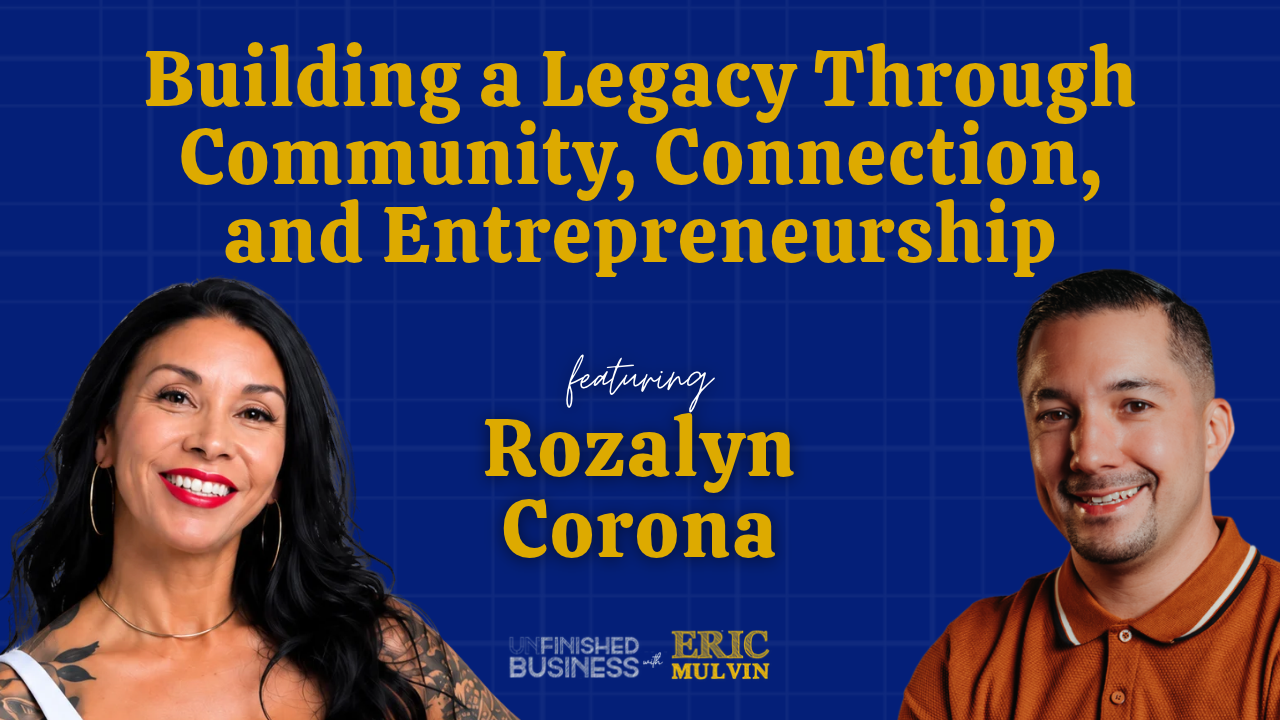
[Making an Impact Series] Building a Legacy Through Community, Connection, and Entrepreneurship | Roz Corona




What does it take to turn a personal mission into a lasting legacy?
After spending 25 years building a career in staffing, sales, and business development, Roz Corona found herself navigating an unexpected career transition. But instead of letting that setback define her future, she continued building something bigger: a community dedicated to helping women grow, connect, and create opportunities.
In this episode of Unfinished Business with Eric Mulvin, Eric sits down with Roz Corona, founder and CEO of Chingona Community and founder of Chingona Vine, to explore her journey from corporate sales to entrepreneurship and nonprofit leadership.
Roz shares how a networking idea became a nonprofit serving women and youth, why her family played an important role in creating the Chingona Community brand, and what it means to build an organization rooted in authenticity and inclusion.
They also discuss the challenges of funding a nonprofit, finding new opportunities after a mid-career layoff, using AI and social media to grow a business, and balancing professional ambition with family, financial responsibilities, and personal growth.
Throughout the conversation, Roz reflects on the importance of human connection, embracing imperfections, and creating opportunities that extend beyond her own success.
In this episode, we break down:
- How Roz transformed a networking idea into Chingona Community.
- The family story behind the organization’s name and logo.
- Why building an inclusive community matters for women in business.
- The challenges of nonprofit funding and sustaining community programs.
- How Roz rebuilt her professional path after a mid-career layoff.
- Why social media and TikTok are becoming important business tools.
- How AI helps Roz manage her work without losing her authentic voice.
- The value of human relationships in an increasingly digital world.
- Why success involves more than financial achievements.
- How embracing mistakes and celebrating small wins can change the entrepreneurial journey.
What does building a meaningful legacy look like beyond financial success?
Watch the full conversation on YouTube or listen to Unfinished Business with Eric Mulvin on your favorite podcast platform.
Episode Highlights
05:28 | Managing a nonprofit, consulting business, family responsibilities, and multiple projects.
08:11 | How Chingona Community started as a networking idea and became a nonprofit.
11:33 | The mentors who challenged Roz to stop waiting and take action.
14:39 | What “Chingona” means and why Roz embraced the name.
17:16 | How Roz’s daughter helped name Chingona Community and her father created the logo.
25:01 | Why Roz believes community should welcome people from every background.
30:02 | The significance of bringing Dolores Huerta to a Chingona Community event.
34:28 | Being perfectly imperfect and speaking openly about difficult life experiences.
38:46 | Why Roz believes entrepreneurs need to understand TikTok and social commerce.
41:22 | Funding, staffing, and uncertainty: challenges facing businesses and nonprofits.
53:19 | Moving beyond survival mode and embracing entrepreneurship later in life.
57:05 | How Roz uses AI to organize ideas, save time, and preserve her authentic voice.
1:00:24 | Why businesses need to adapt to AI while keeping human experience at the center.
1:08:30 | Teaching the next generation about technology, relationships, and meaningful success.
1:16:27 | Learning to celebrate personal growth, accomplishments, and lessons from mistakes.
1:18:58 | Roz’s unfinished business
ABOUT ROZ CORONA
Rozalyn “Roz” Corona is an entrepreneur, nonprofit founder, business development professional, and community advocate with more than three decades of experience in sales, staffing, leadership, and relationship building.
She is the founder and CEO of Chingona Community, an organization established in 2019 to create opportunities for women through leadership development, community engagement, wellness, networking, and access to resources. The organization provides programs and community events designed to support women and youth throughout Southern California.
Roz also founded Chingona Vine, a consulting and business development company offering services in sales strategy, branding, marketing, lead generation, partnerships, and events. Her entrepreneurial work includes launching Chingona Vine Wines, with proceeds supporting Chingona Community.
A graduate of Loyola Marymount University, Roz has built her career around connecting people, sharing opportunities, and helping others move forward. She is also a wife, mother of four, and grandmother who believes in creating a legacy through relationships, service, and community impact.
CONNECT WITH ROZ
Chingona Community
Website: https://chingonacommunity.com
Instagram: https://www.instagram.com/chingonacommunity?xtok=d2N0ejljN29pdGRo
Facebook: https://www.facebook.com/share/g/1GF7FPizHN/?mibextid=wwXIfr
Chingona Vine
Instagram: https://www.instagram.com/chingonavine?xtok=MXdvM21venI3Ym90
Follow Roz’s work to learn more about community programs, events, consulting services, and ways to support Chingona Community.
Follow Unfinished Business with Eric Mulvin
Instagram: https://www.instagram.com/bizwitheric/
Facebook: https://www.facebook.com/profile.php?id=61560126743830
TikTok: https://www.tiktok.com/@bizwitheric
YouTube: https://www.youtube.com/@BizWithEric
LinkedIn: https://www.linkedin.com/in/mulvin/
Powered by Pac Biz Outsourcing
Pac Biz Outsourcing helps NEMT, software, and eCommerce companies scale dispatching, customer support and back-office operations with dedicated teams in the Philippines.
🌐 Learn more: https://pac-biz.com
📩 Email: info@pac-biz.com
🎧 Podcast: https://yourunfinished.biz
Transcript
Eric Mulvin: 00:00
Welcome to the Unfinished Business Podcast. I’m your host, Eric Mulvin, and this is a show where we sit down with CEOs, visionaries, leaders, and creatives who are out changing the world through their business, through their organization, through leadership or creativity. Because it doesn’t matter who you are or what you’ve accomplished. Even someone like Dolores Werta still has something that she would like to accomplish in her career, in her life. And so we explore those stories here on Unfinished Business with Eric Mulvin.
Eric Mulvin: 00:52
This episode is brought to you by Pac Biz Outsourcing. At Pac Biz, we help software, e-commerce, taxi, and NEMT companies outsource their customer support and back office work with a dedicated team in the Philippines. These are full-time remote staff who work as part of your team, handling calls, emails, dispatch, chat support, and admin tasks so that you can improve support, scale faster, and keep costs under control. For example, one client is saving over $600,000 a year by switching dispatch teams to Pac Biz Outsourcing. And so if you’re trying to lower costs or scale support, please visit pac-biz.com to learn more or give us a call Monday through Friday during business hours at 480-771-3009. All right. Today I’m excited to introduce you to our next guest. She is a business leader, an entrepreneur, a nonprofit founder, a community advocate, and an unapologetic connector who has spent more than three decades building relationships, developing businesses, leading sales teams, and creating opportunities for others. A graduate of Loyola Marmont University with a degree in business administration, she began her professional journey through In-Roads and Xerox, eventually creating a successful career in sales, business development, leadership, and DEI. She was selected to participate in Harvard Business School’s Summer Venture and Management Program and was recognized as an In-Roads Alumni of the Year in 2010. And in 2019, she founded Chingona Community, a non 501 C3 nonprofit dedicated to advancing women through leadership and development and entrepreneurship, workforce opportunities, community service, networking, wellness, and access to resources. What started as a desire to create a space where women can connect and share business leads has grown into a thriving community serving women and youth throughout Southern California. And she’s also known as a founder of Chingona Vine, a consulting and business development company focused on strategic planning, sales leadership, and business development, a partnership as branding and organizational growth. She has built her career around one simple philosophy that connect people to people, businesses to opportunities and ideas to execution. And today she continues to expand her impact through community leadership, entrepreneurship, speaking, and content creation, wellness, and her work with sports research. She is known for bringing authenticity, humor, grit, and Chingona energy into every room she enters. A wife, a mother of four, an entrepreneur, and lifelong advocate for women, she believes that if there isn’t a seat at the table, you build another table and bring other women with you. Her mantra is simple. Stay Chingona. So, ladies and gentlemen, please help me welcome Rosalind Raz Lucero Corona. Welcome to the show. Hey Eric, how’s it going? Whoa.
Roz Corona: 03:57
Yeah.
Eric Mulvin: 03:59
Like hearing that intro, all together there. That’s an amazing uh set of uh accomplishments for a career there. So congrats to what you’ve been able to build for yourself there.
Roz Corona: 04:09
Thank you. I know it’s crazy. And then when you say three decades, even though like I know that it’s three decades, whoa, that’s a lot.
Eric Mulvin: 04:17
It’s weird when you hear it, because I’ve there’s some things that I’ve been doing for I I wrote that down yesterday for something. I’ve been doing videography for three decades. I’m like, I have to do the math at some time. I’m like, is that right? That doesn’t sound right. It seems too long. Yeah, yeah.
Roz Corona: 04:31
Yeah. And it’s and it’s actually refreshing to hear because I recently had a few folks in my network and my circle that, you know, applauded what I do. And I it’s not that I don’t receive. Well, actually, I I it is that I I don’t do well at receiving. I don’t do well at receiving that those um compliments, and it’s not because I don’t think I’m deserving, it’s because I’m just not used to hearing them. Because I just do this, I do this, like you said, unapologetically and so authentic that I don’t that doesn’t even enter my brain sometimes. So um yeah, it’s really nice to hear it though, because it’s I need to receive that, and I need to be proud of that because that is also a feel for my soul, but also feel for what I do.
Eric Mulvin: 05:12
Yeah, awesome. Well, definitely deserved, and uh, I want to get into some of those stories here. Um, so for the people listening, I you know, I gave a big intro there, but like what is it exactly, in your words, what do you do? What’s what does your day-to-day look like? What are you doing for people today?
Roz Corona: 05:29
Oh my gosh, my day-to-day is crazy. I don’t even know how I can keep up with my day-to-day. I make a there’s a running goal of mine. I don’t want to call it a joke, because if you manifest it, it will happen. All I need is a PA and a driver. I can get so much done with the PA because at least I wouldn’t forget. I try my best not to forget, or maybe I wouldn’t be some so stressed at at times, and then a driver because I can get so much more work done if someone’s driving me around all day because then I could still work while I’m driving. Um, but um I do many things. My day-to-day consists of yes, being the founder of the Chingboto community, that is my heart and soul, and like my that is my bloodline. That that truly is what fuels me from head to toe every single day. So managing the nonprofit, and that could be anything from our programs to soliciting for grants to attending networking meetings or even just a strategy in the back end, right? Right now I’m working on our calendar for 2027 with my board of directors, so that is a chunk of what I do. Um, and then I also do own a business called Chingona Vine. Um, it’s a consulting firm. So about three, actually, I think it’s been longer than that now. I put it so far back to, or I put it so far back behind my brain and my head and my energy. Um, I got laid off of a career in staffing for about 25 years, and it just was all market driven. Um, as you know, the market’s very interesting these days. So, mid-career, about three and four years ago, I had started the business not realizing I needed to utilize my EIN and all that kind of backing to be a contractor. So, in the past couple of years, I’ve been working and doing side projects. The biggest one and one of the most exciting that I’m in right now, day to day, I mean it’s helping me and my family survive, is I’m working for sports research. So, sports research has me contracted as a part of their social commerce team. And my day-to-day right now, the meat of my week is working for them as not only a live host on TikTok, but also a brand ambassador and doing community outreach and doing just kind of an advocate for their products. I use them, I believe in them, they’re a sponsor of mine. So the seamless um connection with the two of them has me not only very fortunate to working for them, but then is also one of a few of the projects, I should say one of four projects that I’m working on right now.
Eric Mulvin: 07:50
Man, I uh you sound a lot like me with all the things you got going on uh and staying super busy. So uh now you talked about your your organization in nonprofit, which is the thing that sounds like keeps you probably the busiest. So for the people listening that probably that might not have ever heard of that, uh of the uh the community, tell us about that. What is that all about?
Roz Corona: 08:11
Yep, so the Chingguona community was birthed in 2019. I actually branded it on my arm. I’m actually known as OG Chingguona Ross on TikTok, which that’s a whole, hopefully a little piece of our dialogue today talking about that land. Um, but yeah, no, the 501c3, I’m the founder and the CEO. Um, since 2019, the idea was birthed out of networking. My career at that time was in the staffing space, and I truly feel that there still is a disconnect with women, our opportunities, us being paid fairly, us having a fair seat at the table, or even a seat at the table for that. So when I started the group, it was really just to do networking. And it wasn’t until about a year and some, like right after COVID, when I really sat down and realized that what I was doing was community servant work. And if you’re in the nonprofit sector, you understand what that means. So it had really nothing to do about branding or networking. I mean, it networking is a piece of it, but it was more than that. Um, what I was doing and what I was creating as far as the space was a land of opportunity for women. And so I initially turned on the Chingona community as an LLC and turned that off and um applied for my 501c3, in which we did um get that granted. This year, it’s actually coming up in the next couple of weeks. We’re celebrating our fourth year as a 501c3. So the Chingona thank you, thank you. And I also don’t even take a minute to like put that date down, like hello. Um I’m gonna make sure to get we’ll get that noted and we’ll we’ll talk about that on my my social media and on our website. But um, yeah, no, the 501c3 was birthed to truly uh enable that little Roz Chingona that didn’t know what she was doing, maybe as an 18-year-old mother to who she’s become today, 30 years later, um, to create a space of talking about businesses, talking about how we can still grow, talking about financial awareness, having some sort of platform or space to talk about mental illness and wellness and great um from everything from menopause to postpartum to even grief, you know. So the nonprofit it really covers all spaces, and I started to realize how important this was, but not until after I was in it. I was giving, giving, giving, but not realizing to what the women were getting, getting, getting. And I never did this to get for that get. I I did this because it’s important for me and not realizing how many more thousands of women are lacking in all of those spaces, whether it be workforce, whether it be, you know, growth opportunity for learning, or again, the wellness space. And again, the community giving back, that’s just a given. I I like to give back just because I I think it’s fun, but that is a part of what it is that that we have as a pillar. So the pillars are leadership development, community, and wellness. And in all three of those spaces, we would offer programs, usually at no cost, um, and giving back to the holistic woman.
Eric Mulvin: 11:12
Awesome. And you know, you mentioned it’s just uh about to hit four years uh of being in existence there. So I’m guessing the things that you’re doing now, you didn’t start out saying this is what we’re gonna do. Maybe you did, but how did you get to where you’re like, this is what the community needs? This is the stuff that’s gonna help these women thrive, grow their businesses, and be successful.
Roz Corona: 11:34
I love that because I had two mentors in particular who I can see. One of them I believe you know, it’s Carlos Gomez of the Chamber in Kansas City, Hispanic Chamber of Commerce, president of Kansas City. Um, on the spot, I had let them know I had this idea. You know, I want to make sure that I want to grow this platform of women to continue networking. I see there being gaps exactly as I just described. And I said, But I’m gonna save the name and trademark the name and I’ll do it later. And both of them like looked at me and just said, well, why later? And I said, Well, I don’t have time. I’ll have a full-time job and the kids and all this stuff. They said, We wanted to share this with you, you know, um, just to kind of help you out as a as a friend and as a mentor. What like what really are you waiting for? And I didn’t understand what they meant until I got into it. And I’ll and I’ll share, share why. So after one year of doing this, I had an epiphany one afternoon at the nail salon uh right before the the beginning of the year. It was a December-ish day, getting looking at, you know, again, forecasting for the next year. I went through every single program that we did. We did 56 events andor programs in one year. I only missed two because my dad was sick and my dad has since passed. Um, I only missed two of those events, and basically what they challenged me to do when they said, Why what are you waiting for? They said, What you really need to do though is tighten up what you’re doing. You’re doing all this stuff, but like what is it? So I sat there in the nail chair and broke down all of the events that we did into those three buckets: leadership, development, community, and wellness. And I started putting what I call the pillars and really looking to see what it was that we were doing to give back to the women of the communities that we serve. And it truly was those three pillars. So it wasn’t until then did I have the what is this? I just did it. Um, I like to refer myself to as the little Chingona that could because I wouldn’t have known even what a nonprofit was supposed to do or what they do. It’s for the common people, it’s for the commoners. Like the nonprofit’s not mine. I might be the founder, but the nonprofit is bred for the entire community, the women, the youth, the people that that this Chingona community serves and in those spaces. And I’ve been very much more, I would say, strategic in the way that we position ourselves to offer not only programs at no cost, but to make sure that I’m building programs with sponsors that will take that in-kind or monetary donation forward to help me carry on in these spaces. Because as you know, nothing’s free. Um, and I did carry the nonprofit for about two, maybe even three years, pretty solid financially on my own before I understood like Roslin, like you’re not supposed to do this. Like, this is not sustainable. This is not sustainable, yeah.
Eric Mulvin: 14:17
So wow, there’s a lot of uh a lot of lessons packed into that and a lot of uh amazing stories. Um, and I wanted to touch on I for people might that might not speak Spanish that are listening or maybe not familiar with the name, yeah. Tell us a little bit about the name, you know, and uh what’s the meaning behind it? What was the inspiration behind you know that? Because you got it tattooed on your arm. So clearly it’s an important crazy leap.
Roz Corona: 14:45
Um, yeah, no, I um so the the the story behind it, which is pretty fun before I get into the definition, is I work out a lot, and a lot of my friends know that I work out, and obviously with social media, we keep in touch with people from all walks of life or times of our life, and a lot of people would just tag on my workout videos, oh Chingona, mass Chingona, and then I’d kind of like even myself included, I’m like, what the hell does that mean? So my husband’s first language is Spanish, and I came home one day, I think I looked it up on my own, but I came home one day and I said, Well, this is pretty cool. I said, you know, the name means badass, you know. So a a Chingona, as defined by the definition in the dictionary, which fun fact, I do even know the woman who patented the definition in the dictionary. A Chingona is a muher who is a fee, so that means female. A muhed who is known as fearless, um, basically hardworking, kind of limitless, and the acronym is badass. So the word is derived from a derogatory word, which is why it took me a little bit of time to get there to be more embracing from old culture, not new culture. Historically, the word is known as a bad word. Like it’s known as a male word, and it basically is meant basically stupid, you know. I don’t know what gets cut out here, but asshole. Like it’s was a it’s it’s known as a very derogatory word. But when the word was patent patented in the dictionary, which I believe is around 2018, 2017, it’s literally right when people started calling me it, um, or at least, you know, tagging me, um, she brought that word to life as meaning, yes, the female version of being strong, being strong-willed. Um, again, I think I love the word fearless because I’ve always been fearless. And whether or not somebody taught me or I just was bred on being fearless because I had to be, um, that’s what it means. And yeah, it did take me a minute for some folks in my circle, in my unit, to accept it. Like one of the first marketing items that we had Shimon community on was maths for COVID. And I would get everyone with the whole chuckle that I can’t wear this. And I’m like, why? You know, and so I would still get a little bit of that. But I mean, we’re talking 2% of the 98%. Majority of the females that I put this in front of mail the shirts to. And I like to say we’re branded in at least 12 states right now throughout the country. Majority of folks like begged me. I had people from like, you know, the Great Lakes and like um Midwest. Can you meet, can you send me a shirt? I’m like, of course I can, you know. So um, that’s what the word means. That’s how it kind of derived. And the name, though, I like to take a special um moment to celebrate who helped me with the name. My daughter Reagan did. My older daughter, we were when I was coming up with a name and coming up with a logo, I said, you know, I I want to, I want to start this group. I don’t know what it’s gonna be, but I, you know, I want the name to have Chingona, but I’m so CC. Like I wanted the name to have two C’s in there. So initially it was the corporate chingonas. And then I thought about that. I’m like, that’s gonna be too hard. Like, you’re gonna that my my friends that are stay-at-home wives or mothers, like they’re not gonna get it because they’re not in in a workspace. So what can this be? And we were driving one day to school, and I told Reagan, I’m stuck. I go, Grandpa’s gonna help me with the logo, which this this logo is my dad did create the logo, gave me nine logos, and we both picked the same one. Um I said, but I want it to be CC. And I said, but you know, what brings the people together and women together, women empowerment. Well, how about community? And I’m like, oh my god, that’s it. My 16-year-old, I’m like, the Chingono was Chingguono community name, not logo, but name was birthed with my daughter driving to school one day.
Eric Mulvin: 18:24
I love hearing how your daughter helped with the name, your dad helped with the the logo. It’s like this family like effort to bring this to life, which is so awesome.
Roz Corona: 18:35
Yep, and it’s a family legacy bringing to life that I wouldn’t even have thought of in those terms until even I say it all the time and share this with others, but right now my biggest thing is legacy. And my biggest thing is leaving a legacy for my daughters and now my granddaughter. I’m a new, very new grandmother to a congrats. Thank you. Well, it was none of it was expected, Eric. I’m way too young to be a grandma. But so is my mom. So is my, you know, I mean, it happens, you know. But um, I want to leave something for them. And I always tell my kids, I’ve got four kids. I don’t have money, I don’t have a ton financially, but what I do have is a network, and your network is your net worth. I can make a call to anyone right now in any vertical, any space throughout California and beyond, and be able to connect a resource to my kids or to the women that I serve. And that to me is my legacy. But hearing what you just stated, Eric, I didn’t put into full perspective that yes, my dad and my my daughter have a play into even how this got birthed, and that just is more of like the behind the scenes of the legacy. So, yeah, pretty awesome.
Eric Mulvin: 19:45
Yeah, no, it’s uh it’s it’s cool to because everyone’s got these stories, like every business, uh especially you know, the the businesses uh you get to work with, and I mean that um that’s my story too. We built it from scratch, yeah. You know, there was no you know, consulting with a bunch of uh you know high-paid consultants on market research and figuring all this stuff out. You just you go out and you do it, just like you started the organization. You’re just like, I’m just gonna do it, and then because you something is driving you. So it’s cool to to see you know an example of that, even in a nonprofit, that you’re still just you got the same energy that all these business owners have to you know, you want to see something different out in the world, and so that’s cool. That’s uh you know, I think a lot of people don’t realize uh the impact family has uh on that. I talk about that on the show sometimes, that whether it’s a spouse or in your case, like parents, like kids, um they all play a role, whether it’s uh helping with the name or it could be helping out with a task so that you have more time for meetings or running around. I mean talk talk to me a little bit how some of the ways your family has been influential in helping you get to where you’re at today.
Roz Corona: 21:00
You know, my mom and my sisters, my my sisters, well, I mean, my sister and my sisters, because I have um non-blood sisters that are very much in my life. So, and actually that’s a that’s a very accurate statement. My mom and my sisters, my you know, my sister and my other sisters, and then my kids, specifically, I mean all of them, but they all attend. Like they all, you know, from being at the very first meeting that we hosted March of 2019 at Geezers in the city of Santa Fe Springs, to, you know, my youth days and my canned food drives and any of the behind the scenes with being physically present has always been something that they do for me. So maybe they don’t take on the tasks of some of the behind the scenes, and quite frankly, especially when I’m like a a second generation business because my parents do have a self self screening business, but my mom and my sisters, and even my my brothers for that matter, my siblings, I don’t think really them understand or we didn’t value what it is to be an. Entrepreneur. My parents were entrepreneurs in the sense that they had a silk screening business. It had afforded to be a second business or a second stream of income to help while we all went to school. I don’t think we understood what that meant, but now we understand. Just having them physically present to attend means all the world. I’ll give an example. We just had a um our second annual book bag drive, and I was, I’m having some midlife stuff going on, and I’ll be real transparent. Like, life is hard as a, you know, almost 50-year-old woman going through menopause and dealing with, you know, changes and growth and you know, all that good stuff that comes with business. Um, I was fearful of like what my audience was gonna be, and guess what? A good two, four, six, like nine of them was my kids, my mom, my sister, my nieces. And honestly, that was fine because they could fill the room and even people like, oh my god, these are your kids. I’m like, yeah, because I just needed them there. Whether or not they wanted to be there, whether or not they wanted to give me three hours of their Saturday in between going out with friends or whatever, but that’s just what they do. So I think that that’s the role that my family has is I don’t fully think they understand what I do. I’m being real honest. My kids might, because they have had to learn, but my mom I don’t even still understand what I do. I don’t think my sister understands what I do, and it’s not for any lack of wanting to try. I’m all over. So if you want to try to keep up with me and you’re not in my own home, you probably don’t understand what the hell I’m doing. Um but yeah, you really probably don’t. But them just being physically present, specifically my sister and my mom have been really amazing because they don’t usually even ask, it’s more of like what can I do, and that’s it. Yeah.
Eric Mulvin: 23:38
And that, yeah, I mean, it makes a big difference when you’re like setting up and you’re looking out and there’s an empty room versus a room full of that you know, you have some people that are there, and uh, you know, that’s so I know that that can make a big impact.
Roz Corona: 23:52
Yeah, it’s huge, and I don’t think people do understand that are not entrepreneurs and that are not in these community serving spaces. You know, there’s a couple people very close to me in my life that still don’t get it. And it’s like, don’t even ask if I need help, just go. Like, there’s no there shouldn’t even be a question if I want you there or if you should be there. Just be there because that goes even long, that goes further. And maybe even for somebody’s mental state when they’re doing some of this prep work. Um, just don’t even just ask when you get there what you could do. Don’t even, you know, like that goes further, especially when there’s lack of funding, there’s lack of, you know, I don’t have a staff, I don’t have a paid staff. Like you are that staff. Like, you know, the non-paid is the, you know, that that’s money to me. If people just show up and like you said, what where can I go? What do I need to do? Like they just go, you know? That that that’s huge.
Eric Mulvin: 24:46
So if your organization didn’t exist, what would be missing in Southern California? What would these women that that are there, these business owners, that community, what would they not have that they get now that you exist?
Roz Corona: 25:01
They would have a authentically open, and when I mean open, I mean open arms to everyone, to every culture, to every vertical, uh, without judgment, with open arms, with not being clicky, with not being siloed, with not being, you know, this is only for this, that’s what they would be missing. I had somebody compliment me over the weekend to say that they don’t see it that often, where there is truly an organization that walks the walk and talks the talk, being exactly that. I’m open for everyone. A lot of people just think I’m only for Latinas. No, I’m not. I’m for everyone. And that goes both ways, right? I want everyone to feel welcome, but that early on, some of the Latina organizations might have taken that to offense that, but you’re Latina, why not just them? Why not just them? Because if we don’t have all, how do we all grow? If we don’t have every walk of life and every door open with us together, how do we really sustain? Because we can’t. We can’t do it alone. So that’s what Southern California, and quite frankly, the U.S. would be missing if you didn’t have an organization like the Chingona community. Community means community. I don’t just say community because I want some, you know, um made-up word. You just heard the background to it. I didn’t want it to be siloed, and that’s exactly what this grassroots organization that is built from absolutely nothing. Zero zilch, no money, no nothing, and has grown to be physically visibly seen by over 10,000 people. My impressions on Instagram are in the millions, and even me. Not until now would I realize what that means. And even like I have to like pinch myself sometimes to see, girl, don’t you realize over 4 million people view what it is that you’re doing, and oh, by the way, have some sort of like touch in, and that supports everyone, not just this. This isn’t bigger than Rosalind. This is way bigger than me being passionate about what I do. It’s serving millions of women and little girls that don’t realize that there’s something that they can have, even if they don’t realize and they’re not dreaming it yet.
Eric Mulvin: 27:15
Wow, that’s incredible. I you know, we haven’t talked in a little while. Um, and for those of you guys listening, you know, Ros and I have bumped into each other at different events over the years. Um, but it sounds like your social media has really picked up lately. I think you’ve always had a good success, but it sounds like things are really taking off then, huh?
Roz Corona: 27:31
Oh yeah, it’s been crazy. I mean, the impressions are part of our um part of our impact report every year. I’ll send that to you because then you can see, Eric, what I’ve done. You can see where I’ve went from the last time that we’ve just spoken. I think even the one of the last times we ran into each other was, I believe, at a conference, but then before that we hadn’t seen each other since Kansas City. Um, but yeah, no, a lot has changed. Yeah, the millions. Um even just having what you said it in the tagline um as we started earlier. Dolores Huerta was my keynote speaker at our awards this past June, talking about Chingona Power, and to be standing alongside an absolute iconic um member of our world, um, to be standing on the same page or you know, page state, everything with her, just to know to see that 96, 48, and then my granddaughter, it was truly like a hundred years worth of power. But to even know that I was able to accomplish that for the community that I serve, everyone was shell-shocked because nobody knew. We couldn’t really say much, but that’s why when she when she entered, I just kind of like you know, stood and just smiled. I’m like, I always love when like people don’t realize who they’re gonna run into when they come into our space, because I like that. Like, that’s the win for me, and not the win to be like the accolades of oh my god, Ross didn’t know to moral be like, what? Like, like, yeah, you guys go connect. And I just kind of like bye, like, you know, that is the win for me. But yeah, no, the impressions, the uh exposure, the respect. I think that’s one of the biggest things. I don’t think people fully recognized the or gave the organization the respect that we deserve for the work that we put in, and that’s a lot of women, not just Rosalyn.
Eric Mulvin: 29:16
Yeah, yeah. Well, it’s awesome that you’re getting able to get now more attention on the work that you guys are doing because it could it could really amplify that that impact and uh hopefully inspire other people out there to be like, whoa, I could do this too. Yeah, or I could, you know, maybe they might be struggling. I mean that’s the point of my podcast, like helping inspire other people, whether it’s a business, organization, nonprofit, you’re covering a lot of those here. Uh to that, hey, you know, we’re all going through the same thing, we’re all going through the same journey. And uh so it’s great to hear that you’re getting more attention on that. Now you mentioned Dolores, um, but also and you know, there might be people who don’t know the significance of her. Like what’s why is that such a big deal for you guys that she was able to speak there?
Roz Corona: 30:01
Um I think the biggest thing for me is that I am blessed right now with the space that I’m in. I’ve always networked, I’ve always, you know, put myself out there for so many reasons, right? For extra, you know, workforce opportunities, or maybe just for learning, or maybe because it’s fun, or maybe it’s a cause that I believe in. So I’ve taken it upon myself as an individual, as a woman leader to network, right? So that’s something that I just do on my own. Not everyone likes that, not everyone, that’s not the jam for everyone. Some and some folks, that’s not their space, right? They don’t, they’re not comfortable with doing that. So through my nonprofit and through the work that I’ve done, I’ve been afforded the connections with so many different people. And fast forward to me being allowed the opportunity to meet Dolores. So I worked at her 96th birthday party. It was at the Plaza de la Rosa. There was a big, I mean, from community leaders to politicians to um uh, you know, entertainers, like I mean, the space is really big. So just to be able to work there and then just to see her kind of cruise by, I was like, whoa. But then I got to get to know her over the course of the past like year and a half, maybe a little longer, but for sure a little over a year. And as I got to know her and really understand that she’s also just a normal person. She’s a human being, she’s a woman, but she’s powerful in the sense that her presence and what she brings to the table and what she did for the farm workers and what she stood for, like, just candidly talking about how many times she got put in jail, I was like, whoa! But it was like one of those things that, like, the reason why that’s so impactful for me bringing that to the table is that I got that opportunity as just Rosalind. But to share that, and I’m gonna get emotional, to share that with others, my granddaughter included, like, whoa. Like, just it’s so special to know that I got to give that to 250 people in my room, but my daughters and my granddaughter, and we shared a space on stage with her that was so intentional, but it was also intentional for me to make sure that the women that I served know that I’m gonna share this. This is not just for Rosalind. This is not just to make, oh, I went to whatever, a soccer game, or I got to see Dolores let go of the eagle with Cristal, you know, talking about like, you know, Hispanic heritage or women’s women’s money. Like, no, no, no, no. I’m gonna bring this to the table so you all can go take a picture. You all can go shake your hand with a legendary icon that has done tremendous work over decades and decades, decades beyond even my own lifetime, at least right now, right? So yeah, you still got a lot of time left. I’m I’m hoping. I made a joke with her in the car one day driving, you know, she said something about, you know, I told her like, whoa, whoa, whoa, and I was so like, I can’t believe this. And she’s like, but look at you. And I said, Dolores, I can only hope to be like, you know, first I thought I can only hope to live that long. I said, but second, but secondly, like it says a lot for her to even say that to me, right? That’s but I want to bring that to everyone. I think that’s my biggest gift to the women in the the generations that I hope to, yeah, have people say that like I want to do something too. I’m gonna continue to give back, you know. So that in itself is like, I can I still can’t believe it. I I can’t. I can’t. I can’t wait to share some pictures with you. Um but um I’m actually in a painting with her, um, throwing out the first pitch at Dodger Stadium for Hispanic Heritage Month this past year, and an artist captured it. And we gifted her the photo, but I even when the art just for the artist put it on his space, I was like, and I was even scrolling, like, oh, this is great, I was there. And the second photo was me and her. And I’m like, um then I looked again, and there was another there was two of that photo that he posted, you know, that were of me and her. And I’m like, what is this?
Eric Mulvin: 33:52
Like and for such an iconic moment being uh throwing the pitch out at Dodger Stadium for Hispanic Heritage Night.
Roz Corona: 33:59
So Eric, Rosalind, like whoa, what like Ross, what are you waving through the thing at whatever local news um Lynette Romero was on the other side, taping her through the fence, and I’m on the other. What is this?
Eric Mulvin: 34:13
Surreal moment. That’s that’s awesome. Way and uh it’s exciting to think about what other opportunities are gonna come up because yeah, we’re all still fairly long. If you look at, you know, like what other people before us have been able to achieve in many decades older, um, we still got a lot left to go.
Roz Corona: 34:30
Yeah, a lot left to go, a lot left to learn. And I think for me in my space, you know, what what makes it so empower impacting and powerful to have someone like that in our space and in our circle is goes way beyond also sharing. It also goes on to what you’re saying. Like the next, who’s gonna carry the torch? Because not everyone’s not everyone’s um, oh, not everyone’s built for this. And I say that because not everyone wants to say what they really are feeling, right? A lot of folks are like, oh, I’ll just keep that to myself. I’m not like no, I’m going through menopause, I’m going through midlife crisis as far as relationships from therapy to um financially to not learning enough financially from before to having to get catch up. Like, so there’s so many things that people just don’t talk about, and they’re either ashamed or embarrassed or think that, oh, if I say this, someone’s gonna be like, oh my god. No, I’m gonna say it for all y’all, and I’m gonna help all y’all and keep helping all y’all because God put me on this earth to do so. I’m I’m un I’m in perfectly, I’m perfectly imperfect. I actually have that tattooed on me as well, and I’m not ashamed of it. And guess what? If someone’s gonna carry some sort of torch, you might as well keep it somebody that’s as outspoken as me, because there’s still a lot that people don’t talk about that we need to talk and work through.
Eric Mulvin: 35:49
Amen. I know we’re not church right now, but very true. Like I I I really believe um, I mean that’s part of the platform here, is that not enough people talk about that. And I think it’s interesting when like, especially in today’s age with AI, there’s so much stuff online that’s that’s fake, that’s not real, people are bending the truth, which uh and you know, they’re out to harm you know our our minority business owners too. There’s there’s stuff out there that is meant to shift the narrative, and you know what happens when you are uh unapologetically uh authentic, like you know, the social media, the algorithms recognize that, and I believe that’s probably part of why you’re getting the attention you’re getting, because it’s so rare that it you know it’s so welcomed when people actually see it and they’re attracted to it. So I mean, would you agree? Is that do you feel like that’s part of what’s caused uh you to get more attention online?
Roz Corona: 36:50
Um I would think that it’s a mix of a few things. I mean, I would like to say that a lot of my hustle and drive like doesn’t stop, and that does lead to social media. I have posted every single day since I’ve had that page up, and that’s that I think has definitely helped with the algorithm because they definitely see from time to your demographic, and if you start learning the background of what analytics come in into play, which I didn’t take into consideration as I started, but again, that’s the fun part of where technology, social media, and AI has come. Now, the flip side to AI is that folks that are not so um folks that just think um AI and social media is is just meant to be just you and not business, that’s where the disconnect is. I have a lot of folks in my space not understanding that my social media, my businesses, my business and my um nonprofit social media was never meant to be Rosalind. That is a business platform. And oh, by the way, the analytics and the drumming up of folks that have recognized us or even taken a look at look at us, I did the work, but there is a whole back end to that. So I’m struggling with that a little bit in my life because I don’t think that people understand that those are two separate pages. My my personal and my business are two separate pages, and if it wasn’t for AI and social media, the business wouldn’t have been what it is today.
Eric Mulvin: 38:21
Yeah, yeah. I I that’s uh a good point. And so for businesses that are listening, because you’re you know you’re talking about trying to get that message out because they’re going through some of the same problems. If the like if they don’t put their presence online, people aren’t gonna find their business, they’re not gonna be able to grow to the business to the size that they’re looking for. So I know this is an important topic that I’m sure you’re uh passionate about with the people you talk like in the community, right?
Roz Corona: 38:46
Yep, no, it’s huge. And that’s what for next next year, actually, as part of my 2027 um programming, I am doing a specific course on TikTok and TikTok affiliates and what that really means. And again, you know, I had somebody um that’s that’s a coach mentor, even peer of mine, make the statement saying, Remember, when we were setting up my TikTok, and this is a whole other segment, TikTok’s not for your friends, it’s not for your family, it’s for your business and your pocketbook. And I kept thinking, like, what do you mean? Like, I think of the kids, my kids on TikTok, and I’m like, what the oh no, now I know what that means because I on I am on a social commerce team that would have never even been born 24 months ago. But now the transformation of business and utilizing platforms, not just a TikTok, there’s so many other platforms in our cyberspace that do have access to algorithms to get you seeing more. If you don’t jump on, you’re going to miss the boat in a huge, huge way. Um, even these conferences that I’ve been fortunate enough to attend, um, YFCon is one of them. I just attended that last week. Um, there’s these conferences that are dedicated to affiliates, social media, um, and really what that means, getting product across different brands, how you can represent them. I’m learning the back end on how many impressions, the demographic of impressions, what time you actually go on. Um, the it’s called GMF, oh uh GMV, there’s a dollar associated with then that then that’s where it goes, the dollars, right? So there’s a whole other land right now, and your midlife chingwana is learning it all right now, and part of my programming for for next year is gonna be to teach a course on that, whether it be virtual, whatever the case, it’s gonna be in there because if you don’t jump on, you are gonna totally miss out. Yeah, way, way miss out. Technology is a huge piece, AI is a huge piece in my day-to-day work every day.
Eric Mulvin: 40:48
Yeah, and you being that you’re in this position to you know help with the the businesses in the the community, and uh there’s a lot of them. You talk about how many states you are, the reach that you have. Um what are you seeing from business owners like what’s the big challenge that they’re all facing right now? It’s we’re what is it? It’s October 2026. Uh you know, there’s a lot of crazy stuff happening in the world. I don’t think we need to everyone knows what’s happening right now. What are you seeing the business owners like what’s their struggles right now? What are the challenges that they’re facing because of today’s environment?
Roz Corona: 41:23
The biggest thing is funding. Um the nonprofits, we all got hit, obviously, because of administration, which we don’t need to go in any further. I think it speaks for itself that a lot of the funding that our organizations, myself included, um, not only do we have to change the language in which we’re writing our grants, because we can’t really speak freely for what the organizations support. So funding is one of the biggest. And then I would also say, in general, I think the unknown. A lot of businesses, especially coming from the staffing world, boy, when everything changed administration-wise, everyone just went on a pause. Job positions got put on hold, you know, the whole thing with, you know, we’re in a hiring freeze, like, you know, that cycle just repeated itself from us being like, okay, yes, we can add to staff, maybe have some part-time. So staffing’s been a challenge, funding for staffing’s been a challenge. The unknown, because although our trends historically have been like this, we don’t know what it’s going to be. Um, so I think a lot of that, and and especially those folks that maybe had those higher goals from a dollar standpoint, everyone just said, no, just kidding. We want to grow by 7%, but we’re gonna just put it down to two because that sounds more, you know, more likely because we don’t know. So I think a lot of that has hindered with what businesses want to do, like myself included. I’ve been looking for a full-time role. You know, yes, everyone thinks my the nonprofit, oh no, the nonprofit’s not paying me. Um, if anything, I’m you know, donating, right? But I I I aspire to get there. But myself as mid-career and knowing all what I know and having all the sales background, everyone just, you know, three and some years to even give me a contract role. Like, I, you know, I would have never thought. And to talk about like the anxiety and the stress and the depression that that put on somebody that me that is very a go-getter, it’s very um uh demeaning to me and my spirit to think that oh my god, it took somebody like me like this long to even find figure it out. And it wasn’t even figure it out, but to get a a table, get get a seat at the table. So, yeah, it’s been very, very challenging in all of those regards.
Eric Mulvin: 43:30
Yeah, so yeah, and uh appreciate again the work you’re doing to help inspire these people and help bring knowledge to people that hey, there’s there’s some resources to fix it. I mean, I know you you also uh we could talk about your consulting business too a bit. Um because some of the things you do there. Um we’re coming up to a good time to do strategic planning. You talk about some of the work you do. So tell me more about the the consulting business. How do you what do you do with that? How do you help businesses out?
Roz Corona: 44:00
Years I’ll wrap them to one amazing Chingona bross. When I established Chingona Vine, it was truly to do a placeholder. Um, I have aspirations, which I’ll talk about. I finally did accomplish my wine aspiration, which we just got back from a wine tasting, but um Chingona vine, the name derived from um rooted, well connected. I do think of an oak tree. That’s part of my logo. I think of like the spokes of connecting businesses and strategy and growing and being that rooted business like forever. Um I offer consulting services, which um are in the sales space, branding space, marketing space, lead generation, and events. I mean, you name anything that has to do with sales, that’s what Chingguono Vine encompasses. And a lot of what I offer does is that sales strategic expertise was without having to hire a team. Um, all of those um spokes that I hit on, it takes years and years for individuals or for teams to be um, you know, paid for to even do that. You can do that all in one shot. And in my business, that’s what I hope to help with is some of that back-end work, right? How do we launch an event? How do we do an execution of a new product? How do I scale my onboarding for my sales team? How do I teach somebody, whether it be coaching them to get into a meeting or just strategically outlining a business plan for them for the year? And oh, by the way, it doesn’t hurt that my staffing career has afforded me to work in several different spaces. So some of the businesses and the clientels, clientele that I’ve helped with thus far include everything from an automotive company, a couple other nonprofits to get launched. Right now I am working with sports research as a content brand ambassador, social media. They did hire me on as the Chingona Community Founder, which is great. I don’t need to take that hat off. Um, also working with a couple of construction companies right now, helping them get their consulting um uh name and business out there. And then, yes, I did finally launch, which I’ve been working on for a long time, a wine label. So Chingona Vine Wines is bottled out of Bealtin, so a company called Flores Family, uh Swareza Wines, um, did do the back-end bottling and the wine with them, but they helped me launch that label and all the proceeds from the wine actually go to the nonprofit. So it was a beautiful like win for me as an entrepreneur in the sense that I was able to leverage my business to still give back to the nonprofit and to still do what I love you know so much, is again just giving back, right? It’s one thing to have some monetary, but it’s another thing to know that the monetary from the wine, there’s nothing for Rosalind. It is that checkbox that says, I have my own wine label, I’m able to use my business to get that started, but to give back to the nonprofit, which that is the biggest win for me on that spectrum. But then on the consulting area, all the projects that I’ve been afforded, I’ve worked for, but being displaced didn’t hinder me in my entrepreneurial journey to have a for-profit corporation that I could still do um do and make ends meet for financially for my family and and for you know whatever gains that I have coming for me.
Eric Mulvin: 47:19
Cool, awesome. Congrats again on the wine. So, with that, uh, is that something that people go out and buy? How do they support you so that you can uh get some proceeds going to the nonprofit?
Roz Corona: 47:30
Yes, thank you for that. So if they followed Instagram on Chingona Vine, so um my Instagram handle for the business is Chingona Vine and on the Chingona Vine portal. I do own my domain, but as you can see, I’m like on, you know, I’m the Chingona that could that has our hands in a lot. I don’t have an actual um website per se for ordering, but on Chingona Vine Instagram, you would be able to get a QR code that would allow you the link to put in what you’re looking for. Um they’re sold in a case and they’re sold per bottle. And again, it’ll show you how to get pay. Um and all, like I said, all proceeds go to the nonprofit. And then if you were to also follow my Instagram for Chinguono Community, um, I do a lot of cross-collaborating because at the end of the day, that helps out both sides. Chingona Community as well, you would see information on either the flyer or you would see a little bit about where we just came. We just came from an amazing festival, Sabor de Valle, that is started by two individuals to really get culturally out Latino winemakers. And I’m in that space now, which is so fun, the Latina piece of it. But um, we just came off of that um program over the weekend. So you’ll see a little bit about what we’ve done, and you’ll you’ll be able to tell that on both Instagram pages. And then we do have a Chinguono community website, which now that this has gotten fully launched, we will have a couple of launch events in the nepple next couple of months that folks would be able to get uh participate and be a part of uh that’ll run through now in the beginning of next year.
Eric Mulvin: 49:01
Awesome, cool. Well, go check that out, guys. So you go support and uh pick up some uh maybe a case of wine for yourself. Um so a question for you you know, organizations that uh, you know, the bigger the organization, the more people you can impact. And uh, you know, you’re talking about challenges with funding. What do you think? You know, maybe there’s some people that are listening here, maybe that maybe some people know you, but um what does your organization need to take it to the next level? What do you need to take it to the next level? And because I’m sure you have I’m sure you have massive dreams for this thing that go that go well beyond where it’s at today. And so maybe there’s someone listening and you’re saying, hey, this is what I I I’m what I could use. What this is somebody, if you’re out there with these skills, come hit me up because you know you can help the mission. So what what do you need?
Roz Corona: 49:53
The biggest thing, I need an executive sponsor, Eric. I’ve been looking for an executive sponsor um for the past three years, although we’ve been around since 2019, three years more seriously have I learned what grants and what sponsorships and just you know um in kind and or a monetary donation from someone means because I did have to learn really quickly that I can’t self-fund this because it’s not going to sustain. So I have an executive sponsor um deck that I’d love to present to someone, a three-year executive sponsor to carry me and an assistant, because obviously, again, there’s a lot of moving pieces to the programs, to the reach and the follow-through that we need to give to again folks that we work with. So an executive sponsor would be like the best, it would be a dream come true because then I know that I would be able to sustain, balance out financially what I you know to live, but then also to be able to make these programs and build these programs up to what they should be. Doing this with a small board is really hard. Um, so that would be king and queen, that would be number one. And number two would always be just access to capital or be invited to present in grants, you know, or present to grants, apply for grants. A lot of times there are so many out there. I sit on so many different portals that send me like a million a day. But hearing what somebody would have heard from me right now with what we focus on, the programs you know that we offer, if somebody’s interested in receiving an impact report or two, they would be able to see if their organization and what their organizations do offer as it relates to grants or sponsorship. If we fit with within their wheelhouse, there’s nothing better than getting invited. You know, it’s not to say that they say that we’re gonna win. That’s not the point. But the point is when folks help me with that funnel so that I’m not like all over and they’re just saying, hey, this grant’s coming up for February or June. When I get invited, it’s so much easier because I know that somebody knows what we do and they know that we fit, and they but that but we have to do the work, right? We have to write write the grant. And that’s only happened like three times in the past few years. So, but when that happens, it’s so much better, and so much just it makes me uh and what I do not only it feel, you know, feel better because I could just get it done, but then I don’t have to be so out of out you know, out of whack and all over. And then the the the piece that comes with that is to be invited to write a grant with someone. Um that’s the other thing that I don’t people I don’t think people in my space even realize that I do, but I have also have a very short list of when I get invited, but when I do, it’s awesome for everybody, all parties involved. The the communities that we serve, the recipients of our programs and of what we offer, but also me as a founder, I get to learn and I get to grow in grant writing and in that space, and that also brings other opportunities. So those would be definitely the areas that would be helpful financially for us to sustain, to grow, and to hit that next level of creating chapters and some of the other wild ideas that I have for us for the future.
Eric Mulvin: 53:00
Great. Um with I’m I’m kind of curious then now, with your entrepreneurial spirit is like out of control. How did you survive so long in the corporate world doing sales? How did you not quit and be like, I’m gonna go work for like how did that not happen sooner in your life?
Roz Corona: 53:19
You know what? I love this because this goes with like my mental health like um journey with a course that I’m in right now. I’ve I’ve got um granted this sponsorship to be in this finding your diamonds um program right now. It’s a 12-week cohort, and something that’s come out of it because I’ve done some radical transformations recently, is you know what, Eric, I’ve always been a survivor. And what does that mean? I’ve always worked to survive. I’ve never worked for myself, I’ve never worked for these lavish dreams of how can I get another property and how can I save some money? How can I invest in an IRA? Or, you know, I A, I wasn’t taught that. B, I never followed that because I was a young mom, was always getting into bad stuff, but then always still doing good stuff. Like I was always in survival mode, never in the okay, let’s take this to the next level. And survival mode for me also stems from the traumatic um maybe experiences of me just being that young Latina at LMU pregnant with a baby, and somebody looking at me like, you know, who the heck is this girl? And how do you think you’re gonna finish school? You know? So I think that the survival mode came from all of that. Culturally, society teaches us women that we shouldn’t have much, or oh, just stay in this space. And sales to me was always a way to get by and pay my bills and live paycheck to paycheck and live. I was alive, right? I didn’t, I never really aspired for more until now. My entrepreneurial my entrepreneurial spirit has come out like this fuel and flame from like the ground that has just been waiting to explode. So it sucks that it happens so late in my life, but I’m also embracing it and to another, a whole other level with I’m not living in survival mode. If anything, I’m the first to be like, oh, that tablecloth’s 300 bucks. I don’t have it right now, but I’ll make it next week. So let’s just do it, you know. Like I I have embraced that like to the max. To the max, to the max, to the max. So I kind of think that it’s a rebirth. I do feel like I’m I’m I’m experiencing a rebirth in my own skin right now.
Eric Mulvin: 55:31
Cool, yeah, I can see it. You know, and uh because I just think back to uh you know my corporate world too, and I was I had so many ideas I wanted to get going, so I’m yeah, I was kind of curious. But it makes sense, you know, your journey and and how you got to where you’re at now. That uh like your those past experiences uh shaped that. So um switching gears, let’s see. Uh I did want to talk a little bit more about AI because we talk a lot about it on the show. And I mean there’s a couple different perspectives we could we could look at it from a community organizing standpoint, you know, your personal life trying to you know for someone in 2026 that’s trying to do it all, you know, you got a really useful tool there to help you out. And then also there’s the perspective of you know, you’re seeing things that you and I are seeing things, and maybe some of the listeners are seeing things that a lot of the world isn’t see right now. And you know, we’re trying to get the message out there that hey, we need to adapt, you need to change because this is gonna affect everybody. So let’s talk a little bit about AI then. Uh and you can pick your which one of those topics to to go into. But I’m just curious uh some different perspectives that you have um and your role because you’re you’re seeing things a lot different. I talk to corporate people, they’re running big companies. You know, that’s one thing. You’re interacting with all these people and uh not every business is gonna need AI the same way, but everyone needs to use it in some way or capacity, right?
Roz Corona: 57:06
Yeah. I was the first one to be so reluctant, and when all the so uh not even social media, all the media came out about it and about especially with the um entertainment world, which I completely understand. So that’s why I’m gonna start out with that piece of it, because I would have if you would have asked me this question maybe like five years ago, I’d have been like, oh no, you know, I’ve got to write everything or do everything on my own. So when all the first kind of stories and the pushback, and you know, especially with the writers and with our entertainment sectors, I believe that still today, because they’re there there never can be the non-human aspect of what we do. Um, I’m still very on the fence with when I can’t, I kind of can’t stand the AI flyers because I know that they’re AI. Um, do I have to do them in emergencies sometimes? Emergencies, like emergencies. Um, because I also have folks in my in my space that help me with my my media, but that’s a little bit weird for me. Um but the writing aspect of it, the gathering and in including your thoughts and and helping you organize thoughts is huge. There is no way, absolutely no way, shape, or form, I could do everything that we just talked about with my nonprofit, with the business, being a mom, being a grandma, still being Roslyn and being my like, still having like a minute, a minute for myself, that I would be able to survive and sustain without AI. And I’m talking at AI as a writing organizational tool. Um, when I first was given the like, you don’t use AI, and I’m like, no. What? What? And at first I thought that it was gonna take away from me. I write all my posts, I organize all my posts, I there’s a strategic method to when I put out my posts. I do them every day, so there has to be a plan behind it. But when they first had thrown that at me and was so shocked, and I thought, well, what do you mean? And then I got a little tate, and I’m like, oh, and I’m like, okay, but then I really learned what this is doing for me. AI for me and the organization and the women that I serve helps me still serve them. Because I can’t be up until one o’clock in the morning writing and rewriting and fixing. And believe me, I have mind, what do they call them, brain farts or mind gaps when I do feel like I’m that mad scientist writer. If I’m not filling it in my heart to write something, I ain’t gonna write it, AI or not. But what the AI helps me do is organize those thoughts, help me get them out, help me with my punctuation, and then I go back in there and I pick what it is that I want it to say. If it says something wonky and I’m like, oh yeah, no, that is not how Rosalind talks, it’s removed. So what people don’t understand is that it’s a mechanism to organize, to get you organized, to help you save some time, but not it’s not your voice. It’s an organ for me personally, it’s an organizational tool that helps me get my work done more efficiently, more effectively. And oh, by the way, it still serves others to a greater purpose that they would never understand. If I can’t be alive and awake and and um happy, then you ain’t getting nothing from me. Like I there’s just no way, right? So that’s how it served me and in so many greater forms than the backlash that I think that it gets.
Eric Mulvin: 01:00:24
Yeah. And what do you say to business owners that might interact with uh in a community where they’re like, I don’t know, Roz, I’m I’m not really my business, the space we’re in, we don’t really need AI. Like, what do you say to those business owners?
Roz Corona: 01:00:38
You’re so wrong. And you’re so wrong because this is the wave of the future. I briefly said it, and I’ll only say a couple of sentences because it’s just too much, but my I I call them TikToks. I’m in the TikTok land right now. And in order for me to sustain a website, Instagram, Facebook, LinkedIn, and oh by the way, now I’m on TikTok. I and I’m I do have a um, there’s a couple more that I have that are just sit there. But in order to even, even sustain on any and all of those portals, as a business owner, as a community activist, as a leader, you cannot sustain without utilizing some sort of AI to help you get through those portals. There is no way, shape, or form, and it is the wave of the future. And if you have not jumped on, your business is either A gonna not succeed, and I’m not saying that because I don’t want you to, but it’s not, or it’s not gonna grow in scale the way that you want it to because you’re gonna be just left behind. I’m sorry. You are not gonna be able to sustain with the the students and the youth that are learning right now, and vice versa. If the youth don’t pick on somebody like us that are mid-career that still know like the old way to do things and balance them out, then you’re not gonna sustain as well as well. We are the we’re the cream of the crop right here.
Eric Mulvin: 01:01:55
Yep, yeah. We gotta we we do have a very interesting perspective that I think the younger generation is gonna need us to because there’s there’s so much experience wrapped up, and we’re not even that old, not like we’re in our 70s, 80s, but we got so much experience wrapped up that that you know, because AI that’s a thing, right? AI will tell you here’s what to look out for. You know, it’ll tell you it’ll warn you about all that stuff, but you still have to make a decision, you still have to take some risks, you still have to go out and and do the thing. And you know, sometimes it really is helpful to talk to someone who’s been there before, you know, like a mentor. And I think you know, that combined with the AI, now you got something really powerful because now you’ve got that human wisdom and then the AI. I the thing I like to say on the show is uh AI plus HI, which I could hear a ton of that in uh what you’re sharing here. So I appreciate you sharing that.
Roz Corona: 01:02:50
And then Eric, you hit it right on the you hit the nail right on the head. You AI doesn’t do anything for you, you have to do it. Like that’s why I don’t think people understand that. Like, just because AI says for oh you won’t, but if you don’t do it, it doesn’t work. Like it’s not gonna, it doesn’t it you still have to have that human aspect, and that is where I I we’re gold. We are gold in so many regards. Even the social commerce team I’m on, I’m still gold to them because they know one thing, I know the other, and you put them together, and that’s dynamite, man. Dynamite. Yeah.
Eric Mulvin: 01:03:22
Yeah, well, and that was in the intro, too. Uh, you know, you’re talking about this people-to-people connection thing, and if you’re just interacting with AI all day, there’s that’s not happening. No, and uh and that’s really where I mean you’re you’re a person that’s helping create these opportunities every week, you know, creating events that people can meet up in person physically, uh, and that’s that’s a big deal. That’s not that it goes against AI, but that is a little bit of uh opposite of some of the trends of everything being virtual and you don’t have to leave your house. I could order DoorDash and never interact with another person. But you’re creating these opportunities where people can connect, people can meet. Why is that important in 2026? We got AI, we got social media, why do we need to meet in person?
Roz Corona: 01:04:13
I love that because that was kind of like my rule during COVID. And actually, COVID was like a pre-AI maybe epiphany for me because during COVID, a lot of the women that I serve, you know, we knew that we couldn’t have meetings, right? Because we had just started, we had just launched the group in in uh March of 2019, and then you know, everything just kind of like went right, fizzled, right? Um, and everyone kept kind of pushing me, like, oh well, we could do virtual, virtual. And I was the first one to say no. I feel like my charismatic being and what I strive to do for the women that I serve, to put them in uncomfortable spaces, to force them to say what they do and to force them to stand up in all goods, you know, in, but in good, right? Not to make anyone feel bad. But I think that that is authentically who Rosalind is. I’ve gained a lot of my learning and expertise from being in face-to-face spaces. I realize how important that is, especially in sales. Like, you know, it’s like as soon as you get that face-to-face, you just I personally just know that I will kill it by myself. Like, as soon as I just get a minute with you, then you’ll be like, oh, oh, you know, because you still like I I believe in that, you still have that human aspect to I’m a mom, I’m a grand, you know, they still fill you, right? And then they’re more, they’re more um apt to maybe give you that chance, oh God, she’s just hustling, she’s just trying to make a dollar, let me buy something from her, you know, like so I believe that that is probably why I feel so strongly about there still being that human aspect, because the human aspect is priceless. The AI and doing things virtually, yes, they’re efficient. But at the same token, if somebody turns their camera off, they ain’t looking at you, they ain’t listening. You know how many conference calls through COVID that. I’m like, I don’t have time for this because there’s a screaming kid, somebody that can’t get their math work done. And oh, by the way, I have my college student. Please be quiet. I can hear your comrades call in the background. Like, so like, you know, it’s like as soon as you shut that off, you’re shutting off a piece of that attention, you’re shutting off a piece of that really like, did you get something out of it? So I hope that answered your question because they’re separate things, but COVID did really show me that like that is still just Rosalind. Like, I still like to have a balance of both. Now, is it effective to have um virtual meetings? Of course. My board of directors, my gala committee, my youth, like we we can’t do those face to face. And the girls always want them to do them face to face, and I love them. I’m like, we’ll do the last one face to face. I can’t do them all face to face. You know, I’ll see you at our Chingboto meeting, you know, but it’s not because I don’t want to, right? But there is a nice little um balance to doing and utilizing both both ways to to you know meet.
Eric Mulvin: 01:06:58
Yep, yeah, definitely. Well, I that’s that’s great because it’s true. You I mean, I especially of all people, like my all my employees are in the Philippines. There is no way if all I could do was meet with them in person, there’s yeah, it’s not happening very often. That’s not that’s not a very good business.
Roz Corona: 01:07:15
So yeah, well, and that’s when we’re lucky, we have both. We’re so we didn’t have both of these before. Oh my gosh, the new sales generation of like right now, like you guys are you they’d be billionaires already. Like, I mean, like, they’re gonna be done if they do this the right way. They’re gonna be done like a normal human being and be able to live their golden years and retirement years as a normal individual versus myself who probably won’t have any golden years till 70. Like, you know, because I don’t have them both. I didn’t have both of these areas of opportunity, and whoa, is this crazy, like awesome? Like, yeah, it really is if you’re user utilizing it the right way and and embracing it.
Eric Mulvin: 01:07:55
Yeah. Now I’m curious, you know, AI is changing a lot of the world. We’re talking about that now. You’ve got some young kids at home, uh, or kids, not all of them young, some of them are a bit older. Obviously, you got a your grandma now. Yeah. But um what are you what are you doing to prepare those kids for the future and the and the future that we’re headed into? Where there’s a lot of uncertainty, there’s a lot of new technology. I think we’re looking at the possibility of a lot of things the way they were done is probably not going to be done in the future. So what are you doing to prepare those kids?
Roz Corona: 01:08:30
Oh my gosh. My kids are like the epitome of like they get all the preparedness and they just don’t listen. They listen, but I don’t think they fully grasp. And the reason why I say that is this I’ll be able to see later on, you know, my lens will look a lot different 10 years from now because I’ve been trying to instill this in my home like over and over again. Meaning the power of, yes, um, technology and what it can do for you, but still being a good human being and right, and still learning how to talk uh externally to others. You still need to be able to shake your hand. My name is Ray, my name is Reagan, Samantha, Rome. Like, I need to be able to have that eye contact, right? So I think the power of what I’m teaching or want to teach to the youth, although I’m practicing in my home, I’m trying to, if they’re not paying attention just yet, some of the youth that I have in front of me, I think the biggest thing that I would share with them is this. Don’t be so jaded to thinking that, oh, the salary is not what I want it to be. Girl, boy, sit down. You didn’t earn that salary. You didn’t earn making more than somebody that’s mid-career, that you are taking my seat because you’ve got schooling or you are a pinch smarter than I am right now because you learn more because that we had we have gaps, right? But I think that I wish that they would understand that that’s not what the end all should be all. The end all should be all is called balance. Learn how to leverage these tools to help you with residual income so that you could do something that you really love. My son, my 12-year-old son, we had a little kumbaya. We were driving to our parent-teacher conference last week. Do I really have to come? I said, look, your mom is running like an octopus. I don’t even know, I don’t know if you have to come. All I know is that we’re five minutes late. Get in the car. I’d rather know that you came with me so I could tell your teacher, oh, sorry, I didn’t know if he was coming. And I said, but more than that, Roman, this is not for me. This parent-teacher conference, now at 48 years old with three adult kids, has nothing to do with me. I pay your tuition. This conference doesn’t have to mean like, oh, what did you? Your grades are your grades. They ain’t my grades. So when she tells you what needed to do, I need to know what more where your gap is. You need to know because you need to do it. But I said, be thankful that one day my light bulb is going off. This conference has nothing to do with me. They take my tuition check and they’re happy. It doesn’t matter. You know, your teacher’s great, meaning that she’s not looking at it from only money, but I am because I have too many things to do. So we went and we sat down, and on the drive over, I said, honey, what do you want to do? Well, you know, I said sports, you said soccer. I said, okay, fine. Do you want to play soccer in college? Do you want to pay it pro? Like, what do you want to do? What school do you want at? Well, and then he spit out USC. Go, these are perfect. You want to play soccer and you want to go to USC. Your mom can make that happen. Here’s how we do it: do good in school, be a good human. We’re gonna find a way to get you some residual income. He can even make residual income on TikTok right now, and we go try to find scholarships and we’ll get you to that path, whether that be community college to USC, whether that be we find somebody with big pockets and we, but now that I know what you need to do at 12, I got six years to help you as your parent. No, no, by the way, AI is gonna probably help us in that journey, right? But it’s just looking at it like holistically, right? I don’t care what like I do care and I don’t. I don’t care what fun, like, just what do I gotta do to get you there? And we will get you there. I do not have the money to do that, but I can help you as a 12-year-old navigate what this is gonna look like five, ten, and even twenty years from now. Boy, are you lucky.
Eric Mulvin: 01:12:03
Yeah, could you imagine having this technology if uh when you were growing up or if you were born in today’s era?
Roz Corona: 01:12:09
No. And I don’t want anyone to cheat. I don’t want anyone to write their. I already got in trouble at school for we were, I was one of two parents that got the we could tell this was written in the AI, and I was like, oh no! And then I even thought, oh my god, we probably said the same thing, and it was the same exact thing that came out. Same written document. It was probably the same, but it wasn’t about not that my son or daughter or whoever’s son or daughter, it wasn’t about them not learning this. I am sorry. I am that parent, that entrepreneur, that authentic real voice that’s gonna speak for all the moms or dads that don’t want to say it. None of this matters unless they’re a doctor, a biologist, uh, you know, something, an engineer, something so technical that they have to have those mathematical-ish skills to like add something or what have you. All the basis is this be a good person and work hard. So simple. You know, the things that I did as a young mom with my older kids and the stress and the screaming and yelling about the grades and you know, even my own self-like thinking straight A’s was king. No, it’s not. None of that has to do with anything. If you are a good person, if you try hard, I want my kids to learn to give back. And then if they’re making millions, you best believe you better be writing a check to the Chingona community or to the YMCA or whatever group that’s around that that means something of substance to get somebody else further. You best believe if you ain’t writing a check to them, you ain’t my kid. Meaning that’s what I want for later. If you make enough money, you should be the executive sponsor to a midlife career woman that’s still trying to figure her shit out. Like that just goes hand in hand. But be a good person. At the end of the day, being a good person, balancing out, giving back to me, that means that you would have succeeded in life. Has nothing to do with with what your checkbook looks like. I’m working in and in spaces with billionaires who are not happy, have more money that they know what to do within their lifetime, and I’m like raising my hand, like here I am. You know, like there’s really more to life than that. I I I believe it.
Eric Mulvin: 01:14:22
Oh, thank you for sharing. And it you do bring up an interesting point, you know, like uh myself, I’m in the same situation. We get to interact with some extremely, extremely successful people. And you’d think, I mean, that’s like what everyone’s trying to get to, like that that they’re trying to do whatever that person is doing so they can have that lifestyle, so they can have the that house, that car, that whatever, be able to travel all those places. Yeah. When you get to really know these people, well, one, they’re just normal like you and me, and two, they’re not actually all that happy sometimes. Sometimes they are. But that’s not that’s not what we should all be trying to all solve our lives for, is to for that because I think that’s what’s happening now, and I don’t I don’t really think the income the outcome is working the way that the world thinks it is.
Roz Corona: 01:15:08
Yeah, no, I I I believe that it’s not. So yeah, no, you hit it right on. And and now I’m in those spaces to be like, what? And it’s not even about you know, she’s Mosa or my, you know, it’s more of like, wow, like, because it is I do have a different traject trajectory on it. I really do. And that’s one thing that I do truly, truly with all my heart. As long as my kids are good kids, which they are. So I have I succeeded in half of that, Eric, but now the other half is the financial. Save you guys, don’t be like me. Like, I’m the first to say, don’t drive like me and don’t be like me financially. Like, it’s so easy. And guess what? I can admit my faults and I’m okay with them. And there’s a you know, like that to me, that’s that’s um, that is a good parent. That is a good mother, is to be able to recognize that, and not to say I’m better than anybody else, but there’s more to it than just money. Like, like I said, if I I would roll in my grave if I knew one of these kids, you know, struck it rich and somebody was, you know, asking for them to whatever it was, you know. Oh no, like no, like that is not that’s not what we awesome.
Eric Mulvin: 01:16:08
Well, uh, thank you for sharing that, and uh appreciate the perspective because I mean a lot of us are our our parents, we’re going through life trying to figure out how to well how to raw this organization, this company, and raise good human beings. And I wish it were easier because it’s not easy.
Roz Corona: 01:16:26
Yeah, no, a hundred percent. I I wish everything was easier, but you know, the one thing for me is that I’ve learned so much and I’ve grown so much. Um, there are still things in my life at this age, at 48 years young, that I’m barely learning, barely embracing, you know, and I think the biggest thing is to not be so hard on myself. I will never be perfect. I don’t want to be perfect. I will fall probably 25,000 more times, and that’s okay. But I think the biggest thing is these growth moments, these aha moments, and you know, the wins for me were soaking in. Oh my gosh, you just poured your own wine this weekend. Oh my gosh, you know, you’ve got somebody that’s speaking your name in a space that you’ve never been been spoken before, and they want to help you. They want to like it’s you know, to me, that is something that I would have never thought that I’d be thinking of. Like, um, what do you call um, I guess receiving and and grasping, and that’s okay. Like all of this right now for me is okay. This is the way it should have happened, you know. This this is my these are my bumps, but this is also my journey. You know, this is gonna be my story for forever.
Eric Mulvin: 01:17:32
Yep. And uh as someone who’s been doing this now for how long have I been running my own company now? It’s like 14 years. Yeah, so many of the lessons I’ve learned where you’re like, man, why am I going through this crap? It’s like, well, when your business gets bigger, that if you didn’t learn that lesson, oh my gosh, I can’t imagine what it would be like to go through that and not have that that painful mistake um happen much sooner because it’ll be so much more painful when you’re bigger.
Roz Corona: 01:17:59
Yeah, and I have so many of them, that’s why I’m like, oh, I’m like, put it on the like, okay, I learned from it today. Like you know, put it on the learning list.
Eric Mulvin: 01:18:08
If you’re not if you’re not making the mistakes, that means you’re not doing new things, you’re not taking risks, you’re not trying, and I don’t know. You for you, you definitely wouldn’t be you. There’d be something wrong if you weren’t making mistakes constantly. Yeah. Cool. Well, we’re getting close to the end of the show here, and I’m been really curious uh and trying my best not to ask it in some version of the same question earlier, but you know, you have a lot of you’re doing a lot. You got your hands in a lot of things, and you you have uh it sounds like a lot of big uh dreams for the future. So I’m really curious, you know, if you could fast like look out into the future and think about what do you want to be able to accomplish in your lifetime and your career. For you, what’s that unfinished business? What’s that big thing that you would like to see in your lifetime completed?
Roz Corona: 01:18:58
I don’t want to say it’s repeat, but I know that this is going to get to the end goal for me. So, my like the ultimate dream truly would be to um, I don’t want to say sit in an office in an office building because that doesn’t matter. I know what you know, office space is expensive. We don’t need all that. But to like literally be sitting in an office running the Chingwona community as the founder CEO with a staff, financially everyone’s taken care of. And I don’t mean that we’re making millions, but I mean that I actually have the um financial capability for overhead to actually run us, like run us like a regular business. Run us like a regular business where we actually are able to, yeah, pay folks to work for us, implement our programs, the same program in different counties all at the same time instead of in one county at a time because that’s all we can do. And that would get to my end goal, which would be sitting in San Antonio Valley. And I always say I don’t need a house, I can live in just a small little nice RV, but um sitting sitting one day watching my granddaughters and children and being able to say that I work as an advisory member of the Board of the Chingona community, which has been around for 25, 30 years now, but now your grandma gets to do it from afar and send on the conference calls to keep making sure that their mission and their vision is aligned and be that Dolores Weerta for them and be like back 30, 40, 80 years ago, like you know, to be that advisory, but to know that I was able to sustain financially, have that business grow, be paid like a normal, real, not that we’re not, but um, a financially paid nonprofit to get that to that point. And that will sustain funding and will sustain somebody to be an investor, to be stakeholders and understand why grassroots organizations, especially mine, given the mindset of both sides, right? The younger generation and the older, you’re not gonna find this that often. And you won’t find it probably a little bit of maybe anywhere. And someone that’s got the drive to sustain as long as you can we can pay ourselves. So that would be my goal. And I think that $500,000 is not a small, I mean, excuse me, it’s my $500,000 is not small, but it’s not big. And if somebody has that those means and able to be like, let’s sign you up, let’s write an agreement, here’s what we want from the stakeholder standpoint. If you have some community relations, government relations bucket things that you need to check off, guess what? I’d probably check them all off. And I can get you there, but I need somebody to believe in that and to be able to say, I want to invest in you, and here is your show me your business plan and let’s make this happen. And that that’s that is a dream of mine. And gosh, boy, would that be fun to accomplish.
Eric Mulvin: 01:21:49
Hey, maybe someone listening here is that person and uh will give you that call. But yeah, no, that’s incredible, and I love how you were able to not just say it, but like I feel like I’m visualizing the what that really looks like. It’s not just your goal, but this is like with your kids involved and your you know where you’re at. So thank you for sharing that. And uh I am uh looking forward to staying connected as you uh as you make your progress towards that goal.
Roz Corona: 01:22:17
Thank you. No, I make I’m excited. It’s a lofty goal, but I in the in the belief of you manifest it, you write it down, you say it, and you internalize it, and it will happen. So I would have never thought we were where we’re at today. So if if I didn’t know any of this then and and what I know now, boy, again, the power that birth, and I could just see the smoke coming from the ground, which is so awesome. Like that’s what I feel right now.
Eric Mulvin: 01:22:41
Awesome. Well, I thank you for sharing this with uh our listeners here today and sharing some of what motivates you and you know your inspiration to get you to where you’re at. Uh now I know you got some stuff coming up. I think you have an upcoming what youth day, canned food drive, right?
Roz Corona: 01:22:57
Yes. So before I get that, I want to say thank you first, Eric. Um, it’s folks like yourself, um, Eric, that don’t go unnoticed. Um, when I get invited to do podcasts or interviews, I don’t take these lightly. If anything, I am very, very fortunate that folks even want to hear our story. So, first and foremost, thank you. Uh, thank you for the platform and thank you for what you do. Um, yes, we do have our sixth annual youth day coming up at the Boys and Girls Club in the city of Whittier that is going to be October 24th. Uh, it’s a Saturday from 10 to 1 p.m. Resource Partners, um uh CeC Valencia from 93.5 is going to be our um keynote for the day. It’s such a great event. We started it in a parking lot. No, by the way, it’s morphed to um to partnering with the Boys and Girls Club here locally. And then on November 22nd is also going to be our sixth annual canned food drive at Rock and Brews in the city of Buena Park. It’ll be fun. We’ll have a DJ, we’ll collect cans, we’ll do our actual um giving to the recipients. That’s a few local veterans um organizations, some churches, some local community um departments that are looking for food for Thanksgiving. And then I’m super excited. I’m gonna give the I have to give the accolade already. We already have our date for our awards for 2027. So our awards, just so I’m not messing up, it’ll be Saturday, June 26th. Um, so save the date. So if anybody is interested in being a sponsor, we’ve got table sponsors, we will actually let our award winners out, usually before the end of the year, right at January. I always kind of like do a little teaser, but June 26, 2027, mark your calendars if you’re not in Southern California. Um it’s looking to be really big, and I can’t wait for others to join. And yes, always follow our Instagram, Chingona Community, Facebook, Chingwona Community, and website www.Chingona community.com.
Eric Mulvin: 01:24:56
Cool, and we’ll get links in the show notes for everyone so you can get to that really easily. And uh again, Roz, thank you so much for being on. Uh it’s awesome to see your journey, and uh again, I’m really excited to see what you’re able to do helping and inspire more people and uh getting that Chigona community bigger and bigger to help more business leaders. So thank you so much for being on the show. And if you guys like what you heard today, you want to hear from more inspiring people from around the country and from around the world, make sure you follow and subscribe. We’re at uh Unfinished Business with Eric Mulvin on every podcast platform and on social media @BizWithEric, um, where you can follow us there. So thank you guys for listening, and until next time, we’ll catch you guys on the next episode. See ya.
Roz Corona: 01:25:40
See you later.