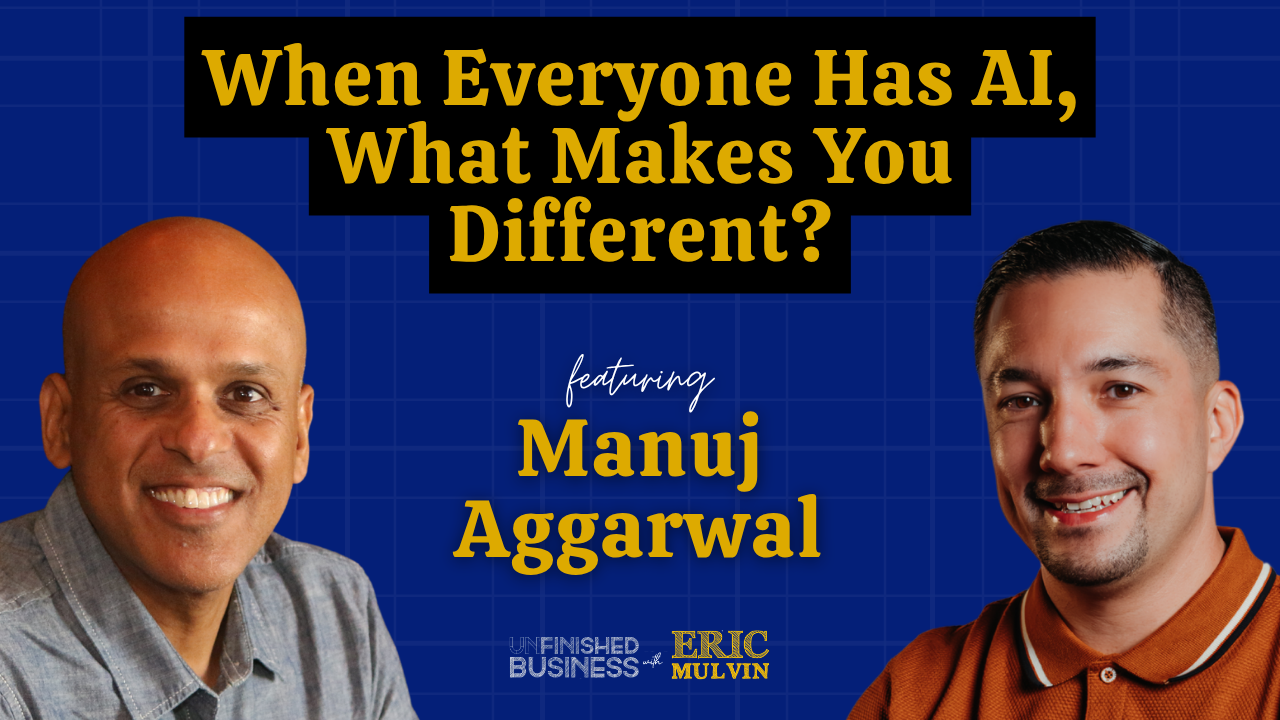
[AI Series] What Happens When Everyone Has Access to AI? | Manuj Aggarwal




What happens when every business owner has access to the same AI? Does it become your greatest competitive advantage—or does it eventually make everyone average?
Manuj Aggarwal has been working with artificial intelligence since 2005, long before ChatGPT put these tools into everyone’s hands. And he believes most of us are still thinking far too small about what AI can actually do.
In this episode of Unfinished Business, Eric Mulvin and Manuj explore what happens when intelligence becomes accessible to virtually everyone.
Why could businesses getting serious about AI today build an advantage that’s incredibly difficult for competitors to catch?
What happens when a one-person company can suddenly operate with capabilities that once required an entire organization?
And if you and your competitors have access to the exact same AI tools, what actually makes you different?
Then Manuj introduces something Eric hadn’t heard described this way before:
The “sixth level” of AI.
It goes well beyond using AI to write emails, create content, analyze data, or automate your business. And it raises a much bigger question about where the relationship between human intelligence and artificial intelligence may ultimately be heading.
What exactly is Level 6? You’ll have to hear Manuj explain it.
The conversation also explores what happens to jobs as AI becomes more capable, why human creativity may become more valuable rather than less, what today’s kids need to prepare for the world ahead, and some unexpected applications of AI that push far beyond traditional business automation.
And stay through the end for Manuj’s answer to the signature question, “What’s your unfinished business?”
We’ve had some ambitious answers on this show.
This one is on another level.
If you think you’re already using AI, this conversation may change your definition of what “using AI” actually means.
Watch the full episode on YouTube or listen on Apple Podcasts, Spotify, iHeartRadio, or your favorite podcast platform. Subscribe to @bizwitheric for more episodes and updates.
Episode Highlights
00:00 – Meet Manuj Aggarwal: Working With AI Since 2005
06:06 – The 60-Year Evolution of Artificial Intelligence
09:15 – 25 Years of Building TetraNoodle
11:48 – How Manuj Found His Way Into Technology
12:31 – Is Your Salary Giving You a False Sense of Security?
14:37 – Technology as a Force Multiplier
19:24 – Are One-Person AI Companies About to Explode?
20:54 – The AI Gold Rush Is Already Here
24:26 – The AI Head Start Your Competitors Can’t Easily Catch
32:26 – What Is the “Sixth Level” of AI?
38:53 – Is AI Making Everyone Average?
44:32 – The Hidden Human Barrier to AI Adoption
47:40 – Why Growth Requires Discomfort
50:24 – What If We’re Thinking Too Small About AI?
53:49 – Can AI Solve Problems We Thought Were Unsolvable?
56:59 – Can AI Understand You Better Than You Understand Yourself?
1:01:47 – What Happens When the 40-Hour Job Disappears?
1:05:18 – Why Creativity Could Become More Valuable Than Ever
1:08:13 – What Should We Be Teaching Kids in the Age of AI?
1:10:19 – What’s Your Unfinished Business?
About Manuj Aggarwal
Manuj Aggarwal is the Founder and Chief Innovation Officer of TetraNoodle Technologies, an AI engineering company focused on helping organizations use technology to create scalable solutions.
Manuj began working with AI in 2005 and has spent decades exploring how technology can improve businesses and people’s lives.His work through TetraNoodle has touched at least 10 million lives and generated more than $500 million in value. His AI implementation frameworks have been peer-reviewed and published in the Mensa Research Journal, and he holds four AI patents.
His work goes beyond traditional automation. Manuj is particularly interested in the relationship between AI, human behavior, self-awareness, creativity, and personal development. His current work includes AI Merge, which he describes as a way of helping AI understand an individual more deeply so it can help uncover limitations and opportunities already present in their thinking.
Connect With Manuj
AI Merge: AImerge.live
LinkedIn: https://www.linkedin.com/in/manujaggarwal/
Follow Unfinished Business with Eric Mulvin:
Instagram: https://www.instagram.com/bizwitheric/
Facebook: https://www.facebook.com/profile.php?id=61560126743830
TikTok: https://www.tiktok.com/@bizwitheric
YouTube: https://www.youtube.com/@BizWithEric
LinkedIn: https://www.linkedin.com/in/mulvin/
Powered by Pac Biz Outsourcing
Pac Biz Outsourcing helps transportation, SaaS, software, and eCommerce companies scale customer support and back office operations with dedicated teams in the Philippines.
Learn more: https://pac-biz.com
Email: info@pac-biz.com
Podcast: https://pac-biz.com/podcast
Transcript
Eric Mulvin: 00:00
Welcome to the Unfinished Business Podcast. I’m your host, Eric Mulvin, and this is a show where we sit down with leaders, creators, visionaries, and entrepreneurs who are out changing the world through their business, through their leadership, through their creativity, or through their organization. Because it doesn’t matter who you are or what you’ve accomplished. Even someone like Steve Simps, still at the top of their career, had the goals that they want to achieve and things they wanted to do with their career and their life. And so we explore those topics here on Unfinished Business with Eric Mulvin. This episode is brought to you by Pac Biz Outsourcing. At Pac Biz, we help software, e-commerce, NEMT, and taxi companies outsource their back office support, dispatching, and customer support with a dedicated team in the Philippines. These are dedicated people working remote for you, handling calls, emails, chat support, tickets so that you can improve support, scale faster, and keep costs under control. For example, there’s one client that we help handle all their dispatching, and they’re saving over $600,000 a year by having their dispatching being done by Pac Biz Outsourcing. So if you’re trying to lower costs or scale support, visit pac-biz.com to learn more or give us a call Monday through Friday at 480-771-3009. All right. I am very excited to bring to you guys our next guest. He is a founder and chief innovation officer of Tetra Noodle Technologies, an elite AI engineering company. With a remarkable track record of driving transformative change, he, through Tetra Noodle, has touched at least 10 million lives and generated over $500 million in value through his expertise in technology and AI. His AI implementation frameworks have been peer-reviewed and published in the Mensa Research Journal, a prestigious science journal by the Mensa Foundation, an organization responsible for IQ research. He has shared his insights at venues like Cornell University and the United Nations, alongside distinguished figures like the Secretary General and Nobel Peace Prize winners. While Barack, our President Obama, and Bill Gates have recognized his work. With four AI patents to his name, he is the perfect mentor to guide you through the transformative potential of AI and its benefits for business. Join us and discover the limitless possibilities of AI under the guidance of this visionary master influencer. Ladies and gentlemen, please help me welcome Manuj.
Manuj Aggarwal: 03:01
Hey, thank you so much. Wow. Yeah, that was a great intro. Thank you so much.
Eric Mulvin: 03:06
Yeah, thank you. I’m glad to have you on the show. And a little background for you guys when I do have a guest that we have some background together. I’ve gotten to know Manuj over the years. And although I don’t know if I mentioned your name directly, but I’ve talked about us working together in the past because I will credit him for being the person that pushed me into AI, which is you know, you talk about the millions of lives that you’ve impacted. And I could say that everyone in my company has been impacted by my push into AI, and that’s thanks to you. So thank you, thank you, thank you, thank you.
Manuj Aggarwal: 03:40
Thank you, thank you, thank you.
Eric Mulvin: 03:41
But yeah, so what an incredible background you have. And as I had mentioned before when we weren’t recording here, that man, I known you for years, and I didn’t know that some of your background of like what the impact you’ve had with your AI and where you’ve been able to take it. And we haven’t talked in a couple years too. So I’m excited to catch up with you and uh and share with the audience today some of your experience and expertise on on AI.
Manuj Aggarwal: 04:07
Yeah, absolutely. Yeah, no, I mean, you know, we we meet a lot of people uh in everyday walk of life, and obviously, as you get to know, many people surprise you with what they have done. I mean, you are doing amazing work, you’re helping so many people in and touching their lives in direct or indirect ways, helping them to get to their doctors, helping them get to their you know, hospital visits or what have you. So we all create impact in our own ways, right? Yep, exactly.
Eric Mulvin: 04:39
So yeah, uh, and you know, it’s amazing if you start to really think about where, you know, how how your what you’ve you help people understand with AI, you know, the benefits of that are so far reaching. And I guess you don’t if you stop to really think about it like man, because I mean some of the stuff we’re doing in our company now with AI, it’s yeah, which we’re helping people like that, but there’s AI behind the scenes that is helping empower people. And you know, it’s a I I know I wouldn’t have gotten into it as early as I did because you were on me. Like every when Chat GPT first blew up, I mean it was out for a while, but when it really started getting popular, I remember Manoj, you were like every day, you’re like, You got to you’ve got to be on there, you gotta start using it, exactly. And and you didn’t give up. So so thank you for that. But well, so what where could we start here? You know, being that you’re I I look I feel like a pioneer in the AI space, let’s go back. Like a lot of people look at AI and they think now especially, they just think of like the recent era. But AI has been a thing for some time, and I know you’ve been involved with it for some time, right?
Manuj Aggarwal: 05:52
Yeah, yeah.
Manuj Aggarwal: 05:53
Yeah, yeah. I mean, you know, look, technologies they don’t like come out of the woodwork on day one and become popular. Like so AI as a fundamental technology has been around since 1960s, okay? And then as the internet came along, around 1990s, it started to become more kind of useful, but it needed a lot of expertise, a lot of technology infrastructure. So people with resources, they started to take advantage of this technology earlier on, like during the 1990s. So the richest people you see on the Forbes list today, right? Elon Musk or Jeff Bezos or what have you, you can directly tie their wealth to when they started using technology in this way in their companies. And then I started working with it in 2005. It was still quite early days, like we had a lot of challenges, but we were able to build some meaningful technologies which helped students, which helped patients, which helped, you know, many people like truly achieve a good life in whatever they were trying to do, you know, whether to get a degree, whether to, you know, heal their joint pains, whatever. So AI was is is a is a is a very flexible technology that can be applied anywhere. It’s almost like electricity, right? And then uh now in 2022, something happened where the entry to this AI world was reduced to the minimum, meaning anybody can use it. You didn’t need PhD in computer science, you didn’t need like a lot of computers to run your algorithms, and that is sort of the revolution we are going through right now, where everybody can use AI to their advantage, right? And what will come next, in many cases we don’t we cannot even imagine. Of course, I can share my insights where things may be heading, but we are in uncharted territory almost because never before in human history we’ve had a phenomena that’s such a powerful technology can be used by anyone, even kids.
Eric Mulvin: 08:13
Yeah, I mean I I talk about that with my team where it’s like when have you ever had a technology be the one that also teaches you how to use it and implement it? And it’s like your Google Gmail did not do that with email, you know, it didn’t you couldn’t ask it questions and it tells you how to send emails or how to do a mass email blast.
Manuj Aggarwal: 08:34
Yeah.
Eric Mulvin: 08:36
So so yeah, it’s it’s amazing what you’ve been able to do with uh with that, and man, that’s crazy how early on that you got involved with it. Uh so back to your company, Tetra Noodle. Tell me more about that. How long has it been around for now, and uh what is it that uh you guys do to help companies?
Manuj Aggarwal: 08:55
Yeah, so we have been around for 25 years. Okay, so I started my company in back in 2001 after the dot-com bust happened. Like, so it’s the story behind it. Is just quickly, I moved to Canada in 1998 and got a job in technology very quickly because of the dot-com boom time, but then in 2000 until around that time frame, in 2001, I had lost four jobs. So I ca I was like kind of forced to start a company. So, what we do is we make technology easy and scalable for people and secure for people. So anytime people have a technology at their hand, whether that was the internet, then the mobile phone, now AI, a lot of people can do a lot of things themselves, but it’s almost like you are able to scratch the surface, but you’re not able to go deep into the technology and really take advantage of what this what any technology is able to give you. So our focus is okay, we understand the client, what they want to achieve, and then help them achieve that using technology, using our products, using our uh services.
Eric Mulvin: 10:12
All right. And man, you’ve had to adapt a lot over the 25 years, I’m guessing, because I well, first of all, I guess I was like still in high school at the time when you started your company, but I think back on how I’ve had to reinvent myself over and over again. And man, if you’re in this space now, it’s like the stuff that you learned yesterday could be obsolete today, right? Yeah, yeah, yeah, yeah.
Manuj Aggarwal: 10:36
Yeah, I mean, I think you know what like uh I say to people, this may be a cliche, but if you find your passion, then it doesn’t matter what the environment is doing. You’re you’re just like having fun. Uh if uh if you’re like I enjoy technology, so it’s not learning for me as much as it’s like a hobby, it’s like a play, you know?
Eric Mulvin: 10:57
Yeah, yeah, that is very true. And good advice for people who are watching, you know, get into something you’ve loved because when those there’s some dark days for entrepreneurship. Yeah, yeah, that’s right. You need that motivation to keep going and not give up.
Manuj Aggarwal: 11:10
Not just entrepreneurs, everyone. I mean, life is not easy for for anyone.
Eric Mulvin: 11:14
Yeah, that’s that’s very true. What got you into this? I mean, like what got you inspired to start a company and be in technology in the first place?
Manuj Aggarwal: 11:23
Well, I just love technology because here is the thing, like I’m an introvert, and I think I I think we have like in our private conversations kind of like shared our stories. I think we both are introverts. I don’t want to like assume for you, but I am an introvert. And initially, I I’ve I really like the concept of getting a machine to do your work and you don’t have to talk to anybody else, right? So I was like, okay, this is fantastic. I can just yell at the machine, say whatever I want to say, but it’s not gonna talk back, but it’s going to like do what I ask you to do. By the way, what the work I do, I can just copy it on somebody else’s computer. You know, back then we used to have these uh floppy floppy drives. So I can write a program, I can copy it on a floppy drive, I can give it to someone without exchange of too many words, and they can solve their problem. That was fantastic for me. So that was the that was still today, that is the whole idea behind my drive towards technology. Okay, you know, we build technology that helps people and it scales. And the company is a vehicle to do that. You know, so yes, I was in a job seeking security, but we know life is not secure. I learned that earlier on. And so now my opinion, and this could be triggering for some people, I think salary is like a drug that you know people take to feel secure, but actually there is no security.
Eric Mulvin: 12:58
So that is an interesting concept for especially those people listening that are thinking about starting a business, they probably feel it the most that it’s a drug and it’s hard to get off of because you yeah, that that false sense of security, especially these days. You you see it in the job market, you know, uh people are less loyal than ever to companies because companies are not loyal to their employees. Like I know back in the day, I mean, my dad, you know, think of the era that he would work in, you know, where people have their pension, they stay at a career for the same company for 30 years, you got the people who moved up from janitor to you know leader, don’t really hear those stories too often anymore. That’s like from back in the day. Correct. So, but yeah, but I I think the job market maybe still hasn’t caught up. You feel like, oh, I need that salary, and I need to uh it’s hard for them to get off of that. So, how have you helped companies find that security and entrepreneurship or maybe using technology? Because I know that’s a big way to help people get there.
Manuj Aggarwal: 14:09
Yeah, yeah. You know, the thing is like uh I I one of the things about me is like I I geek out on history and anthropology to see like what what other people have done before us, right? And what I find is even if you are on salary or you have a business, we all want to achieve bigger and bigger goals, okay? And we only have 24 hours in a day, everybody has 24 hours in a day. So, what can help you achieve a bigger goal? Either it is your contacts or your intelligence or your resources or technology that can speed things up and do the repetitive things for you, but most people are not able to figure out the intricacies of these technologies. For example, I have a nice car that I drive, but if it breaks down, I have no idea how to fix it. Right? So I have to have a specialist who can do it quickly. Now, if I say, you know what, come h come, you know, like no matter what happens, I’ll figure out how to fix my car. I can I can figure it out, I’m sure. You know, it will take me maybe a year, two years to figure out the whole thing, but I can do it. But why will I like you know take it upon myself to learn how to fix the car where I can go and hire an expert to do it? So my point is that utilizing someone someone’s expertise or products that have already been tried and tested gives you the edge over your competitors. And so that’s how we help other people by leveraging this big lever that is now available to us, which is technology.
Eric Mulvin: 16:03
Yeah, yep, and you’re able to do that in amazing ways. I know some of the work you’ve done working with Fortune 500 executives, helping them learn how they could use it in their organization. And I could tell you, someone who I took it upon myself to teach my organization AI, because there was nobody in the Philippines that was doing that, right? Like they hear the headlines, like, oh my gosh, AI is gonna take away all these call center jobs, and for people in the Philippines, it’s their lifeblood, so they’re scared, but then no one’s there teaching them how to use it. Like it was the first time they were all getting exposed to it was when we started teaching them that. And then it you’d think, oh, you give them this tool and go figure it out, you know. You could you go run with it. But no, you it’s it takes a support system, it takes it takes some effort to get people to start adopting these technologies, right?
Manuj Aggarwal: 17:00
Yeah, yeah, yeah, yeah, yeah, yeah, yeah, yeah. Exactly. Uh yeah, absolutely right. But but the thing is you gain the advantage. That’s an investment you are making in your future, in the in your uh team’s future, and it will pay off huge because imagine like if somebody started I can I literally have so many friends who started building websites when they like in 1996. That’s all they did, just plain websites, and they’re multimillionaires, right? Just because they were they figured out a skill that other people needed.
Eric Mulvin: 17:39
Yeah. I built websites in 96. I’m not a multimillionaire. What happened? No, but I mean I I do credit that to being the thing that got me into it today, is like I taught myself HTML, and uh you know, I was able to see what technology can do. Because like back then, you know, like it was for an organization, we had to communicate stuff out to everyone, and no one in the organization took advantage of this. I’m like, look at this website I put together. Yeah, you don’t have to tell anybody anything, they could just go to the website, get the information, they could download pictures, and I mean now AI is like that times infinity in what you’re able to do for your organization. I speaking of like startups and you know, people who are able to grow things, you know, multimillionaire people who built websites, but one of the ideas that I that you always had talked about, and I’m curious if you still have this belief, you kept saying that there will be a day in the future where there’s a a publicly traded company with one employee. And I’m wondering, do you still believe that? Or do you feel like uh Yeah, yeah, yeah.
Manuj Aggarwal: 18:50
I I mean it’s already happened, right? Like it’s already happened. Multiple companies are being sold for hundreds of millions of dollars for with one employee. Yeah, like yeah, I mean, just go uh Google it and you’ll find out. I mean, literally, this guy Mark Zuckerberg is paying a salary of one billion dollars to some experts that he hired.
Manuj Aggarwal: 19:14
So a billion dollar salary a year. Yeah. So it’s already happening. Absolutely, it has happened.
Manuj Aggarwal: 19:24
Cool. So you know, I think Elon Musk paid $60 billion to a company cursor. And it was like maybe like 16 months old company. I think two people started it. $60 billion.
Eric Mulvin: 19:41
Wow, that’s crazy. Yeah, I actually didn’t know. I haven’t been keeping up with the news, so I’m like, oh, is it when is it gonna happen? It’s already happening. So, well, what does that mean for business owners then? Because before, you know, to be able to compete against you know a company, that company is gonna have massive resources, big headcount, offices, you know, lots of expenses. What does that mean for a business when now you could be competing against someone that’s just a team of one, but they have the footprint of a big company?
Manuj Aggarwal: 20:17
Correct. I mean, look, this is the which is why I said we are uncharted in in uncharted waters, never have a this has not happened ever in the human history. But that’s where the opportunity is. So think I’ll give you a simple analogy, right? Let’s say you know you live in Arizona and in your neighborhood somebody you you find a secret gold mine. Okay, and you can basically just take however much gold you want. Now you say to other people that hey, you can take some gold and use it for your advantage, but if they don’t use it, whose fault is it? So AI is that gold mine. Now the difference is in the past, if you had to dig out the gold, you needed to hire a lot of bulldozers, people, you know, a lot of machinery. So you needed to have a resource to mine this gold mine. So only a few people had access to this gold mine. But now you can pay literally twenty dollars to twenty dollars a month and get this gold. Right? It’s up to you what you want to do with that. So yes, everybody will have more competition, but imagine if you had the gold, if you had the intelligence, if you had the resources, you can move much faster than large companies. Because in large companies, if they come up with an idea, the next time they will talk about it, they will have a meeting in six months about it. Okay. So the advantage you have is speed and reduction of the resources that you need to start something. Like the entry le entry gates have been flung open for everyone. Everyone can build something.
Eric Mulvin: 22:20
Yeah. Yeah. That’s a that’s a great analogy. That and then it reminds me of when we you were first really trying to get me into AI too. I remember these different analogies where I’m like, okay, I feel like I’m gonna miss out if I’m not here. And it’s interesting, you know, that’s but that was already like two, three years ago, I think close to three years ago when you first made that push for me. And you know, there’s still people that are still like I’m still hearing companies saying the same thing, like, oh, we don’t know where to get started. We’re there’s they’re still at the point that I was three years ago. What is I mean, for someone in your space there, you know, you’re trying to get people moving into AI to see the advantage of that. I mean, I guess you you’ve studied, you’ve looked back at human behavior and how people have adopted to this. I guess from from your research, you know, and and where you think things could be going with AI, where do you see things going with businesses applying? Because I mean, that everyone keeps talking about hey, there’s gonna be the people who adopt it, and those are the ones that are gonna be the future, and then the ones that don’t that are gonna be out of business. I hear that a lot. Do you feel like that’s really gonna be the case? That it’s just gonna be like this black and white almost, pretty much like the people who are adopting and who aren’t?
Manuj Aggarwal: 23:42
Well, so here is the thing, right? Everybody finds their own water seeks its own level, right? So, meaning most people are walking around with the latest iPhone, but there are some people who are still using their flip phones today, right? And they survive. It’s you know, they’re living their life, but it’s up to them to define the quality of the life they are living. I mean, if they’re not missing anything, all power to them bar if they come into the new era. Similarly, for businesses, there are many, many, many businesses still today with n with no website. Right? So it’s not like they they’ve they vanish from the face of the earth, but they just get so much disadvantage in terms of competition that you know they they get left behind in that sense. But there is a there is a kind of like you know, a level of people that work in that order. Nothing wrong with that. Now the thing is that whenever this kind of technology brings new opportunities, obviously, if you are early, if you go deeper, you will be able to extract more value from those opportunities, and you will you will go faster and farther, and it will become more difficult to catch you when there you have three years head start. Or you know, for example, for me, I have 20 years head start. It’s difficult to catch up as long as you continue to go further and further and further, right? But human nature is even let’s say if if we are like, you know, let’s say we are flooded, like let’s assume that somebody lives next to a river and there is a flood in the river. How many times we have seen on the TV that they will wait until the last moment to kind of leave leave the home? And that is human nature. I’m not criticizing it because we always hope that I don’t want to change my situation, I don’t want to learn this new technology, I don’t want somebody to take over my business that I have built over 20 years with hard work and manual effort. I don’t want these things, but I will wait until the last moment until water comes to this level that I cannot escape it. But some people will say, Oh, I have seen this season before, the water is rising. Let me start to build a wall right now and also have an escape plan just in case the water rises. So it all depends on whether you think you want to preserve what you have right now and not change, or you can see that change is about to happen. I am willing to let go of what I have so that I can have something new in the future. That’s the only difference.
Manuj Aggarwal: 26:37
Yeah. Yeah.
Eric Mulvin: 26:39
Well, that that is true. You know, people do survive, but do you want to put yourself through that being the one rescued off of the roof, being the last in the flood? So when it’s and there’s options out there, so yeah, that’s another interesting way of looking at it too. That was one of the amazing things during COVID that I was like, what do you mean there’s companies still that don’t have a website? Yeah, and I mean even today, still that it is it is interesting. I think, yeah. But I I think for people watching the show here today, they’re not the kind of people that wouldn’t have a website. I think they’ll they understand the the web presence there that and all of that that’s important because I think you’re just not gonna get now before like I I go back to the the last job that I had where I actually worked for someone big corporation, yeah, Yelp. And like Yelp replaced the phone book, and you know, now then Yelp and Google Maps have been the thing of how people look for information for finding a small business, but now so many more searches. Now we’re going to Chat GPT, Gemini, Claude, Groc, looking for that information. And if you don’t have any kind of web presence, I’m gonna take a guess to say that the AI is not gonna know you exist either, right?
Manuj Aggarwal: 28:00
Yeah, exactly, exactly, exactly. Not just that, right? So see, we are we are attention-starved. So we are always talking about oh, does AI know about you? But also your intelligence, your wisdom, like you know, is it being enhanced by AI? Is it interacting with AI in a cohesive manner and all that? So these are deeper topics, but yes, you’re right. Like you the sooner you start to see how the world is changing, the sooner you can adapt.
Eric Mulvin: 28:33
So let’s touch on that a little bit. You know, they said there’s deeper sides to AI. I think there’s a lot of folks that all right, they they start using Chat GPT. Maybe they’re doing some basic stuff with transcripts. There’s levels to this though, right? And I I I don’t know if there’s a standard set. I’ve seen those four levels or five levels or you know, whatever the framework people have created. But a lot of people are really at that level one, just like chat GPT, help me write this email, help me make this graphic. But there’s so many more layers that you can get where the deeper you go, the more you could do, but then also the more infrastructure you need to get set up, and it it starts becoming more difficult to implement. I think it it starts getting closer to like what you were saying, what AI was like in the early days, because like for me, I I can’t just go have an AI factory behind the scenes in my company without having engineers putting it together, without building those layers of data so that there’s other applications that can come in and communicate with that. But for the people watching, so that maybe they don’t they aren’t aware that it gets way more advanced. What are some of the levels that you feel like there are in AI where it’s like, all right, this is level one for a business owner? Because I’m sure you could talk to people and you could probably already tell, like, okay, there’s where they’re at, and they need they need to go way deeper.
Manuj Aggarwal: 30:02
Not see again, I I will never say they need to go deeper. If if they don’t, and you cannot change a human’s perception. If if they want to, yes, there are many, many, many, many levels. Even the level five that uh people talk about, it’s autonomous organization. Meaning if this is we are talking Star Trek level, where you know it’s like you just talk to a human, there’s like kind of like you know, imagine a like a control room, like massive monitors, and you just talk to the AI and say, hey, make it happen, and then it’ll just do it, right? Like, so we are we are going to be at that level within like five maybe five to ten years. I mean that is where AGI sort of becomes powerful enough that humans it exceeds a human intelligence, right? But imagine my the way the in my in my world, I work at a deeper level still, because let’s say if you found uh a genie today, right, and it says, hey, I’m I’m ready to give you three wishes. Anything you want, anything you want, right? What do you think you will ask? More wishes. More wishes, okay. So you see, your mind has been tuned in a certain way that given an opportunity, you know how to multiply it. Right? In this very example. So the the G didn’t do much other than amplify what you already had in your mind. Right? So the sixth level is to enhance people’s thinking. How much do you think like imagine Elon Musk built a giga factory in nine months and a lot of people get frustrated with their bathroom remodeling because it has been held up with like for 15 months almost or whatever, right? So what is it that his mind thinks that you cannot think about? Because the technology is only going to follow your orders, it’s not going to like make up stuff and say, Hey, by the way, you could do it much faster. You see? So the sixth level is not AI automation because those things are happening regardless. The sixth level is optimizing your mind and removing any limits on your mind.
Eric Mulvin: 32:45
So do you need to get to all the levels to be able to get to that point?
Manuj Aggarwal: 32:50
No, no, no, no, no, no, no. Life is never linear. Okay? I mean, look at your anybody’s life, anybody’s life. I can guarantee you, you can trace steps when you elevated from one level to another. You met somebody, a new opportunity, a new job, a new kind of like coincidence that elevated you to the next level. Right? So if you desire to go to the sixth level, you can start the journey today. But if you think in your mind that you need to go through one, two, three, four, five, then you lead off that path.
Eric Mulvin: 33:31
That is that is interesting. It reminds me, there’s uh and I’m trying to look it up while talking to you. It was in the like the 1920s or 30s, and I’m sure you know the example of the long-distance marathon runner that no one ever broke four hours. Yeah, yeah. Ever, ever. People like it’s not possible, it can’t happen until this one guy, which looks like Roger Bannister, did it in three eighths. Oh no, it was a mile. Well, it looks like it was a mile, four-minute mile is what he broke, and he was able to do it in three minutes and fifty-nine seconds because he knew this is possible, and it took that mindset to make it happen. So you’re saying it’s like the same thing as applying to AI, which makes sense. Like, a like whatever you give AI, that’s what it’s gonna solve for. And so, if you’re saying we need to build this factory in nine months, that’s what it’s gonna solve for, not we need to build this factory, so you put those constraints in and they’re able to move further. So interesting. So the yeah, well, you know, as business leaders, I and you work with a lot of people, it does seem like that you hear this a lot, like the thing holding you back is yourself.
Manuj Aggarwal: 34:42
Absolutely, absolutely, absolutely, and it’s still the same here, so absolutely, and it’s going to amplify because in the past you could hide it behind other skills you had, and people could not figure it out. Now everybody is an Einstein, literally, everybody is an Einstein, and this is not a joke, because everybody has access to this intelligence, which is Einstein-level intelligence.
Eric Mulvin: 35:08
Yeah, and I always thought, like, what happens in a world where everybody has access to the same tools? Because all of my competitors have the same tools. Now, how you use them, that’s another question, but they still have access to the same things. And that wasn’t that wasn’t possible before. I think of like in my space, call centers, you know, and it reminded me as you were talking about where the technology was in the early days of AI, you needed a lot of money, investment, equipment, infrastructure, engineers to program things to be able to do this stuff with AI that you could now pull up an app on your phone and do in seconds. Same thing with the call centers. I I meet people in the call center industry and they’re like, Man, if you had any idea the millions of dollars it took to put together an office with a hundred seats that I could do in one afternoon clicking a few buttons, and then everyone has a phone line. Like they had to wire things up, everything was like there’s crazy PBX boxes and stuff. Yeah, yeah, yeah. And uh, you know, so it’s the same kind of thing, is it but what does that do to businesses when it and I I think that’s where maybe some of that unknown comes in because what what are people gonna do when everyone has access to the same technology? Because that I’m seeing this a little bit now, and uh I’m curious what you think about this. You know, with Chat GPT, and I’m I’m guessing a lot of the tools, but I see it a lot with Chat GPT, where you know, chat GPT is like a graphic designer, it has a certain default style, just like it has a certain default voice. And if you don’t do anything to change that default style, everybody there’s millions of people in the the United States that have hired ChatGPT as a graphic designer, and that designer is making like if I’m scrolling through my LinkedIn, scrolling through Facebook, I’m seeing a lot of the same designs, the same, like it looks very similar. So one thing that I’m starting to see is like, how do you differentiate yourself? I mean, I know the answer, but the the interesting challenge that I’m starting to see with people who are using this default graphic designer, everyone’s stuff looks the same. Like, I just saw five restaurants in a row, they all look like they’re the same restaurant, it’s just a different name and different food. But that’s happening in business, it’s happening like a highly visible thing that we’re seeing on our feeds, but that’s also happening in in offices and boardrooms and strategic planning meetings. So I’m curious, I’m I’m I’m curious where things are gonna go when everyone uh I guess, yeah, I don’t know. I don’t have any questionnaire.
Manuj Aggarwal: 37:52
It’s just I don’t know if you have any comment or no no, I can I can I can comment uh I can just certainly comment on this, right? So uh you actually right rightly pointed out this is a very important conversation that everybody has the same tool available to them. Now, human nature is to do the easy thing. Okay, so it’s very easy to fall into the trap of oh, I can just use AI and and do it, but then a million other people are doing it. So what happens is over time everybody becomes average, right? And some people are okay being average because by law of nature and mathematics, most people are average. I’m sorry to say that, right? But only few people take the m time to go and kind of refine their art. And those are the top five percent in any industry, whether you have a tool or not, whether you have technology or not, those are the people who are kind of like refining, refining, refining and rising above the average. So the tools are not going to get you there. Your desire to become more than average is going to get you there.
Eric Mulvin: 39:07
I love that statement. Yeah. So great advice for you guys watching. You gotta be that 5%. Because otherwise, I I’m just seeing it now. I mean, again, going back to the example, but if you have 20 competitors in the market space marketplace, and everybody’s going to Chat GPT with the same prompt, make my strategy for 2027. And you know, how do I help my business grow? They’re all gonna get very similar versions of the same strategy, and you’re all gonna be doing very similar things, not differentiating yourself. Exactly, exactly, exactly. So interesting, interesting times to be a business owner. What about like I’m curious, are you seeing any kind of divide? You know, because growing up for me, you know, like websites and all that, like that was a young person’s thing. Like older people didn’t really want to get into the technology. I mean, I think of my parents that didn’t even want to learn how to program the VCR. I had to go in and program the VCR for them, and every time the power went out, you had to set the clock back again. They just refused to adopt technology. Are you seeing some of the same patterns with AI, or are you seeing something entirely different?
Manuj Aggarwal: 40:21
No, no, absolutely. It’s the same thing. And this is again, it does nothing to do with technology, it’s human nature. Every technology takes time for adoption. And as I said earlier, like there are some people walking around with flip phones, and that’s okay. Here is another, like I already mentioned this, but I’ll try to clarify it. You see, even kids and very old people are are using iPhones today, right? And if you take out that device, there is unbelievable complexity inside that device. Unbelievable. Okay? And it’s amazing how it lasts one day, like you know, for average for the battery charge, and it can like connect you with the entire world, and you can like conduct your business on the phone and do whatever the hell you want to do on the phone, right? But there’s none of that complexity is visible to the user. You can just take out your phone, you know, just use your fingers and you can start working with it. So the true power of technology is not when it is complex, but it is easy. It is easy to use for anyone. And that these are some of the things that we as a technology company do that other people cannot do on their own. Meaning make it so easy and transparent that technology moves out of the way so that you can go faster in whatever you are trying to do.
Eric Mulvin: 41:55
Yeah, yeah, that is true. The I I can’t tell you how many times I’ve tried to bring some software to my company or something, and I’m like, this is exactly what our company needed, go run with it. And then six months later, what the heck happened here? Like, no one logged in, even no one has submitted anything in this tool. I’ve been paying for it. So, yeah, that’s it’s a very true human behavior. It’s a fun one. So I’m guessing then you’ve had you’ve looked back quite a bit at human behavior, and I’ve thought about that too. I mean, I haven’t done much of the research, but I have thought a lot about that living through the dot-com boom, living through you know, the rise of the smartphones, and I’ve really tried to think, okay, there’s patterns here that are just repeating over and over again, and we’re going through the same one here, where it’s like you could already tell, like, not exactly what’s gonna happen, but you could see where things are headed. And I feel like a lot of businesses are putting their head in the sand because the pattern’s repeating in front of everybody’s face, and yet some of people are still deciding to I’m gonna wait it out, I’m gonna sit on the roof and wait for the flood to get higher. I wanted to talk more about your business though, because you do help companies with that. So, like, what are some of the things that you’re seeing? What are the some of the problems you’re seeing with people being able to adopt this? Is this what’s holding people back?
Manuj Aggarwal: 43:26
So, first and foremost, it’s the human identity. Okay, so what is happening is as people are seeing that their competition is beating them, or their industry is getting automated, or they are not able to understand how they will survive in this world, their identity is at stake. Meaning in our world, when we meet someone, the first or second question is what do you do? That is how we recognize a person, and that is how the person recognizes. themselves that okay I am a director of blah blah blah, I am a vice president of blah blah blah. But as these jobs are getting in danger or disappearing or whatever, now the question is who am I? And it is very uncomfortable to say I am a nobody. It’s very uncomfortable to say. And that acceptance is what is creating the resistance. Okay. Now what we do is we we go in there and find out what their true identity and their true purpose is, because in most cases they are not living that life already. So in the new age of AI, what will be most important is somebody who can help people find their purpose, find their identity, build a tool that can actually create that for them, and then help them monetize whatever they bring to the table.
Eric Mulvin: 45:03
That’s really powerful. Because I think a lot of people think about it from a different aspect. And I love the angle you bring, and I’m sure there was some influence from you on my beliefs around AI, because I feel the same way, you know, that it really is all about the people. And you know, we’re I’m trying to empower people. You’re looking at it from a whole other angle, almost like the guru up on top of the mountain that like will help you find your purpose. But there are so many people in life that are going through life and have no idea, and they don’t have that that they don’t have that self-awareness, I guess. But that so that’s another angle too. Like as business leaders, and you’re helping business leaders understand how to leverage these tools, and part of that, a lot of that is some of the self-awareness. Like, what does it take for a business leader to be able to take maybe a tough conversation they had and and bounce that off of AI to say, I could have done better in that, you know, in that conversation? How can I become a better leader? How can I handle this situation better? Those conversations, those questions aren’t coming up if the leader thinks they are the best. They have there is no room for improvement. Why, why is there anywhere to improve? It comes back to the people again, too. So I mean, does any of your work touch on that too?
Manuj Aggarwal: 46:29
Because I think not only that, because you know, after doing so much deep research on human behavior, that also is a safety valve. We cannot, it takes a lot of courage for somebody to say, tell me my faults. Okay, and not only that, but as as business owners or anybody who has achieved something, you also understand that growth happens outside of your comfort zone, never inside. So imagine this phenomena that I don’t want to be told where where I’m bad at or where my boundaries are, yet I want to grow. Meaning I don’t know where my boundary is, how to cross it, but I want what is outside of that boundary. Imagine putting some address in your GPS and saying, take me somewhere. You know, the GPS is gonna say, Where do you want to go? Right? Until you put in the address, it’s not gonna start. So my point is when we work with AI, imagine it is always nudging you outside of your comfort zone and then helping you figure out who you truly want to become and helping you get there. That is the true use of this technology.
Eric Mulvin: 47:49
That is so for you guys watching, listening, think about that because you know you might think, oh, it’s there to help me write better emails, put together better strategies, put together a better marketing plan. But again, this is where it goes so much levels deeper that you’re just at the surface level with some of that stuff. You know, there’s really a lot more you could impact, and it’s you know, it’s pretty crazy to think of how far reaching this could be. But I mean, I don’t know some people might I I’ve seen it, I’ve seen conversations pop up where they’re like, man, they were feeding the whole conversation into chat GPT, and I’m being manipulated by AI by this person. But on the flip side of that, there’s people that are generally just trying to get better in their lives and their career, and it’s just a tool to help you to do that. So yeah, I mean, with there being like a million directions this could this is going with AI, and anything is possible, you know, in the last couple of years since you and I have last talked, what’s what’s some examples of some things that you’ve seen people do with AI that’s been like shocking in a good way? Not I know there’s we could find shocking bad ways, but where it’s like, man, I never thought about it from that angle, or wow, that’s so innovative that they were able to use it for that for their business. Because I mean there’s every day people are doing stuff like this.
Manuj Aggarwal: 49:13
Yeah, yeah. Okay. I mean, I’ll be biased here, so uh rather than using other people’s example, I’ll use what uh we are using it for, yeah, which may surprise you. So we are using it to help people with chronic pain. We are helping people with ADHD to come calm their mind. We are helping parents connect with their teenager uh kids. We are helping people get rid of their what do you call it? Um addictions. Okay these are some some things that used to take decades of work, hard work, and we are able to do this in four to eight weeks.
Eric Mulvin: 50:01
That’s life-changing. I mean, especially I mean the things you talked about are very heavy topics for people and and things that plague them for their entire life.
Manuj Aggarwal: 50:12
Yes.
Eric Mulvin: 50:12
I’m kind of interested. Is there anything you could share more about any of those?
Manuj Aggarwal: 50:16
Sure, sure, sure. Yeah, I mean, it’s you know, you mentioned this word self-awareness. That is the most important word for the AI era. If the more self-aware you are, the more you will flourish in this era. So think about chronic pain. Chronic pain, and this is all science-based, by the way, you go go ahead and do your research. Chronic pain actually is stuck emotion. So something you were not able to accomplish, something you blame other people, blame the society, blame someone, you know, you got divorced, blah blah blah. Those things they carry energy and they get stuck in your body, literally. So how do you and and over time it builds up, it creates chronic pain. It’s your body telling you that there is something wrong. And so, how do you find it? You take medication, you go to surgery, but there are new ways now to use AI without surgery, without medication. I’m not saying this is a cure for chronic pain, but it actually starts to relieve without without these intrusive measures. Take, for example, you know, connecting with their teenagers. Teenagers are anyway, I’m trying, you know, get they’re getting isolated these days, you know. There’s a lot of problems with teenage suicide because they are isolated and whatnot. And when the parents are not connecting with their teenagers, it negatively affects the parents, negatively affects the teenagers. And let’s imagine there is a very successful business owner, his whole company is automated, but he cannot connect with his teenager. What good is that AI? Yeah, right. So, what we do is we help raise the self-awareness of the parent so that they can connect better with their teenager, rather than the parent saying, Why doesn’t my teenager talk to me? They can start to understand what does the teenager actually want, and I can facilitate that. Yeah, you know, rather than rather than like changing the other person, what changes can we bring to ourselves so that people around us start responding differently.
Eric Mulvin: 52:31
I have a lot of curiosity with uh your thoughts on things. So there’s obviously a lot of doom and gloom predictions and a lot of I mean they make the great headlines, and there’s plenty that you could attach to to find the negative parts of AI. I don’t want to focus on that. Because I I also believe, you know, when you have these infinite possibilities, then it also means that you know there’s there’s possibilities where we solve these problems, we solve these chronic illnesses, you know, we do get a we do find a cure for cancer, we do solve these political, you know, like why do we have to have all these wars and stuff? For you, what do you what are you some things you’re hopeful to see in the future that maybe wouldn’t have been possible before with AI?
Manuj Aggarwal: 53:17
I think you just listed them, right? Like find cure for cancer, find cure for chronic pain, find cure for wars, find cure for poverty, find cure for you know lack of education, lack of water. These are huge problems which humanity has been trying to solve for like since we were in caves, right? Every new level of technology has helped because no matter how difficult life is for anyone, if we look at our life and compare it with what people used to live like in 100 years ago, we are in so much better shape. You don’t have to go back that far. Yeah, exactly. And and so continuously, as technology has evolved, it has provided the benefits, you know. So now we will have these solutions, but by the way, human nature is to create more problems as we find more solutions. So there is no I cannot imagine a world where there is no problems. When these problems get solved, some other problems will come up. That means more opportunities will come up because entrepreneurship is all about solving problems.
Eric Mulvin: 54:30
So there’ll always be room for us entrepreneurs because there’s gonna be new problems. That’s a good point. You know, we thought, I really thought, oh, with cell phones, internets everywhere, you know, this is gonna be so great. I if you go around and talk to everyone now about how they feel about social media, probably not as positive as they did back in when it first started coming out. Correct, good, correct, good. So it created a whole new set of problems, which is yeah. So two steps forward, one step backward, maybe, but now we got some solutions to to help tackle it. And uh but there’s always room for the entrepreneur to solve those problems.
Manuj Aggarwal: 55:05
Exactly, exactly.
Eric Mulvin: 55:07
Now, before we started the interview, you had mentioned that you’ve been working on there’s a something that you have started new that uh the first I heard about this, something called AI merge. Right. Can you tell me a little bit more about that? Because I think you know, people listening they might be interested in like, I like the way that Manuj’s talking about this, and I’d like to maybe see how I could learn AI through that same lens. So what tell me more about that program?
Manuj Aggarwal: 55:36
Yeah, I mean, uh you know, the technology that I was talking about, chronic pain, uh connecting with people, and in business scenarios, like making faster decisions, being being a better leader, collaborating better, it’s all related to this idea of self-awareness. And self-awareness can happen, can be increased by various practices, you know, a lot of self-reflection, a lot of self-control, or we can use a technology like AI. What we have done is created something called AI Merge, which is essentially in kind of creating a bridge between your mind and AI in a way that AI understands you better rather than you understanding AI better. Okay, and then from this, when you interact with AI, it kind of helps you to really unlock what is already there in your mind. The limits that you see are all created by you. So imagine there was a wise person like a genie or you know, somebody who has centuries of wisdom, they are guiding you to understand what those limitations are and how to remove them. That is what AI merge is. Correct. So the idea is that you know when industrialization happened, we we needed to create everything at a certain size, at a certain color, because that’s how you can produce it with AI, hyper-personalization. Any like we can create a solution that fits any. This may be counterintuitive to a lot of people, but to answer your question, who can who are you attracting? People who want to get ahead. So again, you know, there isn’t this is nothing different when industrialization happened. People who figured out how to run the machine, how to fix the machine, how to kind of like produce quality material with the machine, they became factory owners, they became industrialists. When the internet came along, people who figured out how to create websites, you know, many of them became billionaires. Like more billionaires were created in the last 20-25 years than any time in history because of technology. Now, the same thing is going to happen again. More millionaires and billionaires will be created in the next 20 years than were created in the entire history because of AI. So, to answer your question, who it’s people who recognize this is a force that needs to be harnessed before it takes you over, and they want to go deeper, further, faster, those are the people that we are attracting. Right.
Eric Mulvin: 58:31
Well, my kind of people who are listening to the show here. So all right, cool. Well, thanks for sharing that, and we’ll get some information. We’ll have some stuff in the links so people can connect with you on that to learn more. Another question that maybe a little bouncing around here, but there’s a belief out there, and you know, a concern that I mean, I I think maybe they don’t have all the information there, but like AI is gonna replace everything, right? Like, and especially me, I have this call center, I got a lot of people. I just came from the conference, and across from me are booths for software companies that are like, you don’t need people. We uh do 100% automation for your dispatching, for your calls. And you know, people in every industry. I mean, I’m here in Phoenix, you can go out and you can see the self-driving cars driving down the street. You could it’s visible. I’m like, man, I’m a driver, my job’s at threat. I’m working on a phone, I’m my job’s at that. And now industries that traditionally have not had that kind of threat. Now people are like, I’m a lawyer. I now I’m an accountant, you know. Am I being at risk of being replaced by AI? So what what does the future look like when I think I think people are going to the extremes and they’re like, how is the society gonna work when everyone’s job is replaced by AI? What are we all gonna do? And who’s gonna spend money with these businesses when there’s no money to spend when you’re not making anything? Like, I mean, that’s one pick one version of the future, but it is one that I think a lot of people share. And curious what you you’re you say to people like that. For sure.
Manuj Aggarwal: 01:00:20
Well, I think uh, you know, I’ll use an example which has used being used everywhere. You know, and before the car was invented, there was a whole industry of people whose job was it to keep the roads clean, cleaning up horses uh sh literally like shit, you know, because everything depended upon horses and horses eat and then they you know uh excrete and needed to be cleaned up. That was the industry. Okay, and I don’t know if people know so most people know this example. There was another example I think for some industry, I think photograph photography or electricity, they actually needed a chemical that is found in human urine. Okay, so there was an industry that his job their job was go to people’s home every day and collect human urine. Okay, literally, you can look it up. So my point is that as technology changes, the job that needs to be done also changes. Going back to my previous uh principle, this these are fundamental principles. When humans find a solution, they create other problems. Okay, so it’s not like jobs are going to go away, but the nature of the job will be different. Okay, so how will it be different? I don’t think there will be a job that requires you to do work 40 hours a week. Yay! Okay, a lot of people are clapping for that one. Yeah, so what you will do is think of an Uber driver, you will say, I have this expertise, I’m available five hours a week. Who wants my services? And somebody will say, I want that service, I’ll pay $200 an hour for you. And somebody will say, Oh, I need this service on a Saturday, I’ll pay you $300 an hour for that. And then you will say, Okay, I think I need to make this much money instead of five hours, I’ll I’ll do seven hours a week. And you will make yourself available. And then you will do the job, you’ll get paid. So think every industry has an Uber, app, every industry, and that’s how the economy will evolve, in my opinion. Now, tomorrow something else happens, I don’t know. But the way things are moving along, this is how I see.
Eric Mulvin: 01:02:52
Hmm.
Eric Mulvin: 01:02:53
Then people will be in control of their schedule, they’ll be able to dictate a lot more. Because I feel like right now there’s a I think that’s part of the challenge, is a lot of people, business owners alike, they feel like, ah, this is all happened to me. I have no control over any of this. And which is not true. There are things that you could do. It’s if you apply any of the stuff we’re talking today, you could there’s a lot you could do, but but I know that’s the belief that’s out there. Another thing that I I thought is that I have a belief around is you know, just along with like self-awareness being one of those critical human traits that we need to really lean back into more than ever with AI, creativity. What do you what do you feel like about the future and creativity and you know with AI, where do you see things it going in that direction?
Manuj Aggarwal: 01:03:45
It’s going to be tremendously valuable, tremendously valuable. Okay. I think you know, if you go here read history again in the 1500s in Europe, there was a period called Renaissance. Okay, in Renaissance, most of the rich people were either painters, musicians, like other than the actual right kings and things like that. Like kings used to seek out musicians and painters and poets and give them like massive salaries because they wanted to create something. You know, you can go look at historical buildings, they spent fortunes on creating buildings, so architects were needed, designers were needed. So creativity is going to become very, very important because of what you just said. Like, if everybody is producing the same thing, human desire is to have something different. Like, I want something that really speaks to me. And how will that happen? It’s the most creative person who can use AI to create something that other people cannot create using AI. So increasing your creativity and taking risks and going where other people haven’t gone before is going to be key.
Eric Mulvin: 01:05:07
Yep. And uh it touches on like a there’s a quote that I like to say all the time. I want to be doing things in five years using technology that doesn’t exist today. And that’s what’s also pushed me, as you know, when when AI came around, I’m like, there you go. There’s like my my quote manifested like it’s it’s exactly what is happening right now. So yeah, but that’s that’s a great point you bring there. So getting close to the question, actually, I could keep going all day with these questions, but I know we have a limited amount of time here and can’t make these episodes run too long. Yeah, but talk to I I know we got a lot of family businesses. I met a lot of family businesses at this last conference, so we might got some people. Shout out to the people who are watching who I met at NEMTAC in Orlando because there’s a lot. Of new followers, I think, uh met me out there, but there’s a lot of people with kids, right? And there’s like myself, I’ve got two young daughters, and I’m really trying to like before I was like, Oh, we gotta make sure they know the computer, they gotta know these certain technologies. What do you think is the most critical things that a parent can be teaching their kids today to help make sure they’re successful in this new future that we’re finding ourselves in?
Manuj Aggarwal: 01:06:32
I think we already covered many of these things, right? Creativity, communication, you know, ability to take risks, resilience, not following other people’s path. That’s very important. These are some of the things, you know, and above all, above everything is self-awareness. Like even teens need to be self-aware. Like I’m teaching my kids not just how to use AI, but how to get a feedback from AI that elevates them little by little on its own.
Eric Mulvin: 01:07:04
You know? That is that is interesting, yeah. Because I’ve been trying to get my kids, they’re really good about pointing things out. They’re like, I don’t know how old your kids are, but I know my kids love pointing out, oh, that’s AI, that’s AI. And then the grandma’s like, how can you tell? But yeah, there’s giving kids that skill is is extremely powerful because then you know what can they do with it on their own? I mean, you could exponentially increase your capabilities, and by the time you get to college, you could be way further ahead than your peers. So that’s a self-awareness for kids. All right, I like that. Well, as we’re getting to the end here, always end every episode with this one question, and I didn’t prep you on this, curious what your answer is going to be, but you know, our show is called Unfinished Business, and so we always ask people, like for you, you know, you’ve had, and and I should have asked you some questions about this. I don’t know how you were in a position to have people like Bill Clinton and Barack Obama reviewing your work, but you’ve done a lot in your career, as I’ve I mentioned back in the intro, and as we’ve talked through this whole episode, but for you, what’s what’s the big unfinished business for you? What’s something that you would like to see in your career in your lifetime be achieved?
Manuj Aggarwal: 01:08:30
Yeah, I I think I I may or may not have shared this crazy goal I have is to use technology to help 20 people win the Nobel Prize.
Eric Mulvin: 01:08:40
What’s the inspiration behind that?
Manuj Aggarwal: 01:08:43
I I don’t know, it is a crazy thing that happened to me like in uh during the pandemic. Like I was in meditation, deep meditation, and something like a voice kind of appeared in my head is like do something with technology to help 20 people win the Nobel Prize. I think I was going crazy. I literally th thought going crazy. But then six months later I was invited to give a talk and they put me next to a Nobel Prize winner. I was like, How does that how did that happen? And so the work that I have been doing in the last five, six years, AI merge, this research, it’s all about that. Like if you increase your self-awareness to a point where you are able to understand your own capabilities, your way that you can connect with people, you can you know leverage resources available to you. And if you work with five hundred brilliant people, twenty of them will for sure win the Nobel Prize.
Eric Mulvin: 01:09:42
That’s crazy. I love it. I gotta connect you with one of my past guests, Derek Maines. His answer was to win the Nobel Prize in economics. So if you could help him, now you’ve only got 19 people left on your Yeah, yeah, yeah. That that’s amazing. Yeah, yeah, yeah. But uh that’s cool because uh that now you’re the second person that’s mentioned Nobel Prize as one of their answers, or or being involved with that. So, which is it’s a very well it’s nobles in the name, but you know, it’s it’s very selfless to be you know dedicating your life’s work to something that will help tons and tons of people. Yeah. And so, well, Manuj, I thank you so much for taking some time to share your thoughts with our listeners here today. And you left me with a lot of things to think about as well. And I hope for the listeners too, a lot of things uh that you could be applying to your business. And and also now there might be some people listening that might want to connect with you, maybe learn more about AI Merge, or just follow you along your own journey. You do have your own podcast. I know you mentioned earlier you have over 400 episodes out. So if people do want to get more into the mind of Manuj, there’s uh definitely some ways to do that. But what’s the best way to for for people to connect with you?
Manuj Aggarwal: 01:10:58
I think uh the best thing is like I can offer is go to ai merge.live and experience the technology for yourself. It’s a 10-minute preview, but you can feel what I’m talking about, not think, feel. And it will help you understand what what this episode was all about, what my work is all about. And if you want to connect with me on LinkedIn, look me up and send me it.
Eric Mulvin: 01:11:24
Right, awesome. Well, thanks again, Manuj. And for those of you guys watching, if you like today’s episode, make sure to subscribe. We’re on anywhere that you listen to podcasts, and on social media, look for @BizwithEric, where you can see we release episodes every single Tuesday with uh amazing thought leaders and people who are out changing the world, like Manuj here himself. Uh, so thank you guys for watching, and uh, we’ll catch you guys on the next episode. See you later.