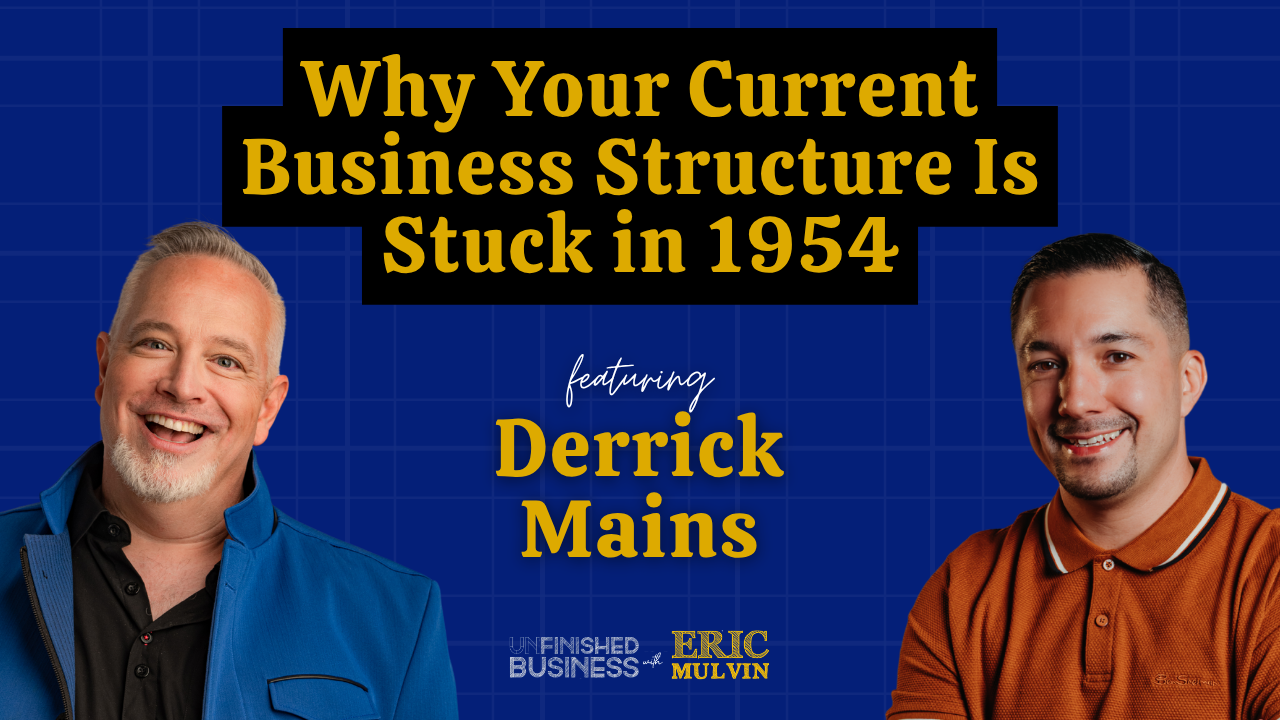
[Vistage Series] Why Your Current Business Structure Is Stuck in 1954 | Derrick Mains




Are you sitting on a potential goldmine in your business simply because you lack the time and team to dig into it?
In this special episode of Unfinished Business, host Eric Mulvin broadcasts straight from Manila, Philippines. Recording against the backdrop of bustling city traffic, Eric shares a candid look at what it takes to manage a global business, Pac Biz Outsourcing, while balancing family life and big entrepreneurial ambitions.
Eric opens up about the logistical challenges of running a company with teams and clients spread across the US, Canada, and the UK, explaining why timing and dedicated resources are critical to unlocking hidden revenue streams. He discusses the reality of navigating major global disruptions, like losing significant UK business overnight during the 2020 lockdowns, and how those moments emphasize why timing is everything in business.
Whether you are trying to scale an established company or struggling to get your side hustle off the couch, this episode is a call to action. Eric shares practical strategies for auditing your ideas using AI matrices or voice notes, aligning your team around shared core values, and creating your own luck by saying yes to new possibilities. Tune in to find out how to evaluate your progress halfway through 2026 and set yourself up to achieve your 10-year moonshot goals.
Episode Highlights
10:20 The Problem with Corporate Departments
14:30 The Paradigm Shift in Leadership
19:07 The Move from 1954 Management Models
19:44 The Next Wave of AI Infrastructure
20:48 The Wave of Agency Burnout
24:15 From Text Prompts to Agentic Workflows
29:40 Operational Optimization over Micro Management
34:17 The Reality of the Founder Exit
38:50 The Post Exit Depression Reality
42:00 Cultivating Radical Communication
47:15 Breaking Down Communication Silos
51:10 Engineering Environments for Success
54:30 The One Year at Sea Challenge
55:40 The Illusion of Perfect Placement
57:00 The Trap of Continuous Resource Gathering
Follow Derrick Mains
LinkedIn: https://www.linkedin.com/in/derrickmains/
Website: www.theprocessfixer.com
Follow Unfinished Business with Eric Mulvin:
Instagram: https://www.instagram.com/bizwitheric/
Facebook: https://www.facebook.com/profile.php?id=61560126743830
TikTok: https://www.tiktok.com/@bizwitheric
YouTube: https://www.youtube.com/@BizWithEric
LinkedIn: https://www.linkedin.com/in/mulvin/
Powered by Pac Biz Outsourcing
Pac Biz Outsourcing helps transportation, SaaS, software, and eCommerce companies scale customer support and back office operations with dedicated teams in the Philippines.
Learn more: https://pac-biz.com
Email: info@pac-biz.com
Podcast: https://pac-biz.com/podcast
Transcript
00:00
Eric Mulvin
Welcome to the Unfinished Business podcast. I’m your host, Eric Malvin. This is where we sit down and talk with CEOs, visionaries, leaders and creatives who are out changing the world through business, through their organization, through their leadership or creativity. Because it doesn’t matter what you’ve done or who you are, what you’ve accomplished, even people like Jim Collins still have something that they want to accomplish. And so we explore those stories here today on Unfinished Business with Eric Malden.
00:26
Unfinished Business Theme Song
Now I’m talking with leaders about the Unfinished Business tonight where people in tech connect to amplify human intelligence plus AI new shot goals that launch you high. Listen close and you’ll learn why.
00:54
Eric Mulvin
This episode is brought to you by Pac Biz Outsourcing. At Pac Biz, we help software, e commerce, taxi and nemt companies outsource their customer support back office tasks with a dedicated team in the Philippines. These are full time remote staff who are working as part of your team handling calls, emails, chat support and admin tasks so you can improve support, scale faster and keep costs under control. For example, one of our clients who started working with US saved over $600,000 in dispatch costs a year by using Pac Biz staff. And so if you’re trying to lower costs or scale support, Visit us at pack-biz.com to learn more. Or you can call us Monday through Friday during hours at 480-771-3009. All right, without further ado, my guest today has spent over two decades redesigning how organizations think and operate.
01:47
Eric Mulvin
He is an Emmy award winning storyteller who has deconstructed over 75 years of outdated management theory to rebuild it into a methodology for operational improvement. He’s an advisor and coach to founders and executive teams who help leaders see their businesses as living systems that can be engineered for clarity and capability, eliminating the need to blame for 94% of business problems. Ladies and gentlemen, please help me welcome Derek Mains.
02:16
Derrick Mains
Thanks for having me, Eric. Awesome.
02:17
Eric Mulvin
Thanks for being here.
02:18
Derrick Mains
We’ve known each other for a long time.
02:19
Eric Mulvin
We have like a long time.
02:21
Derrick Mains
Right. So I mean like, let me think. Probably. Well, it was still 2000s, right.
02:28
Eric Mulvin
Something. Well, because you first met my brother.
02:30
Derrick Mains
Yeah, your brother. Right. Probably like 2013, I would think. Think. Yeah.
02:33
Eric Mulvin
Which is now about 13 years ago.
02:36
Derrick Mains
A long time. It’s good to be here on the podcast.
02:39
Eric Mulvin
Yeah. Great to be here. Great to be here in your office. Thanks for having us.
02:42
Derrick Mains
Thanks for coming over.
02:43
Eric Mulvin
Awesome. So I have been excited to get you on the show here because I really want our listeners to learn about systems, processes, what you do, and the amazing work that you’ve been doing with businesses all over. And so, I don’t know, let’s start with, I guess just give us a little background. And I got the little intro there.
03:02
Derrick Mains
Yeah, sure.
03:03
Eric Mulvin
From your words.
03:03
Derrick Mains
Sure. So I’ve really been doing this work for over 20 years. I started as a turnaround guy. I didn’t go to college, didn’t do any of that kind of stuff. I started my own business in high school and landscaping business, worked that through high school. And I got into. Early in my career, I was in sales and ended up walking into a couple of situations that need to turn around where I got hired as a salesperson. You know, they’re like, you need to get out there and sell because this whole thing is falling apart. And I’m looking around going, why would I sell something into something that’s falling apart? You can’t manage the few customers that you already have. Why am I gonna put more people into this system?
03:44
Derrick Mains
So that ended up in a couple of situations where I took charge of a turnaround and said, hey, look, why don’t we just do like, let’s just fix this first. Let’s not just sit here and talk about growth. Let’s spend a little bit of time trying to fix what we have, and then let’s see what happens. And in every one of those, it was able to radically turn it around by stopping selling and stopping growing and saying, let’s make sure we’ve got all our ducks in a row. Everything is aligned. We know what we’re doing. We can align with customers very quickly. Not only did the sales grow, but they automatically happened. People came back for more, they bought more stuff, they brought their friends, and it was like, do we even need a sales function?
04:22
Derrick Mains
So there’s this belief, I think, that we have to grow our organizations every year. But if we get back historically and we look at the 50s, 60s, 70, 80s, 90s, the market doesn’t grow up into the right every year. For decades, CEOs had to plan, well, what if this is a year where we lose 10%? What if it’s flat for the next four? What if we gain one, then lose the next, then gain another one, then lose the next, then gain another one and lose the next? What if the market conditions are different than what we anticipated? And that is an environment we’ve gone through the longest period, I think it was 129 months in a row where we had growth in an economy. It’s never ever happened before in any economy, everywhere, anywhere. So this is not normal. It will end.
05:07
Derrick Mains
And it’s been propped up by, you know, new financial product offerings, new technology, all of these things. But I feel like we’re starting to get to the end of that. I think AI is a little bit of the beginning and the end. And we’ve got to prepare our businesses now because there’s going to be a rocky road for the next couple of years. I think we all can see it. Organizations like ITR Economics, I don’t know if they’ve been predicting the Great Depression, a huge Great Depression in 2030. And every time I read their stuff, they’re like, now our probability is up 10 more percent because a lot of it is around debt and the restructuring of global trade and all of these kind of things. And I don’t think anybody’s saying that the bottom is going to fall out of it forever.
05:45
Derrick Mains
But I think what we’re going to have is there’s going to be a reset of the board. And we as business owners have to be prepared for that. We have to be able to prepare our business to say, what happens if I lo. If revenue goes down by 5% every year for the next five years? What’s your plan? What are you going to do? Oh, I’m going to lay everybody off. That is not a strategy. So I’m really anti Western management in a lot of ways because I think it’s been very perverted. And you mentioned Jim Collins in the intro and mad respect for his work. But I think right people write seats is just totally nonsense. Doesn’t make any sense to me. I don’t think every person I’ve explained it to is like, that doesn’t make any sense to me either.
06:29
Derrick Mains
So I think we’ve got to move away from those old ideas. A lot of our ideas about management are 19th century ideas. I’m trying to run a 21st century business with an idea that came out before automobiles or before cassette tapes or air conditioning. I just don’t see how those things are relevant anymore today. We used to hire hands. Now we hire brains. Even when you’re hiring hands, you’re hiring brains. So we’ve got to change our management philosophy. We need to, you know, we either need a lot of change management in our organizations or we need a lot of change management in our organizations. And I’m not saying throw out management. I’m saying that management has to evolve from its current position of goal setters.
07:09
Derrick Mains
This is what management does in America, we just sit around and set goals and then we just go, yeah, like try, you know, like, here’s a pizza. That is not, it’s not leadership. Leadership is looking at the team that you have and saying, okay, how is this team going to win the national championship? NCAA football winners this last year, great example, terrible team. I mean, by everybody’s accounts, one of the worst teams in football, wins the national championship, defeats everybody and does it with the same kids as last year. No big, oh, we got to go out and recruit and get all these stars. No, the coach walked into the locker room and said, you guys are an NCAA championship winning team. And they were like, really? He’s like, yeah. Everybody in this room, well, who are you going to replace?
07:48
Derrick Mains
Who are we going to bring in? Nobody. This team is the team that wins the NCAA championship. And immediately something clicked in those kids head and they were like, okay, we’re going to go freaking do this thing now. If we had sat around waiting for, oh, we gotta get Michael Jordan in here. We got, you know, the worst baseball player, mlb. I mean, there’s probably some worse. But the worst that we all remember is Michael Jordan, terrible athlete in the game of baseball, in the game of basketball. He had the right setting and the right coach, the right talent, the right people around him, all of these things. So you’ve got to build the system for the people that you have. I call it. I’ve been challenging CEOs here lately to something called A Year at Sea.
08:32
Derrick Mains
And they’re horrified when I tell them this. What I essentially say is, I say, here it is. Today you launch on A Year at Sea with your company, you’ll be leaving port. Everybody that’s on the boat will be on the boat. When you get off at the end of a year, you’re not firing anybody, you’re not hiring anybody. We’re going to figure out how to get this team to operate efficiently so that we can accomplish our goals. Now, if you really are egregious and you do something that’s outside of the norms, you might be walking the plank, but there ain’t nobody else getting on this boat. I mean, other than if it’s pirates and take that idea and say, okay, now what do I have to do? And people go, well, that’s crazy.
09:08
Derrick Mains
Well, every military leader ever, that’s exactly what they had to do. You don’t get on it. You’re not the admiral of a ship. And you get on the ship and then halfway across the ocean, you’re like, well, get rid of half of these people and get me new ones. No, this is the team that goes to war. This is the team that has to accomplish it. This is the team that’s world class. And a lot of psychologists will tell you this. And in the 1960s, a lot of managers warned us about the young managers that were coming up, these guys that served in World War II and their command and control attitude. And managers at that time, guys like McGregor said, look, people, 100% of the time, your people are exactly who you say they are.
09:46
Derrick Mains
If you say they’re a bunch of bums, 100% of the time, they’re a bunch of bums. If you say they’re world class, weirdly enough, 100% of the time, they become world class. So it’s up to us as the leader to lead the people. Not to set goals and try to encourage them with carrots and sticks to move forward. No, we have to lead them as a team. And that’s what’s missing in American management. And that’s why we all feel like it’s broken. That’s why nobody stays anywhere more than two years. So there’s a lot there. And nobody really wants to uncover the system that we have. Everybody wants to talk about the people and the events, but nobody wants to talk about what’s actually happening.
10:21
Derrick Mains
And that is that we are trying to operate businesses using ideas that are truly ancient from a technology perspective. I mean, think about it. The idea of departments General Motors created that we didn’t use departments before. Like, that’s weird. Thinking about, why would you break people up in departments? Why wouldn’t you break them up by the function that they perform? Well, this guy’s an attractor. What does that mean? Hey, it’s. Every time we put him in a situation, people are like, I love this freaking guy. Like, we. Let me introduce more people to him. Find those people and make them attractors. Find the convincers in your organization and make them convincers. That could be somebody on the dock that’s just got to convince the truck driver. But find the functions of people and rely upon them, not these silly little.
11:03
Derrick Mains
Well, you’re in the marketing team, so you have to do marketing things. And it’s just a whole kingdom of fiefdoms that needs to be torn down and rethought, particularly in the world of AI.
11:11
Eric Mulvin
I have a lot of questions about all that you said.
11:14
Derrick Mains
You know, listen, you got to understand, I am a long form kind of guy. As everybody always says, there’s a Reason I’m not on TikTok. It’s most of my stuff. You’ve seen some of my stuff, right? Most of my talks are three to six hours, so. And that’s because when you’re talking about something complicated, you have to break it down into simple concepts that people understand. And then you have to stack those together to say, okay, well, what does that mean? Now, if management is faulty, and I can show you statistic after statistic that shows you that the system that we use doesn’t work if it is faulty. Well, what would work? Well, okay, let’s look at history.
11:47
Derrick Mains
Let’s look at World War II, where all of these women got poured into these factories and all the experienced people left and managers had to figure out how to take women who had never been in these situations and get them to perform. By the way, the women in World War II produced 2.4 for each woman. They did the work of 2.4 men. How did they do that? Not because they were stronger or faster or smarter or knew more about manufacturing for the exact opposite reasons is the reason because management understood they didn’t have those things. And management said, we can’t make more people. This is what we got. We have the disabled, we have the elderly, people that couldn’t get drafted in the war, and women as well as children. FDR allowed children over the age of 12 to enter the workforce.
12:29
Derrick Mains
Could you imagine how old are your kids? So two years from now, imagine your 12 year old coming home and saying, hey, President says I can go get my own place and get a job and can’t do anything about it.
12:39
Eric Mulvin
Scary thought.
12:40
Derrick Mains
Yeah, right. So the point is they didn’t have experts, they had amateurs. And with those amateurs, they were able to accomplish significantly more than the experts were. Something’s there and we need to find it as we need to define it, and we need to bring it back into our management theory.
12:56
Eric Mulvin
So do you think if Michael Jordan was in the right system on the baseball team that he could have been successful?
13:02
Derrick Mains
I think it’s possible he could have, but I’m not sure he had the chops for it to begin with. Maybe that was the wrong. In every aspect, it was wrong. I wonder if he wouldn’t have been. I think he still would have been a Hall of Famer if he wasn’t on the Bulls. But I’m not sure he would have won what he won. I mean, Dominique Wilkins, who was in my TV show, Dominic Wilkins, was an incredible player that had a team where there was no other real Talent on it. And he beat Jordan in the dunk offs. Like, Jordan hated to go face to face with him because he’s like, man, this one on one, this guy probably gets me. But I have a team and he doesn’t. So he’s never going to be me because he doesn’t have that support.
13:41
Derrick Mains
And not knocking the Hawks team at the time, but he did not have the team. I mean, Michael Jordan, every one of those guys on their own could have carried a team.
13:49
Eric Mulvin
And my favorite thing about that whole, like, sports analogy is, and I learned this after reading the Mamba mentality book, that these athletes, it doesn’t matter who you are. Like, people look at these leaders and they’re like, oh, they’re doing it all, and they’re doing everything. And they see maybe stuff like this, and they’re like, oh, Eric’s running this whole show. Like, no, there’s tons of people behind the scenes, and it doesn’t even matter. Like, LeBron James. And if you dig into, like, his. The amount of people that supports him, I think he’s spending over, like, a million dollars a year just on, like, that or millions of dollars a year. And so the. It’s not just the individual, but the team.
14:30
Derrick Mains
And listen, I would tell you, even, you know, people used to ask me, because when I used to do a lot of consulting, my base rate was $1,000 an hour. So, you know, people be like, wow, how do you get $1,000 an hour? I’m like, I get $1,000 an hour because I have $100 an hour analyst, I have two $40 an hour creatives. I have all of these things. I produce work that’s worth $1,000 an hour. That doesn’t mean that I got paid $1,000 an hour. Now, did I get paid well for that? Yeah, I did. I got paid really well for that. But I have a team that I know how to operate with, that I can take an idea, give it to them.
15:02
Derrick Mains
They can come up with four or five versions, run a bunch of scenarios, spend hundreds of hours of time to figure it out. And then when I turn in that $60,000 project, people go, wow, I can’t believe you got this much done. You’re right. I’m directing their acting, and I’m given direction. And many times they’re given direction because a lot of my philosophy on management is that very little can be discovered in a boardroom, where you discover everything is a concept we call Go and see Gemba. You have got to peel your Ass off your seat and get out there and see the actual work. That’s fundamentally a problem in a world where we can’t see the work anymore, Especially with my business, everything is virtual. So what you have is you have this process.
15:42
Derrick Mains
You have the people that are in it, and if we overlaid them, we would see how that would work. But we have all these conversations. You know, if you have 12 people in your organization that do 10 meetings a week and have eight contacts with external vendors or clients, that means there’s 19,100 conversations a week in your company. You’re trying to manage the process, the people in the events. No, no, what you need to manage is that 19,100 conversations. Now, can I decrease? Yeah, I can. There’s ways to decrease that. There’s. There’s a whole. There’s four different types of meetings. The bottom of the barrel is the inform meeting, the status update. Let’s catch up. Because that means that I’m run. We’re running a race, and we’re not in sync because you’re way behind.
16:24
Derrick Mains
You don’t know where I’m at, or you’re way ahead of me, or you think I’m someplace else. Those kind of meetings have to go. And that’s about 30% of all labor is just in those silly little meetings.
16:32
Eric Mulvin
I believe it.
16:33
Derrick Mains
And then you add slack and DMs and everything else to it, and the water cooler talks. I mean, it’s a massive portion of your business is just trying to do that, just trying to keep each other up to date. So we got to figure out better ways to do that. But we also have to figure out better ways to take the communication in our organization and apply a glossary to it, apply a dictionary to it, apply a framework to it. Or we say, here’s how we talk about this. Every time you tell me about something that’s happening, you got to give me a frequency. How often does it happen? You got to tell me exactly where it happens in what process and where exactly it is. You can’t blame people or resources. You got to tell me what’s wrong with the system.
17:11
Derrick Mains
You got to tell me the impact of that. And you have to make an if, then statement that tells me at the end, hey, look, boss, if we make this $500 investment, I know I can get 5% more out of these people. $500 For 5% more products. I just want those all day. I want thousands of those crossing my desk every single day. And listen, I don’t expect all of them to be right. I tell my managers that, hey, if you got an idea and we spend some money on it and it doesn’t work, no big deal.
17:36
Eric Mulvin
Now we know, because we definitely waste plenty of other money on those 19,000 conversations.
17:42
Derrick Mains
So manage that, right? Figure out how to get above the work and get control of it and get people talking in a way that when they do say things, if you hear it in a certain pattern, you go, oh, I know what that is. You know, I learned that a long time ago working around executives at bigger companies, that we would be in a lunch, like a cafeteria at one of their companies, and they would hear somebody say something like, fiduciary responsibility. Shareholders just in a passing conversation, every single executive would be like, who is that person? And they would follow them across and many times they would get up and go, who are you? Why would you talk about that? Why’d you use those words? Oh, well, you know, that’s our purpose here, this fiscal responsibility to share what you’re talking executive.
18:23
Derrick Mains
What are you. What. Who are you? What? You’re in the mailroom, you’re talking. You speak executive. You need to come with us. You’re not speaking that language. So teach people to speak the language that you understand and you know. And what most of us understand are numbers, specifics, and impact. What happens if you do this? What’s the cause and effect? And, and that’s what we’ve got to start training people on, because most managers don’t have it. And if the market starts to go down, any idiot can lead on an up year. It’s the down years where you get killed. And we’ve got to, we’ve got to improve our skill.
18:54
Eric Mulvin
I agree on 1 million percent. And I wanted to piggyback off. Going back to your first thing you said, you know, that we’re all running these companies on ideas and systems that.
19:05
Derrick Mains
Were like, from the 1950s are. I mean, the most modern ones are 1954, pretty much.
19:11
Eric Mulvin
And if Peter Drucker practices. Yeah, yeah. So if you’re trying to adapt, you know, and change, and maybe you’re like, oh, I’ve got. There’s some stuff that maybe came out in the early 2010s, but AI has changed everything. So now you’re trying to play catch up to rules that don’t even exist anymore again. So what do you think about the companies now? Like, I don’t know. I have this thought that in some ways I’m really lucky that we’re in the middle of all this transformation in my company while AI is here. Because if we would have done it like three years ago, we’d had to do it again.
19:43
Derrick Mains
You have to do it and you’re going to have to do it again another three years. Like Manus. The Manus drop just a couple months ago. Like we don’t use ChatGPT Cloud anymore. We got rid of all of those. We would just use agency now. LLMs are, I mean that’s search engine kind of stuff. That’s for boomers. LLMs is for boomers. And I mean I still do use Claude Cowork and I use some advanced things, but like I can’t use the old tools. The old tools feel very calculator ish to me.
20:07
Eric Mulvin
And how many people are watching right now that are like old tools I just started using?
20:11
Derrick Mains
No, I mean Claude code and Claude Cowork I would say are pretty good. There’s some new clauds coming out too. I have some friends that work in big tech that are getting access to some AI models that we’re not seeing. But Manus is where it’s at right now. And I mean I would say we probably spent $2,000 this month on Manus. Three of us just in the office here. I see us spending 10 to $20,000 a month on it going forward.
20:35
Eric Mulvin
But this goes back to your thousand dollar an hour idea. Like, hey, with what we could do with this tool, the work you could put out must be worth the value.
20:45
Derrick Mains
I will record myself doing a segment of a talking about complexity or that 19,100 thing that I said. Yeah, I recorded that, sent it to Manus. Manus built an entire website with all these very cool mandalas where you can enter in your information. It shows the levels of complexity, then it calculates this full complexity score and explains all of these kind of things. That was from a voice message that I sent to Telegram to my Manus agent and came back with an entirely built branded website. Working, functional, everything’s there and it’s like I bought a domain, here’s the domain. What would you like me to do with this? And that was like 50, 60 bucks. I’m doing that 10 times a day now. Like I’ve gotten rid of my PowerPoint. I don’t do decks anymore. I just build websites.
21:30
Derrick Mains
If I’m talking to you about a proposal, I’m just going to take the read AI recording, give it to Manus and say build an entire website, scrape everything, find all the comments from my clients, put those into it. Go onto LinkedIn, look up Eric’s background, find all the common connections, put it all together, put it all into a website. And I’m going to meet with him in three minutes. So let’s get to it and it’s done. I mean, there’s. We need to learn. The one great thing I think about AI is it’s forcing us to actually better at giving instructions. Particularly when you get into agency AI where it’s costing you money and you’re like, shoot, I just did that. And realize that just cost $400 and it’s garbage.
22:07
Eric Mulvin
Yeah.
22:07
Derrick Mains
Because I didn’t know how to explain it.
22:08
Eric Mulvin
Burning through tokens.
22:09
Derrick Mains
Yeah.
22:10
Eric Mulvin
And the output is not there.
22:11
Derrick Mains
And listen, I don’t look at it as a mistake anymore. I look at it as, okay, how much labor, how much better did I become out speaking at people? Because I figured out how to talk to a machine and the same thing. But you know what I mean, like, give the detail. I realize the holes in what I talk about.
22:28
Eric Mulvin
Yeah. Because with a person, you might give minimal. And I’ve been dealing with this in our organization. Like, how do we level up the communication? Because we’re all so busy that people aren’t spending enough time giving the necessary context so that they could make the right decision. And so bad decisions are being made. But you’re not getting that immediate feedback loop. Maybe it might be three weeks, four weeks before you see the implications, that decision where with a chat, you’re like, oh, this is garbage. And then you realize instantly. So that is an interesting.
23:00
Derrick Mains
It’s. Everything is an MVP now. Every conversation is an mvp. Every, every proposal is an mvp. And then when I find one that really works, I’m like, whoa. Okay, remember this. This is now. Now it’s called Skill Creator. I’m like, now save that skill. So next time I can just say, go to that skill. And instead of Eric Malvin, it’s now Gabe. Bam. Two seconds later, it’s done.
23:19
Eric Mulvin
Yeah.
23:19
Derrick Mains
And it’s like, dang, that’s what we need. And that is what’s going to really change the world. I don’t, you know, I’m very optimistic about the future. I don’t think we’re going to have, you know, AI take over the world. I think we’re going to let AI take over the world. I don’t think it’s going to do it on its own. I think we’re going to realize very quickly that the logistics systems across this planet, we know there’s at least 60% inefficiency in them. When you buy a pencil and they ship it from China and the store down the street from you has the same pencil, that’s inefficiency. That’s a good point.
23:49
Eric Mulvin
There’s so a massive problem those are going to solve.
23:52
Derrick Mains
And once you see one or two of those fall, all of a sudden now an AI comes out and goes, you know, I could do this with healthcare.
23:58
Eric Mulvin
And I know that’s what they’re working on with like, cancer research. I’ve been to talks where, you know, the studies for new cancer drugs, like the difficult. I didn’t ever realize the difficulty they have finding, like, qualified people to like that have these exact conditions that can test this drug out. And now they’re able to match people up in seconds. And the doctors would be the ones that would spend days working on this stuff. So how many more people can you treat when you’re not dealing with that? So that’s just.
24:28
Derrick Mains
Yeah, you’re right. So the process, the systems are going to become more efficient. But if we still have 19,100 conversations that are just full of shit, that’s a problem. And even if those conversations go to 10,000, yeah, that’ll improve the organization. But we have to. I really believe that when you hire somebody, you have to sit down with him and you have to say, look, before we even talk about this job, you got to understand some definitions. When I say this word means these things. When you say to me, hey, boss, I have a problem. I expect you to have these five things before you mention it to me. You have to have them thought out. You have to have them laid out.
25:04
Derrick Mains
And I might push back to you and say, hey, I want you to go talk to five other people that do the same job and see if they have the same experience. Like, we’re going to work this as experiments. I’m going to teach you how to be a thinker. Because in biology, you know, a biological cell has what they call a thinker and a doer. The doer is, I’m sorry, a sensor and a doer. The doer is the tail. If you think of like a sperm, it’s the easiest thing to think of because everybody knows it. Right? Yeah. The tail is the doer. The body of the sperm is the sensor. It’s sensing where to go and it’s giving information to the doer so that the doer can move the tail. Go this way. Oh, there’s food over this way. They do those things.
25:42
Derrick Mains
But, but, but when you think about that in an organization where the we’re the doers, the executives are the doers, we’re the ones that control the volume, the velocity, the direction, all of these things. Where do we get our information? Mostly from news from outside sources, from advisors, from coaches. That tells me nothing about the actual conditions. The actual conditions are known by the sensors and the sensors, interestingly, in biology, the sensor and the doer, the combination between them is called the mind. The mind of the organization is the communication between the sensor, the front line, and the doer, the executive. But yet we get all of our information from outside sources or from managers. Looking at it from different perspectives, I can’t imagine any. We would be as a species, we would be extinct.
26:27
Derrick Mains
Yeah, if single celled organisms did that, they’d be extinct. But yet me, with trillions of organisms, I’m trying to do it a different way. I have to get connected to the sensors. It’s the difference between a scout and a soldier. In the military, a soldier stands there with his gun and protects the position. A scout, like, wait, hold on, let me run back. He goes back and goes, hey, General,.
26:47
Eric Mulvin
You’re pointing the right. Yeah.
26:48
Derrick Mains
This ain’t gonna work, man. Like, this is not. He’s not tattling on the people. He’s telling about the enemy’s position, the conditions at the front. Hey, it’s raining down there now. Now it’s getting muddy. He’s giving the conditions at the front so the general can actually move the organization. And our generals stand around and listen to podcasts or set goals. It doesn’t make any sense to me. And I think even when you talk to higher up military people and you explain them American management, they’re like, you gotta be kidding me, right? They’re like, they run it like a.
27:16
Eric Mulvin
What?
27:17
Derrick Mains
Why would they do that? It’s so silly. Don’t they know thousands of years of how you motivate people and bring them together in teams and take them to war. There’s some experience there in how people work together and how communication works. And communication is the reason that Rome was the country it was. Right. So we’ve got to get back to that piece.
27:36
Eric Mulvin
But it seems like people think that it’s these 19,000 conversations happening every week. We’re communicating, right?
27:43
Derrick Mains
Yes.
27:44
Eric Mulvin
Why is there a disconnect?
27:45
Derrick Mains
There’s a disconnect because we don’t have that vocabulary. When. If I say dog, think of a dog, think of, well, I’ll think of a dog. How many of you thought of my dog?
27:54
Eric Mulvin
Not Me?
27:55
Derrick Mains
No, you thought of a different dog. Right? So when you say pain, you don’t think about my pain. You think about your pain. So what I have to do is say, oh, no, no. Here’s a dog. Here’s the dog that we’re going to talk about. What do we know about this dog? Well, that dog’s much smaller than mine. Yeah, it is. What else is different? And we start to talk about it. But we both can look at it now. We still have perspective, because you see it from that way and I see it from this way. So I also have to have a leadership style that. That really believes that not only decisions are made at the top. I have a firm belief that there’s three ways to run a company. My way, your way, or collaboratively.
28:30
Derrick Mains
And for a long time, I thought collaboratively was the right way, and I was wrong. It’s not. What’s actually the right way is all three of those. So there are times that you bring something to me, and I do this with people all the time. And I encourage CEOs. If somebody brings you an idea and it’s like, $500,000 idea, say yes to every single one. Yes, yes. Don’t even question it. Just if you think so, yeah, go ahead and do it. Go, go, do it. Go, go. Do it, do it. Because some of those things, they’re going to be successful and some are going to fail. But now my manager is going to learn or my person’s going to learn the difference between what looks like success and failure. And that really doesn’t cost me a lot.
29:03
Derrick Mains
I’m going to make way more money on the upside than I am going to lose on the downside.
29:07
Unfinished Business Theme Song
Yeah.
29:07
Derrick Mains
So. So I’ve got to encourage people to do those experiments, and I have to give them the structure on how to do it. Now, that’s for me, giving in to them. There are also times where somebody will come to me and I’ll go, okay, wait a second. Let’s think this thing through. I focus on those two types of management. Collaborative and giving in. Because when I do need to move now, I can say, okay, decisions made. Here’s what we’re doing. Oh, but we should. Decision’s been made. Here’s what we’re doing. Don’t I give in to you? Most of the time you’re like, yeah, you’re right. 65% Of the time you would ask me. You would either let me do it or you would ask me for my opinion. And if you could if you needed to, obviously, in this instance, you don’t need to.
29:45
Derrick Mains
I’m going to follow that out of respect for the system that we’ve created. And if you do those three things really well together, people don’t feel like they’re being told what to do. They actually feel like they’re part of management. And I really feel that management, we think of it as a role, but it’s actually a function. It exists inside of each of every one of us. Every one of us has to do something every single day. We have to update something or create something or read something. So let’s get those management skills down to the bottom so that they can talk the same language we talk.
30:16
Eric Mulvin
I find that really interesting because with a company like mine, we do call center. We have a lot of frontline agents. There’s a lot of labor there. And actually we had a recent guest, Ajitesh, who came from Google Cloud. He worked on Gemini, and he talked about how like, customer centric their organization is and how much like he learned so much about how important it is to talk to the end user. And it’s such. It’s crazy because it sounds so. It sounds like it’s logic. It makes sense.
30:50
Derrick Mains
Yeah.
30:51
Eric Mulvin
But in practice, in business, it’s so foreign that it sounds like a crazy concept when it’s like the answers are in our face. Like, I, I can’t tell you how many times, like, because of us developing software these last 14 months, like, going back to, we need to talk to the customer, we need to talk to the end user. And I have to remind the team over and over again because they’re like, oh, we have this idea and we started working on this. I’m like, what do the customers think? We don’t know. We didn’t talk. It’s just, it’s almost like we’ve made it second nature somehow.
31:22
Derrick Mains
We really have. And it’s unfortunate. And I challenge CEOs this all the time. I just did one a few years ago where a CEO, I was talking to an event and I said, what do people think about your company? He said, well, it’s great. And I said, well, tell me about referrals. So we don’t get a lot of referrals. That’s interesting. I said, why don’t you. And I, I threw a number out there. It was a pretty big number. And I said, I’m gonna call three of your customers. Give me, give me. Show me the numbers of three of your customers. I’m gonna call as an interested Party that’s interested in your services, and I want to see what they say to me. Every single one of them said, run, do not buy this product.
31:52
Eric Mulvin
Oh, my God.
31:53
Derrick Mains
They said it works, and it’s amazing. It’s amazing, and it does everything it says it does. They what they promise, they deliver. They said it would take 90 days. It took 340 days. They said the training would be that when we switched over, they would teach us on day one how to do the functions that we needed to do. No training started out with the history of the company. Their company. Bro, I just pulled my whole team in here to get trained on how to make the changes in the system right now, because we just went live. Don’t be telling me about your company.
32:21
Eric Mulvin
Yeah.
32:21
Derrick Mains
How do I put an order into the system and run reports? Oh, well, we don’t teach that until the third time we come out. So I’m out of business now for the next three months. Yeah. I mean, I heard everything from these people and went back and told them this, and he was like, oh, my God. He’s like, now that you say it, I saw it all along. It was happening all along, and I just couldn’t see it because I was like, well, I got this private equity. I got to get this money raised, and then we have this new transaction, and we didn’t hit our quarterly returns, and we’re going back and forth. And the actual problem with the company is none of those things. It’s the last thing private equity would tell you to do. Go talk to the freaking customer.
32:58
Derrick Mains
Go talk to the employee and ask them if we think about this. We talk about, like, competitive advantage and all. All of the interaction with the customer. And our company is at front lines.
33:09
Eric Mulvin
Yeah.
33:09
Derrick Mains
And I don’t talk to the front lines. I mean, it’s almost immoral. I mean, it’s like, you know, I feel like if I was still a pastor, I’d be telling people they’d be going to hell for this, you know, But. But I feel that way. It’s like, I don’t think it’s moral to do that. Somebody is suffering, somebody struggling. People are struggling with your organization and with its structure, and you know nothing about it because all you’re worried about is growth. That’s why I love a great recession. I’ve been praying for one for years. They’re excellent because they wash out all the dumb managers out there. There. Those who can’t manage. All they know how to do is set goals and yell. Those guys all get to go be Paper boys again and you know, and.
33:50
Eric Mulvin
Do real estate agents.
33:50
Derrick Mains
Yeah, they could be, yeah, they all could become real estate agents again. But you know, it’s finance, bro to paperboy from them. And because they are so concerned about the short term, I think this, we’ve been polluted with this idea that you have to sell your business. I was asked by somebody the other day, said, what’s your exit plan? I said, I have zero death. They’re like, wow, like, don’t you want to sell? I’m like, no, I want to build a really great company and have a great lifestyle. I know the lifestyle I want. I know the days I want to work, I know the weeks I want to have off. I have it all planned out. That’s what I’m building. I’m building something somebody can buy. I’m building something that I can hold onto and never want to sell.
34:30
Derrick Mains
I want something that when I’m 90, it keeps me alive for another 10 years because I’m like, you know what? I only have to go there one day a week. But I love going over there because I love meeting with those people. And I know they’re all flourishing. And I saw the one just bought a brand new house and I saw this one just got a boat. And I’m excited and I want to go celebrate with them that we all made this together. That’s what I care about.
34:48
Eric Mulvin
That’s, that’s really fascinating because I feel like there’s so many businesses where it’s like, that’s the goal, right? And silly. You’re building everything for that moment at that point and then you sell it in. I don’t know, you get to work with people and you know, people who have gone through this process, who have exited and what.
35:09
Derrick Mains
It’s horrific.
35:10
Eric Mulvin
How do they feel after this?
35:11
Derrick Mains
Everybody hates it afterwards. Everybody hates it. They all. I was with a CEO the other day. They just sold her company. I mean she never ever needs money ever again. And she’s feckless, she’s wandering around, not really sure. I’m just meeting with people. I think I want to join some boards. I want to do something. She’s figuring it out. But it was devastating the first. I mean, she was seriously depressed. To think about having a payout that would change your life. A nine digit payout. And you’re depressed because now what do you do? I loved working. I loved my people. I love developing them. I love doing all these things. I just hated the reports and I Hated this and I hated the board meetings. Well, could we have a. Could we have designed the company so you didn’t have to do those things?
35:49
Derrick Mains
We could have done that pretty easy because you were in charge. But instead you sold that and now what do you want to do? Find something else to buy so you can try this again in the same probably industry. Yeah. Potentially competing with your. And then, you know, then I hear this conversation all the time from the disappointed and I’m like, well what are they? Oh, they hate it. They just, you know, they’re like, is there any way you can buy it back? I think most people regret that. It’s sort of like kids, you know, everybody says, oh no, no, it’s great. And I’m like, seriously dude, I don’t have kids and here’s what I can do with my life. I’m going to go to Antigua at the end of the. I think it’s going to Antigua.
36:21
Derrick Mains
We just decided the other night we should go to Antigua. We can do whatever we want. We’ll jump in the motorhome this weekend and go away or we can do whatever we want. So I’m not sure that everybody who has kids is telling me the truth. I think they might be full of shit. And everybody that sold their business that tells you, I think when you get a beer with them they go, eh, well it’s not so great. But what we could have done is built something to last. You know, IBM was a meat grinding company when they started. Then they started, yeah, IBM International Business Machines. I mean they started in the 20s and stuff and their motto for the first 50 years they existed was just one word. Think, mission, vision, values of your company. What is it? Think. Just think.
37:00
Derrick Mains
That’s it. And because of that they went from meat grinders to calculating machines to cash registers to computers. I don’t even know what IBM does to this day, but I know they’re still huge and they’re big blue. I have no. Do you know what IBM does?
37:14
Eric Mulvin
I see they have, they still do a lot of like AI big computing stuff.
37:18
Derrick Mains
Like is there a meat grinder that you can go to the store and pick up?
37:21
Eric Mulvin
You can’t go buy any IBM off the shelf.
37:24
Derrick Mains
The organization was built on the concept of thinking. And they just said, look, it doesn’t really matter the product. We just think so we do. We just think, where’s the market going? We just think you got to build an army of thinkers. You have to be a CEO that’s willing to Walk down and get into the weeds with people when they need that to become thinkers. Thinkers. You have to train them to be thinkers. People are not born thinkers. We are. If anything, our brain does not want to think because it requires a lot of energy. So we make shortcuts. If I say to you, I have three apples and you take away two, how many apples do you have? I got one left. Think about it. You took away two. How many apples do you have? Two. Right.
38:01
Derrick Mains
But the point is that’s a riddle to show you that everybody does that. I have four or five of those that I can do because it shows people that we. We just jump to conclusions on stuff and we’re so sure about it. And then when we think about, we’re like, oh, you did say if you took away two. Yeah, I would have two apples. Right. Sometimes we have to slow that down, and we have to teach people how to think that way. We have to teach people to think more slowly, more deliberately. We need to teach them the different types of thinking in engineers. Engineers and architects use all different frameworks, the five whys, Pareto charts, all of these things because they know they can’t trust their brain. They have.
38:38
Derrick Mains
I know what my brain thinks, but I need to write this down, and I need to go through some steps. The five whys. Why? Why? Why? Why? Oh, wait, no, I was wrong. It’s this. Our first impression is wrong a lot. So we have to teach other people in our organization to do that, too. And let me just tell you, if everybody in your organization, if you taught everybody to just ask why one more time a day, you’d have a totally different company in six months. Because they would start asking customers, well, why are you canceling? Well, you know, when I was really disappointed in this experience and this and this. Okay. And now that passes back up to the CEO. Now we can change that experience for other people. And.
39:13
Derrick Mains
And, but we don’t want to do that because we just want to sit around and set goals and yell at the, you know, yell at the world. It doesn’t work.
39:21
Eric Mulvin
So you think differently than, like, anybody else that I know.
39:25
Derrick Mains
Yeah.
39:26
Eric Mulvin
Where did this come from?
39:29
Derrick Mains
You know, that’s funny that you say that, because I don’t talk about it a lot, but I’ve just been talking about it for the last two weeks. So my parents were both very blue collar. Nobody in my family ever went to college, me included, or my brother. Didn’t hear about it, know about it, do anything with that. They were very blue collar. My dad Drove a school bus when I was a kid. Growing up, my mom worked part time at J.C. penney’s seasonally. It was a struggle, you know, we didn’t have a lot of. My dad eventually got a job in a dairy and moved up the salesman’s role and did okay. By the time I graduated high school, you know, they were lower middle class. But I saw that both my parents were highly intelligent.
40:05
Derrick Mains
My mom was an itinerant speaker that used to go out and talk to women’s groups very well. I mean, pack the house, people. 3, 400 People would show up to hear her talk. My dad became the same way, you know, later in his life. And I realized that they were extremely intelligent people. But they were trapped inside systems that just did not want to listen. And they worked inside those systems for years and years. And they had a spark about them. But it never came out at work. And I saw that. And ever since those days, I’ve always believed that the people inside the company are the solution to the problems. And I prove it every time I go out. Hundreds of times I go out, I prove it to people. I show them with numbers. I was just with somebody recently.
40:43
Derrick Mains
We were walking a production floor and I said to somebody, how long you been here? He said, 25 years. I said, what’s going to happen next? He said, that machine is going to break down tomorrow. How do you know that? Because it always sounds that way the day before the machine breaks down. Does anybody else in this place know that? Nope. Does maintenance know it? Nope. Management know it? Nope. One guy, 25 years standing in the same spot can tell you more about your business than any because he has seen it all. And listen, you might go, well, he ain’t as productive as he used to be. That’s true. But six months from now, when that one unique case comes through, that could shut you down. And he goes, Dude, 18 years ago we had the same thing happen.
41:19
Derrick Mains
Let me show you what we did. And all of a sudden the value of that person was not how much you paid them per hour or their KPI or anything. The value was what’s in their brain, what can’t be captured by AI, what you can’t train anybody else on. That’s the value in your company. And it is hidden. And it’s buried underneath layers of management and miscommunication and fear and concern for their own well being. And KPIs that are misaligned. It’s all bound in there. And if we can figure out a way to release those people. Not that everything that they say has to make it to the CEO. You know, my method, if there’s a hundred things, we’re getting it down to three. What are we. Just keep.
41:59
Eric Mulvin
Put the little bottle down.
42:00
Derrick Mains
Boiling it down, boiling it down. Okay. But if, like, we gotta get there. What’s the one thing I can tell the CEO? And time and time again, it’s the most important information in the. In the company. It changes the trajectory of the way that people see the work, and we just got to do more of it. And I just am. I’m frustrated that I’ve spent 20 years trying to tell this message, and, you know, there’s not a lot of followers in comparison to what I would expect. But then, you know, somebody reminded me recently, they said, you know, hey, there was this guy, Jesus, he got 11 followers in three years. Well, actually had 12. But one of them ended up betraying him. And, you know, so he didn’t do such a good job. Right. Yeah.
42:37
Eric Mulvin
You need to die first. Yeah.
42:39
Derrick Mains
I mean, that might be. Yeah, right? It’s like the starving artist.
42:41
Eric Mulvin
And then all of a sudden, like, wow, Derek, this guy.
42:44
Derrick Mains
Yeah. You know, you gotta be. You gotta be dead for your art to be truly seen. I hope that’s not the case. But the good news is that we’ve seen in the last six months, I think, a real transformation in the way CEOs are thinking now. A lot of them are starting to see that this doesn’t work. They see that there’s so many external factors. We’re one tweet away from the whole world being different. And I don’t mean that in a Trump. I just mean it in everything. There’s breakthroughs in energy, there’s breakthroughs in science and cancer research. I mean, some of this stuff in the last six weeks that AI has helped find. I mean, I don’t know if we’re going to have cancer, you know, 20 years from now. I mean, these things are going to go away.
43:19
Derrick Mains
The whole world’s about ready to change. And I think we have to change our management stock, because if we continue to manage like it’s 1895 Taylorism, you know, that’s what we’re going to get. What we’re going to get is nothing. Those who manage, those who actually lead and engineer and design their company in the future are the ones that are going to lead, and everybody else will just fall to the wayside.
43:38
Eric Mulvin
So there’s so much advice packed into here, and I know we’re wrapping up on Time here when I wish I could keep going for another hour. But for people listening today, maybe they’re hearing some stuff. They’re like, yeah, that makes sense. And I think that’s the case all the time. Everything.
43:55
Derrick Mains
You’re like, you always got to check in more with me. There ain’t no one close, one click sale with me. Right? I mean, it’s like, there’s a lot of depth to this kind of stuff.
44:05
Eric Mulvin
But, like, what’s something that a business can do? Like, they’re like, you know what? Yeah, I do need to talk to my people more. You know, I do need to talk to the frontline staff, to the people who are out doing the work, talking to the customers. Is it as simple as just like, hey, let’s go sit down and talk?
44:22
Derrick Mains
It depends. I mean, I like to bring people together and just talk about stuff. And I think you need sticky notes. You got to put them on a wall and you got to go, hey, we’re looking at this. We’re not blaming each other. Other, what’s wrong with this? I. I think that’s a great place to start. I think you find stuff very quickly in just getting people to think differently. Instead of look. Having them look face to face, now they’re looking shoulder to shoulder at something that can be really beneficial. I also think, like I said, the real challenge is the one year at sea. Could you do it? Could you do it? Could you do one year at sea? No hiring, no firing for one year unless they walk the plank.
44:56
Eric Mulvin
That right now, yeah, that’s.
44:58
Derrick Mains
You really have to think about. It would be a challenge. But what would you do differently if you didn’t have to spend all your time on hiring and looking for the right people and trying to manage all this HR stuff all that time you get back, if you devoted that to, say, the people you have and say, okay, how do I up level these people to a point where they become that? I think you would find that your money as well is better spent investing it into what you have. And I’m not talking about raising their salaries. That might be something that you do. I’m talking about investing into things that make it easier for them to do the work, because if the work’s easier to do, they’ll do more of it. That’s like new technology. Everybody gets an iPhone. It’s weird things.
45:38
Derrick Mains
Well, one that I suggested to a CEO years ago, which he used, and I used it a few years back. I had a bunch of 20 somethings working here a Few years ago and for Christmas I gave everybody a tempur Pedic mattress. Okay. With sheets and the whole works. And they were like, why? I’m like, because every one of these guys working here sleeps on a mattress that their parents got them when they became 12 years old. Right. Because they’re all sleeping in the dorms. I’m like, they have a horrible night’s sleep. They always come in here looking like they got ran over by a bus. I’m like, get them a good night’s sleep. Who does that benefit more, me or them? It’s hard to tell.
46:13
Eric Mulvin
It’s a good argument.
46:13
Derrick Mains
Arguably, it’s probably me. If they show up at. Our CEO here had a baby back in January and the company bought her a snoo. And I don’t know if you’re familiar with the snoo, but it’s a bassinet that’s AI enabled, that moves around. Yeah. It like listens to their heartbeat and stuff and figures out. And this baby’s sleeping six and a half hours a night as a newborn. How different is my coo? Six and a half hours a night’s sleep versus what usually you get to sleep. Yeah, that’s a big deal. It’s a big improvement in her well being, which is a good thing for me. So, I mean, she feels like I did her a favor, but I did myself a favor. I mean, that’s like the do unto others thing. I don’t think people truly understand that. The golden rule, right?
46:55
Derrick Mains
It’s in all religions. Every religion has this do unto others thing. You know, we call it the golden rule, but it’s not golden because of where it stands, but because it’s reward. When you do unto other people, when you invest into other people, you actually get a return out of that. See, we’re in the mode of extracting out of it people, how much can I get out of them? How many hours can I get out of this person? How much work can I get out of them? But the exact opposite is also true, that if you invest into them, you get more out of them. So what if we could just reverse the whole equation and just say, hey, instead of extracting, we’re investing and what happens?
47:27
Derrick Mains
And listen, you can go back and look at the financials of every company in the 50s, 60s, 70s and 80s with 20 years, 30 years. All of the things where people worked and had legacy with companies, all of them did that invested in, not extract out. Yeah, awesome.
47:44
Eric Mulvin
I wanted touch a little bit on this because I love the work you do, like, we’re getting ready to implement this in our own company. And you’ve been able to do this for a lot of amazing organizations, including the U.S. olympic team, right?
47:57
Derrick Mains
Yeah. So we do some stuff with U.S. olympics now. They’re just getting started, but we’ve had some other folks down here for training. I’ve been up there. We’re going to do some more stuff this summer. It’s really cool because what I found is going up there and meeting with Olympic athletes and Paralympic athletes is this makes so much sense to them because they’re like, yeah, you have to have a regimen. You have to know how you’re going to communicate with your coach. You have to have sort of code where you have to have sort of like your safe word with your coach. You know, you have to have all of these things. And we’re not looking to shave off 10 or 20 or 50%. You don’t become an Olympic runner by being, you know, 50% improvement.
48:32
Derrick Mains
You do it by a hundredth of a second at a time, over and over. So they really like that idea. I talk a lot about this concept of 1% better. I don’t like if I see proposals from employees that they’re like, we can make it 5% better with this. I’m like, I don’t want to do that because that’s going to cost. Change management, project management. I don’t want to do that. Just Everybody make it 1% better a week. At the end of the year, I’m going to get way better results and everybody can find something that they can do little. So that fractional piece, I think that’s what US Olympics really likes and why we’ve been training facilitator there. We’re doing some work up there. It’s fun.
49:05
Eric Mulvin
Yeah, that’s incredible. That doesn’t matter whether it’s a business organization. Athletes like the same thing is needed. I’m sure government. We could definitely.
49:13
Derrick Mains
They need to hire university yesterday. Right? I mean, yeah. And actually some of our method goes back to the Medicaid system in the US where some of those systems were actually developed using our methods early on. Because the work that I do has roots back in the early 90s when it was created in the tech industry, some of our tools. So, yeah, I think there’s a lot there and I think it is very broad. It’s not just about business. It’s about everything. How do you run organizations more efficiently anytime where there’s a coordination of people how do you run them most efficiently?
49:44
Eric Mulvin
Cool. You did it. You were able to do a succinct answer.
49:46
Derrick Mains
I was pretty succinct. I tried. I tried to get. I tried hard.
49:49
Eric Mulvin
So we always end the show with this one question, and I can’t wait to hear your answer on this, because I think. I think it could be five possible answers. But you know this.
49:58
Derrick Mains
So now I have to do a sixth. Okay, So I have to think about this one for a second.
50:01
Eric Mulvin
But the show is unfinished business with Eric. So for you, with. You’ve done so much, and you still have a lot that you want to do. You know, your concept and these ideas. There needs to be more people following you. So what’s some unfinished business for you? What’s like the big thing that you would like to see in your career or your. Before you die?
50:21
Derrick Mains
Okay. Okay. So I’m going to do it succinctly. There is a paper called theory of the firm. 1939, Ronald Coase, efficient coordination is competitive advantage. Wins a Nobel Prize. This concept that competitive advantage isn’t growth. It doesn’t happen outside, it happens inside. The company wins a Nobel Prize for this. So that’s how big of an IDEA it is. 1976, Jensen and Mecklin, two other economists that write a rebuttal paper to that said, well, look, yes, that’s true. Efficient coordination of resources is good. But companies now have all these people that have been there 20, 30 years because they think that’s about efficient coordination of resources. But isn’t it true that people are just greedy and all they want is money? So why do you pay these people pensions? And why are you keeping them around?
51:03
Derrick Mains
Keep them for one or two years, throw them away. You don’t want people hanging around forever because they’ll learn your business and they’ll steal it from you. That became the new idea starting in 1975. That’s why pensions ended. That’s why corporations restructured it. So, I mean, you can see it all comes from this one thing. I want to write theory of the System, which will be a paper that finishes that completion and says, look, efficient coordination of resources is right, but to really understand an organization, you have to understand it as an organism, and you have to think about it in a little bit different way. So I’m working on that. And so maybe we’ll get the Nobel Prize for that. So there we go. We’ll just. That’ll be it. I love the Nobel Prize in Economics. We’ll take. We’ll take one of those.
51:45
Derrick Mains
Okay, well, you know, I’ve got the Emmy. So instead of working on the egot. The Emmy, the Grammy, the Oscar, the Tony. Yeah, I’ll just do a knee Nobel. Just. That would be a new. That will start a new.
51:58
Eric Mulvin
Well, yeah, I mean, it is a very sought after prize. I mean, it’s something.
52:03
Derrick Mains
I mean, there’s one a year and you better be legendary to do it. So that’s what I’m aspiring to.
52:08
Eric Mulvin
All right.
52:09
Derrick Mains
And I mean, seriously, I actually wrote that down years ago as I was like. Because I see this thing from the economics perspective and see how the market conditions affected and see how people affected. I’m like, this is actually a economic theory that there’s a different way of doing things. And so, yeah, that’s what I’d like to accomplish. I don’t have any business goals, sell none of that kind of stuff. I think a Nobel would be at least a nod, at least a nomination,.
52:33
Eric Mulvin
You know, I mean, that’d be some good validation.
52:36
Derrick Mains
It would be good validation, right? Kid didn’t go to college, has no background in economics. To write an economics paper that wins a Nobel Prize.
52:42
Eric Mulvin
What a.
52:42
Derrick Mains
What an incredible story. The problem with Nobel Prizes, though is it usually takes about 40 years for you to get it after you write what you write. If you look at most of them, it takes about 40 years for their work. Yeah, I mean, if I’m gonna be 53, as 93, I would be. I mean.
52:58
Eric Mulvin
Yeah, well, like you said, I might work till then. We’re not gonna have cancer in the next 20 years. And you’ll be able to see those 40 years after your paper is published. So for people that are watching today, you obviously do this as a business to help companies and you got a lot of amazing ideas that you get out there. So how do people, if they want to learn more about the process fixer or just hearing some of your ideas, how do they get in touch or.
53:23
Derrick Mains
So the process fixer is going away. We’re actually sunsetting the brand right now. Everything is moving under the system because we no longer really see it as process, we’re seeing it as efficient coordination of resources. So we’ve moved under the system. Websites, the systemisteproblem.com, and it’s all about how the system is the problem. But also we have a system that we think can help you solve that problem and see the business in a different way.
53:47
Eric Mulvin
Cool. And any place on social media where you’re sharing your ideas?
53:49
Derrick Mains
Yeah, LinkedIn heavy. I’ve been off for a while. We’re getting ready to really start to launch something here in a couple of weeks. So LinkedIn will be really heavy and TikTok will be really heavy. I have a new team that insists that the message that, it’s highly likely that the message that I’m bringing is not relevant to executives today. So now I gotta talk to 18 to 25 year olds that will be executives in 20 years.
54:11
Eric Mulvin
Wow, you are thinking so far ahead.
54:13
Derrick Mains
Yeah, I mean, I truly am thinking about it. Not from this generation of leaders. I’m not sure they’ll get it. I really don’t. Even this week I have my head of sales who usually will work with old family run businesses, you know that CPA firms that. She’s at Altech combined conferences this week talking to young entrepreneurs and going, hey, look, don’t form, don’t think about departments, don’t think about it this way. Think in a different way and see how that changes the way that you run your business. So that’s my challenge for you too is I’d like to hear back from you. One year at sea. Could you do it?
54:45
Eric Mulvin
All right, well, the problem is you.
54:47
Derrick Mains
Can’t fire like 30 people and then call one year at C, you know, it’s like offload them all and then be like, well now we start the clock today.
54:55
Eric Mulvin
I think we’ll be good. We’ve made a lot of change.
54:57
Derrick Mains
So you may. So you listen. People say, right people, right seats, right? Oh, I need the right people, right seats. When you hired those people, were they the right ones at that time? You thought they were or you wouldn’t have hired them. So either they weren’t the right ones or you aren’t very good at management. Which one is it? Well, you’re always going through this turnover and I’m not talking to you directly, right. I’m saying in management in general, I believe. Right people Write, teach for 20 years. Well, then that means the people that you have the right people. Well, they were then. Well, what’s changed? Them or you? Well, them. Well, how have they changed? Well, they’re not any good anymore. Okay, so you put them in your system and now they’re not any good.
55:31
Derrick Mains
So you hired Michael Jordan, put them on a professional baseball team. Sounds, sounds about right. So do we get rid of the coach or do we get rid of them? I think we get rid of the coach.
55:38
Eric Mulvin
NBA. You get rid of the coach?
55:40
Derrick Mains
Yeah, you get rid of the coach, you know, you start to go, wait a second, we have a team that we didn’t. We already recruit the best team three years ago, and now you tell me this team doesn’t do it anymore. I’m sorry, you need to go find a job in high school, you know, peewee football. We got, we got to be grown ups here. We got to stop thinking that. I do Vistage talks every week. I’ve been 121.121vistage talks, plus like 40 in the last two years of other things. That is crazy. And every one of CEOs, and every one of them believes right people, right seats. And every one of them sits around and blames everybody else for all their problems.
56:13
Derrick Mains
Real leadership is to stop blaming everybody else and just say the only problem that there possibly could be here is me and fix you and then see what happens. I think what you’ll find is it’s a totally different, much less anxiety, a less stressful way of managing people when I take out the threat. And if I tell my people I’m doing one year at sea and they know for the next year they can’t get fired. Wow. Now first thing you thought is, oh, they’re going to screw off. I mean, that’s what you’ve been trained.
56:40
Eric Mulvin
To think instantly in my head, how.
56:41
Derrick Mains
Did you read that? Odd. Yeah, but what if they don’t? What if I actually say to them, look, we want you guys to be here for the next 20 years and we want to figure this thing out. And I think the people in this room are the best that there is, so why should we be looking for anybody else? Now, if you prove that you’re not, walk the plank, you can leave, you can jump off the boat, and if you go really far overboard, we’re going to walk you off of here. But for the rest of you, what if we could make. What if 30 years from now were all here together as leaders of an organization of 25,000 people and every one of you was a leader of a group?
57:12
Eric Mulvin
Well, you know what? We got to stay in touch because maybe we could make that happen to my company. And I can’t wait to hear more.
57:17
Derrick Mains
So what I’m going to do is I’m doing this little thing for you. I’m just going to announce it to your whole company on that and no, dude, you were terrified.
57:28
Eric Mulvin
On that note.
57:28
Derrick Mains
Yeah, well, you understand what I’m saying? Just look at it differently. Like we constantly are. Oh, who. Why do you need. What do I need? What do I need? You got it all, bro. You got all the tools you need right there. Now you got to figure out how to take those out and actually do something with them. And if you just sit around saying, well, I just still need more stuff, I still need more stuff, all you’re doing is just sitting in the bay in your boat waiting. You haven’t sailed out on anything yet. All you do are sitting in the bay trying to collect resources and sell into the settlers. And you got. You got to launch out there, go find out what’s over the sea.
57:58
Eric Mulvin
I love it. Love the message. Well, Derek, thank you so much for being here. Super appreciate it. If you guys love the message you heard today and you want to hear more amazing leaders speak, then make sure you follow us bizwitherick on social media or subscribe to the podcast Unfinished Business with Eric Malvin. And we’ll see you guys on the next episode. Bye, everybody.
58:24
Unfinished Business Theme Song
The world’s changing fast. We’re talking to business leaders who adapt, innovate, and keep moving forward. Because nobody’s business is ever finished. This is Unfinished business with Eric Malvin. Took my last check from Yelp turned it into a taxi ride earn my street MBA lessons you can’t buy 6 LLCs later pack biz at new heights Now I’m talking with leaders bout their unfinished business tonight where people in tech connect to amplify human intelligence plus AI new shot goals that launch you high Listen close and you’ll learn why. CEO’s and visionaries shaping what’s to come building more than profit lifting everyone every pass unique but it takes a choice to grow set your goals and shape the way your future goes where people in tech connect to amplify human intelligence plus AI moonshot goals that launch you high Listen close and you’ll learn why.
59:53
Unfinished Business Theme Song
People attack connect to amplify unfinished business movement intelligence plus AI moonshot goals that launch you high Listen close and you’ll learn why. Subscribe look for subscribe look for Eric online and follow unfinished business on Spotify, Apple, podcasts, YouTube wherever you listen.
01:00:37
Derrick Mains
Sa.
Transcribed by https://fireflies.ai/