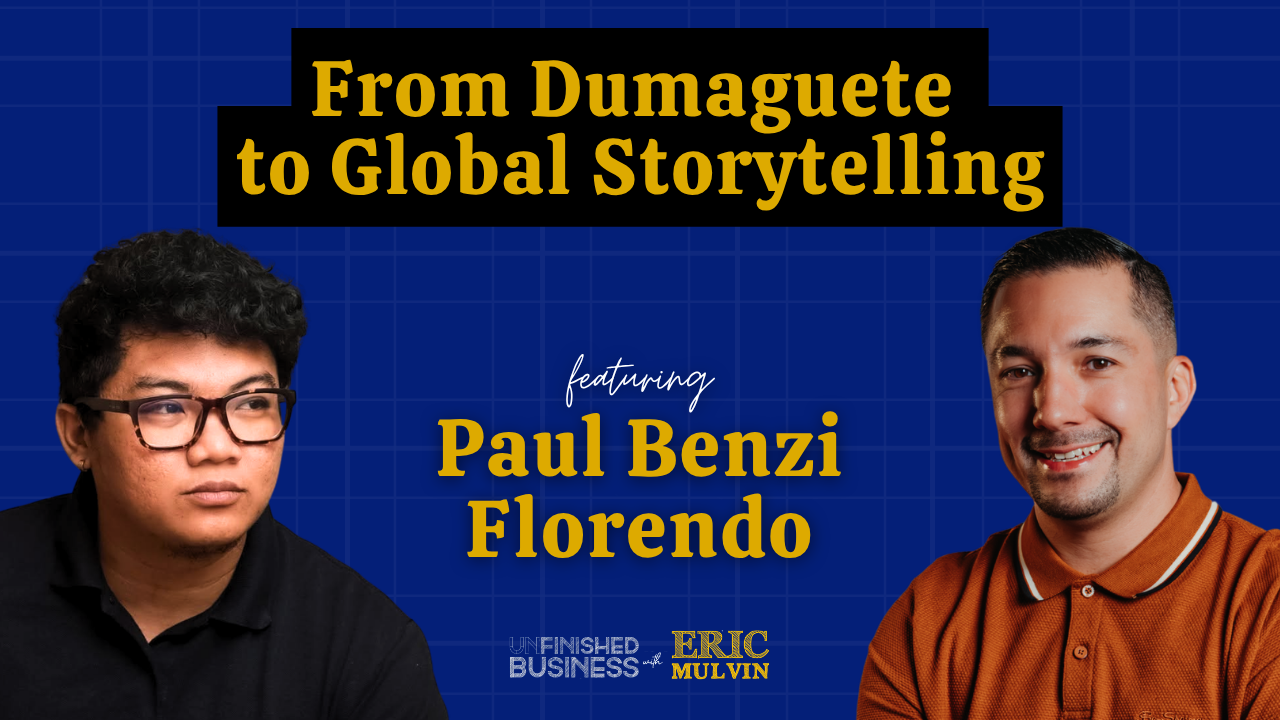
[Creator Series] From Dumaguete to Global Storytelling | Benzi Florendo




What happens when a kid who loves drawing grows up to tell stories seen by millions around the world?
In this episode of Unfinished Business, Eric Mulvin sits down with visual artist, photographer, filmmaker, and storyteller Benzi Florendo to explore his remarkable journey from growing up in Dumaguete to creating content featured by the BBC, LA Times, ABS-CBN, GMA, and major international brands.
Benzi shares how a love for art started at age five, why Dumaguete became a breeding ground for creativity, and how a simple downhill race video unexpectedly launched opportunities beyond his hometown. He also reveals his philosophy of storytelling, why emotion matters more than equipment, and how documenting authentic human experiences has shaped his career.
Whether you’re a creator, entrepreneur, artist, or someone pursuing an unconventional path, this conversation offers valuable lessons about curiosity, persistence, and the power of telling meaningful stories.
Episode Highlights
00:00 Welcome to Unfinished Business
Eric introduces the show and today’s guest, visual artist, photographer, filmmaker, and storyteller Benzi Florendo.
02:15 Growing Up Between Manila and Dumaguete
Benzi shares his family’s move from Manila to Dumaguete and how the city shaped his upbringing.
05:10 Why Dumaguete Captures People’s Hearts
The unique culture, lifestyle, and charm that make Dumaguete one of the world’s top retirement destinations.
08:20 The City’s Artistic Influence
How Dumaguete became known for artists, writers, and creative thinkers.
11:15 Discovering Art at an Early Age
Benzi’s first experiences with drawing, poster-making contests, and creative expression.
14:00 Choosing Fine Arts Instead of a Traditional Career
Why he pursued creativity when many peers followed more conventional professions.
17:20 Falling in Love with Photography
How experimenting with his father’s camera sparked a lifelong passion.
20:05 Becoming a Multi-Disciplinary Creative
Why Benzi embraced photography, filmmaking, murals, graphic design, and digital art.
23:10 Learning by Saying “Yes”
How taking opportunities before feeling ready accelerated his growth.
26:00 The Downhill Race Video That Changed Everything
The story behind the viral project that opened doors and expanded his career.
31:15 Why Storytelling Matters More Than Technology
Benzi explains his approach to creating emotional impact through visual content.
35:40 Capturing Authentic Moments
The difference between taking photos and telling stories.
39:10 Creating Content People Can Feel
How emotion drives memorable photography and filmmaking.
43:30 Building a Creative Career Through Curiosity
The mindset that helped Benzi continuously learn new skills and adapt.
47:00 Lessons from Working with Brands and Public Figures
Insights from collaborating with major companies and influential personalities.
51:15 Creativity, Community, and the Future
Benzi reflects on where he’s headed next and what continues to inspire him.
Follow Paul Benzi Florendo
Instagram: https://www.instagram.com/paulbenzi/
Facebook: https://www.facebook.com/paul.b.florendo
LinkedIn: https://www.linkedin.com/in/paul-benzi-florendo-b4581923b/
Follow Unfinished Business with Eric Mulvin:
Instagram: https://www.instagram.com/bizwitheric/
Facebook: https://www.facebook.com/profile.php?id=61560126743830
TikTok: https://www.tiktok.com/@bizwitheric
YouTube: https://www.youtube.com/@BizWithEric
LinkedIn: https://www.linkedin.com/in/mulvin/
Powered by Pac Biz Outsourcing
Pac Biz Outsourcing helps transportation, SaaS, software, and eCommerce companies scale customer support and back office operations with dedicated teams in the Philippines.
Learn more: https://pac-biz.com
Email: info@pac-biz.com
Podcast: https://pac-biz.com/podcast
Transcript
Eric Mulvin: 00:00
Welcome to the Unfinished Business Podcast. I’m your host, Eric Mulvin, and this is the show where we sit down with CEOs, leaders, visionaries, and creatives who are out there changing the world through their business, through their leadership, through their creativity, or through their organization. Because it doesn’t matter who you are or what you’ve accomplished. Even someone like Steven Spielberg still has unfinished business intelligence movies he wants to make. And so we explore those topics today. Today’s guest is a Dumaguete-raised, Manila-based visual artist, photographer, filmmaker, content creator, and visual storyteller. With over 14 years of experience behind the camera, his work has been featured by the BBC, LA Times, ABS CBN News, GMA, and other international media outlets. He has collaborated with brands such as Sketchers, Levi’s, Xiaomi, and Axor Helmets and has created content for some of the country’s well-known personalities, including influencer Mark Striegel. He is also part of the Group Brand Ambassador for At ADNOC Voyager Philippines and the co-owner of W Studios, an upcoming creative studio set to open the world. Through his work, he continues to document and telling stories, cultures, and communities across the Philippines. Please welcome to the show, Paul Benzi Florendo, aka Benzi. Alright, thanks for being on the show. Excited to have you on here. And impressive resume, I do forget to times, uh, all you’ve accomplished here. So uh we’re excited to have you here. And uh for those of you who are listening and are wondering what is all that background voice, uh, maybe you’re not watching. We are live, really live in the park here, uh, on the boulevard in downtown Dumaguete. It’s Sunday night, as with you. Didn’t expect this much. Yeah, we’ve got karaoke over here. There’s a live band over there. There’s dogs barking. So, but we wanted to bring you some of the life about Dumaguete, and I thought it’d be fun uh to film here. So at least some feedback in the comments if you like this, if this worked out okay. I’m curious how it works, but just wanted to start with that. And I guess a little background between uh Benzi and I. He is uh he had worked for Pac Biz for a couple years, and I feel very fortunate that he did spend a couple years working with us. He was our first hired after COVID started, and he has left a lasting impact because even though he hasn’t been at Pac Biz and he’s moved on to Manila and uh green in pastures, uh we have the gigantic mural every time you go upstairs to our office on the second floor that he put together, and uh we do work uh on projects from time to time. So um with that background, yeah, we we have a little bit of history together, but I’m gonna stop talking and I wanted you to talk a bit. You know, you’re you’re born here, right?
Benzi Florendo: 03:28
Like I said, I can’t be born in Manila. So like the place where I’m in Manila right now, like where like it looks as funny, it’s like where I’m born in Captain City, and like back where I’m born. Wow, crazy. Like all the cities in Manila is like Captain City. Like close to where you grew up? Yeah, like close to even where the not really close to where I grew up, uh close to where the my the hospital was born. Oh it’s like this right there.
Eric Mulvin: 03:54
Yeah, crazy how that works.
Benzi Florendo: 03:57
When did you move to Dumaguete? So I moved to Dumaguete when I was three years old, so um kept flying back and forth with my mom and dad based in Manila for a while. Then my dad’s family was from Dumaguete, the rest of his brother and sisters were in the US. So he was the only sibling here, so he had to like take care of like my grandparents back there. So we had to both like here in Dumaguete since I was gonna three years ago. I’ve been here till um be the college line.
Eric Mulvin: 04:30
Okay. So most of Duma. Yeah, absolutely. Okay, so the people who never been to Dumaguete, which is probably most of the listeners to the show that are all over the world, tell people a little bit about Dumaguete, because I I could try to talk about it, but yeah, you moved here for many years. What’s this place all about?
Benzi Florendo: 04:49
Like first in the mind when you ask about Dumaguete. It’s like according to the forums or like even the articles, like one of the top twenty places to be married. So like right now, it’s like yeah, there’s like a lot of different people from around the world like living in Dumaguete. So growing up in Dumaguete, it used to be like this really small late backtown. So we called like we called like the main city like downtown, Dumaguete. That’s where like we have just one really small hall, flaza. Then we had this like function of boulevard where we’re at right now. It was really like simple. We I remember back then we could ride on Kalesas, those force carriages, should we call those? I still see them around here. Oh I still reach that part, like get paid and say, okay, bring me home around this area. I didn’t know that they went off the boat. Yeah, like it wasn’t just like a tourist attraction, sort of, but I could like have a so that’s like a fancy way to get home. Yeah, it was basically that and yeah, pedicam tricycle. And aside from that, yeah, the simple life. Remember, you could see like lots of you had lots of green, like lots of plants, lots of different insects. So it was really that that like compared to what they see now. Really different. We have Starbucks, but we can do a lot.
Eric Mulvin: 06:29
Uh yeah, that’s true. There’s a Starbucks here. There’s several Starbucks here that you can’t hear about Jerusalem. Yeah, so it’s really good. All the chains are moving. Um what’s the charm?
Benzi Florendo: 06:41
What what why do people why is it one of the top 20 places in the world that retired? I think it’s charm is they actually magenta comes from the word baby, which besides means like the capture. Because way back then we have this huge bell tower right or left here, and um it would they would use it to warn people when pirates were coming in. But like in a way, it sort of like captured like fast forward to like quantum times, it sort of like captured people’s heart figure. It was laid back, but you basically had everything like you can like live peacefully if you needed like uh stuff for your daily needs. But then like to like what do you call it? Like it’s city life, but it’s not like many other sticky like big city life. You can have all you need right there, it’s still like lots of my friends who like been traveling like backpackers, like living here. Now I know one of them like haven’t even like restaurants, so yeah, they made it to me.
Eric Mulvin: 07:48
So they traveled around the world backpacking, and they decided of all the places that we’re right here. Yeah, and they set up shops, started started businesses, and are it’s part of the growth of the city. It’s been uh pretty interesting. I’ve been coming here since I was little. Yeah, I was like, well, I know I was a baby when I was brought here. Maybe and they’ve been coming here ever since, yeah. I’ve I too have seen a lot of it growth. But you know, you you talk about it’s funny that we’re Daga to capture, yeah, and you know, your background as a photographer or videographer. Yeah, yeah, yeah. You’re out there capturing stories, capturing moments on film, on uh on digital sensors here. And you know, this city is also known for its uh artistry, the artists that are here. In fact, right over there is one of the shops where I always love to stop in and see, okay, there’s all the local artists that are featured there. You could buy postcards, you could buy posters, t-shirts, a little toys like unique. Usually you go my my the thing I love, and it’s always a challenge, whenever I travel, my wife and I look for like what’s some souvenir that we could bring back that’s unique. And after traveling so much, you realize there’s a lot of stuff that’s like I can go to the Philippines and get the same little like sea turtle shell, yeah, and they stamp Cebu, they stamp do the Dumaguete, they stamp you can get the same thing all over the Philippines just with a different name. Yeah, that to me is not very unique. Like a store like that, they feature local artists and they got super unique stuff. And one of the artists featured there is Benzi. So, but there’s like dozens and dozens of artists that come.
Benzi Florendo: 09:30
Why how does this place end up becoming such a such a place for artists even like even not just like artists, even like litigant, like right nurse, like we’re named like one of the in this old heritage. Yeah, that’s where they were named like one of the places like for literature. I can’t I guess the case of it’s like cloud like now coming from Manila, from uh like a busy city, like experiencing Dumaguete again for like three weeks, I’ve realized that it’s really laid back, like there’s a lot of time for you to just like think and do art and just like you don’t have that much of anxiety about you know trying to get into traffic, trying to like get into work two hours before just to get there. So it’s just again, and also nature. I think we’re really close to like nice um mountains, nice rivers, falls, and just like natural stuff. So yeah, I think just be in a laid back city and then have it worry about a lot of stuff.
Eric Mulvin: 10:37
Alright, and what got you into this creative world? Because uh Doomageti is known for the universities here. You could have studied anything, you could not nurse anyway, engineer while why did you get into this creative world with?
Benzi Florendo: 10:56
I think it started really, really loving. Like I remember my mom keeping like um a pizza group when I was five years old that I have it. And then I went into like elementary and high school joining like before elementary was folks are making contests was like a big thing could like I could earn or win like 2000 pesos back then. Alright. So um yeah, I like that really like on my creativity. I never knew it could be like a professional way or like a way to like make a living up. So um yeah, fast forward to college. Uh so happened to fine arts open here and growing up seeing much of work for heroes. It’s like okay, I’ll try this way to school in South Mexico and other places. Partly because maybe I was like scared to get in another place back then. Can’t imagine myself, but yeah, so that’s it. I realized that okay, I could learn fine arts in a educational manner.
Eric Mulvin: 12:08
Okay. And you some people just stick with like one medium, maybe just photography, just painting.
Benzi Florendo: 12:16
You’re kind of all over the I think yeah, I started learning, not really learning, but playing around with the camera when my dad had this um camera back then. I forgot the friend. I tried the cash out, it’s like a calculator brand because we like play around, but not really like uh never learned it formally because back then we didn’t really have looks so hard to come by. So I was like, you know, picking and I I enjoyed like just documenting life. Like when we hang out with my friends, I would always like be the guy taking photos like just a little blue, have like and even they even realized that they’re taking photos over hangout. So that’s where it started. I never saw myself into like graphic arts because I knew I was always like no at the chain and like and be like really strict just to be painting, nothing digital. Fast forward, I did the opposite, I’m like doing more digital stuff, more graphic arts. I guess it’s just me wanting to learn more of stuff that I don’t really know. So some people like ask me before, like hey, did you know how to look things for sure? I’ll be like, Oh yeah, I do, but I didn’t really know how to. So it would force me to learn something here. And also like just being too magetted, the resources we have here craft it is really, really like bit how much. So it gave me an opportunity to just really learn as much as I can. Yeah, there’s not much that’s like okay, that’s cool, I’ll do myself.
Eric Mulvin: 14:00
Like, oh I’m gonna try it. Yeah. So at what point did you like how old were you when you decided like this is gonna be my um career profession is to do art?
Benzi Florendo: 14:15
I think when I was in college, yeah, I used like fine arts, but it was more of yeah, it was generally fine arts, it wasn’t like a specific media, so I had the taste of like making photography. And then I met this guy named Kirsty, like who did murals. So I like just volunteered myself to like learn. I wasn’t doing it as a working student, like I’m gonna learn that. So I think in transition to like when I graduated in college, I just hung out with him a lot that when he did um projects with photos, they also like to with him. So then that’s where it started, yeah. Um I decided, oh they I kept also very strong of doing what doing something I love. But it wasn’t really easy like I had to really go out there and do something that uh gave me opportunities to like do the stuff like a lot of like yeah, doing stuff for friends and doing stuff that uh exactly here on uh the downhill part. Like my documented that hey, wanna do something like this with it’s like a really unique wooden downhill part race how people actually want to documented and like they were like hesitant or something. So that’s what that sort of like helped me uh go out there because before that I was like just hearing them again, so that video sort of like put me again people out because it’s a little video. Maybe we can like have people over here and there.
Eric Mulvin: 16:04
So that moment was a pretty big yeah, so not just a moment, but also getting out of great story. I’m sure that’s what uh put together something. It wasn’t just a story, right? Like what I don’t actually introduce talked about storytelling, and I think there’s a big difference between throwing some clips together and actually telling a story, right? How can we what does that mean to you like storytelling and when you’re out for capturing an event for capturing?
Benzi Florendo: 16:52
Yeah, I always train even like when I capture like simple events, I always make sure that anyone who views it feels the same way as I felt or like one and everything feels like or like really happy. I make sure that they can’t feel that they can also and that has always feels my like sort of like core value stuff. I don’t just like take pictures and especially like an event where like someone’s speaking and like it’s really hard to capture that the perfect moment where they’re like smiling and they’re speaking. So I I always make sure that they still look good. Even though it has to be because I know um I perfect some photographers, they just don’t like capture. And sometimes you know the face of the kid. Yeah, it’s like okay, that’s there you go. I did my job. But no, like I really want to like even simple photos has to be like a story that uh can be told. So that has always like uh been at me ever since then. So you had some kind of entrepreneurial spirit here because you did that, the the race downhill race influencia, and it sounded like that started opening up some opportunities for yeah, so because of the down like unique downhill race, like the video like honestly my death video I never from it. I didn’t even look credits. But there was just like one like one part with my name in it, but it was like sort of like that credit scene. So then I uploaded it and I think one guy on Facebook downloaded that video from YouTube and uploaded in his personal profile, like not knowing anything after right. Just because he literally liked the video so that um I think the few things or few weeks after while my friends were like Is that this you had the video thumbnail? Like me like falling down from a huge jump like wait a minute, it’s that’s good. There’s like thousands of views and like millions of views like if you like all them together. So then yeah, that’s where like BBC came in with like uh uh just Henry Golding, the guy from Pittsburgh Actions. So he came all the way here just for that. Like other people, like producer from Red Bull did like uh the highest job of space, like a sky jump. So they were like, I was like so surprised like. So they were reaching out to you? Yeah, they were reaching out. I was like, who’s this guy? Like uh they were like, yeah, they were reaching out to like come here to like build that.
Eric Mulvin: 19:24
So that yeah, that was really like surprising for me, like coming from like a small down and you can get in and just like that’s really fascinating, because not too many people get to experience uh interacting with such big media outlets. Uh I mean how how much confidence did that give you in your creative career?
Benzi Florendo: 19:47
Like honestly, even for a long time, uh there’s this thing called imposter syndrome. Yeah. So I’ve always had that sense even like I mean this sort of like conquered years back. I always had that kind of like fear that yeah, these are just opportunities, but yeah, I’m just still this guy is gonna get I don’t think I’d be like like go anywhere. So but yeah, like but years later, like looking back, that’s where like well, that’s like this guy is like uh big celebrity now back then he wasn’t. So like I didn’t know he was he was the one like serving like making jokes like uh I’ll give you rice if you don’t serving rice as a big celebrity. So uh like it always came back, like you never know, like in those moments, like in the future this this will be like a bigger Ripple effect of that. So I guess I just had to like continue doing what I really love. And like also like aside from this what I love, I also like to like really make people happy and like even if like the job isn’t paid or like uh or just have a small business group, I think one of the most rewards is like seeing like a change or like the other happy or a business or happy. A simple video that they did.
Eric Mulvin: 21:14
So even for not yeah, I mean there’s there’s so many deserving businesses that don’t even know well uh marketing’s a crazy world, right? Like making videos, I always like there’s everyone’s been in business, like has had some weird experience with like someone that promised them something marketing-wise and then they didn’t deliver. And so you probably get people that are like, Hey, I’ll make you a video, and they’re like, I don’t have money, and yeah, and like, no, no, I’ll I’ll that’s crazy.
Benzi Florendo: 21:45
It’s hard, especially if their business is like, for example, like a family business, and you hear their story, their background, like it’s really, really nice. They start from nothing, that they’re here, that they’re potentially, that they’re really struggling, and just they just want to survive because. They wanna like keep their blades like they they still wanna get blood shot trap. So like cut their budgets like this like so like that’s where the strong comments is where like I don’t want to really help them like I don’t want to also like really like uh make myself like put all my energy there and like have that for me so that I think that’s like my weakness or everything like that But yeah still I still feel that that you when I see like the potential of the business are I would myself every day someone Yeah it’s like uh it’s like uh yeah and there’s if I mean if you walk around the city for a day you could probably find five stories or more like just through your inter everyday interactions and talking to maybe uh some a new comic shop that we can have and you start talking with you go to the market on uh Wednesday on Sunday, you know, and you’re like, oh check out this this new up and coming like food vendor that just started. I didn’t know how to determine uh what stories it yeah I think like being an introvert since I was a child I think for me being a photographer and a photographer sort of like change that sort of become like uh extrovert and introvert so I never heard the word but so I know a lot of people in business that are introverts but they have to they have to be an extrovert.
Eric Mulvin: 23:48
Yeah but they’re really introvert, you would never know it. It always shocks me like no tell myself like oh yeah yeah I can see it.
Benzi Florendo: 23:56
Yeah so something like that. So like being an introvert, I’ve learned to really be really observed. So like just being quiet and just like observing around things. So that’s when I see an interesting story, and especially if it’s unique. And people like each of us has different uh point of views, like I can tell this story I can tell the story story that’s what’s a different like point of view. So um I think what I always see is that some judgment, like like care, that’s where I like the that’s the time uh scale of things like if I see that uh generated uh someone like that with the fitness. I see that pattern they have for their business. Um that’s when I like and recently like the clipping in the like just uh lipping here to make it easy to like film compared to like other things that we can just like film on the role, you know, it’s all that so that’s how we learned also black players. We went back to it. Yeah. Like maybe like shit like that would do it. I mean that could you throw up.
Eric Mulvin: 25:18
Yeah, well, I mean yeah, I mean I did my I started my film stuff like in college and I didn’t know anything about permits and like my one of my first short films I filmed inside of a we filmed several scenes inside several grocery stores. And we just went inside and started shooting. I pretended like I was a worker. Okay, okay. We did another one that was like behind the scenes inside uh an Asian grocery store where we were filming workers like with hidden cameras and had no idea that.
Benzi Florendo: 25:47
They were like, hey, are you guys filming or well we were trying to be quick?
Eric Mulvin: 25:51
Quick, okay, like we and I figured in the Asian store, they’re not gonna care. We we went a little like camera, we had a crew of people. But yeah, I mean, as we once you started to get professional, yeah, like we like one of the last films I did for that 48-hour film fest, which you also we worked together on. I didn’t do anything. You put together a film here and didn’t get to it and place in Arizona, by the way. Uh but yeah, that’s where we started running into like, oh, this is like a you gotta coordinate schedules, people, equipment. We can’t just go film in this location because they’re gonna kick us out. Yeah, yeah. Especially when it’s one thing when you just walk up with one camera, it’s another thing when it’s a equipment truck and people notice it’s like a cart full of audio, but then it starts becoming uh problem. So yeah. So have you run into issues in Manila where you’re like there’s something you want to film and you’re like, oh, if this was Dumaguete, I would have just gone and shot. Yeah, and then you realize no, I gotta this is gonna take more. I think.
Benzi Florendo: 26:57
In a business sense, it’s it’s more like the sketch here is gonna be like has to be this deck that magete could be like, you know what? Let’s shoot it the next day. So okay. Or like it’s gonna be a bit late or something like that. So it’s or yeah, because everything’s near here that you can just reshoot it next time. Or down yeah, so that’s when you’re shooting it with red. It’s like wasted yeah, it’s like a travel car, so yeah, yeah. So a lot of like aspects of that. So I think if I get the get the second uh there and you’re filming it there, and you could you could probably film different in different locations in one day. Yeah. So that’s that’s how it’s like right now.
Eric Mulvin: 27:58
Some cameras and here we go. So I I want to dig into some of the entrepreneur stuff, since this is a distance show and you you’ve really created a living for yourself in uh in this space. Who whether it’s employed uh to the company, doing creative work, uh, or just freelance, you know, doing your own projects along the way. What were what was one of the what was the moment where you really questioned, you know, if this is the right move for you? Like maybe maybe making a career out of the architect is anything. Is there any moment for you like that?
Benzi Florendo: 28:41
I guess it’ll probably be like pre-pandemic and after the pandemic. So like the challenge I had before was all the projects I did here was like happening. A lot of times it wasn’t really like something like that. They were not a lot of businesses were like used to having like advertisements. And if they did, they’d use it for like I know. I just met one restaurant, yes, a few days ago and it was like still used your head since like of course like uh probably 2017.
Eric Mulvin: 29:22
Oh like nine-year-old videos, yeah. So it’s like shows you how good the work is. Yeah, yeah, thanks. He doesn’t need any more videos, he’s sad.
Benzi Florendo: 29:31
So they just shot another one like a few days ago. So like yeah, like pretty much like how they do business here, tech with uh partition uh because uh advertising. So it’s more of if you wanna do video work or photo work, you have to do it. It’s just um yeah, not like like it’s not wrong, but for me I really want to push like I wanted to do documentation. Like it gave me joy to have business like with this. I did a video for like helping like sales or something. So that sort of like feeling from that like helped me a lot compared to just like weddings are nice, but sort of felt like it was like you know, not like it here, like the same thing.
Eric Mulvin: 30:23
Alright, well you were talking about documentaries, and I know there was a a project that you risk your life doing. Oh yeah.
Benzi Florendo: 30:34
Yeah, uh I don’t know if uh is it it’s not really released publicly, right? No. So that yeah, actually my question sort of like relates to this one. When like when did I decide decide to like or when I was like questioning like if this was really for me? So yeah, yeah, when I was doing all these other videos, uh actually alternative was like, are you sure that’s what you wanna do? Like just the a jumbo manila or uh just like uh jump up sound. Yeah. Yeah, yeah, it’s like I don’t know why you have this dream, like I wanna like do this and like maybe like give opportunities so I know like kids like me into my candidate who don’t talk that much and like you know, do something. So it’s like also idealistic back then. So moving forward, like yeah, there’s people who talked with me, so it’s like I wanna do this crazy project, like or like it the project came up from Giraffe. I met this guy uh and he’s like you wanna stay with me and document this um film like sailing from the Philippines to Australia. I’m like, yeah, this is hypertaining for people that you know passion can like my passion for video could like you know help me out. Like if I can prove them then I’ll not just be death to that extreme.
Eric Mulvin: 31:56
So yeah. So yeah, you you agree to go on this. Are you allowed to talk about this?
Benzi Florendo: 32:03
Yeah, I think it’s actually something where I didn’t really have talking about this earlier. Then I guess being someone from Dumaguete, we don’t really have that much work here. It’s here like if you’re in Manila, everything’s there, like man, like the film industry is there, like everything’s there. So like if you’re starting, like you have lots of opportunities like but here in Dumaguete like you really have to like work uh like 50 times or 10 times just to like even get LBs. So like uh Yeah, so like when the opportunity gives like to be able to travel to film and to be part of like something, so it’s like yeah, it’s like this go fast forward. We didn’t really ex get the uh film we expected, but sort of like ripple or like build up in the character that you know I don’t have to like really I just have to like just do and like just do it consistently and you really get there and really push yourself out there when you’re assistant in what you love here, it’s like no world. Because I did a lot of stuff but I wasn’t even showing it. So it’s like how can people discover you and no matter how good you are, like I can be like the best painter, but I can just like my uh painting in my room because no one to see it.
Eric Mulvin: 33:37
So putting the work out there is an important part of being an artist, is what I’m hearing.
Benzi Florendo: 33:44
Yeah, and what at what point did you learn that lesson? It’s funny because I’ve been around people who are living like one of the creators, like more like TV hosts, and they’ve been like putting their work out there, even like artists, like they’ve been like it. And I guess it’s the interpreting me, like you know, I’m I’m waiting for the perfect time like waiting for maybe if I have a better camera, or maybe if I have the other thing, I think um myself for like maybe like honestly like I just sort of like put myself out there recently, like a few months back when I tried making content for myself. Um I tell people like I haven’t I’ve done this for two years, but if you go to my Facebook, I have actually advertised even myself, like I’m like good about like talking about other people’s business, like I never realized I’m in business. Yeah. So that’s like a few months back. That’s when I like started making like motorcycle content, which I never knew I would like reach a point to where I would be making motorcycle videos.
Eric Mulvin: 35:07
But it’s been wildly successful, right? Like, so you just started this a couple months ago, and I I think this is really interesting for people to hear this watching because there’s you know, business owners are trying to build their brand online, and a lot of people struggle, you know, like you think maybe you’re like, oh, I could make this viral content, and then you start making posts and you’re like 20 views, yeah, you know, 50 views. But you were able to actually you went in with a really specific purpose. And because I mean, why motorcycle content?
Benzi Florendo: 35:44
Was that a specific uh passionate about it? Actually I just started riding motorcycles just recent like throughout a year for year thoughts. And I didn’t make content just because of uh basically because of motorcycles, but it just so happened that I was just making a lot of videos, full videos not riding my motorcycles with my friends. And um yeah, like going back to struggling, like that’s when I realized that why don’t I like if struggling is such a big thing, or even uh mid-chaners, uh even like some of my clients with their business and so many videos, why don’t I just like show struggles? Like highly marshals also what inspired me was like when I posted a photo of like uh me falling down the bike and stuff, like some someone from our someone anonymous from our group was like what you felt down like I I’m so good, I don’t I don’t need to fall back by inspired me to make a video of the falling down matter how much you fall down, you always get back up and twice too much in a like how you know you just have to like do it one step at a time, so I made that video so if you go to my Instagram I always like sort of like post once a year. I created the account and even working air with you before you’re like showing me like uh you were posting the system you showed me like I remember that video you showed me like millions of views and like I was always saying, no, I just have to post it like and I was myself, yeah, I don’t want to do it myself. So I kept telling people yeah, post and they were like doing it and I wasn’t doing it, so I was like, Yeah, I’ll just do it. I’ll do my own voice over it with the sky of cringy testing and editing my own voice. And fast forward for like three months later, like I was happy with watching from like uh Instagram profile was like 1,000 followers. Then like sort it sort of like being engagement and not like going 80,000 views with like hundreds of comments from around the world. So it’s like surprised like people like making them comments like oh yeah, I could relate so much to the struggle. So like I was thinking like what if business owners make videos of their troubles? Especially nowadays, like when it comes to like social media, everybody knows the post stuff and I can even relate to that. I wanna like what the post stuff like people think about. So no one like shows like the ugly parts of like me falling down on the bike or like how hard it is to like start a business. So like if I guess if we start doing that, more people will be like, yeah, I can’t relate to that. That person can be So there you go.
Eric Mulvin: 38:47
Great advice from Benzi here. If you’re looking for content to talk about, start talking about your struggles. I guarantee if you run a business multiple times a day, you know, if you’re you will find struggles and you can go talk about them. And that yeah, being vulnerable is being vulnerable is definitely it’s an important leadership quality. So it’s not just like for your content, it’s also just like if you’re talking to your employees, if everything is perfect, right? Like what no one ever no one believes that. You know, they might listen to you, but really deep down, they know like nobody’s perfect. That’s the thing with AI too, which we’re gonna talk about in a bit. AI will help make everything look perfect for you, but it doesn’t have the real like AI is not gonna be able to make that authentic story about you falling down and how you felt like it’ll tell you you could say this, this is here are some feelings you might feel that you could talk about. It’s not gonna be the same as you, and then tying it back to like, oh, this reminds me of a time I was in Doom again. But like you know, so great advice, thank you for sharing that. And what doors has that opened up for you already? Just because you’re three months into this experiment finally listening to your advice.
Benzi Florendo: 40:12
And yeah, so I like when I started doing content. I w I had the goal of this and uh I wanted the brands that I looked up to like public without me like tagging them or hashtag. Personally, like there were brands that were cool brands. Well one of my friends because they were like a professional brand because one of the ways to get them up just and like use them and like uh get half of my story or folks or something like that. They were like for the story. So then I was surprised when I started that the brands like saw them organically, like started following me. And like um so then later I it opened doors to meet meeting with friends and like the horse like community, like I explained I was like this, you know, like doing it just for the like uh like an escape just for like but not really like uh unfortunately like for get to know other people, like beyond the driving or something with the business like I met other entrepreneurs, other like filmmakers, which them introducing my work like hey this is like now I have like brands like more than a couple of brands, like I working with them. Yeah, that one of the oil brands drop uh the Beatle piece where they’re like getting a screen with the stuff. Yeah, it’s like it’s like small width or awesome.
Eric Mulvin: 41:42
So do you have any goals of where you wanna see that go? Is it the future motorcycle content or is it more storytelling and taking it to the next level?
Benzi Florendo: 41:53
The point of my content is like I have recorded a lot and I actually even still have a backlog of like of of videos that I haven’t done, so like I still have to do those, but I think I wanna put this part of like funding creation is like just experiments I could use for other like businesses, like hey, you don’t have to have like uh a million followers to like get all this. You just have to like think of system, just be honest with like what you do and make it relatable to people so like so that they’ll find value to be honest. So it’s sort of like an experiment that’s like uh for me like learning like okay how much people can like like how much have they like watching that real 60 seconds real and like seeing a lot of like me and okay that works so it’s sort of like not just a bit for the sake of like me and out and content, but also in the business side, like okay, this could be like uh like a five for other yeah, that’s like one of the things it might be transitioning to like life stuff. It’s just like experimenting. For me, before I wasn’t afraid to like it’s gonna be like just this, this is just it’s gonna pay for the experiment. It’s like me before I never even knew I that starts to engage me earlier.
Eric Mulvin: 43:21
Alright. Now, a lot of the stuff you’re doing now is partially possible because you did a big move. You know, you have your family, you’re married, you got kids, you’re raising the family here, then you get up and jumped up and like moved out to vanilla. You know, it’s you you had talked about a little bit earlier with all about kids are. I mean, it’s much like you know, for people in the US, you know, if you want to do film, go to LA. That’s for all the actors, the talent, the everything there. The studios, producers, all that. But what drove you to
Benzi Florendo: 44:07
Maybe I could I didn’t really know that’s funny. So Yeah, this I think it just should be doing something or just being out of my comfort zone. Like Manila is one of the places like uh even at Sky was like I’m never gonna do it I’m never gonna need to get traffic, everything. But then yeah, I was like, yeah, okay, I’ll go to my I’ll be there for a year and come back. And yeah, I think just seeing the opportunity, like meeting even the people I look up to. Like I would always want to join workshops and that, but it’s like so hard to pick flight to Manila. But now it’s just like oh well, the workshops is like here by a few months. Or yeah, meet the people which find a meeting so like the opportunities just like fair and I guess a goal would be like stoppage and stuff and like just surface goal or like a stoppage bike draft, like for stuff right and stuff. I would talk about it. I’ve been doing the character.
Eric Mulvin: 45:31
Alright, we’ll explore that at the end. My last question. But you know, we talked about your journey getting into creativity and the arts, and then up to now where you’re at Manila, and a lot has changed with art. You talked about it too, like before you’ve got camera, uh film, and then now everything’s digital. And there’s debate, a lot of controversy with the use of AI in in either in art mostly. Content creation, I think people are pretty accepted. Like, hey, there’s gonna be some use of AI. So and and I have this theme of AI plus HI. You know, AI is great, but you gotta have the human intelligence part brought into it. But art is where it gets a little tricky. You know, I do photography, yeah, and for me there’s a limit. I’m not gonna, you know, like if this was a picture, you guys watching live, I’m not gonna digitally add, you know, like hot air balloons, and you know, maybe some jug rules trying to make it look like there’s some authenticity there that I feel like I’ve got yeah, I’ve got some limits here. But uh talk to me about that. And uh the the like the use of AI and where do you for you like where do you draw the line? What do you what do you feel like the limits should be for AI and creativity?
Benzi Florendo: 46:58
I think if you’re like in the artist side, if you’re a real artist, you’ll know when stop or like how you’re gonna use it. Like for me, like the contents that view like made, a lot of that uh was things too, like AI helping me, like like what I do is like I ask AI to help me tell a story or script, but I like we did a lot of stuff on my own, that’s for like AI plus yeah human. But then um I looked then I hey direct this, do this. It wasn’t just like hey, make me this, okay that’s good. I’ll use that. So it helped me like sort of like jump start like concentrated process instead of me just like especially um like maybe created block or you’re just like too tired and stretched before it’s not good. So like that’s where AI function, like the parts that you’re not so good at that you like sort of eat it. So that helps with my content. Like, okay, help me this and that, like help me make a stick for like 60 seconds like they don’t go beyond that. So that’s how AI works and it comes like hard. It’s funny how like when you pull out and station and like they know that’s AI slob. Yeah, they like know like when it’s AI like a poster, like I even saw like a post a few days ago, they’re like, I’m not going to your if your ulcer makes me of AI because they know like you’ve not put your heart into it that much. Like there’s times when like AI posters, but like they especially when they you’re gonna stop this business that’s really nice part of it. Like I I didn’t let you know this like I got this conversation. That’s really nice music because it’s telling you like it was like really off. So people are starting to like sense like yeah, yeah, it’s about that’s not that way. So I do years back. Yeah. Yeah.
Eric Mulvin: 49:11
So you’re seeing a shift. Shift, yeah. This is an artist. What do you think that means for the creators that are trying to come up with anything?
Benzi Florendo: 49:23
You gonna look out more? It helps a lot. Like, for example, when I’m film filming, like I did this, yeah, for motorcycle brand, I did this. And so we I’m gonna film my at this admission, like to create this bridge in Manila. At the end, the guys are gonna like come there and the sunset’s gonna like like perfect. But then it is traffic and we didn’t know that road was closer. So we had we spent our like going through traffic just to reach a point. They were actually the the scene, the bridge was just like there. But since we can’t go in, we have to like go way around. So it was nighttime and this is that’s it. So what I did was like I shot the scene, like okay, I’ll just she doesn’t have you like coming in. Like with lines and like and then it was like after something. I had a photo of my inspiration, so I had AI like a time lapse of that, so just to like stitch it in. So that’s it. Like I didn’t like have AI to like first I could see quite so I think it’s AI could be like something like a supplementary that way. Not like a whole video of AI, although they can do that right now, but still we can sense the uh lack of artistry anyway, but serve like the spirit of the artist. So yeah, that’s all I use.
Eric Mulvin: 50:43
Oh, thank you for sharing, because uh I mean I I think there’s we’ve got a lot of business leaders on the show, you know, we talk about how they’re using it in their business, and I like you know the what you’re sharing about how you gotta bring your stuff to it, you know. And be able to talk. Bring your input. And not just take what it gives you, but also, oh okay, we need that change and add that. That’s what that’s AI plus HI. That’s how you guess that. Oh, we got a couple more questions here, we’ll wrap it up because I know we’re uh yeah, maybe we’re still good. We have 56 minutes, so we’re gonna try to keep it like around this table. Alright. So uh oh, one of the things I always found fascinating with you was like your I don’t know, it’s an outdated channel. Well with the people you know. Like, you’re always like, oh yeah, I know, and then it’s like casually mentioned like, oh I know this person and I work with them, or like uh I could connect you with this guy, and I’m not like it’s like oh this person’s like an LA Times photographer, they have a gallery in LA, or this person, you know, like the soon upcoming guest for the show, Ken Okazaki from Tokyo. I know because of this got connected with them on Facebook because of that, uh, would be a future episode. But like for someone that’s an introvert, you know a lot of people.
Benzi Florendo: 52:17
Let’s go with that. I didn’t know I think that’s like I know if it was a game character, that was like one of my perks. I guess like I guess it’s for me, like looking back, it’s like I like to give a lot of my energy to people, like sometimes like people can mistake myself people pleaser, but like like not people fleezer, like I just like I’m just happy with people are having like like even between like the LA types gallery owner when they were here doing a workshop, I was like we had a workshop before. I would like carry stuff like just like hey how can I help you? How can I think it’s easier for you? So I like to like be of service to people, like oh like if one of you was like missing an SD card, like hey Betsy, are you available? Can you like do me a favor? Bring me my SD card, weigh up in Valencia, I’ll be like, okay, I’ll do that. So yeah, I’d be I was just like yeah, like giving myself out there, although we can feel pretty like be taken advantage of stuff. I always talk to myself like that’s up to them, like that. Anyway, like as long as I’m doing good, and I just give myself out there someday. That’s why I tell people like why you always do this stuff for people and uh just the book someone and like no one day is gonna like might be someone successful and be like, yeah, that’s it, yeah. So something little can be like something bigger. So like, yeah, like for example, if I uh help this friend of mine back the pandemic, like I I was doing boxing stuff. This is very funny. So it’s like just just throwing out not even thinking of like anything like a getting technology that we’re playing in China that I’m working on. Okay, what’s it called?
Eric Mulvin: 54:13
So when is that happening? December. Okay, December. So if you’re in China in December and you want to learn photography, you can then uh that’s awesome. I mean that you do get to do a lot of travel considering from this little Dumaguete here. And uh and you built a great big network of people. And I don’t know, you you’ve done so much creatively. I I really admire like how you’ve been able to jump into so many situations. And like even though if you’re working at a gym in Boracay, you know, you’re still doing creative stuff for uh wherever you’re at. Uh like the murals that you’ve done, you know, around here. Uh it’s it’s a lot. So uh well, I’ve been trying to hold back asking this question, but I I think it’s a good time to ask this question here because you know you’re getting ready. Well, yeah, let’s hold off just a little bit longer because I I want to talk about some of the projects that you’re working on. So I know you were sending me pictures recently of your gallery or opening up, right? So talk to me about that. That’s a big actually I’d like to talk a bit about that. That’s a big step forward. You know, opening your own space. So that the first thing I thought about is how much is that gonna cost and air conditioning? Yeah. Either that or it’s just gonna be hot in it.
Benzi Florendo: 55:39
Uh so talk talk about that. What is what are you working on? So here’s the interesting thing, like work back to me just being giving my people, which led me to like, okay, this person. That’s why I can start by my business as a photographer and artist. Is that people were like just reading or talking about like word of mouth. And some of the people were like for me I was talking back then, it’s like, yeah, that’s like happy, but they were like even like the best word, like it’s like people trust you if they’re like want to work with it, they just like cherry. So like when I went to Manila, even Boracay like I never put myself out there, but like like um I’m like grateful that people like start like discovering me that just like we’re just off. So that um studio that we’re opening us to be like a kits playground. So the owners like a client of mine, so like someone shared like about me, so like they hire me. So I did content for the playground and other businesses they propose to like start like a studio business last year. They did not like okay, like I had lots of plans last year that did not put at 255. That’s like oh kid, maybe it’s just like meant to be but I was like really discouraged, but yeah, fast forward just like meant to be. So I always thought myself like as much as I want to be like um chapter, but like it’s hard to be an artist and mentor at the same time. It’s like if I was to choose, like even back in the day, like if you did art, then you did hard like art, but you didn’t do uh good for like income. Yeah, so it’s a hard ballot. So it’s like I I told myself like if I wanted to like start a business, I wish someone would like invest in me, knowing my skill and how I work and without me having to like shout out money. So then it happened, like we went to smart you manifested it. Yeah, like um and like um I kept also like praying, like, okay, just give me the right people. I’ve met a lot of people who would you know like they seem good at the time, but they like it. Often a lot of moments where I like I’m stuck and like even one more I had this 200 vessels though like why am I here? Why am I why why am I doing like questioning myself? But then I was like, yeah, just continue like doing good and giving your best for other people out there, and it’ll all slowly like now, like I haven’t really wrapped myself around it, but like yeah, we’re starting we’re opening up in July, and like I have to find like a photographer, and how can I find a photographer who it’s gonna be my grand person and they want someone who’s female because they’re both females, they’re like pretty strong business women and it’s like I have to find this, like where do I find it? And funny enough, someone like messages me on Instagram, like hey, I’m selling my camera, I don’t know you. I I on my camera, and maybe like maybe you would wanna buy it to help me like your photographer check for pay kit. Just like starting. I’ll be good. So like you wanna like work in a studio? So we could hire you, so yeah, so um and the cost-wise, yeah. We we talk about like a coverage target, we have like maybe like um earn 30,000 pesos a day, something like that for each. Yeah, I’ll try to make content like circle as uh just live up there, like I’m excited, and in the future episode I’ll come back to Manila and uh we’ll get to show that to you guys in the future time.
Eric Mulvin: 59:45
Yeah, we’ll do the interview there, Manila, and then get to see uh see how Benzi’s doing with that. But yeah, you know, you’ve done a mix of working for yourself, working for others, you’ve done politics, you’ve done it. You know, like what pushes you to try so many different like you’re all over the place. You know, and yeah, uh and and I think uh it reminds me a little bit of me. Like I’m all over the place too. People always tell me, Eric, you’ve got to kind of hit something on like no, I’m gonna do everything. Uh do you think though, like, because I know like in our work together, you know, we’ve tried a lot of things too. At one point you’re like, yeah, I’m gonna start a we’ll just start this whole thing where we’re teaching a bunch of up and coming. Which sounds like you’re still doing it. I got this up-and-coming photographer. But you know, you learn about what you love to do, and maybe some things you’re like, ah, you know what, that was interesting to experience, and I’m not gonna do that again. And I think that relates a lot to entrepreneurship too, where we gotta be passionate about what we’re working on, because if you’re not, like when things go bad, it’s gonna be hard to keep pushing forward. So, talk a little bit about that. Like, what what’s your motivation behind going into all these different places? Like going and following a politician for a year filming like all their speeches all over Luzon and wherever. Like, you’ve done some some interesting stuff.
Benzi Florendo: 01:01:18
I think it’s just my curiosity. And I’ve been like going back to Dumaguete, like having not so much like you know little here. I just wanted to try the shops like I was like a restaurant manager. I was like I I was a waiter one time. I even designed like uniforms for like a bang. So super random stuff. But I always thought myself they will people say like you know, Draco Ball trades master, but yeah, uh Draco trades master of itself. Okay. So I can do all this. And like but I don’t want to like do everything and be like, oh this that’s so good. It’s I try to be like good at everything. Like some people don’t know me as the uh photographer, they know me as the graphic designer, some people know me as an artist. That’s this. I never really put myself all this like you you do know me, and like I I’m like really grateful that the working is back with I guess like explore that as well. Like during murals, the videos, the variety shows that was so I mean that was like sort of like jump start with like the stuff I could do. I was like doing technology. Yeah, that’s like the curiosity of building stuff and exploring stuff and um yeah, going back to like not having so much resources, so me doing type of stuff. Yeah, so yeah, I forgot about that.
Eric Mulvin: 01:02:46
It they’re not public because it was like internal videos, but right when COVID started, everyone went before that we had everyone working during COVID. Yeah, because everyone was working from the office before we didn’t have work from home, it didn’t exist, and uh it was a big challenge because yeah, roosters crawling at people’s homes, the technology, the internet had issues, still has issues today, power challenges, but but we had no choice, we had everyone working from home, and I was like, Well, I’m gonna start a TV show so that we can keep everyone connected, and I think it was like once a month we came up with a little episode I think we do once a week, maybe maybe we were crazy like I’m doing that now, crazy it probably was once a week, but then we got it to like maybe 15-16 episodes, and then we shut it down.
Benzi Florendo: 01:03:41
Oh Phoenix. Yeah, some people shut this at home, some at the office. They were somewhere playing music.
Eric Mulvin: 01:03:48
Alright, well, it was a full-on show, and I think it was a lot of, you know, like just like you, like the stuff that you did led to other things. Like for me, that was a big like it’s something I’ve always wanted to do to just kind of like run some show like uh. So I’d I’d film all the like intro, outro clips, like in-between clips, and then I’d have people in the Philippines talk, we’d have a a band, different performers from Pac Biz do the ending song, and it were like 35, 40, like without commercials, yeah. If you put commercials in, it’d be like a 60-minute TV show that we were putting together. It was a lot of work. So that’s why eventually we had to end it. But we were able to connect everybody for you know, during a time where, like, especially here in New Baguette, the lockdown was so so restrictive. I mean they had police checkpoints here. And that’s one of the reasons why we couldn’t have people come to the office. They didn’t keep up with like motorcycle registration, and they couldn’t drive to the office. So like it’s either give them a laptop to work from home, or they can’t work. So we had some crazy stuff, but but that was like one of the early one of the first things when we first started working at Pac Biz, and then we just did so many video projects in there. He helped with the the first podcast, Contact Center Cactus chat, which we got to like almost 30 episodes again. Like, so even though Betsy’s not directly involved, he actually, I will say, designed the logo for the show. So his fingerprints are still still around here. That you know we’ve been able to work together, and I really appreciate uh that attitude of like saying yes to anything, because which is dangerous because I’d come to him with all these crazy ideas and he’s like, Yeah, let’s do it. I’m like, then what are we what did we get ourselves into? But you know, it’s that’s I always talk about entrepreneurship is a journey. You know, it’s just like uh you know the NBA championship, it’s yeah, it’s great for those few minutes after you win to like celebrate. But I’ve heard professional athletes talk about you know, like those are so fleeting they ha they come and go it’s all about the journey and we’ve had a fun journey together uh getting together and I still get to stay connected getting involved.
Benzi Florendo: 01:06:11
That’s what people don’t really get to see like the journey of it’s not although the products beautiful but I think the journey like looking back how we like did all this that’s like the stepping stuff to like moving R right back see like you start to get a butt gas another butt like this podcast like something maybe in that picture.
Eric Mulvin: 01:06:33
Yeah and you never know where it leads to which goes back to you guys and your business. Maybe there’s a new service you want to start maybe you finally need to get your business going and you want to go from working out of your garage to a studio work in mortar where now you gotta think about like oh I’ve got to pay for air fish and utilities and stuff on top of what you’re doing. But you’ll get to hear the story of Benzi as uh he as he makes that leap and where it goes from there and as you get to follow the journey with the podcast here. So well I think it’s a good time to transition to my final question that we like to ask from the show since this is called unfinished business and obviously there’s a lot of unfinished business but I’m curious if you have like a big goal that you have in mind. Like what’s what’s something that’s you know because I I know there’s something bigger than the studio we talked about Stephen Spielberg as one of maybe someone that uh could be an inspiration for you. But what do you want to be able to accomplish by the end of your career? When you know you mentioned coming back to Dumaguete one day when you made it and just be able to like what is that making it to you? What’s your unfinished business?
Benzi Florendo: 01:07:48
I think just having more like guides like me welcome like help less and like being that sort of like um a gateway to like other opportunities so like me going to Manila with me sacrificing my comfort here to begin the car line to maybe bring that here the city so I have lots of um guys that I thought before like for now and some of them are like even like big editors for Billport. And like before we were just like hey do you want to like come with me edit in this one laptop it share like one laptop and like our judge and like edit through that really slow laptop but now they’re like editing for celebrities and so like me having that joy of seeing them successful in their own way through how we started Little is like for me like I want that to be bigger someday. So like you giving me opportunities for the back miss is also like that for me as well. So like I also want to be that static software as well so like I know if I think you can get it or even so work that’s not 64 but I just want to be that yeah sort of stuff and finish their business.
Eric Mulvin: 01:09:14
Help other people realize what they’re unfinished business. Alright thank you for sharing and uh I’m curious like uh with everything that you could do like you you have a big wide range of like craft design photography videography controls for businesses you can do documentaries like what is what projects are you looking for right now that you would like to be able to work on and how can people get a hold of you to work on this um I think I wanna like I don’t want to look up into fake face.
Benzi Florendo: 01:09:48
I’ve like helped like I went home recently and I I still have one canvas hanging there blank canvas. Oh they have it finished so that’s my unfinished post. So and I bought new materials like a few months back for my kids like I never did that so I guess going back into painting the Google is a bit if they want to get in touch me at Instagram Facebook I get the search there and yeah what’s your tag appear yeah and we’ll get the link up online so you can connect with him and if you want to work with him shoot him a message.
Eric Mulvin: 01:10:32
That is super creative and guarantee he will not regret one. So well thank you so much for sharing some of your story on the show uh it’s been fun doing a live podcast in the park we had uh lights going off and uh all kinds of things unexpected happened with yeah rat ran by so you never know what you get on the show uh shooting live but thank you so much and for more stories like this make sure you look for our podcast Apple Podcasts iHeartRadio YouTube wherever you listen to podcasts unfinished business with Eric Mulvin and look for us on social media at Biz with Eric to keep up with all the new episodes that we release every Tuesday and until next time thanks for watching and we’ll catch you guys on the next episode see you later CEOs and visionaries shaping what’s to come building more than profit lifting everyone every path unique but it takes a choice to grow set your goals and shape the way your future goes for people attack connect to amplify human intelligence goals that launch you high close and you’ll learn why we’re