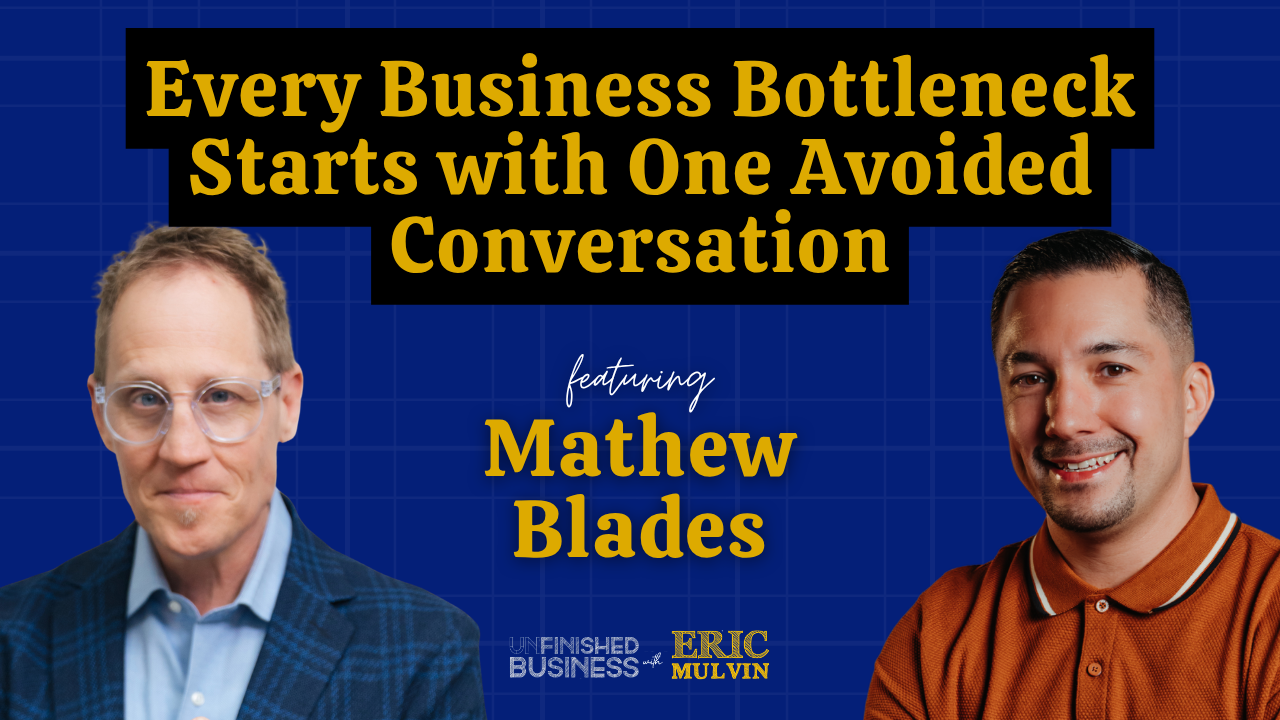
[Leadership Series] Every Business Bottleneck Starts with One Avoided Conversation| Mathew Blades




How do great leaders handle the conversations everyone else avoids?
After a 28-year award-winning career in radio and television, Mathew Blades interviewed presidents, celebrities, CEOs, and world-class performers. Today, he helps leaders build trust, improve communication, and navigate the difficult conversations that often determine the success or failure of a business.
In this episode of Unfinished Business with Eric Mulvin, you’ll learn:
- Why every business bottleneck starts with an avoided conversation
- The “Air Check” framework for improving every conversation you have
- How to give honest feedback without creating conflict
- Why listening is a leadership superpower
- How curiosity can make you a better leader, entrepreneur, and communicator
- Behind-the-scenes stories from interviewing Barack Obama, Jay-Z, Taylor Swift, and more
Whether you’re leading a company, managing a team, or simply trying to become a better communicator, this episode is packed with practical leadership lessons you can apply immediately.
Episode Highlights
00:00 Eric’s Intro Message and the mission behind Unfinished Business.
01:40 Introducing Mathew Blades: Keynote speaker, communication expert, and former radio host.
04:03 Moving to move up: Mathew’s journey through 28 years in broadcasting across multiple cities.
08:16 Why the media industry consists of some of the worst communicators on earth.
10:25 The Air Check Framework: Three simple questions to evaluate every conversation you have.
14:34 How to give yourself grace and deliver effective feedback under intense stress.
17:58 Moving your ego aside: Understanding that everyone experiences the same conversation differently.
Connect with Mathew
Website: https://matthewblades.com
LinkedIn: https://www.linkedin.com/in/matthew-blades-02bbbb4/
Instagram: https://www.instagram.com/matthewbladesmedia/
Email: matthew@matthewblades.com
Follow Unfinished Business with Eric Mulvin:
Instagram: https://www.instagram.com/bizwitheric/
Facebook: https://www.facebook.com/profile.php?id=61560126743830
TikTok: https://www.tiktok.com/@bizwitheric
YouTube: https://www.youtube.com/@BizWithEric
LinkedIn: https://www.linkedin.com/in/mulvin/
Powered by Pac Biz Outsourcing
Pac Biz Outsourcing helps transportation, SaaS, software, and eCommerce companies scale customer support and back office operations with dedicated teams in the Philippines.
Learn more: https://pac-biz.com
Email: info@pac-biz.com
Podcast: https://pac-biz.com/podcast
Transcript
Eric Mulvin: 00:00
Welcome to the Unfinished Business Podcast. I’m your host, Eric Mulvin, and this is the show where we sit down with CEOs, leaders, visionaries, and creatives who are out there changing the world through their business, through their leadership, through their creativity, or through their organization. Because it doesn’t matter who you are or what you’ve accomplished. Even someone like Kim Scott still has something that he would like to accomplish out there. And so we explore those stories here on Unfinished Business with Eric Mulvin.
Theme Song: 00:27
Unfinished business. It’s a close, and you’ll learn why.
Eric Mulvin: 00:52
This episode is brought to you by Pac Biz Outsourcing. At Pac Biz, we help software, e-commerce, taxi, and NEMT companies outsource their back office tasks with a dedicated team in the Philippines. These are full-time remote staff who work as part of your team handling calls, email, chat support, and admin tasks so you could improve support, scale faster, and keep costs under control. For example, we help one client save over $600,000 a year in payroll costs by switching key support roles like dispatch to Pac Biz teams. If you’re trying to lower costs or scale support, visit pac-biz.com to learn more, or you can give us a call Monday through Friday during business hours at 480-771-3009. Alright, today’s guest is a keynote speaker and communication authority brought in when capable leaders and high-performing teams are stuck in patterns that quietly undermine trust and results. A former award-winning radio and TV host, he draws on decades of high-stakes experiences to help organizations replace avoidance and guestwork with clear, direct communication and conversations. His air check your life and sharp communication approach gives leaders a repeatable standard that accelerates performance. Ladies and gentlemen, please help me welcome Mathew Blades. Welcome to the show.
Mathew Blades: 02:17
Eric, thanks for the invitation, man. How are you? Doing unbelievable.
Eric Mulvin: 02:20
How are you doing?
Mathew Blades: 02:21
Yeah. Ready to dive into this, man. I almost want to ask you out of the gate like, what’s the conversation you’re avoiding right now? Is there a conversation right now that you’re avoiding?
Eric Mulvin: 02:31
Well, consider I’m doing like a thousand things at the same time, probably too many. Way too many conversations that need to be happening, but uh that’s a story for another day.
Mathew Blades: 02:41
Next podcast. That’ll be on the next podcast. But thanks for having me.
Eric Mulvin: 02:45
Yeah, no, absolutely. And you’re joining us from where today? Are you in you’re based in Phoenix still now, right?
Mathew Blades: 02:51
I am Phoenix, yeah. Yeah. We’ve uh we’ve never left. My wife owns a salon business here in Ahwatukee. And uh, you know, she’s she’s one of the last remaining uh uh businesses out there where the customer has to still be right in front of you. And so if it’s you know most of the work that I do, I can get on an airplane and travel, but she she still lives uh here in Ahwatukee and and does hair every week. So, you know, yeah, we’re we’re here in our hood.
Eric Mulvin: 03:16
Well, give it a shout-out. What’s what’s the name of the salon?
Mathew Blades: 03:19
So people can she would hate me if I she would hate me if I if I said it and she has no room on her dock to let people know. But I mean, technically rocket designs is it, and but she’s she’s amazing and she does a great job.
Eric Mulvin: 03:31
All right, awesome. Well, shout out to the women business owners out there. My wife is one as well, and so uh yeah, what’d she do? She runs a marketing agency, and so she’s in the room behind me, constantly stressing about campaigns and all of her clients, number of local clients here. So but we’re a rare breed of couples who are both in business, and you guys are too. So maybe there’s some things we could talk about there.
Mathew Blades: 03:55
Let’s jump. Let’s jump in.
Eric Mulvin: 03:57
Yeah, so well, I gave a little background, but in your own words here, why don’t you give uh a little background on yourself here and kind of how you got to be what you’re doing today?
Mathew Blades: 04:08
Sure, Matt. Well, look, I I fell in love with radio and television as a young boy, nine years old. I was down in my basement pretending to be a radio personality. Just 15 years after that, I’m literally being nominated for Billboard Magazine’s Award for Personality of the Year. I went on to achieve every dream that I could have possibly imagined in my 28 years in radio and television, saw all the things, did all the things, talked to all the people, had what I consider to be one of the most charmed careers one can ask for. And then about, excuse me, five years ago, I just fell out of love with it. And it wasn’t serving my soul anymore. And it turned into a business that I didn’t recognize. And I knew really quickly that I had to find something different to do. But, you know, like most people who decide to make a career change a little later in life, you learn all of these amazing skills. So how do you take what you’ve learned already and apply that to business, apply that to consultancy, apply that to a speaker business like I have? And that has uh been the thing that that has led us here.
Eric Mulvin: 05:21
All right, awesome. And for people who are listening from Phoenix, because I know we got a probably a bigger chunk of our audience based here, because that’s where I’m based too. Oh yeah, you yeah, you spent a number of years DJing so Mathew and Priscilla in the morning on Mix 969. So people probably uh might be familiar with that. But did you get to I I know in broadcast a lot of times, and that’s one of the reasons why I kind of shied away from it after get learning more about it, was you have to move a lot to get up into your career. But you had you’re fortunate enough to have a nice long run here in Phoenix. Did you have to move around a lot too, or did you get to grow up in here?
Mathew Blades: 05:59
No, man. My journey starts in a little town called St. Cloud, Minnesota, which is about two hours north of the Twin Cities. And then I go Minneapolis, then I go Midland, Odessa, Texas, Erie, Pennsylvania, Washington, D.C., Kansas City, back to Washington, D.C., Denver, Milwaukee, Phoenix.
Eric Mulvin: 06:17
So that is very that holds very true. You have to move to move up in your career.
Mathew Blades: 06:22
Yeah, and look, most of those moves were in the first five years. You know, I mean St. Cloud, Minneapolis, Midland, Erie, D.C., that all happens in about four years. And then I’m lucky enough to spend, you know, almost four years in Washington, almost three years in Kansas City, two years in can’t uh back in Washington, D.C., a really short stint in Denver, a few years in Milwaukee, and then 12 years here. So I I think for most people they would say that’s a lot of moving, but I loved it. I mean, I grew up in a military family, so I, you know, we we moved a little bit. And for me, that’s the fun of it is like getting to a new city, reinventing yourself, making new friends, seeing new things. I I loved that part of the business. And if you asked me to move today, I would absolutely load up a truck and go somewhere new.
Eric Mulvin: 07:12
All right. Well, that’s uh yeah, that’s a lot of moving. You’re right. I’ve from someone that’s born and raised here, and I’ve lived in like three houses my whole life. That’s like one, not even barely one year of your career there almost in the early parts. So it’s not for everybody. It’s not for everybody, Eric. Yeah, well, so I mean, being able to move around a lot, you got to work with a lot of people, and I know you know your whole thing’s around communication. So, I mean, how much was that getting exposed to all these different kinds of personalities, all these kind of leaders, people you have to work with? I’d imagine that had to have been pretty influential in shaping your your business career, right?
Mathew Blades: 07:54
100%. And in my business, I worked with a lot of really, as you said, really big personalities. And look, the entertainment industry is filled with a lot of insecure people, myself included, right? The people who are uh attention-seeking, who are very comfortable in that limelight. And that’s a special kind of person. That’s not everybody who wants to put themselves out there. But, you know, the interesting thing about the radio and television industry is we call ourselves a communications business, but I feel like they were actually one of the worst communicators on planet Earth. And what’s very funny to me is that since I’ve been out of the business now for five years and working with, you know, several different companies on their on their communication styles, I I don’t think that we’re special. Radio and television wasn’t special. A lot of people have never been taught how to have effective conversations. We we communicate with each other, I say some words, then you say some words, then I say some words, and then you say some words. But we’re we’re not talking to each other. I’m simply saying what’s on my mind, and the whole time you’re talking, I’m going, okay, here’s what I’m gonna say, here’s what I’m gonna say, here’s what I’m gonna say. And then so we both just sit there and we sort of empty out our chambers, and we never really fix anything. We never really solve anything, we never really get anywhere. And that’s been probably the biggest blessing of my life, man, is to not only give uh others the the power and the tools to jump into those difficult conversations, but to have them with a lot more grace, a lot more humility. As I say on the stage, man, you don’t have to drop a grenade in every difficult conversation. There’s a really easy way to have these conversations and do so in a way that doesn’t blow the whole thing up.
Speaker 3: 09:48
Hmm.
Eric Mulvin: 09:49
So that is really fascinating because I feel like as a business leader, and I know we’re talking a bit, well, I mentioned right at the beginning, like, what conversations am I not having? Like plenty because I’m trying to go like a thousand miles an hour. My approach is I’m usually dropping grenades because I don’t have time. I gotta bring a lot of impact and move on because I’ve got to talk to so many people. Now you’re out helping today executives, businesses with communication and like the exact challenge I’m talking about there. How does someone that’s so busy or think they’re so busy, maybe they’re not really, but they feel like it? What’s something that they could start doing to I don’t know, is it is it slow down? Is it like where do you go? Like I’m just thinking, even for myself.
Mathew Blades: 10:39
Yeah, what’s the first stop on the tour? I I I actually what I teach people is something called air check your conversations. And and it’s probably the first place that I would send you, Eric. And and I steal this from the radio and television days. So a lot of people don’t know this unless you were in the business. But every single day when we got off the air, we would go into a different room and we would listen back to our show or watch back our show. And we would ask ourselves three questions. What did we get right today? What’s okay, but if we’re going to do it tomorrow, we should probably tweak it. And what did we do today that cost us an audience, that cost us a listener? Another way to say that is what did we do today to make it like harder for ourselves, or something that got in our own way, which is something I can be really good at, is getting in my own way. Uh, and so that’s the first stop on the tour, Eric, is to simply go back. I mean, and and literally go back to the the the meeting you had before you and I got on this podcast and reflect on that conversation and say, okay, if we were air checking that, what did I get right in that conversation? Was I direct? Was I was I articulate with my words? Like when we left, was there no choice but to act? What kind of words did I use? Was I honest in that conversation? Was I a good listener in that conversation? Did did my tone match my words and my intent? And so I I would that’s the first place I would send you, Eric, is I would say, go back to the last conversation you had and take a look at it and air check it and ask yourself those three questions. What did I get right? What was okay, but I could tweak it and make next conversation better. And what did I do today that probably made it harder for people to do business with me?
Eric Mulvin: 12:22
That is fascinating. You know, we’ve been trying to do this thing, like a debrief. I had this Air Force. He wrote the training manual for the debrief for the Air Force, literally, and came and talked to our our uh business group uh a couple months ago, and that was there was a lot of eye-opening. Was he a top gun? He used a lot of the imagery from that.
Mathew Blades: 12:43
I I I don’t I’d have to go back and look at what his because I just saw this dude at Accelerant last week, and I’ve forgotten his name now, but he was a top gun pilot, and he was totally talking about the debrief, and it’s it’s like it’s so similar to the air check in its intent and its purpose that I wonder if that’s what you were if it that’s what you were thinking about. It has to be the same guy.
Eric Mulvin: 13:04
I can’t imagine there’d be two people in the military talking about the same thing. But yeah, uh yeah, that whole concept, yeah, you’re right. That’s why I was like, oh, it’s uh there’s a lot of some overlap there. But that’s also fascinating. I didn’t realize that you guys I know you guys do the pre-production meeting, so you know you think, oh, they get on at 6 a.m. they’re getting in the studio at 5 30. No, it’s like two in the morning, but that you guys are also after the fact listening to the show. And because sometimes I’m like some of the stuff they the the morning show people have, I’m like, what are they talking about? Where do they it didn’t seem too organized? So yeah, that then they’re they’re having a discussion about that after, which makes a lot of sense.
Mathew Blades: 13:43
Well, think about it, man. Like from your own perspective, if everybody listening to us today just reflected back on their last conversation and they thought to themselves, like, oh what what did I get right? What what was okay, but I could probably have done that better. And what did I do that just made it really hard for people to even want to interact with me? We could solve a lot of problems that way. But the problem is we we we label ourselves busy, which is absolute baloney, and we we don’t take the time to do this simple exercise. In fact, I would go as far as to say this so many people I interact with were on a format like this. Like, I know you’re using Riverside to tape the podcast, but take Zoom or StreamYard or Teams or Meet, whatever it is, and people are recording those conversations. Go back and watch 15 minutes of yourself, go back and watch how you presented to your team today. Go back and watch how you interacted on that Zoom call and ask yourself, like, would I want to work with me?
Eric Mulvin: 14:45
Yeah.
Mathew Blades: 14:46
That’s a good question.
Eric Mulvin: 14:48
That’s a good question, and we should be asking ourselves that. There’s some days where I probably would say no would be the answer to sometimes. You know, the the stress of the business is like I said, sure dropping grenades and not gentle feathers of what the feedback could be sometimes.
Mathew Blades: 15:05
But that’s okay, right? Give yourself some grace and say, look, it was a tough day. I had a lot of stress, but you know what? Next time when I’m stressed, I need to maybe take 20 seconds before I jump on that call. And I need to say, these people are not my enemies today. These people aren’t the reason that, you know, I I like there’s no reason for me to to steamroll them today. I can just give them really good, effective communication and feedback. I can even get deliver really good. I mean, look, dude, when when we were in the radio and television business, sometimes the feedback that we would get was so brutal and so harsh. And you know, I uh do people swear on your podcast? Go for it. Yeah, like so. I I remember uh getting feedback one time from a focus group, and this woman said he sounds like an asshole, and I would never want to hang out with him. And I was like, Whoa! Like I never think of myself that way. I don’t ever think of myself as an asshole. But there had to have been something in my tone that morning. There had to have been something in the words that I was choosing to use that morning. There had to have been I had to have said something in a way where she was like, Oh, he’s a he’s a jerk. And and so, anyways, hearing that, you can do with it one of two things. You can sweep it under the rug and you can say that person is crazy and I don’t want them to listen, anyways, or you can take a look at yourself and say, Was I a little harsh today? Was my tone a little bit, you know, off? Did I use incorrect words? Was I doing things like interrupting the room? Was I trying to be the biggest personality? And and look, that’s just really good feedback for you to make your next conversation better, and that’s what I’m all about. That is that’s a great example you gave.
Eric Mulvin: 16:56
Cause I think back to my earlier days in my career, I used to work at Yelp back when it was pre-IPO, so they had a big office in Scottsdale, and this was like when the iPhone had just come out, and so there’s a lot of people that I would call to try to buy Yelp ads who had no idea what Yelp was. And you know, if you did, if you were lucky enough to get some contact information, an email, you know, those AOL and hot mail email addresses, you’re like, oh, this is gonna be a tough conversation. They don’t know the internet. And but the conversation would always steer towards as soon as they found their Yelp page, and I was the messenger, right? Like, I’m not the one writing the reviews for them, but they would see bad reviews and they start taking it out on me and they’d be calling me up, like, hey, this this review is BS. There’s no way this never happened, this person was never my customer, and so it you know, you actually got to experience being in the role you were in, you know, something that now a lot of people who are putting themselves out there in business have to face that criticism. Like anybody can jump on a comment and comment on a post and trash you, and you have no idea who they are. But man, that it’s crazy how much like this little they might have a thousand reviews, like 4.8 stars, but that one review with the one star keeps them up at night, and they’re like, No, this is there’s no way I gotta get this removed. So, what is it about? Maybe it’s business people, maybe it’s just people in general. Like, why are people so bad at taking feedback? And maybe giving it’s a two-way street.
Mathew Blades: 18:41
They have to get outside of themselves, first and foremost. Like, move your ego to the side and remember this one phrase. If you remember anything from our conversation today, remember this. Everybody experiences the same conversation differently. So you’re coming to the conversation with all the things that you’ve been dealing with that day, that week, that month, that year, this past decade. And so is the other person. And especially in environments where we’re customer facing, where we’re dealing with outside influence. So this is sales, retail, marketing, you know, all healthcare, uh, real estate, in all of these companies where we’re client-facing, we need to be very aware of the fact that we have two choices when we come to work every day. We can make somebody’s day, or we can ruin somebody’s day. And if you’re in the business of making people better, lives better, experiences better, well then you have to choose the first one. You have to choose to make their day. And how do you do that? You take yourself out of the equation and you stop making it about you, and you start making it about them. How do you do that, Eric? You listen. Uh-oh. Well, how do I what do you what do you mean I have to listen? Like, I mean, listen. Like, take a couple of minutes and actually hear what somebody has to say. Because Frank Lutz wrote a great book once upon a time, and he said, There’s what you say and there’s what people hear. We have to remember that when we’re dealing with outside teams, there’s what they say and there’s what we hear. So you asked me a question about how do we be better about taking critical feedback. So I could have taken that comment that was given to me, you’re an asshole. And I could have I could have really internalized that, and I could have said, Man, I I’m a dick. I’m a real jerk, man. Like, and and I could have made that comment a lot about me. But instead, what I chose to do in that moment was I said, Okay, she might have been having a really bad morning. There might have been something going on in her life that all I did was simply trigger something for her. And I I I’m not gonna choose to take that personally, but what I am gonna do is the next time I’m in or have my opportunity of interaction, I’m gonna make sure that I make her day. I’m gonna make sure that I listen to her a little bit better. I’m gonna make sure that I tune in to exactly what she’s not only like saying, but how she’s saying it. And I think this was one of the coolest parts of the radio business was I never got to see my audience, Eric. So I had to listen to them. I really had to pay attention to the pauses they took, the thinking that they were doing on the other end of the line, the way in which they were saying the words, what their breath sounded like, you know what I mean? Were they getting anxious? And our job is to, if we’re client facing, right, to read those visual cues so that we can make the conversations better. So I would to answer your question in a long ass way, I would say, do a better job of listening, but most importantly, stop making it about you and just take it as feedback and use it to improve. The next time.
Eric Mulvin: 22:02
Yeah. That’s super great advice. Thank you for sharing that. And I think it’s kind of funny with all of the AI tools that we have, myself included, right? And I’ve been doing better at this, maybe because of the the debrief training that I got recently. But everyone has their note take AI note takers on the meeting. And sure, I mean it takes 10 seconds to grab that transcript, throw it through Chat GBT, give me some feedback. If all else, if all that’s all people do, you know, and then it’s getting you starting to get in the habit of thinking about what happened that conversation. How can you do better? And you could always go deeper, but man, even 60 seconds, you can start getting some feedback really quickly to see where to change things.
Mathew Blades: 22:51
So it’s a great suggestion. I actually wanted to ask you a question, Eric, if it’s all right with you. I I you you use the phrase AI plus human intelligence, so AI plus HI. And I I wondered, let’s talk about that for a second. Like, where do you think people are getting the balance wrong? Because I I know it’s new for all of us, and some some are overusing it, some see it as the way I see it, which is it’s simply maybe one of the greatest tools of our generation. But help me understand where you think people are still getting the balance of AI and HI wrong.
Eric Mulvin: 23:27
That’s a great question. And I love the mic getting turned back on me. So well, it you can’t do all AI. I mean, that’s for one, like if you go in there and then have it, you know, write me my email, write me this document, make me this picture, make me this video, make me this song, whatever it is, like it’s gonna be okay. But you gotta realize like you’re using like what’s trained in these AI models is like all of the internet, everything, good, bad, and everything in between. So, you know, and I I think like right now, I see a big problem, not a problem, it’s just it’s just how people are behaving with these new tools and trying, like you said, they’re trying to figure out where the where they should fit. And one thing, you know, I’ve been doing graphic design my whole life. I got taught in high school. I I started, I worked at a marketing agency here in town, Raster, for a number of years. And you learn a lot about like design, and you know, it’s it’s not also what you put on the page, it’s what you don’t put on the page. You don’t want to put everything like, for example, the very first company I worked with, they were a fabric store in Mesa, and I started taking over their marketing. And one of the first things I saw is like, no one is looking at these ads. Like, you have a novel squished into this one single-page ad. No one’s gonna read that. Like, I remember learning in in at ASU, you know, they had us practice making billboards because they’re like, look, you’re gonna fly by and drive past this thing, you know, 80 miles an hour, and you got three seconds to get people’s attention to read it. No one’s gonna be reading all that fine print. And it cracks me up whenever I see fine print. It’s probably like legal reasons, but like stop putting so much stuff in your graphics. And so with Chat GPT right now, Gem and I, all of the tools, people are like, here is everything I want to put in the graphic, and what does it do? It’s trying to please you, so it puts it all in there for better or for worse. It’s not saying, Hey there, Eric, you’re kind of putting too much in here. No one’s gonna look at that. Maybe you could train some GPT to start pushing back on you like that. But out of the box, it’s just gonna give you what you ask it and it’s gonna put so much information on there. So it takes some of that HI to see human intelligence. Like, all right, well, that’s too much. You know, no one’s gonna look at this. Let’s scale this down. What’s the most important thing that we need to get across here? And how can we deliver that without overwhelming the person that’s looking at this graphic or this this image? So, I mean, that it’s bringing that human intelligence in, or as uh a recent guest, Ken Okazaki from Japan, he was he said it also too, wisdom. You know, it’s he just it’s like that same thing as wisdom, but it does take and I I do like the wisdom part because it also it highlights that you kind of got to know a little bit on what you’re doing before you go into it, and so you know, then that’s probably where we’re we’re running into some things that issues where people aren’t graphic designers, they have it spit out of graphic, and you know that’s okay. And I think it’s a it’s a good starting point, but maybe it’s the evolution for the business owner that okay, well, this is me starting out doing graphics and I’m learning now. I realize okay, I maybe need to hand this off to an expert who could help out, and that knows that has the wisdom to know what are the phrases that actually get people to take action and not just overwhelm people with messaging. But but that takes that like the the AI tool is not gonna tell you to do that, it’s gonna say, Yeah, I could do that. It’ll tell you I could make this into a Photoshop file when it even can’t. And I’m like, give me the file. Oh, I’m sorry, I can’t do that. Like, you just said you could. What happened? So, but yeah, that so that’s a little bit on the HI.
Mathew Blades: 27:25
I can keep going on on that one, but well, you said something that I had to write down, which you said what you don’t put on the page matters too. And that made me think about the way we talk to each other and the way we have conversations with each other. And how many times have you been in a conversation where what’s not said was louder than what did get said? Right. And I just thought that was a really fascinating parallel that I could that I could draw from your line of work to to my line of work. What does it mean, by the way? I and and and I promise you can get back to asking me questions, but uh, you know, I I when I’m gonna be on somebody’s podcast, I always do a little digging into them because I’m obviously I interviewed people for a living for 28 years, and so I have a very natural curiosity. You were a three-time Sun Double 100 honoree. What does that mean? Because my son’s at ASU right now, and I’m gonna like I I need to I want to show him this, and I want to say, look at what this dude was doing. How do you do this? All right.
Eric Mulvin: 28:23
So something that ASU put together, and you don’t have to be a business school graduate, it’s available to anyone. Is if you graduate from the school and you start a business, then they’re you could apply to their program to be recognized as one of the fastest growing businesses run by ASU alumni. And so every year, and and they’re pretty serious about the details. Like, I have to submit, I have to have my CPA submit financials to their official CPA firm that reviews everything, make sure that yeah, they really did grow in revenue by this much so that they could rank us. And they have three different groupings, like the small businesses, and then there’s like two to ten million in revenue, and then I think ten to fifty, and I think fifty and up, or they have these different categories, they’ve broken it down to, and and it’s become pretty fun. I unfortunately missed it this year. They always highlight people in May, and that’s an event that’s open to the public. Look out for that. If you guys in the community want to attend, because it is it’s it’s pretty cool to see these businesses, like and where like their trajectory, some of them that are really growing, and also that hey, there’s all these people that are here in the valley. Some people fly in from all over the country, they’ve moved in other places and and they have their business there. But there’s some recognizable names of starting to, and after being there for three years, you get to see companies really take off, and and some really unique ones. Like I think there’s one like a dog boarding company, like dogs 24-7, or I can’t remember the exact name, but I remember that’s one that has really shot up and they’ve been opening more locations. So it’s fun to see that, and then the networking that you could do. And you know, there’s a bunch of other people that are all we’re all going through similar stuff in business and and trying to grow a company, learning to be better at communicating, dealing with people, managing and leading people. And yeah, it’s it’s it’s a great way to recognize those businesses that are out there. So if your kids has is uh gonna follow in your entrepreneurial footsteps, you know, that’s something to possibly shoot for, or someone to look to for a mentor, because you know, you don’t have to apply to this. This is a choice to to put yourself there to be part of the group. And so I think that the group of people is more, you know, willing to be part of the community and share some of what they they’re learning along the way.
Mathew Blades: 30:52
Yeah, that’s it. You said something else in there that I think is worth pointing out. Like there’s a lot of people who are good at business, but they’re not good at communications. You know, I think of really intelligent doctors. I I work when I left radio, I started working with a lot of physicians because I one of the things I was getting really fed up about was the amount of TikTok medicine that was out there. And, you know, that was like all these people who had never studied shit were going on the internet and telling all of us how to take care of our bodies and our minds and our and our health. And so I started reaching out to doctors here in the valley and I was like, look, you actually know something. Can I please help you produce your content so that we can get that out there into the world? And so, you know, I think about there’s a lot of physicians who are really, really smart. They’re just not great at talking to people. I think about engineers who are really smart. They just the communication just doesn’t come natural to them. I just did a talk a few weeks ago at ASU, and there’s a guy that I’m working with who’s who’s in data um analysis. He’s a really super smart guy, but he him and I are working together one-on-one right now because he wants to improve his communication. And so I felt like after you said that, it was worth announcing to your audience that it again, I said it earlier, it just doesn’t come natural to everybody. And if it doesn’t come natural to you, well, then work with somebody on that. If you’re interested, right? Not everybody needs to be the most effective communicators. But I said this to you before we jumped on today. I believe at the root of every bottleneck and every single business, at the root of almost all of the problems in our house, at the root of almost every problem that we’re having politically right now, it is traced back to an avoided conversation. Conversation, maybe that would male, that’s not fair. Maybe it wasn’t an avoided conversation, but it definitely was a conversation that wasn’t effective enough, that wasn’t thoughtfully produced, that wasn’t in the spirit of making people better and lives better. It gets back to what I said earlier. It was a real it was really about that person and what they wanted to say and how they wanted people to think about them. And that’s the missing ingredient that we have in our world right now, man. As we, especially when we talk about artificial intelligence and AI infiltrating our world, what people are craving, even if they don’t believe it or know it, is the human intelligence and is the human factor. And that’s what we are all missing, is what I would like to bring back to more folks.
Eric Mulvin: 33:25
Yeah, well, there is there’s a thought that I have, you know, I I don’t know if you have any kids. I got uh two two daughters that are in elementary school still, and I see the young generation and like their communication skills, you know, like and everybody’s on social media, TikTok, like they they can’t like put people in a room and good luck, they’re like, where’s my phone? I’ll text you. Right, you know, you’re sitting right across from me, but we can’t talk to each other anymore. And I’m just thinking, man, if I like one of my biggest responsibilities I feel like I need to be able to do by the time they’re out of high school is if they could be great communicators, they’re gonna be able to run circles around their peers because no one else is gonna know how to talk. I don’t know.
Mathew Blades: 34:14
I don’t know if you’re a great skill, man. 100%. So a lot of the reason that I do it, it’s probably one of the biggest topics that I have with both my boys. And I’m I believe I’m lucky in the in the sense that they watch their dad in a very public atmosphere and they grew up watching me work a room, watching me work a crowd, watching me work a radio station. And so they they sort of innately have picked up these tools that and and I see it now. Like when I when when I’m just talking about the sidelines and I’m watching them interact, I notice how they do things differently. You know, one of the the things that I didn’t sh teach my kids, but I showed my kids was how to initiate a conversation to get things to move in your direction, you know, and and for example, like you go to, I don’t know, you go to the post office, you go to a car dealership, you go to get your nails done, you go to, you know, a retail store. And man, if you can just walk in and make your tone one, which is like really welcoming and encouraging, and you use their name and you walk into a store and you’re like, hey Eric, how’s it going, man? How’s your day going? And it almost interrupts the pattern for them because they’re like, wait, what? You want to know about me? Okay, yeah, I guess I’m I’m good. Awesome. Well, here’s why I’m here today. Here’s here’s what I’m looking for, right? And that sets the conversation up for success. But we don’t do that. We walk in, we say what we need to say, and then we wonder why we don’t get the things out of it that we want. And here’s uh this will be a great communication lesson for everybody listening. Almost every conversation that I’ve had that’s been successful started with a what I call a runway. And you think about the way a plane takes off, right? And and it goes down that long strip, and then it kind of eases into the air. And we don’t do that in conversations. We actually we wear this badge of, well, I’m just gonna be honest and I’m just gonna tell them how I feel, and I’m just gonna say what’s on my mind. And it’s like, okay, great. That’s what I call throwing a grenade in the conversation because you likely will just be heard, nothing will change. You will simply tell me how you feel, and I will walk away from that conversation and be like, he’s an asshole. Like it goes back to that kind of a thing. And so setting a little bit of a runway for everybody, and I’ll give you a for example because I’m I’m I’m not about theory, brother. I hate it when I listen to people on podcasts and they talk about all these great ideas and they don’t tell me how to use them. The next difficult conversation that you have to have with somebody, literally use this sentence. Walk in and say, Eric, I’ve been sitting on something for a couple of weeks that I need to talk to you about. And I can’t promise you that I’m gonna get all the words right, but I know that we’re gonna be better on the other side of this conversation. Can we take a minute and just handle this really quick? What happens in that moment? A million things, psychologically speaking. Dude, it’s like it’s such such a game changer, and and the other person isn’t like they like they have a second to warm up to it a little bit. And you’re not just walking in and punching them in the face. Like you give people a little bit of runway, and then you know, just to just to sort of piggyback on that, like you think about what happens in the plane, right? Like sometimes it’s a little turbulent, sometimes it’s a little shaky for a second, but eventually we get up to 30,000 feet and we can put our trade tables down and we can set our soda on our trade table and things smooth out. But then the biggest and best part about using the runway philosophy is that eventually we land in a new destination and we’re not where we used to be. We’re someplace new. And I don’t know about you, but when I go someplace new with somebody, it feels really good, feels exciting, feels energizing. And that’s the kind of thing that I’d like to see happening in more people’s lives.
Eric Mulvin: 38:19
I I love that analogy, and especially I fly a lot, so I’ve been on a lot of planes lately. But yeah, I feel like I’m taking more of the helicopter approach and dropping in on ropes, dropping those grenades and bouncing out. But that’s a that’s and there’s this theme that I’ve been having in my business as we’ve been trying to move really quickly. I was fortunate enough to be out in the Philippines just like two weeks ago to do planning with my team. And I’m like, all right, how are we going? How are we doing? We’re it’s the middle of the year now, we should be halfway towards our goals. But there was this whole theme that came out with you gotta we gotta start moving slower to move faster. And it it really comes down to communication, and a big thing of that is context too, not just oh, I said I checked the box, I talked to them about it. Man, I can’t tell you how many issues had come up just in the last like couple months because we’re like, oh, we had that conversation, but they had no idea what I was talking about, and so this little thing that my business coach and a tip for people listening here just to add this is at the end of those conversations, checking in with these people, all right, what are you gonna work on? What did you hear? Because so many times we we just assume that part, and then we go running on like the runway, right? We’re we’re taking off, the plane’s gone, and they’re still standing there like with their luggage. What do I do? Yeah, what do I do? And then they do the best they can. Then when we come back, and it’s like this isn’t what I talked about, but then they’re not you’re not given the space to let people even be able to explain, like, hey, you’re you’re not really communicating to me.
Mathew Blades: 39:57
So what you’re saying, Eric, is actually backed up by a bunch of research that just came out from Vital Smarts, and they said 40. I what’s the number? It’s like something like 47% of all leaders think that they’re being effective communicators, and only 22% of their employees think that. And so leaders will say it’s a huge gap, right? And you and and so leaders will be like, Well, I sent the email, it was all in the email. Well, I I told them what I needed, and it’s uh so I love what you just said to people because are you super clear? Are you so clear there’s no choice for them to act but to act? And and that’s a great, great tip that I hope people really lean into as you said that.
Eric Mulvin: 40:39
Yeah, cool. Well, I love where this conversation is going. Lots of really cool stuff here, and I think usable stuff, right?
Mathew Blades: 40:46
That’s the key. We gotta we gotta talk about things that people can use in their next conversation, otherwise, I’ve wasted your time in another theory book. It’s ridiculous to me. I’m so sick of it and so over it. We just need to have these conversations. But I can I say one thing before we move on. I do believe there’s a time and a place, Eric, for the helicopter theory, right? There are moments where we need to be direct with each other and we need to tuck our egos and our feelings aside because we recognize in the moment that something is really important and it needs to happen. For example, if we’re in, if I’m in the OR, I’m okay with my doctor being very direct to the nurse and to the other people that are in that room to make sure that I stay alive. If I’m on a sales team and I’m a sales manager working with my sales team and we’re in real time getting ready to lose a big customer because of a mistake, it’s okay for us to be direct, but let’s remember the the both the check-in that you mentioned, but the runway theory. Say to somebody, Eric, I need to be really direct with you right now. Please don’t take this any other way, other than we need to get to an answer fast. Boom. And then unveil the content. So I’ll I’ll let you go where you want it next. But I just feel like that was worth mentioning. There’s a time and a place for everything. Oh, yeah.
Eric Mulvin: 42:04
That’s thanks for bringing that in too. So yeah, yeah, because I’ll I’m gonna be thinking about this episode for a while after today. Like, oh, I can apply some of this stuff, hopefully good listeners as well. Now we talked about like, well, one thing that I think uh call centers have in common with broadcast is we really want to avoid dead air, right? And I think that’s like the killer in radio. And I think you have some kind of analogy around, like, you know, 10 seconds of silence kills a radio station, months of silence kills a business, right? So, what what does dead air look like in a business?
Mathew Blades: 42:40
For me, the dead air that I’m talking about in that example are these avoided conversations where you’re not saying anything. Silence is golden. That little pause that I gave you right there in that interview, every single person listening to us leaned in a little bit. Silence is golden, and that’s a really useful tool. Dead air is where we avoid all the conversations and we don’t say the thing that we need to say, and we just hope that time is going to fix it. There’s an old what’s the old wives tale that’s out there? It’s like time heals all wounds. Don’t think so. There you there are people that I have come up to me after I get done on the stage, and I have a talk that I deliver called Air Check Your Life, where I get really personal about some of the things that I dealt with in life and some of the avoided conversations that I didn’t have. And I will have 60-year-olds, 65, 70, 75, year-old people come up to me after, and they’ll say, I have been thinking about a conversation I had with my mom when I was 15. Like, so don’t kid yourself. These conversations that you avoid are the dead air in your life, and you are absolutely right. They kill you inside, they hurt your chances of being. Being whole, a feeling good, a feeling like yourself. And here’s a really interesting thing about the avoided conversation is that when we avoid them, we don’t even give the person a chance to say yes. Like we literally remove that from the equation. And, you know, one of the things I’ll that I’ll talk about on the stage is for years, brother, in my career, I was really good at avoiding conversations. And I would do it in a way where I would say, Well, you know, I need to talk with so-and-so about this. Well, I’m pretty sure I know what they’re gonna say. And then, you know, they’re they’re gonna say this, and then I’ll say this, and they’re probably gonna say this. All right, it’s not worth it. And and I think, how many times in my life did I make up somebody else’s mind for them? Do you hear how ridiculous that sounds? And and all of us need to think about that, you know, this avoided conversation that you’re sitting on. Who are you hurting? It’s like the old traffic analogy. The guy that cuts you off on the road, he’s going to work, he’s not thinking about you. You’re the only one festering on it, right? And when we when we don’t decide to jump into the conversation, we lose time, we lose momentum, we lose trust, we lose respect. And the biggest one on the list for me is we lose self-respect. I think we look at ourselves in a way where we say, Why didn’t I just do that? Why didn’t I just send the email? Why didn’t I just ask for the meeting? Why didn’t I just ask for the raise? Why didn’t I just ask her out? You know, and and that’s the dead air that hurts our lives.
Eric Mulvin: 45:36
No, that’s that’s so true. And I I mean, thinking back, you know, let’s bring it to some reality, you know, instead of in instead of just uh theory. And you know, we’ve I’ve had to deal with that a lot in my company. As we’ve been transforming our business, we are an 11-year-old organization, and we’re really trying to level up. And so it it there’s been some tough conversations that we’ve had to have with employees who are no longer there just because the business outgrew them. Not that they were bad people, but man, it took it took a while for me to have some of those conversations like that should have gone on months prior. And I mean, it’s just doing those people such a disservice because I thought, oh, I’m keeping them in their job and they’re they’re having a job, but like they’re failing at their job, they’re not able, I don’t know what’s going on through their mind. I know they’re just like in survival mode, but like you’re causing people to have to go through a level of stress that is not necessary, and it’s not just them, it’s like everybody around them. So it’s just it’s it’s definitely a problem in business. I’d imagine it’s a huge problem. Like you said, you can boil down so many things going on in the world to to this, the conversations that aren’t happening. I do also like how you’re bringing it to family too. And so much of stuff in business applies to family or personal relationships. And I mean, same thing, you know, like avoiding conversations with your spouse, with your kids. It’s just prolonging things that don’t need to be prolonged. You’re not giving people the voice that they could be talking about it back to you. So it’s really interesting.
Mathew Blades: 47:23
I’ll take you one step further, Eric. Is that I I believe this with my whole heart. There is nothing that will weigh you down at work more than trouble at home. And I I watched it for years, you know, and and and that’s the other thing that we need to be thinking about in business is like, yes, we have these coworkers, and yes, but they have lives too. And and there’s somebody who’s coming to work today who’s just lost a friend, who’s just lost a loved one, who’s just had the biggest fight of their life with their mom or their dad or their kids, or their kids have done something that they totally don’t agree with, and they’re gonna be stewing on it all day. And so they may just not have the mental capacity to handle all the things that need to go down that day. But it’s such a I’m glad you highlighted that because if and I’ll tell you point blank, dude. The I I had to have several difficult conversations in my life, no, no way around it, right? But two or three of the biggest, most difficult conversations I ever had to have were in my personal life. And they were game-changing moments for me, and I hate that phrase game changer because I feel like everybody uses it, but they literally changed the trajectory of my life, not with not just with me, but with my mom, for example, or my wife, for example, or my co-workers, for example. Like these conversations have the ability to to free you up in a way that you you can’t even believe. And and and oftentimes when I help somebody get on the other side of those conversations, they are saying to me the first thing they say to me is, Why didn’t I do that four years ago? Why didn’t I and it’s like, because you didn’t have the tools. Because four years ago, you just wanted to empty out your chamber. You just wanted to be heard. There was so much hurt in there that you just wanted to say all of the things. And that wasn’t gonna make things better. That was just gonna let you be heard. And I don’t know about you, brother, but I don’t do well in those conversations where somebody just needs to tell me all of the things. As you can see in our conversation today, I like a little two-way transmission here.
Eric Mulvin: 49:41
Yeah. Well, that is very true. You know, and it got me thinking about again, this this um most recent episode, I was editing it and it’s coming out now. But in that episode, I was saying, like, you never know, and as a business leader, you never know what phone call you’re gonna get tomorrow that could change everything. And I’ve been thinking about it in the context of like sales and like uh this big new client could come in, and all of a sudden, you know, it’s like what you’ve been waiting for this whole career. But you’re bringing a different angle that’s got me thinking about that too, where, you know, what about that phone call? What about that conversation that someone’s been waiting for that opportunity to have for four years or longer? And and that’s the call that changes your life, not the new sales opportunity, but that conversation where you could finally talk about whatever that issue is or whatever that topic is. So it’s uh another different angle. So still the same thing applies. Everything could change with one phone call.
Mathew Blades: 50:43
Well, dude, you’re a perfect example, and you’re and you’re actually in a position to change people’s lives as a business owner, right? Who’s got employees that are coming to work and working with you and for you, you know. And what’s what’s coming to my mind right now for you is send an email out to everybody on your staff and say, hey, next starting next week, I’m gonna have talk to me about anything meetings. I’m gonna give you 30 minutes and just on our one-to-one, this is your opportunity to talk to me about anything. You can ask me any questions that you want, you can tell me what’s on your mind. You could air check the company that you work for, and you could say, you could tell me what we’re getting right, what’s going okay, and what you think really sucks here. Like, I just want to hear from you. And I I will, dude, you will, you will build such a fan base. That’s the thing that people don’t understand. The reason the most the most successful radio personalities were the people who made their listeners feel very welcome to the party. And if we can do that for our employees and for our coworkers, if they can feel like, man, Eric really cares about me, they’ll go to war for you, bro. They’ll work the 10-hour shift and they won’t even put it on their time card, right? Like they will do the little things because what’s the old saying? People won’t care until they know how much you care. I don’t know, there’s some phrase out there that’s like that. But it’s it’s so true. And so that came through for me to you, which is have a talk to me about anything meeting and let people say anything they want to you, no bias, no bars, any of that stuff, and see what you get, man. You might get some feedback that absolutely catapults your business, right?
Eric Mulvin: 52:19
Yeah, actually, interesting you mentioned that I have for years told people I go up and do my company-wide talk in person. There’s like 200, 250 people there, some on Zoom and virtual, but I’m speaking to a big audience of employees. Every time I talk, I’m always like, anytime you guys did a reach out, you know, you’re welcome. Like, and maybe it’s a culture in the Philippines, I don’t know, but like I could count on one hand the amount of people that have reached out to me because I’ll give my email, I’ll I’ll do all this stuff. So I think it takes a little bit of structure to that. This last trip, my COO set up these focus group meetings that I got to have. And coming from ASU, coming from I worked in call centers for years before I had my own, I knew the value of like what those frontline agents have, like the knowledge that they have doing the work every day. And I just I’m so busy trying to manage all the leaders that are like, well, I’ll focus on the leaders because there’s like a smaller group of them, there’s like 30 of them, and there’s like 160 so people on the phones. That’s too much for me to talk to. But uh, I got to do two sessions with, I think there were groups of like four or five in each group, and it was really amazing being able to like just talk to them and and get them to to share what’s going on, and that the fact that they even open up, yeah, I’ve got this problem going on, or yeah, this isn’t working right. And it’s something I learned in college. You know, they teach you that in business school at ASU, and I’m sure every other school, but it’s just how rare, how how little it actually happens, and but it the impact that you get out of it is so incredible.
Mathew Blades: 54:07
So yeah, steal this is what I’m talking about. Steal my framework. Go to your employees and have it say, Hey, we’re gonna have a talk to me about anything meeting, and we’re gonna, I’m gonna ask you three questions. What are we getting right? What’s going okay? But if you were me, you would fix it, and what makes it harder to work here? That’s it. There’s your structure. Now nobody has to overthink it. They can think about what they want to say. But the but the point of these meetings is there’s one singular focus. And my old consultant Steve Reynolds used to say it like this the good people do more of the stuff they’re getting right. That’s it. And so you’ll get that feedback and you’ll say, you’ll your employees will tell you what you’re getting right, and that’s the stuff you double down on.
Eric Mulvin: 54:50
Yeah. Oh, that is amazing advice. So, guys, hope you guys are taking notes for this one. There’s a lot of takeaways for for everybody here listening. Even if you don’t have a business, great leadership.
Mathew Blades: 55:02
Yeah, look, this applies personally, equal parts professionally. Yeah, absolutely.
Eric Mulvin: 55:08
So I wanted to switch gears a little bit. Sure. And I know you know you’ve got to have a very interesting career where you got to interview people, and I could tell, you know, it’s fun getting some questions from you as well. So I you’ve got to interview some pretty big people over the years, I’d imagine. Any particular interview that was a favorite one or conversation you got to have that was really like a highlight of your career? Sure, man.
Mathew Blades: 55:36
I al I always go back to kind of four or five that were really different and unique and special. There was a conversation that I had with uh Jay-Z in my studio before he was even like the Jay-Z we know him of today. I always say to people, he only had two people in his entourage. That’s how that’s how like up and coming he was. But he was so gracious, he was really funny, and and we just we really bonded. We had a very, very cool conversation that night. So he he’s one where it was just fun and different. The other one that I go to is Barack Obama had a chance to talk to a president is is a pretty unique experience. Like, I don’t give a shit about anybody’s politics in this moment. Like sitting down with the president is actually a pretty cool thing. And then, you know, big, big sports stars. You know, I’m a humongous hockey fan. And one time I got to watch a hockey game with Mario Lemieux. That was that was sick, man, and and just so much fun. Getting to spend 15 minutes with Taylor Swift is is one of the more wild moments in in my career. Uh interviewing Johnny Depp was was one of the more wild moments of my career. Spending spending so much time with Backstreet Boys, InSync, Britney Spears, Christina Aguilera, LFO, O Town, like all those big boy and girl bands in the late 90s was, I mean, there’s there’s so much that comes to mind, but those are the handful of stories that I usually love to share with people.
Eric Mulvin: 57:12
Man, that’s incredible that you got to interview that. As as someone who’s uh up and coming in my my podcasting interview career, I definitely have a list of people that I want to interview. And so, yeah, that’s amazing.
Mathew Blades: 57:27
Go after them, bro. Like, you know, one of the one there’s a slide that I have at the end of my presentation, which is I have yet to meet a person that doesn’t like to talk about themselves and and like lead with that, man. When you send when you send correspondence out to people, it’s like, dude, I am fascinated by you. I love the framework. I read your book, I da-da-da. Like, people love to come on and talk about themselves. So use that. That is awesome.
Eric Mulvin: 57:52
Well, one thing I was gonna ask, you know, being able to be around these people, I have this belief, and I’ve shared this on the show before, that because people put business like CEOs, they put star like you know, celebrities and and people who are I mean, anybody, athletes at the top of their game, they put them on this pedestal and they’re like, nobody else can do what they’re doing. Like, I don’t have the skills to start a business, I don’t have the skills to you know start this new idea. And I always say it doesn’t matter who you are, like everybody, and it it’s it’s very evident if you actually just look at the news, but nobody knows what they’re doing. We’re all just trying to figure it out as we go. Now you’re getting to sit with these people, you know, firsthand. I mean, uh is did you get to experience any of that? Like, is that true? From I don’t know if that you could figure that out from like a 15-minute or you know, some some afternoon with a person, but I’m just wondering if that’s to answer your question.
Mathew Blades: 58:51
Yeah, I I think yes, to answer your question, right? Like everybody poops as the book goes, right? And so there is that idea that we all we’re all pretty much the same. But what’s interesting about sitting down with business leaders, thought leaders, actors, actresses, musicians, people who are really successful is look, we could all probably agree they have figured something out. They have figured out something that we don’t know yet. And, you know, one of the the coolest things that you can do in life is just get curious. And so for me, when I had a chance to sit down with these people, it wasn’t like, oh my God, you’re Britney Spears, oh my God, you’re Barack Obama, oh my God, you’re Johnny Depp. It was like, dude, how did you know what what led to this? Like, do you remember the moments? Do you remember the thing? Do you re you know, and then also with thought leaders and business leaders, it’s like, help me understand what you do that separates you from other people. And that’s the thing that I think can can separate the because I saw this a lot of times in my life, Eric, where somebody would come into our studio, my co-host would get so starstruck she wouldn’t even know what to say. And I’m not talking about Priscilla, I’m talking about any one of the co-hosts that I had along the way. And I can honestly, honestly, in my, and I’m not lying, there was never one person that I met that I didn’t just treat like you and me. You know, from a general manager to a vice president of my uh programming to to Britney Spears to Jay-Z, like, dude, you’re just a regular person like me. And I’m gonna respect you 100%. I’m gonna respect your boundaries, I’m gonna respect your time, but I am curious about you. How did you get here? What led to this thing? And I just know that when we take that lens in life, we can not only have really cool conversations with people, but we can learn from each other. And I I’ve I’ve spent enough years on the earth to understand that I think that’s our goal. Our our goal is to learn some things and then help other people when it’s their turn.
Eric Mulvin: 01:01:02
That is that’s so true. And that curiosity, that’s something that I’ve been talking about more and more with people. I’m almost like, that needs to become one of our core values. I’m gonna have to kick one out. Yeah, buddy. Because especially with especially with AI, I’m gonna bring it back to AI a little bit. Sure. Like again, like you have the entirety of the internet, like this theme keeps coming up about like, all right, all the information is there, every everything is there and it’s accessible. And it takes curiosity to figure out like, well, how does this work? What is like I know, and I I know that’s really important in business too, is like questioning things. But I I have this phrase with with AI, I’ve been telling my team is you got to get comfortable doing things that are uncomfortable using AI because it’s helping you out getting, but that’s the curiosity thing. Like for me, I’ve had so much fun with AI. Like, I’ll be out, I was just in Asia for a month, and I’ll see something that I’ve never seen before. I’m like, how does this work? I’ll take a picture of it, send it to Chat GPT, trying to reverse engineer some of these ideas. But if you don’t have the curiosity, you just look at it, oh, that’s interesting and move on. And you don’t get to start learning more about the world or or or that person, that that idea, that thought.
Mathew Blades: 01:02:21
So like you, like Gwen Gretzky said, man, you miss 100% of the shots you don’t take. And uh, we when we when we miss out or we don’t take that chance to be curious or learn a little bit more, we miss out.
Eric Mulvin: 01:02:33
Yeah, absolutely. So, well, there is one question we always end with here on the show. Okay, and we’re getting close to the time. And so, with you, with all the crazy people you’ve interviewed, and now you’re in this second phase of your career where you’re helping other people understand communication. What’s what’s a big unfinished business for you? What’s something that you want to be able to accomplish in your lifetime and your career?
Mathew Blades: 01:03:01
I’ll just tell you what came to my heart right away. Personally. I I don’t know if I have a career answer because, like I said, I had a charmed career and I feel like I’ve done all the things. And so that I’m gonna leave that aside. Personally, what I want to do is I want to be the person in my family that is responsible for taking the next generation to a better place. I want to be the person in my life who ends a lot of the dysfunction that I had to grow up in. I want to be the kind of person who steps away and and when generations look back, they’ll say, you know, Grandpa Mathew, he was the one that sort of led the charge for our family to try something different and think about things differently, and most importantly, do things differently. And I know in my heart that this is why I’m on the earth, is to be that person for my family and to be that person for the people that I am lucky enough to experience life with. And so that that is my unfinished business, is to leave this thing better than I found it.
Eric Mulvin: 01:04:16
That’s an incredible answer and a big responsibility, but very worthwhile. Very, very worthwhile.
Mathew Blades: 01:04:23
Look, I’m not gonna get it all right, dude, but I’m gonna take I’m gonna keep swinging and I’m gonna do my best. Awesome.
Eric Mulvin: 01:04:28
Well, thank you for sharing that. And thank you for being on the show. I mean, we we have people should have a whole page full of notes from this one today. So, for people who heard this and are like, you know, I do need to get better at communication, and it is difficult to just do this on your own. It’s really helpful to have someone come alongside and help you. How do people get connected with you if they want to learn more about working with you, or just follow you online and uh see some of the events you’re speaking at? And sure.
Mathew Blades: 01:05:00
Everybody’s got a different level of comfortability, right? So for some people, you’ll want to go to mathewblades.com with one T and you’ll want to hit the contact tab and you’ll reach out to me that way. Other of you, others of you are gonna feel uh like you, you know, you find me on LinkedIn at Mathew Blades, or you find me on on the gram at Mathew Blades Media, and you’re gonna want to send me a DM. That’s wonderful too. Other people are gonna want to just send me an email, and so that’s simple. Mathew with one T at Mathew Blades, B-L-A-D-E-S.com, and then we can get connected there. But I I would say to you, and I and I really mean this, if something we’ve said today really landed with you, this is a really challenging thing to do by yourself. I I have uh I credit many people in my life for getting to me to where I am today. And now, as I said earlier, I see it as my role to help other people get there themselves. And so if what was said today really resonated with you and you want to work one-on-one, or you want to work in small groups, or you want to work with a leadership team, or you want to bring me in to speak to your entire group to get everybody on the same page chasing the same goal, don’t ignore that thought. Don’t fester on that thought. Don’t, as you said, Eric earlier, don’t dead air that thought. Just do it right now. Just get on your computer and send the note and let’s get the conversation started. I’m very easy to work with. I’m not somebody who blows up my prices and tries to make this out of reach. I want to be accessible and so we can really we can do this together.
Eric Mulvin: 01:06:40
Okay, awesome. We’ll get links in the show notes for you guys too, and it should be up on the screen as well to help you guys out so you could find them easily. And uh thank you again for being on the show. Uh, super appreciate it. And uh, since you’re a local Phoenix, hopefully uh we’ll run into each other at some point here in town.
Mathew Blades: 01:06:58
Let’s make a point to do it, man. Yeah, great job on the podcast today. Congratulations on your success as well.
Eric Mulvin: 01:07:04
All right, thank you, Mathew. Well, uh, if you guys like today’s conversation, you want to hear more amazing, inspiring interviews with people like Mathew here. Make sure you subscribe, listen for the Unfinished Business Podcast with Eric Mulvin on Apple Podcasts, iHeartRadio. You can find us on YouTube and anywhere on social media @BizWithEric. And until next time, we’ll see you guys on the next episode. Bye everybody.
Theme Song: 01:07:34
CEOs and visionaries shaping what’s to come, building more than profit, lifting everyone. Every pat’s unique, but it takes a choice to grow. Set your goals and shape the way your future goes. And you’ll learn why. look for this with Eric online, and follow Unfinished Business on Spotify, Apple Podcasts, YouTube, wherever you listen.