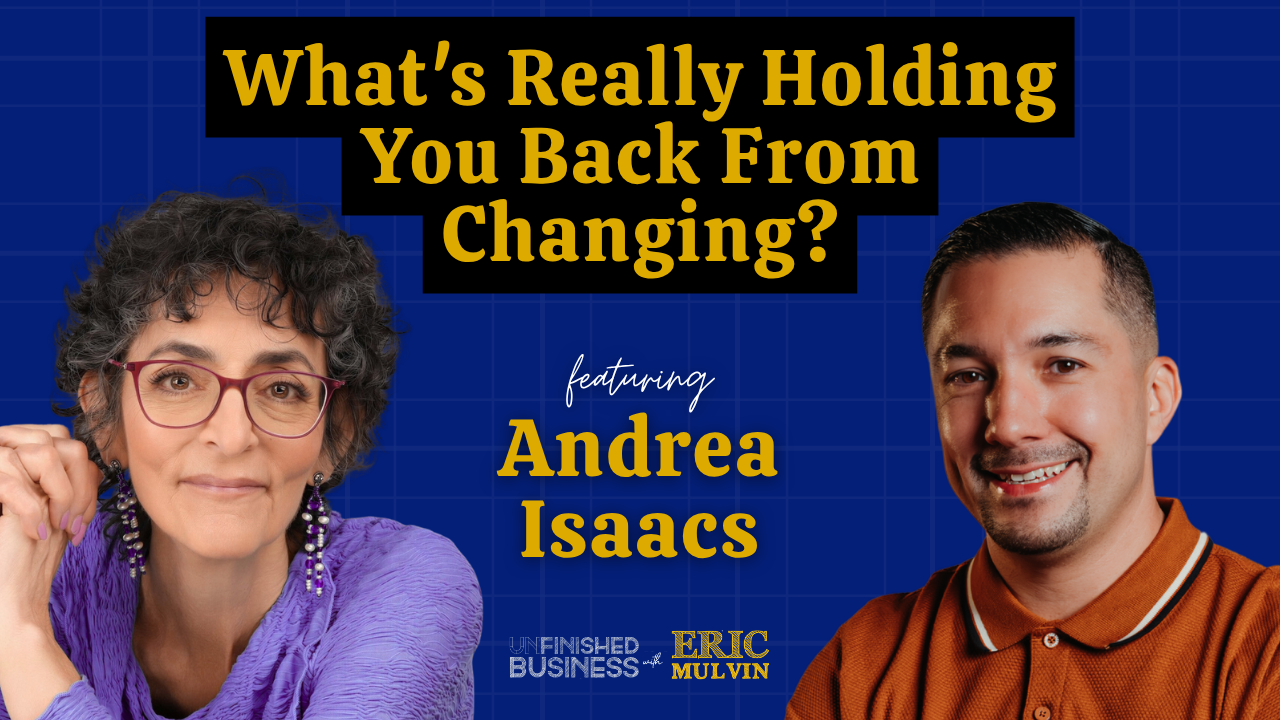
[Growth & Leadership Series] The Quarter Second That Can Change How You Lead | Andrea Isaacs




What if knowing exactly what you need to change still isn’t enough to actually change it?
We’re often told that growth starts with awareness. Recognize the problem, understand what you’re doing wrong, and make a different choice. But Andrea Isaacs believes there’s more happening beneath the surface.
Once painfully shy and afraid to speak up or be seen, Andrea spent years trying to become more confident. Simply telling herself to “be confident” didn’t work. Her search for why eventually led her to explore personality, emotional mastery, embodiment, and neural pathways and to develop an approach to change that goes beyond intellectual understanding.
In this episode, Eric and Andrea explore the hidden patterns that can keep people repeating behaviors even when they consciously want something different. They look at how those patterns show up in leadership, team trust, communication, risk-taking, relationships, and even the split second before we react under pressure.
In this episode, we break down:
- Why knowing what needs to change isn’t always enough to change it
- How a leader’s internal patterns can affect trust and team performance
- The “magic quarter second” between an impulse and a response
- How embodiment can help reinforce new neural pathways
- Why getting uncomfortable can help leaders become more comfortable with risk
- Why human intelligence and self-awareness still matter in an AI-driven world
Andrea also shares practical tools for recognizing and shifting patterns, including her Notice, Shift, Anchor (NSA) framework, along with stories of individuals and teams learning to communicate, trust, and show up differently.
If you’re leading a team, growing a business, or trying to change how you respond when pressure hits, this conversation offers a different way to think about what’s happening beneath the surface.
Episode Highlights
00:00 – Introduction to Unfinished Business Podcast
02:34 – Andrea’s Journey From Shyness to Emotional Mastery
05:29 – Why Growth Requires More Than Insight
08:05 – When Strengths Start Holding a Team Back
14:05 – Notice, Shift, Anchor: A Practical Exercise for Change
17:03 – Trust, Communication, and the Patterns Affecting Your Team
24:23 – Self-Awareness and Becoming Free to Be Yourself
31:42 – The “Magic Quarter Second” Before You React
35:03 – Getting Uncomfortable: Confidence, Risk, and Growth
42:33 – How Old Patterns Affect Relationships and Communication
48:47 – AI, Human Intelligence, and the Skills We Still Need
53:00 – Self-Awareness in Leadership and Parenting
56:38 – Andrea’s Unfinished Business
About Andrea Isaacs
Andrea Isaacs is a master of change whose work blends emotional mastery, embodied transformation, and neuroscience.
Her approach draws on her background as a professional dancer and choreographer, where she explored the connection between movement, emotion, and authentic expression. She later combined that experience with personality work and her understanding of neural pathways to develop an embodiment-based approach to change.
Andrea has worked with thousands of people in more than 30 countries, helping leaders, teams, entrepreneurs, and individuals better understand their gifts, recognize patterns that may be holding them back, and create new ways of responding and being.
Connect with Andrea
Website / EQ Quiz: https://eqquiz.com
Follow Unfinished Business with Eric Mulvin:
Instagram: https://www.instagram.com/bizwitheric/
Facebook: https://www.facebook.com/profile.php?id=61560126743830
TikTok: https://www.tiktok.com/@bizwitheric
YouTube: https://www.youtube.com/@BizWithEric
LinkedIn: https://www.linkedin.com/in/mulvin/
Powered by Pac Biz Outsourcing
Pac Biz Outsourcing helps NEMT, software, and eCommerce companies scale dispatching, customer support and back-office operations with dedicated teams in the Philippines.
🌐 Learn more: https://pac-biz.com
📩 Email: info@pac-biz.com
🎧 Podcast: https://yourunfinished.biz
Transcript
Eric Mulvin: 00:00
Welcome to the Unfinished Business Podcast. I’m your host, Eric Mulvin, and this is a show where we sit down with CEOs, leaders, visionaries, and creators who are out there changing the world through their business, through their leadership, through their organization, or through their creativity. Because it doesn’t matter who you are or what you’ve accomplished, even someone out there like Ronda Renee still has something that she would still like to accomplish in her career. And so we talk about those stories here on unfinished business with Eric Mulvin.
Theme Song: 00:36
Eric Mulvin: 00:53
This episode is brought to you by Pac Biz Outsourcing. At Pac Biz, we help software, e-commerce, NEMT, and taxi companies outsource their customer support and back office work with a dedicated team in the Philippines. This team handles everything from calls, emails, chat support, dispatching, and admin tasks so that you can focus on your business and help your business grow. So uh as a matter of fact, we have one client that’s saving over six hundred thousand dollars a year by switching their dispatching routine to Pac Biz outsourcing. So if you’re looking to scale support or trying to lower costs, please visit pack-biz.com to learn more or give us a call Monday through Friday during business hours at 480 at 771-3009. All right. I am very excited to introduce you guys to our next guest. She is known as a master of change and has leveled up the lives of thousands of people in more than 30 countries. I haven’t even visited that many countries by bridging the gap between who they are and who they know they can be so they could live fully, love deeply, and leadable way. Her clients have elevated their businesses to six and seven figures while creating greater vitality, meaning, and joy in all parts of their life. Pioneer in blending emotional mastery, embodied transformation, and neuroscience. She creates methods that turn insight into lasting embodied change. Her work goes beyond insight and mindset to engage the body, creating new ways of feeling, responding, and being, and greater freedom to all that you are. So, ladies and gentlemen, please help me welcome Andrea Isaacs. Welcome to the show.
Andrea Isaacs: 02:36
Thank you. So glad to be here with you.
Eric Mulvin: 02:37
Excited to have you here. And uh I love talking with people about neuroscience and how the brain works and how you could use that to really understand more about who you are. And so I’m excited to talk about what you have to share with our listeners today. So um now I know I gave a little intro, um, but maybe you could share it in your own words here. Uh tell the folks listening, what do you do?
Andrea Isaacs: 03:03
This this came to me for many reasons. One is I spent much of my life being painfully shy, afraid to speak up, afraid to be seen, and I didn’t really like it. And I tried to change, I wanted to be confident. My mother used to say to me over and over again, just be confident, Andy. And I tried and tried and tried without success. Fast forward many years, I was in a science lab and I had to do these unspeakable things to a frog. Because we were working on this is many years ago before neuroscience was a big thing. But one of the things we were discovering with these terrible experiments was about neural pathways and the fact that information travels on them in both directions. And then fast forward many years, I came across this personality system called the Enneagram. And it was fascinating to me. These different personality styles had different gifts and challenges, and I finally understood for the first time why I had been the way I was, why I had been so shy my whole life. And so I created a system based on embodiment, which you mentioned in your intro, based on embodiment, which came from my former career. And I realized, oh, there is a way to embody all these different gifts of all of the types, not just my own. And that changed my life because I had created the neural pathway for confidence. Finally, and it changed my life. And then I realized, oh, this just changing other people’s lives too. And that brought me on this journey to 30 countries and some.
Eric Mulvin: 04:26
Awesome. Well, that’s an interesting. Yeah, I do remember yeah, cutting up the dissecting the frogs and uh I don’t know if they still do that these days. I’m curious if uh that’s still one of the science experiments. But but the the science, uh, I feel like that’s something that that over the last uh, I don’t know, 10 years of my entrepreneurial journey, I’ve been starting to get exposed more and more to how the brain works and how as business leaders, there’s a whole world that no one really talks about that you can be tapping into to really help yourself become a better business leader and to overcome some of those limiting beliefs, some of those things that hold you back. So I I don’t know this is kind of maybe well what’s what’s the reaction to people or from people when they first learn and maybe not just learn but actually understand what you’re saying? Because it’s one thing to hear it. I think I’ve heard it for years, and when I finally started understanding, I’m like, oh wait, this is this is not what I didn’t realize how deep this goes.
Andrea Isaacs: 05:29
Sure. Well, the way I talk about it has to make sense, of course. And so I have a quiz, it’s the EQ quiz. And when I see the results of their quiz, which I call their emotional mastery blueprint, and I talk to them, I can tell them what I see, which reveals so much about who they are and why they are the way they are, including everybody has a unique combination of gifts that points to their life purpose. And many of us, unfortunately, also have challenges that get in the way from clarity about our gifts, clarity about our purpose, and living it. So when I look at their blueprint and I see their unique results and I talk about what it means, and they tell me, oh, that’s exactly what’s been happening. Oh, oh yeah, and now I get it why this was happening. Oh, you’re seeing things I never saw before. So I look at it very specifically in terms of each unique individual because I do believe we are all unique.
Eric Mulvin: 06:20
Oh yeah, very true. So what all right, so you you walk them through that uh assessment and what’s some of the reactions? Well, you you mentioned some of the reactions, but like, yeah, what’s a typical reaction of someone when you first walk them through that?
Andrea Isaacs: 06:35
Well, there’s a difference if I’m working with an individual or a team. Let’s talk about individuals first. So the reaction is, oh, I want some of that. You know, when I talk about their purpose and what’s holding them back, they’re done with that challenge because the brain’s purpose is to keep us safe. And so if it’s if you’ve always done what you’ve always done, it’s gonna cause you and motivate you to do what you’ve always done because it’s keeping you safe. And that’s why, as entrepreneurs and leaders and change makers, we’re always growing and we’re always wanting to grow our business. And in order to do that, we have to grow ourselves. We have to know how to step outside our comfort zone. And one of the reasons change or growth, because by the way, growth means change, one of the reasons people think that’s difficult is we don’t have that new neural pathway for that new way of being yet. And I believe change can be easy when you know how to create a new neural pathway.
Eric Mulvin: 07:30
Hmm. So that’s really interesting. So there might be people listening that are like, what are you talking about? Like, that’s the thing that’s stopping me from getting the stuff I need to get done, is there’s some missing neural pathways. Like, I’m already doing the thing, but like because I I know there’s things holding businesses back. Uh this is uh something I was talking about with uh my CEO buddies yesterday. That uh, you know, there what are the stories we’re telling ourselves that aren’t true, but are the ones there’s things holding us back because they’re creating the neural pathways for us that we don’t even realize, right?
Andrea Isaacs: 08:05
Well, I’ll give you a couple of specific examples that will help make it more clear. So one is uh an ergonomic furniture company that was on the cutting edge when we start talking about ergonomic furniture and office, particularly for offices, and I was working with their team and I saw that they had a score that pointed to me that they are so innovative, which in fact they were. And there’s a challenge of something I call the gift gone wrong. Too much of a good thing. So their ability to be innovators meant there were so many ideas they had, and the leaders were saying, well, we want to put our arms around all of it, we want to collect all those possibilities, which is what put them on the cutting edge, and it was also what was at that time holding them back. And so in doing that, they realized that they didn’t have the of the score that tells me that they’re focused. Now they can focus and they do focus, but the score was surprisingly low. And it’s not that they can’t, it’s that they have so many possibilities they don’t know what to focus on. And so then there’s what I call the domino effect. So one of their dominoes that was causing the um, they weren’t achieving as much as they, they weren’t moving, they were achieving a lot, but they weren’t moving forward as quickly as they wanted. I saw that their decider was kind of offline. So when you have what I call the scattered whammy and your decider is offline, the domino effect is you’re not focused, and the domino effect of that is you’re not achieving as much as you want or as quickly as you want. And so in doing that, I as you mentioned, and we’ve both mentioned, we do embodiment work, and when we do that, we have a way of anchoring that new way of being with the new neural pathway. And my what sort of separates me from other people doing this work is we anchor it twice. We anchor it in the body and we anchor it in the mind. Together, it’s the fastest, most efficient way to create a new neural pathway, which actually helps you step across the edge of your comfort zone into that next bigger, bolder version. So I’ll tell you what they came up with. And we we you we work with uh we usually call them mantras or affirmations, but it’s more powerful when you engage the body. So it’s something like this arms around it, those are the ideas. Arms around it, then we focus. Step, step, step, and we achieve. Arms around it, then we focus. Step, step, step, and we achieve. So it has the the arm, they get to do what they want to do. They gather the ideas, and then at some point they stop, they choose what to focus on, they commit to it, and then they take the action, and guess what happens? They get it done, they move forward more quickly, and they were just thrilled. There’s a 10x talk, many of our listeners may have heard. Amy Cuddy. She talked about the power pose. Well, in my world, the power poses are there is an unlimited number of power poses. And they were they called me Amy Cuddy on steroids, which I really I really enjoyed.
Eric Mulvin: 10:49
Nice. So for people who are listening, they’re like, why do I had to move my body around? What like that might seem like silly or like not necessary, but it’s an important part of the step. Like it’s critical, right?
Andrea Isaacs: 11:02
Well, I tell you, I’ve had CEOs and senior managers and and tax accountants do the embodiment work because information and insight alone does not promote change, it does not implement change, it does not create change. Great ideas. It you know might happen over time, over a long time, but if you want to expedite change, engage your body.
Eric Mulvin: 11:26
Yeah, and I could say right now, like I’m pretty sure there’s people listening that can relate exactly to what you’re saying, that they’re their business is growing, but they’re like, and they get to the end of the year and they’re like, we’re not where we wanted to be. We could have been further. Or I don’t know, they there’s that. There’s also the the leader going oh the other thing I wanted to mention was being in meetings. You know, how many lead how many times has leaders been in meetings and you communicate to everyone what needs to happen and then you go away and it just disappears? Like no one no one got it. So you’re right. Like the just because you’re saying something doesn’t mean that it’s gonna happen or that e-people are listening or that it’s that information is received.
Andrea Isaacs: 12:11
So true. And I some one of the things I’ve noticed in some leaders is as a leader, we’re uh we’re efforting, we’re you know, we’re bringing a lot forward. And so there’s some self-criticism. Oh, that wasn’t right, that wasn’t good enough. We can do better, and that’s a good thing because it makes what you’re doing better and better and better. However, when we have, or anyone who has that inner critic, guess what happens? It leaks out onto others. We may think we are softening it because we’re not as harsh with others as we are with ourselves. When it leaks out onto others, it diminishes things like commitment, motivation, productivity, and retention. And when they notice that, and when they’re able to have quality communication where everyone is seen, heard, understood, and honored, and all and their voices are heard, it increases their motivation, their commitment, their passion, their productivity, and it diminishes retention. And there was one group I was working with where afterwards, after I did this live presentation for the group and I other things I was doing as well. This one woman said, you know, I wasn’t going to going to come today because honestly I was going to leave. But now I’m so committed. It got everybody on board in alignment with the vision of the organization, and it became rocket fuel for their trajectory.
Eric Mulvin: 13:29
Nice. Yeah. That’s the I think that’s what a lot of people running their businesses are trying to do. We’re all trying to achieve big things, and we’re a lot of people are missing that rocket fuel. You know, it’s there’s a lot of people like, oh, we’re gonna get to this size, and then I meet them a year or two later, what happened? And uh well, this happened, this happened. There’s a lot of stuff that pops up. So you’re giving people some useful tools here to help break through that. Um for people listening at home, is there any simple exercise? Is there like a small sample version of this that people can try out and learn a little bit for themselves? A small version of this?
Andrea Isaacs: 14:06
There there sure is. I have there’s three steps. Um I call it NSA, but not what you might think. The N is when there’s something you want to change, notice your guess what? Notice your body. What’s the energy in your body? Is it contracted? Is it expansive? Is it big? Is it small? Is the energy like jagged and all over the place? Is the is the energy still? These are some of the words we don’t really know the language of the body, it’s a foreign language. So I teach the language of the body so people can recognize it. But for starters, use some of those words. Is it contracted or expansive? Calm or crazy. Just notice the energy in your body. And S means shift. This could take some training, but you can do it on your own as well. If you’re contracted, what’s the opposite? Oh, it’s expansive. If it’s all over the place, what’s the opposite? Stop. Stillness, focus, whatever the opposite is to you. Have your body do that. And then A S N S, notice, shift. The A is anchor. Anchor whatever it is your body did instead. So instead of this, it’s anchor it, anchor it twice. You could anchor it in your body, like I’m just kind of demonstrating. And then we bypass the thinking mind just for a moment, because remember I said information and inside alone, they do not promote change. The body inform our mind. So once they’re in this new state in their body, I say, ask your body, what does it say about you? Give me an I statement. Oh, I am, I have, I am focused and clear. Or something like that. I never know what people are going to say because again, it’s unique. But to anchor it creates that new neural pathway. So when you feel stuck or you’re anxious, or some challenge came your way, it could be a challenge with a person or a thing or life or the world. Stop and do NSA. Notice your body’s reaction to that experience, to that situation. Shift it. You don’t need a lot of language to shift the energy, just do the opposite. That’s the simplest way to approach it. And then anchor it. Remember that feeling in your body. Have your body inform your mind with a new way of being, and then you will have a neural pathway that will get you through that challenge. NSA.
Eric Mulvin: 16:20
Awesome. Thank you for sharing that. And uh so for you guys listening, that’s a simple exercise you guys could try to do and and try it out. I think it’s uh there there’s definitely a lot of uh neuroscience packed into that that is uh you know, I’m sure go go meet with Andra and uh learn more about it, you know, and why this actually works. But uh but yeah. Now you talk about working with teams as well, and as a business leader, you know, we’re trying to create big change. I think as a lot of people can relate to that lack of uh you know, the getting information and then the it the action isn’t happened from the team. There’s some disconnect there. So you talk about working with teams. So tell me more about that. Like, how do how do you help teams be able to uh function better? I’ll I’ll show this. Like from my experience these last uh running my own business the last 10-15 years, just the last couple years I’ve really leaned in more into like how important and critical the team is, not just oh, we got like one rock star or two rock stars. Like, man, uh I’d be really treating it like a sports team, like everybody on the team needs to be able to perform. And uh but that that takes a different kind of leader and a different skill set for me to to you know create that environment. But tell me more about how you help teams uh break through some of those challenges that a business like mine might experience.
Andrea Isaacs: 17:44
Sure. Well, let’s see. So what I do when working with the team, the first thing I do is I give them my quiz. And then I meet with them individually and I talk about what their blueprint means because it’s very personal and they may not be ready to be seen in the ways that I can see them. And so it’s important that that’s done privately. So I do those first, I collect the blueprints, and then I make a uh a blueprint of everybody, which shows me the strengths of the team and the challenges of the team. When I did this with one group, what I learned, I don’t think this person I’m about to describe is like you, but she the leader of that team had had anger issues, and so people weren’t trusting her. And the team wasn’t the team, they weren’t connecting to her, they weren’t moving forward, they weren’t getting stuff done, no one was stepping into their leadership. There were a lot of problems, and there was the fear that the company would dissolve, especially since the CEO who hadn’t who didn’t have those challenges was leaving. So it was the CEO who brought me in. So I went in and I worked with them and they put the topic of trust on the table. They talked about it, they talked about their challenges to trusting. And you know what? If someone doesn’t trust or has a challenge in knowing who to trust or how to trust, or they don’t trust themselves, it always comes from an early life wound. And part of working on the healing that I did in the private calls, so when we came together, they felt safe to talk about it. And once the topic of trust was on the table, people felt safe to be seen, to speak up, to be heard. The woman, the leader who was the um the senior leader of that organization, her anger issues were dissolved. And then they’re the ones actually who I’m quoting when I say I became rocket fuel for their trajectory because their culture changed dramatically. Now, in terms of someone like you who doesn’t have anger issues, it would be a different challenge. I would have to look at the team’s blueprints to tell you what their challenges are, but I would bet that if they felt more seen and heard and understood and they’re in the right positions, things would change.
Eric Mulvin: 19:38
Hmm. There’s a couple things I want to follow up with on that. So one is well, I’ll get back to that. Uh the one thing I was gonna say, uh, because I have like a bunch of ideas and I’m trying to sort them through to to ask them. This reminds me a lot about something I learned uh a couple years back about the uh the trust pyramid from Patrick Lencioni and how the bottom of that, the very first part of that pyramid is uh trust. So we got trust, there’s conflict, commitment, achievement, and results. And if you can’t if you don’t have that trust factor, you know, just like a pyramid, you gotta have a good foundation. If you don’t if the foundation is weak, none of the other things you won’t get to results. You won’t get to achievement, you won’t get to commitment. So that’s uh that’s very interesting, you know. But like if that’s a challenge in your company is lack of trust. And I see that happen a lot in companies where there’s for whatever reason I don’t trust the CEO or the COO or the finance person or the HR person. And I think, oh, it’s just that person. Ah, we could work around it. But no, it like leaks into every part of the company and it won’t go away.
Andrea Isaacs: 20:46
I’m sure that’s something you see a lot. Absolutely, and when I talk to the individuals in an organization like that, there’s a reason that some people don’t trust. Usually they’re brought up in a home in an in an environment that was not trustworthy. Perhaps the parents fought, perhaps the kids were uh, what do you call them? Um key uh door door locked, um what’s the word?
Eric Mulvin: 21:08
The the latch key kids.
Andrea Isaacs: 21:09
Thank you. The latch key kids, but mom and dad weren’t there. And so you can’t trust that mom and dad will be there. Which is so they became uh they the brain created this uh ability for them not to need to trust mom and dad to believe, to believe that no one’s there for me, for instance. So they have trust people like that have trust issues, and for good reason, because they couldn’t trust mom and dad. So my work with them, oh I want to back up and say this first. I was saying before when change is difficult, there’s the missing step, which is not having the neural pathway for the change you want. I used to think there was one missing step. However, now I believe there are two missing steps because the other step that’s often missing is healing the wound that was put in place a long time ago because those wounds take up room and there’s no room for a new neural pathway. And when we do the healing work, which isn’t that painful, it doesn’t take very long. But when it’s healed, there’s space and in its place, there’s room for a new neural pathway. And so in these in the private sessions, again, it’s a private thing, it’s very personal. But we heal those old wounds. And then they create the new neural pathway, and then they’re able. See, trust has to start with trusting yourself. I trusted, I know I can trust you, but I can’t trust you. Because there’s a feeling in your body when you feel safe. You can only trust someone else when you feel safe. But when your body’s shut down, when you don’t listen to the language of your body, and you have this old neural pathway alive saying you can’t trust anybody, you are not going to trust anybody. But they can learn how to recognize the feeling of what it is like in their bodies when they’re safe. Oh, I can trust you. And then trust grows. You know who to trust, you know who not to trust. And you can make decisions that you trust are the right decisions. But it comes from it has to come from trusting yourself, which has to come from healing the wound in the first place.
Eric Mulvin: 22:58
Yeah, and that’s another one of those things where it goes back to the neuroscience, and it was one of the things I thought when I first learned about it, like, yeah, right. How is that like because I don’t know that this whole world, this is like the whole world that just didn’t seem like it was just kind of like woo-woo science and stuff like us. But it what’s been amazing is as I’ve learned more about the neuroscience and read the papers and listened to the experts and read the books, and also hearing firsthand from so many other business leaders like just yesterday, there was a person that uh gotten to know sharing exactly exactly what you just said, that it was because of trust issues that they had growing up that well, no, it was parents always told them to not talk, you know, they don’t like communicate about issues, you know. We only talk about these things, these are the safe topics to talk about in the house. And so now as an adult, they’re dealing with that in their life, and uh and they didn’t recognize it. It took them years and years and years. So it’s just I I can only imagine the responses you get from people that have been dealing with these and probably not even realizing that this is something they’ve been dealing with, and now all of a sudden they’re like, oh my gosh, you’re right, this is all making sense, and then they’re able to break through. There must be some crazy stories you have of incredible change.
Andrea Isaacs: 24:23
I do. And you know what’s so interesting to me about all of this is so often, whether it’s a leader, a CEO, an entrepreneur, or a baby boomer who’s retired and still wants to have meaning and joy, the outcome is so often some version of finally I’m free to be me. And it’s because they feel safe. I’m free to be all that I am, and that’s one of my passions. I want people to feel empowered to be all that they are. And any of those early life wounds will hold us back. Any of those limiting beliefs hold us back. And so that’s a theme I see across the board.
Eric Mulvin: 24:54
Now, you it’s gotta be a bit different when it’s it’s one thing when it’s like the CEO inviting you in. They’re the ones making the choice to like, hey, I know this is something we gotta work on. It’s gotta be a little bit different for people there that are like part of the team. They’re like, I didn’t sign up for this. What the heck are you making me do? This is weird. Like, talk to me a little bit about that.
Andrea Isaacs: 25:15
So that’s a really good point, and I had to learn how to work with that. So in my first professional career, I was a professional dancer, choreographer, and they did a lot of what was called lecture demonstrations where you talk about your the work and what you’re about to see and so on. And so, sort of as practice, I did gave talks for all kinds of weird groups, not just in schools and universities, but also for um the uh the um what do they call the um these groups of why am I with chambers of commerce for sure, the what are the groups of men who come together in the Lions group or something? Okay, one of those groups, yeah. Why am I forgetting all their names? The Elks Clubs, groups where they would get together and talk. They would, you know, maybe smoke cigars and Freemasons. But yeah, I mean they were not my my my niche, so to speak, but they were not into their bodies. So I I learned way back when how to introduce this work in a very easy, safe way. Sitting in the chair, moving an arm, moving it slowly, moving it fast, moving it with energy, moving it with, you know, not no energy. Just very small, safe, incremental steps. And I’d have them stand up and walk around. Walk slowly, walk fast, walk with energy, walk with no energy. I would have them do very simple, safe things. And then they’re laughing and they’re interacting, going, ha ha, isn’t that great? You know, it’s comfortable. It’s still inside their comfort, it’s it’s slightly outside their comfort zone because they’re just walking in the you know in these different ways, but it’s still safe. So I gradually increase the what is safe for them very gradually. And then I’ll create an exercise. So, oh, this what was this one? Um I think it was about communicating. We’re avoiding communicating. Like if you’re communicating, you’re looking at someone. If you’re avoiding it, you’re not going to look at that person at all. So we kind of exaggerate things to really make a point. And again, increasing their comfort zone. And then we sit down and just talk about it. And in the even in those little simple exercises, things started coming up. I never really looked you in the eye. You know, and I never really talked to you before. How interesting this is. Huh. So you know, it has to be incremental. And because of my background, I I learned how to do that in a very safe and incremental way. And that’s why at the end they feel safe to be seen.
Eric Mulvin: 27:28
That’s really interesting because that’s exactly the kind of the groups you’re talking about. Those are the kind of groups where I’m like, I would I would imagine like a majority of the people will be the ones resisting in there.
Andrea Isaacs: 27:39
Well, yeah, yeah, I get it. Yeah, yeah, for sure. And it was so much, it was it was so much fun. It is so much fun to do that with people who initially don’t want it. I was doing a more in-depth program on uh for um people, many people who were there because they wanted to be, and this one woman brought her husband who didn’t really want to be there. So every time we did an exercise, he would sit down in his chair with his arms crossed and scowl. That was what he did. And except on the last exercise, he raises his hand high and he says, Now I get it. Now I know why you’re doing what you’re doing. Because I f and then he started wanting to make changes in his life because he finally got it.
Eric Mulvin: 28:14
Nice. That’s that’s awesome. Well, thank you for sharing those examples. And uh you know, I think that’s uh getting teams to function is uh you know, it’s as a leader, it’s a tough thing. And I think we’re we’re always dealing with that, we’re always having to even if you know all this stuff, it’s still like ah, this is this is not easy. So having some extra tools to help you out and major ones, and and and the incredible thing about that too is that you are you are giving those people on the team a gift, uh especially if they’re not aware of some of those limiting beliefs from childhood, or they’re not aware of some of those gifts that they really have in them that they’ve been holding back for whatever reason. Uh so I yeah, I mean I I’ve had some experience with where we go through our personality uh behavioral analysis that we do with our staff, and it’s always even that, like people have it’s just a it’s incredible. And I mean I get it as I think about myself, but just how much we don’t know ourselves sometimes. It’s it’s an interesting thing. So I mean, what do you think would happen? This is a random question. What do you think would happen in the world if more people knew who they really were? There would be peace on earth.
Andrea Isaacs: 29:27
That’s that’s a big you know what’s interesting about all of this too is some people don’t want to know. There was one woman who actually I remember my mother when she first noticed I was doing this work, and I invited her to a program. She said, Why would I want to go to something where I’d learned something about myself I don’t like?
Eric Mulvin: 29:43
Ignorance is bliss, right?
Andrea Isaacs: 29:45
Well, you know what, yeah, yeah. You know what? Later she did come and she really liked it. I bet she had the experience before she died. You know, she finally understood what I was doing and why I did it. But not everybody has self-awareness. Not everybody wants to know about who they are and why they are the way they are. Not everybody realizes the impact of their thoughts, of their of what they say, or the impact of their actions. So self-awareness is a really big and very important thing, especially if you’re working with a team, if you’re working in a relationship. When you’re working with others, you self-awareness is huge.
Eric Mulvin: 30:19
Uh yeah, definitely. And it’s the the answers are right there a lot of time for some of this stuff. It just uh takes a couple little steps. You know, one thing I was thinking, um one of the other things I wanted to bring up that your exercise had me thinking about was uh there’s a a famous quote I’m sure you know by Victor Frankel talks about you know this the space where we hold well I maybe you can explain it more. I’m I’m I butcher these quotes, but you know, the essentially it’s like this the time the space from when you hear this stimulus and then when you react, that’s uh that’s what we can control. And these exercises you’re doing kind of makes me realize like, hey, this is something you could do to force yourself to create that space so you have the time to think. Because I think as business leaders, we just go blah boom. But like that’s what we’re trying. Like you talk about neural pathways. My neuropathways are trained to come up with a solution quickly, spit it out, move on to the next thing. And many times like we don’t even realize what we’re saying, and uh it just comes out, it’s all automatic automatic. And uh you know, maybe you’re not saying I I know it’s a fact. Like the business leaders are not showing up the way that they want to show up, it says maybe uh I don’t have enough time, I don’t I got too much stuff going on. But uh I don’t know, talk to me a little bit about that because I think that’s that exercise I maybe not by maybe well there’s the science behind it, right?
Andrea Isaacs: 31:43
Well, yeah, I love what you said because it’s actually the the foundation of my work. It’s that space between the impulse, the thought, and the action, or what you say. So this is what I call it the magic quarter second. And I came up with this when uh Daniel Golman did some research with uh, I think it was a neurosurgeon. I may not say this exactly correctly, but it was something like this. Um the brain does not feel pain. Literal, I mean in a very literal sense, in a physical sense. So they had a patient on the table and had a clock that was demarked into a quar a thousandth of a second, which is so fast you can’t count that fast. And they had a man on the table and they were able to um with uh a probe to tap into different parts of the brain, and they like lift your lift your right hand, and they would give him an instruction to do something, and they could watch on this clock, which had those thousandths of a second increments, to see how long it took from lift your right hand to uh lifting the hand, and it took like a quarter second, a quarter of a second. And one of the reasons change is difficult is we have to catch that quarter of a second, and that’s hard because it goes so quickly. So, in my work, what I realized we could do is to create the change you want before you need it. For instance, if I always get triggered when you give me a comment that I interpret as a criticism, and I want to go, eh, no, that’s not who I am. Whatever that reaction is, we have to um create the neural pathway for I said, for instance, I believe in myself. So, say for instance I create that neural pathway when I don’t need it. I mean, maybe I always do, but when I get triggered, I forget. Okay, if that’s the example, I forget, and then I just get reactive. So I prepare and the reason we do this is there’s it’s about will, willpower. And in my world, I talk about two kinds of will, higher will and lower will. So in lower will, it means it takes effort. It means I have to practice. I uh I have unshakable confidence. I have to practice saying it over and over and over again because that is like going to the gym and doing your reps. I’m doing my neural pathway reps. I have unshakable confidence, and every time I say it and feel it in my body, I’m strengthening that muscle, right? Okay, so that’s lower will. It takes a little effort, doesn’t take a lot of time, but it does take effort. And as we do that, in my world, we do that with a whole bunch of different emotions. So again, you’re expanding your emotional capacity and you’re increasing your emotional flexibility, which helps make change easy. Okay, so then life happens and you get triggered, and we have that magic quarter second. And higher when you’ve done your work at lower will, higher will takes over. You don’t have to try to be different. You finally show up differently because I’m maintaining my unshakable confidence. So even with a comment or criticism or negative feedback, I can hold my ground and not feel diminished and small, and oh, I don’t matter. I don’t have to go into that because I still have unshakable confidence. So when we do our work at lower will, which takes a little effort, higher will takes over, and that is so magical. And I hear it over and over again with a client who we did some work on creating this new neural pathway. She’ll he or she will say something like, Oh, you know, I had that trigger what I was telling you about, it happened again, and I couldn’t believe it. I just said something I never would have thought of saying because it came from that place of unshakable confidence because that neural pathway was there and it automatically engaged. Higher will took over and they responded in a way that honors and reflects their best and highest self.
Eric Mulvin: 35:03
That’s awesome. Cool. Well, to switch gears a little bit, I I wanted to go into uh I’m I’m kind of curious. Like you mentioned earlier you were a dancer before, that’s drastically different, right, than what you’re doing today.
Andrea Isaacs: 35:17
So, how did you get into this? So, as a choreographer, my biggest passion was choreographing dances about people and emotions. And so I learned decades ago how to have my dancers embody a whole range of emotion so that their performance on stage was authentic and really powerful. That was my background when I came across this personality system. And as a kinesthetic learner, which is something we all have, whether you know it or not, there is a learning channel which engages your body. It’s experiential, it’s kinesthetic. In fact, they say, by the way, that when you want to learn something new, I can tell you all how to embody unshakable confidence, and you’ll forget 80% of what I say. However, when you when I teach you how to embody unshakable confidence, it’s the opposite. You will remember 80% of what I’ve said. So when I came across this personality system called the Enneagram, which means Enea means nine, it’s nine different personality styles, and we embody it because of my background. I knew how to embody the confidence of this type and the peace of that type, and the acceptance and the nurturing and the focus and the brainstorming. I know how to embody all that stuff. So, in a way, my career seemed very different, but I combined them in a way that just makes perfect sense because when you embody, as I said earlier, when you embody the change you want, you create that new olthway. So actually, in a way, they are quite similar.
Eric Mulvin: 36:40
That’s amazing. I never thought about that connection, or even uh just we just signed up our daughter for uh dance class. Oh uh they’re gonna be doing some dance and hip-hop soon.
Andrea Isaacs: 36:51
Oh well, I’m not sure it’s emotionally based, but you know, there’s so many forms of dance, but that’s awesome.
Eric Mulvin: 36:56
But yeah, I didn’t I never thought about that connection and being able to bring that emotion out to and that it makes a lot of sense, right? Putting that into the dance and then people embody it.
Andrea Isaacs: 37:07
So But you know what? I don’t use the D word. Because it’s yeah, because too many people think I I don’t dance, I don’t know how to dance. I don’t use that word. We’re gonna just move, we’re just gonna stand, we’re just gonna move.
Eric Mulvin: 37:19
Yeah, I can see that the reaction.
Andrea Isaacs: 37:21
Dance, I’m not gonna do that.
Eric Mulvin: 37:24
Yeah, don’t use the D word. Immediately, yeah, scare some people away. Yeah, yeah. Like yesterday, we had to do an exercise to to train some of our neural pathways to overcome some of these fears. So we all had to get up and sing in front of uh the other CEOs. That’s great.
Andrea Isaacs: 37:44
Yeah, that was an interesting exercise. I love it. That’s a way to get out of your com out of your comfort zone. You know, recently I’ve been forcing myself to do things that deliberately made me uncomfortable. So I joined a comedy improv group. Yeah, very uncomfortable. But it’s so much fun, and it uh it has helped me be more comfortable doing other things that are uncomfortable.
Eric Mulvin: 38:04
So, yeah, let’s talk about that for a second because that is that is a concept in the business world, um, and it just something that people uh are are teaching business leaders is and I’ve I’ve seen people like you, and it’s it’s usually the the people that I see do this are people like you that are the ones uh the practitioners teaching people this stuff. You go out and do these crazy crazy things that push yourself to the limits. Now yours are pretty safe as far as like physically you’re in an improv group, but uh there’s some people I know they’ll like go to Costa Rica and like live in the jungle for a week, or you know, I mean there’s obviously like skydiving and stuff, but walking on fire. Yeah, walking on fire. Why as a business leader would you go out and seek or not just a business leader, as anybody, uh why would you go out and seek these things that make you so uncomfortable that you know you you that you’re facing your fears and like why I could just stay at home and like watch Netflix instead? Be made more comfortable. What’s the point?
Andrea Isaacs: 39:04
Well, there’s a part of it that when you do it, it’s thrilling. Thrilling. And that’s an experience that people actually end up enjoying. And the fact that it does stretch your comfort zone, I think, is something more intellectual that people can understand. Because when you’re willing to take a risk, and look, I want to back up. You know, having a business is a big risk. Building a business is a risky. The bigger you want to get, the riskier it is. So I believe we have to become safe taking a risk. We want to judge, am I gonna die? You know, if you’re gonna die doing this thing, you know, don’t maybe don’t do it. Maybe sometimes those bungee cords will break. I hope not. But when you feel safe doing something like that, you’ll feel safe being seen in a bigger way. Because you know, I think being an entrepreneur and leader as well, we are seen. And if there’s any iota of fear of being seen, it’s gonna blossom, it’s gonna bloom, it’s gonna hold you back. And so, you know, to be seen, to take the risk of being seen. Like, what if this new idea you have is really stupid? I mean, what if? It may not be. Sometimes I can’t tell, I can’t tell the difference, the difference between a brilliant idea and a really goofy, crazy idea because they’re so close together, really.
Eric Mulvin: 40:12
Yeah.
Andrea Isaacs: 40:13
Sometimes innovation is so out of the box of what people understand and know and accept. Like the like running it in less than a five-minute mile was a concept people did not understand. I was reading an article about um the man who and many years ago thought crystals could have energy, which today sounds both woo-woo and is also used in our phones. And um, he was put in jail and later died without and they burned all his books because they thought his idea was too crazy. Well, it may it was ahead of his times. So, but and it was brilliant. And he was put in jail because of his crazy ideas. So there’s a fine line. I guess my point in all of this is when we have the ideas come to us because they’re ours to do, and it might feel risky and scary for good reason. And when we believe in ourselves and we accept that this came, this came to you for a reason, and we’re willing, and here’s it goes back to why, and we’re when we’re willing to take a risk and to do something outside our comfort zone, we’ll be more comfortable engaging this great idea and bringing it to the world and really making a difference because it’s those crazy ideas that really make a difference in the world.
Eric Mulvin: 41:24
Yep. I love that. So, yeah, so you guys listening, go out and do something uh uncomfortable. But it doesn’t have to be it doesn’t have to be too crazy. I like I mean, like I said yesterday, it could be getting up in front of a group and singing, or like you said, uh you’re doing improv. Uh that’s something I really want to do too. But for me, it’s not a fear, it’s just like I I want to get into doing it at the time. But there’s definitely those uh things I as I’ve learned more about like you know, that concept, I’ve been wanting to get into some of those things. But I got enough stuff I’m taking risk on in my life for the business and uh new ideas, but good for you. So uh now we talked a lot about business leaders, but I mean I think anybody can really benefit from the work that you’re teaching. So it doesn’t, you know, if you’re listening and you’re not a business owner, you’re like, I don’t know this doesn’t apply to me. Well, if you listen this far, I’m sure you’re there’s something you’re intrigued and want to learn more about. But tell me more about that. Like you you work with that there’s people obviously high achievers, or maybe people are just trying to break through something that’s blocking them from getting to their goal. But tell me more about working with other people that aren’t entrepreneurs.
Andrea Isaacs: 42:34
Yeah, I I have so many stories to choose from. The one that popped up first is Robert. So uh Robert is when I looked at his blueprint, I could tell that he values his highest value is peace. Really kind guy, very sweet, very he connects with other people so easily. And when I talked earlier about too much of a good thing, the gift gone wrong, so his gift gone wrong was because of his deep value of peace, he would often compromise, which is a great way to get along with other people, but he would compromise again and again and again and again and again and again and again, etc., until the point where he felt like no one cared what he wanted to do, or no one cared what he thought, and no one cared about his opinions, and he started to feel like I don’t matter. It’s like I’m not even here. And he would get together at family, he was um he was retired, by the way, and so he was just wanting to have a good life, and he’d get together at family reunions, and he’d sit back on the couch and watch everybody have a good time and engaging, and he’d sit back on the couch and watch. And he felt so he told me he felt like he was living life underground. And uh, in a way, my energy kind of scared him because I I have a lot of energy sometimes. As much as I’m an introvert when I’m teaching, I get really excited, and my energy gets big. And we were doing an exercise about big energy, and it in its I saw him like pulling back, and he realized that he had just been afraid of that because he had been the recipient of big energy used for bad, abuse of energy, the wrong use of power. There’s a right use of power, the power to believe in yourself, the power to Take a stand, to speak up, to be seen. That’s the right use of power. And he had lost it for good reason because as a kid, if he had spoken up, bad things would have happened. Anyway, in our work together, he was also saying he just wanted some vitality. That’s all he wanted, vitality. And in our work together, I watched him blossom and he became he had the vitality like to the nth degree. It was so beautiful to watch him become fully himself. And oh, he said that he had his next family gathering, they got together, and he spoke up and he made a choice about where they should go and what they should do. And they saw their father in a whole new way, being vibrant and alive and whole, at peace with himself and fully engaged with others and with life. It’s beautiful.
Eric Mulvin: 44:48
That’s incredible. Yeah, and I wish it were that easy for everyone because I know he’s we all have family members or people in our life that are struggling with things. You’re like, man, if they could just get through that. And uh, you know, you’re you’re hearing some of the some of the tools out there because it’s what what’s the typical things we all tell these people? Hey, just just keep pushing ahead.
Andrea Isaacs: 45:08
You know, you’ll get through this, or that’s hard. That’s hard. You know, they have to want to change and they have to be ready to change. And one of the reasons changes, another reason change is difficult, is people aren’t ready for the consequences. Like maybe it means you have to move, or maybe it means a divorce has to happen, or maybe it means you have to lose that friend, or maybe it means you simply have to speak up. One I had this one woman who came to me right before COVID hit, and she told me she just told her husband of 50 years she wanted a divorce. And then COVID hit. And now she’s sheltering at home, like we were all doing, with the man she just told I want to leave. And so we were doing our work together, and I asked her, Well, do you tell him what you want? Well, no, I don’t think he would do it. Well, but do you know what you want? Well, not really. So in our work together, we went back to her early life, and she was trained not to want. You know, if you have as a kid, if your needs aren’t met, it’s so hurtful to have a want or a need and have it disregarded that we teach ourselves not to want. And she finally was able to know what she wanted, and she would speak up and she would ask him for what she wanted, and he always provided. Always. And now here we are many years later, and she says, He’s the man for me. And now they they communicate because she speaks up. You know, not speaking up will destroy a relationship. And sometimes they’re tough to one of the things I love to talk to my clients about and my students is about how to bring up difficult topics. Because when you don’t, it can either challenge or even end a relationship. And it doesn’t always have to go that way. Because when you know how to speak up, when you know how to navigate these challenging conversations, you can talk about it, see and understand each other’s point of view, and resolve the situation so it never has to happen again. And then, oh my god, it it really changes your so many more stories are popping up. I don’t know if you want more stories, but so many stories are popping up about how this has changed people’s lives.
Eric Mulvin: 47:02
Oh, that’s incredible. I uh if we had the time, I’d have you tell them all. But I have some more questions I still want to ask you. So uh but that that no, that’s really amazing that you know you’ve been able like that’s that’s one one couple that you talk to, and that’s completely life-changing, you know, like I think if if COVID had not happened and she just pushed through with the divorce, would she have been happy?
Andrea Isaacs: 47:25
She’d have the same challenges.
Eric Mulvin: 47:27
She probably would have been more miserable.
Andrea Isaacs: 47:28
She’d have the same challenges in herself. She certainly would, yeah. So I’ve helped couples either navigate divorce and still remain friends, or to save a relationship so they don’t have to end it.
Eric Mulvin: 47:39
Yeah, that’s uh that’s amazing. Uh thank you for sharing that. So one other thing I wanted to touch on here too is you know, we talk on the show about AI, and obviously there’s not a lot of AI here to talk about. Maybe there’s some aspects, but what I really love about all of this, and you know, more and more I want to highlight this kind of stuff on the show, is like more than ever, people like the importance of people and working together with people. Like we’re getting we already had the uh instantaneous like lifestyle of everything. Like I could order something on Amazon and it’ll be here before my lunch arrives. But that I think is ruining our minds because life does not move that quickly. Like we cannot change ourselves that fast. We can’t expect people to change that fast. Or some of the rapid you know, some of the transformations you’re talking about here. So I think it’s really interesting, you know, these things you’re talking about where it’s you know, like there’s there you could make a big impactful change and it doesn’t use any AI, which I like. Uh yeah, obviously we love AI, but uh my uh my question for you is uh well one I mean does AI benefit if is there any use of AI that could benefit people at all to help them through this um through this journey of uh trying of self-discovery?
Andrea Isaacs: 49:06
You know, that’s so interesting. And um I both love and hate the question. I you know, either way, I love hate AI and I hate AI, it’s all of the above. I know there’s uh uh Tony Robbins is a very well-known coach. I know that he has a Tony Robbins AI, and you can use his AI as a coach. And I had a coach who was trying to teach me to do that for potential clients, and I started to create it and I didn’t want it. So I’m not saying it’s a wrong or bad thing, but um I still want to believe everyone’s unique. And in working with me, I can uh point out those, you know, challenges, the both their gifts that point to their purpose and living in and the challenges that get in the way. And I have so many modalities that I choose from. It’s not just one modality I do of teach my AI this modality, do this, like the an essay. That’s not gonna solve all problems. It’s gonna be helpful, yes. It’s but there’s so many other things I do. Some methods aren’t our whole methods. Yeah, I do have my system that I’ve created that I will guide people through. And sometimes I do things outside the system because they come to me, because I’m uh what’s the word? I’m I have the spontaneity and I can and I have insight. And I go, oh wait, we need to do this. I never did this before, but this is what we need to do. And so there’s in a good coach, I believe there is that kind of uniqueness that applies whatever method or something that’s not a method to whatever your challenges are. And I so believe in that that I didn’t go forward with the creating an AI of me. A coaching AI of me. I didn’t want that. You know, there are other ways where it’s handy, like say creating graphics. I love doing that because I’ll come up with the idea and the words, and sometimes they have the pictures, but I don’t know what goes with what. And so you know AI can create that. That’s pretty awesome.
Eric Mulvin: 50:45
Yeah, so well, thanks for sharing your thoughts on that because uh, I mean, it goes back to like this belief I have about AI, like we’re all getting access to the same tools for the most part. I mean, there’s some you could pay more to Claude and Chat GPT and get a higher version of it, but ultimately it’s you know, you you got some AI, you can ask it a question, you can go to the other AIs, ask it a question, you’re gonna get varied responses. Um it’s just something I feel like is critical and I really want to be able to promote on the show is that we really need to lean into these human skills and like understanding ourselves that AI, maybe it can help a little bit, but at the end of the day, like you personally need to be able to understand those things holding you back or the things that are getting in the way of you achieving your goals. Maybe it’s from something from childhood, some limiting belief that came along the way. So uh I just think it’s really important for people to listen to like as we get more and more deeper into this AI world, that things like what Andrea’s teaching here is gonna become more critical than ever. And I’m I’m sure you would agree.
Andrea Isaacs: 51:53
You know, I love that you use the um the abbreviation H I for human intelligence, because we need to remember that is a very important factor to maintain, to listen to, to have in our lives.
Eric Mulvin: 52:07
Yep, one million percent. So one other question I had, and we’re getting close to the end here, but uh you know, we talked a bit about these childhood traumas and things holding you back. As a parent, and I’m sure this goes through the mind of some of the people, like as you learn this stuff and you’re like, yeah, we all kind of messed up a little bit from our parents. Like, how do we make sure we’re not doing the same thing to our kids? And I think you know, every parent is always like, oh, I got raised this way, I’m never gonna do that with my kids, but then we go maybe in the opposite direction, or maybe we there’s something else that we do that, oh, my parents didn’t do it to me, but unknowingly, I’m creating a a new problem for my kid that I didn’t have, but now they’re gonna have growing up. So, how does we as parents, you know, navigate that to limit the uh trauma that we might pass on to our kids?
Andrea Isaacs: 53:01
I think it’s such an important question, and to add to one of the challenges is sometimes we pass on how we were treated as kids without knowing, without wanting to, and without knowing it. So, what do we do about all that? I think the best thing to do is to have really good communication with your kids, and you’ll find out how they’re doing with what you did or what you said. Because kids don’t, they’ll probably be honest with you. And when they’re honest, if they tell you, you know, well, you know, I felt really sad or whatever it is they what’s going on, you might realize well, maybe I said or did it not the best in not the best way, and then finding another way to deal with that. But I think it would go back to quality communication because that’s essential in every relationship, and especially as a parent, because you’re you’re training these little beings into how to be a person and how to show up in the world. And I I would just add this too you know, when we come into the world, we don’t know yet how to be, what to expect from how we should be treated, how we should show up. And so any message that we’re given, anything that’s less than empowering, whether it’s spoken or unspoken, which actually has even more impact, is going to create a new neural pathway. And that will become who they become. That will be who they become. And so we we want to be as empowering as possible. You know, if they do something wrong, you know, you they have to be told it was wrong in a in a nice way, and not necessarily with punishment, but of course there are degrees of everything. But to uh be as empowering and uplifting and as understanding as possible, and just really have quality communication.
Eric Mulvin: 54:28
I like that. Great advice. Thank you for sharing it. Hopefully that’s helpful for some of the parents that uh are listed in there. Because I know we’re all dealing with uh our kids trying to get through school, and it’s uh the I don’t know, the kids are they’ve got a lot of issues.
Andrea Isaacs: 54:45
Well, yeah, you know, I think I want to add on to that. So it’s like you know, it could be really something simple about acknowledging what they just did, what they said. Acknowledgement is really simple, it doesn’t cost you anything. It’s so rewarding for a kid to hear something they did well. That’s just a really simple thing. Just acknowledge them for a gift that they’re expressing or how they’re being or how they felt.
Eric Mulvin: 55:08
Yeah. And it seems so simple, but I think you know, some it’s the simple things we forget to do many times and you don’t realize that it hasn’t happened in a while. So and I think whether it’s your kids, whether it’s your employees, uh I think that’s another thing that business leaders we all maybe it’s a symptom of being a risk taker and moving really fast. But uh I I know a lot of other business leaders like myself, we rarely slow down and acknowledge the work that has been done to get to where you’re at now. And uh so it’s a good reminder to go thank your team. Uh and uh it’s uh something I’m going to film after this uh interview is uh I got a video I need to shoot to my mess my team because uh they’re leveling up right now and uh uh really growing. So they need some acknowledgement too.
Andrea Isaacs: 55:54
Sure. And slowing down is so important. Just to give someone your full attention even for a short period of time means a whole lot.
Eric Mulvin: 56:01
Yep, so putting down your phone, looking at them. Yeah.
Andrea Isaacs: 56:06
That’s right.
Eric Mulvin: 56:07
Well, we’re we’re about at time here, and uh I I could probably keep going on some more questions, but uh and hearing some more stories. So it’s been awesome to hear everything and for you to share some of some of what you’ve been able to do with teams, with leaders, with individuals, and uh with with everything that you’ve been able to do, helping people around 30 countries and helping I mean countless numbers of people. I don’t know how many people did what was the number of thousands. Thousands, literally thousands of stories like what you just heard. For for you, no, the show’s unfinished business, and so I’m curious, you know, with I’m I know I could see how passionate you are about this, and that you you want to get this message out to as many people as possible. So for you, what’s your unfinished business? What’s that big thing that you still would like to see accomplished in your lifetime?
Andrea Isaacs: 57:01
Well, even though I have been to 30 plus countries, I still want to be on bigger stages and get this message out to millions because I want to change the world, and it can happen one emotion at a time, but it’s more powerful if I can get the message to one too many at a time. And so my passion these days is getting on these bigger stages podcast summits. I’ve been on many so far, but I want bigger ones because I want the world to know it can be a peaceful world where everyone is seen, heard, understood, and honored.
Eric Mulvin: 57:29
I love it. And I I agree, as we mentioned earlier, you know, if there were more people that had that self-awareness, more people that were aware of these things, the world would be a better place for sure.
Andrea Isaacs: 57:40
Yeah.
Eric Mulvin: 57:40
Well, Andrea, thank you again for being on the show today. And uh, I know you you have this uh tool that or the cool, what is it, the uh EQ emotional mastery, right, that people can take to learn more. So tell me more about that or tell the folks if how how they can get connected with you.
Andrea Isaacs: 57:58
Sure, thank you. It’s the EQ quiz. It’s um you can also call it the emotional mastery quiz. It’s based on this personality system called the Enneagram. Uh the shortcut to get there is eqquiz.com, EQ quiz, Q U I Z, two Qs in the middle, eqquiz.com. And the reason you want to take it is you will get your blueprint. And when you and I talk, and there’ll be a link to talk with me, when we talk, you’ll see this unique combination of gifts that points to your life purpose to give you more clarity. You probably know what it is, but it’ll give you more clarity about it. And if there’s anything holding you back, whether it’s procrastination, too many ideas, or this inner critic that’s leaking out, whatever it is that’s holding you back, I can point to that too, so you can have clarity about it. You can undo those challenges and be empowered to bring your message to the world, empowered to be all that you are. So it’s at eqquiz.com, and I can’t wait to talk to as many of you as possible.
Eric Mulvin: 58:49
Awesome. We’ll get the link in the show notes as well, so you can easily get to it. And uh, Andrea, thanks again for being on the show. I really appreciate it. And uh, if you guys like what you heard today, you want to hear more inspiring guests who are out there changed, literally changing the world, as you guys see here today. Uh make sure you subscribe to the show, Unfinished Business with Eric Mulvin, on any podcast platform that you listen to or on social media @bizwitheric. And uh, we will catch you guys on the next episode. Thank you guys for listening. See you.
Andrea Isaacs: 59:20
Thank you, Eric.
Theme Song: 59:25