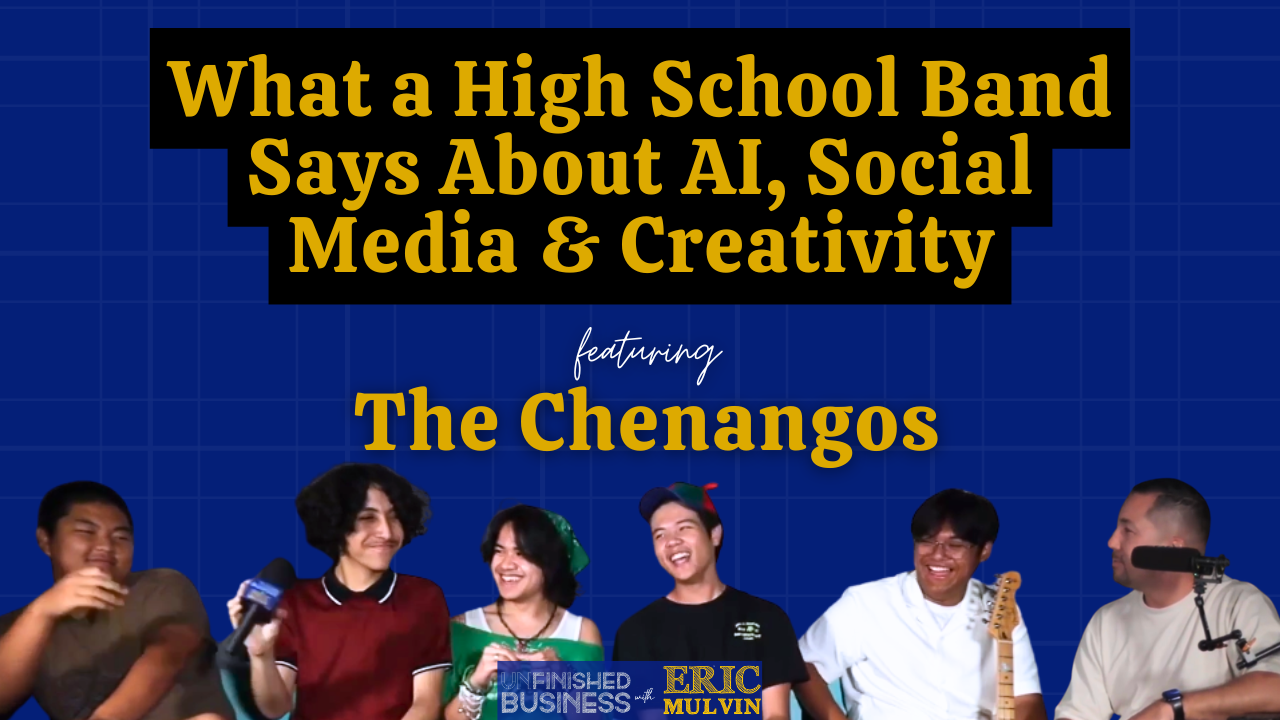
[Creator Series] What a High School Band Says About AI, Social Media & Creativity | The Chenangos




What can a high school band teach business owners and creators about AI, social media, and staying creative?
The Chenangos are a group of high school friends from Orange County, California, making music in a world where artists are increasingly expected to think about algorithms, views, followers, and content alongside the music itself. Drawing inspiration from The Beatles, The Ventures, surf rock, jazz, funk, and other artists from generations before them, they’ve developed a perspective that feels surprisingly relevant to anyone trying to create something today.
The band officially came together almost by accident. Days before a school talent show in January 2025, drummer Joey Bernabe needed a backup band after his original group fell through. His friends stepped in, they rehearsed once, performed together, and The Chenangos were born.
In this episode of Unfinished Business, Eric Mulvin sits down with The Chenangos to explore what it looks like to create in an era dominated by social media and rapidly evolving AI. They discuss the pressure musicians face to chase trends and build an online audience — and why focusing too much on what gets views can pull creators away from the work that made them want to create in the first place.
The conversation also tackles one of the biggest questions facing creators and businesses today: Where should AI fit into the creative process? The band shares where they believe AI can be genuinely useful, from learning new skills to restoring old recordings, while explaining why they don’t want technology replacing the human process behind making music.
Along the way, they talk about friendship, creative chemistry, learning from previous generations, finding an audience without losing yourself, and what they hope to accomplish before graduation takes their lives in different directions.
Whether you’re building a band, a business, or a brand, The Chenangos offer an unexpected Gen Z perspective on a challenge every creator faces: How do you embrace new technology without letting it dictate what you create?
Listen to the episode to hear what a high school band can teach us about AI, social media, creativity, and making something because you genuinely love making it.
Episode Highlights
00:00 – Welcome to Unfinished Business
02:23 – How The Chenangos First Came Together
04:04 – One Rehearsal Before Their First Performance
07:15 – Early Bands, Friendship, and Getting Serious
10:06 – Why They’re Drawn to Surf Rock, Jazz Fusion, and Older Music
12:41 – How The Beatles Inspired Their Music
15:26 – Getting an Unexpected Talent Show Reaction
16:24 – Their Goals Before High School Graduation
17:35 – Writing Original Music as Young Musicians
20:40 – Does Social Media Help Young Artists — or Distract Them From the Music?
24:10 – Where AI Belongs — and Doesn’t Belong — in the Creative Process
29:24 – What Gen Z Really Thinks About AI
34:43 – The Story Behind The Chenangos Name
36:09 – Will the Band Continue After Graduation?
41:00 – Their Musical Unfinished Business
About The Chenangos
The Chenangos are a high school band based in Orange County, California, blending influences from surf rock, jazz fusion, funk, pop, and classic rock.
The members became friends through school and music, with several playing together as early as eighth grade. The current group officially formed in January 2025 when drummer Joey Bernabe needed a last-minute band for a school talent show. With only one rehearsal, the group performed together and decided to keep going.
Their musical influences reach across generations, including The Beatles, The Ventures, Masayoshi Takanaka, Miles Davis, John Coltrane, and other classic rock and jazz artists.
As they enter their senior year, the band hopes to play more live shows, record original music in a studio, and continue developing a sound that reflects their wide range of influences.
Band Members
McCoy – Rhythm guitar
William – Lead guitar
Joey – Drums
Oliver – Keys
Liam – Bass guitar
Connect With The Chenangos on IG
The Chenagos – https://www.instagram.com/thechenangos/
Follow Unfinished Business with Eric Mulvin:
Instagram: https://www.instagram.com/bizwitheric/
Facebook: https://www.facebook.com/profile.php?id=61560126743830
TikTok: https://www.tiktok.com/@bizwitheric
YouTube: https://www.youtube.com/@BizWithEric
LinkedIn: https://www.linkedin.com/in/mulvin/
Powered by Pac Biz Outsourcing
Pac Biz Outsourcing helps transportation, SaaS, software, and eCommerce companies scale customer support and back office operations with dedicated teams in the Philippines.
Learn more: https://pac-biz.com
Email: info@pac-biz.com
Podcast: https://pac-biz.com/podcast
Transcript
Eric Mulvin: 00:00
Welcome to the Unfinished Business. I’m your host, Eric Mulvin, and this is a show where we sit down with CEOs, leaders, creatives, and visionaries who are out changing the world through their business, through their leadership, through their creativity, or through their organization. Because it doesn’t matter who you are or what you’ve accomplished. Even someone like the Beatles still had stuff that they wanted to get done at the top of their career. And so we explore those stories here today on Unfinished Business with Eric Mulvin.
Theme Song: 00:27
Unfinished business.
Eric Mulvin: 00:51
Our next guest is a group based out of Orange County, California. They play a variety of genres such as surf rock, jazz fusion, and more. They formed as a group in January 2025, but we’re all friends with each other since their eighth grade year. They’re currently seniors in high school and graduate this next year. And so, ladies and gentlemen, help me welcome our next guest, the Chenangos. Alright, welcome to the show, guys. Hello. Cool. Well, I’m excited about this interview because uh this is something a little different. You know, we do have in our intro, we bring on creatives. I want to bring on musical guests. My last guest was a local DJ, plays on the radio out here, Power 106 and K-Day and stuff like that. So and I’ve had a few other musical guests that have won different awards. So I’m excited to have you guys on. Welcome to the show.
William: 01:44
Hello. Hello.
Eric Mulvin: 01:45
So first up, I gave a little intro to your band here, but I think it’d be much better if you guys give the intro. And so, first, I guess let’s start with introducing yourselves. So just pass the mic down. Tell me, what do you play? Your name.
McCoy: 01:58
Hi, I’m Mikoy Lavastia, and I play electric guitar, and I’m the rhythm guitarist of the group.
William: 02:04
I’m William Pyon, and I play lead guitar of the group.
Joey: 02:09
I’m Joey Burnabe, and I play drums of the group.
Oliver: 02:12
I’m Oliver, and I play the keys of the group.
Liam: 02:16
My name is Liam, and I play bass guitar.
Eric Mulvin: 02:21
Alright. Now that we got to know you guys and uh what instrument you play, so tell me a little bit about the band and like why do you how did you guys form? What’s up? Like, why do you guys exist?
William: 02:33
We’ve been through a lot. In 2022, our band director, her name was Miss Massey, she would let us play, just rehearse in her classroom after school for like 30 minutes. And we were a big fan of the Beatles back then, too. And you know, we wanted to perform in front of an audience, so we were pretty motivated to practice for that. And we wanted to copy the Beatles rooftop performance, but no, we didn’t. We just played Wipeout. But fast forward to 2025, our drummer here had a little inconvenience with his other band, so he asked us to help. And you know, we played the same Wipeout song for the talent show, actually. That’s when we formed for that. You you want to tell the story about that?
Joey: 03:21
Yeah. So in January of 2025, our school was having a talent show, and I was set to play a cover of Heart Shaped Box by Nirvana with a different group, but everyone bailed last minute. So literally a couple of days before the performance, I believe, I asked these guys if they wanted to perform with me, like as an emergency backup performance, and it actually worked out really well, and that’s how we performed. We had one rehearsal for that.
William: 03:55
Yeah, there’s a video out there somewhere.
Eric Mulvin: 03:57
So one rehearsal, and you did your first live performance together as a band. What made you guys be able to click so well? Have you for like practiced jammed out before?
William: 04:07
Yeah, we have. In our eighth grade year, we performed for this mandatory school thing. It was Festival of Learning.
Joey: 04:17
Yeah, yeah.
William: 04:18
It was just us four that played it, and including another member. He wasn’t in yet. Sorry, McCoy.
McCoy: 04:25
Oh, yeah, I joined pretty late.
William: 04:27
But we we played that wipeout song and we were we were still familiar with it for the talent show, so all we had to do is just refamiliarize ourselves with it and just one rehearsal, and that was it. It was really good.
Eric Mulvin: 04:40
Have you guys thought, like, because you all met minus you maybe you did you all meet in eighth grade?
Joey: 04:46
Yeah, I yeah, we might friends with him, but um he he wasn’t a random kid.
William: 04:50
Yeah, he he he wasn’t into guitar at that time yet.
Eric Mulvin: 04:55
Like uh did you get him into guitar just to join the band, or how did that work out?
McCoy: 05:01
How did how do you do that, McLean? So I bought the Shadowcaster, like literally the last day of school back in eighth grade, because I want to learn guitar because these guys are pretty inspiring. But uh it took really long time for me to get into it, so I think January 2025 was when I actually decided to do it properly.
Eric Mulvin: 05:25
That was eighth grade, and then January 2025, you were what it was a sophomore year, right? So it took like so it sat on the shelf for like two years.
McCoy: 05:33
Oh yeah, the strings are pretty rusted. Yeah.
Eric Mulvin: 05:39
And what made you uh finally pick it up and say, Alright, I’m gonna do this. We needed a rhythm guitarist.
McCoy: 05:46
Oh yeah, they they need a rhythm guitarist.
Eric Mulvin: 05:48
I was like So pressure from these guys over here.
McCoy: 05:51
Their previous rhythm guitarist was gone. And I had a guitar line around, so I decided why not play it? And I think it was what was the first song we played?
William: 06:03
Three Falls of Fire.
McCoy: 06:05
Oh yeah, oh for for that one, that was I was on a piano. Yeah.
William: 06:10
Yeah, wait, what song? Sleepwalk you played, right?
McCoy: 06:13
The first song that I ever probably played with these guys was Sleepwalk, and it was pretty good. It was fun.
Eric Mulvin: 06:19
Was it worth it?
McCoy: 06:20
Oh yeah.
Eric Mulvin: 06:22
Alright, so and you they didn’t make you audition? You were able you were in instantly? Pretty much, yeah.
McCoy: 06:28
Oh yeah, they just picked me up.
Eric Mulvin: 06:30
Alright, cool. So what was it like? Uh I mean, you guys were you guys all into music in eighth grade already?
William: 06:37
Yeah, uh, we were all in the same band class together. Oh, you gotta hold the mic. Oh. Yeah, we were all in the same band class together. So that’s pretty much how we knew each other.
Eric Mulvin: 06:48
I was asking you guys about like, were you into music eighth grade? So already you guys were into music in the eighth grade. It wasn’t and so that’s how you guys all met up was because of band though? Yeah. Okay. And did any of you guys think hey, we’re gonna be in a band one day at that time? Not at all.
William: 07:04
Like we had a previous group. It was oh goodness. Oh goodness. We were called the Roots. Uh that failed miserably, because you know, half of us were taking it seriously. The other half thought it was a joke, so we didn’t really have any good rehearsal time. And then yeah, we all kind of just reconnected into the Chenangos in sophomore year.
Eric Mulvin: 07:35
So it worked out. So you guys have been let’s see, that was 2022. Well 2025. What was 2022?
William: 07:46
That’s when you guys started Yeah, it was like when we started to think like a band, like we thought, oh, let’s just form together and try being serious and stuff. And it didn’t really work out that you know we were we were still focused on eighth grade class.
Eric Mulvin: 08:04
Alright. Let me hear from some of these guys. We got Liam.
William: 08:07
I’m Liam.
Eric Mulvin: 08:08
Oliver. Okay. So Liam, what was the big change? What went what you guys were kind of like just kind of messing around, and then you started getting serious in 2025.
Liam: 08:20
I mean, I wasn’t in that talent show that these guys were talking about. I was I was kind of too chicken to do it, but I don’t know what it was. It was it was probably the spring concert of that year, right? Yeah, yeah. What song do we perform? New Zealand. Yeah, it was we were performing a song called Till There Was You. It was by the Beatles. I decided to do that one. I fight I guess for me that was the big change because that was when I was like actually in the band. But I don’t speak for everyone, so I can’t really tell you I can’t really say what like the big biggest change was. So I’m gonna just pass it to you, Oliver.
Oliver: 08:58
Well, yeah, I mean, I guess yeah, all of us had different changes at different times. Like me personally, I was in like a bunch of smaller groups outside of this one, so yeah, just different moments in our life just changed how we viewed music. Yeah, yeah.
Joey: 09:15
I was actually friends with two with both of these guys prior to junior high and high school, and in seventh grade, this was it seventh grade was when he started playing bass. So sometimes we would get together and we’d play sometimes.
Eric Mulvin: 09:30
Okay, okay. So got and I’m curious, you guys are in a lot of different bands, and I feel like that’s not normal for high school kids, right? Talk to me about that a little bit. Like what like any of you guys, like what yeah, how did you guys all get into all these different bands? And I don’t know, like that’s uh not normal, I think.
Joey: 09:54
I’m in like how many, like four different bands? And that’s just because that’s just because I like playing other genres of music too. Like surf, surf music and jazz fusion and all that stuff is isn’t like my top. Like my main stuff is stuff like all like alternative rock and all that kind of stuff. So I have other bands for those, and then these are the guys I go to when I want to do like surf or jazz fusion or funk or anything like that.
Eric Mulvin: 10:24
So let’s talk about that for a bit too, because it’s not only are you guys like unique that you’re in a band, but you’re a choice of inspiration, right? Like Beatles, okay, that’s not too I mean, that’s they’re pretty popular. Some of the other bands, the ventures, is that yeah. And I I had to be honest, I’m not familiar with the name, but then when I looked up their music, I’m like, oh, I know all this music. Everyone’s heard it, maybe just not familiar with the artists, and then there was another one Joey had mentioned that’s a Japanese. I’m gonna butcher the name.
Joey: 10:59
How do you say Masayoshi Takanaka?
Eric Mulvin: 11:01
Thank you. So you got some really fascinating inspiration to like kind of build your music around, which is again not normal. Most people, I feel like you’re getting like most people, what kind of music are they singing that are in high school? Not what you guys are doing. Well, here. So typically your generation, your age, what kind of bands are they like, what kind of music are they doing?
McCoy: 11:33
A lot of performative music, like Bossa Nova, Leve, and Claro, and uh Tunia. Wait, no, that’s uh Leve’s sister. Alright, Oliver, you know the you more you know more music than I do. Sabrina Carpenter.
William: 11:52
Yeah, yeah. Yeah, no, it’s just yeah.
Joey: 11:55
But there are some other people and my other groups of friends that play this some of them play the same music, some of them play like the other genres that I’m more familiar with. Like, I have a friend that’s in a metal core band, so there’s other there’s other stuff like that too, but I don’t think it’s like the main majority of what people our age would usually play these days.
Eric Mulvin: 12:19
Yeah, so how did you get into this genre solid music?
Joey: 12:25
Me personally, I got into this because the Beatles was the first band I started with when I started playing musical instruments, so I’ve loved them for a really long time.
William: 12:38
My fifth grade teacher, his name is Mr. Hunt. Hi, Mr. Hunt. We were doing this like music appreciation topic, and he put on the Ed Sullivan show, and he had the Beatles on it, and I was just I really liked it, so I just went home and I listened to it on repeat because I enjoyed all the melodies and the harmonies and the guitars and stuff, and that’s when I started getting into the Beatles. I I’m a big fan of that 60s rock. Yeah, that’s pretty much how I got into that stuff.
Eric Mulvin: 13:09
But it all of you guys at the same time just got into it, or was there one person that like pulled you on, like, yo, I just listened to this Beatles album, you gotta listen to this thing.
William: 13:18
You know more about that, Joey.
Eric Mulvin: 13:20
But I and I guess you have a different angle because of your appreciation for music. Like you’re not listening to it like, well, this is like good music, but like you’re listening to it from different perspectives. Like, listen to this, listen to this artist, or listen to this part of the drummer, listen to this part of the song, right?
Joey: 13:37
I actually have a kind of funny story that took place a very long time ago. In fifth grade, when I started playing guitar, like I said, the Beatles were the first band that I loved. So there was one time he was the only other musician that I knew, and I tried to force him to play bass and he quit.
Eric Mulvin: 14:02
Why did he quit?
Oliver: 14:03
I’m just I wasn’t into that style of music. I mean, I learned to like it more, appreciate it, but at the time I was more into yeah, a lot more complex. Sabrina Carpenter? No, no, no, no, no, no, no. Way more complex music. Like, I don’t know, like jazz in general, like yeah. Miles Davis and John Coltrane, and just yeah.
Eric Mulvin: 14:28
Is any of your like these again are not like common music that people like even my age, like I don’t know a lot of people that listen to jazz. So was there like what were what was the inspiration behind like getting into this older music? Because I mean like I’m thinking about like a lot of your parents, I don’t think even that’s like before their time.
Joey: 14:53
My parents listen to hip hop.
Eric Mulvin: 14:54
Yeah, exactly.
Oliver: 14:56
Well, for me it’s just the experience overall, like just yeah, to try something new, like dip my foot into different waters and yeah, build from that.
Eric Mulvin: 15:07
What’s been the most surprising reaction you guys have gotten from like performing this kind of music?
William: 15:15
To get people to cheer for us.
Eric Mulvin: 15:17
Oh, here, take the mic.
William: 15:19
To get people to cheer for us.
Eric Mulvin: 15:21
You were surprised that people cheered for you guys?
William: 15:23
Yeah. Yeah. At the talent show, everyone was screaming like it was a Beatles concert.
McCoy: 15:28
Oh man, that was me.
William: 15:30
One of my friends almost threw his underwear at us.
Joey: 15:32
Oh, no, no, no.
William: 15:34
Hi, Chris.
Eric Mulvin: 15:38
Okay, so but so you guys weren’t expecting that reaction. What were you guys thinking it was gonna be like? Like a like a golf clap? Yeah, pretty much. That was cool.
William: 15:48
Everyone, everyone at school thinks we’re weirdos, so before the show.
Eric Mulvin: 15:52
Yeah, or did that change anything? They’re like, oh, they’re weirdos, but that could play good music. Yeah, I guess. Yeah, yeah, pretty much. Yeah, yeah, yeah. Alright, so senior year high school, it’s your last year, and you guys are all in the same school, right?
William: 16:11
Yeah.
Eric Mulvin: 16:12
So what do you what’s your plan with the music this next? You got it’s July right now, about to be August. School’s gonna start in a couple weeks. And this is your last year together in high school, and then I don’t know, you’re gonna see where you go from there. But what’s your guys’ what do you guys want to accomplish this next year in with the music?
William: 16:33
My personal goal for this band is to actually go into a studio and record something, like one of our songs, you know, because we never really had the opportunity to do that. That’s my goal. What about yours?
McCoy: 16:48
You can come back to me and I’ll be okay.
Joey: 16:51
How about you, Joey? Kind of the same as William. I want to record stuff in studio, and I also wanna I wanna play more gigs with these guys. Like that kind of thing.
Oliver: 17:06
I just wanna write original music. I want money.
Eric Mulvin: 17:16
So talk to me about the writing part too, because again, a lot of bands did I just think they just do cover stuff. They’re not really writing their own music typically. What’s uh and are you trying to do songs that are kind of like the genre that you’re like a modern version of you know, like the Beatles or uh that kind of style? What are you guys trying to do when you’re coming out with music?
William: 17:44
Probably just take a simple chord progression and just build off of it. I think that’s how most songs usually be are formed. What about you guys? Leon.
Eric Mulvin: 17:58
I mean, are you trying to stay like a certain style, right?
William: 18:00
Like Yeah, you know, we’ve written a few like pop songs, mercy beat songs. It’s more simple stuff. It’s nothing too technical because we we don’t have the equipment for that. We just have amps and guitars. But yeah, it’s it’s really simple things. I don’t know. I’m I’m not too sure about that. It’s just How about you, Liam?
Eric Mulvin: 18:28
Wait, what was the question? You guys are coming out with original music, right? So what uh kind of music are you guys trying to put together?
Liam: 18:38
Um I don’t know. I probably music that’s like sorry, probably music that’s like simple enough to be like friendly towards like many different audiences. Like we don’t want to make things things too like complicated. Because I remember like I was in a phase where I wanted to like put every instrument in every song, but obviously we don’t have those resources. But I think now I think the goal is just to make more simpler, but also like like hey, this song is kinda like it’s kinda catchy, kind of thing.
Oliver: 19:10
Like something that lands but like isn’t um yeah, yeah.
Liam: 19:14
Like something that’s not repetitive, but you know, something that’s like whatever genre works as long as it lands and is not over the top, right?
Oliver: 19:26
Yeah, basically. Just to keep things simple, essentially.
Eric Mulvin: 19:31
So you’re keeping it open. We’ll see. Do you have any? Back to you.
McCoy: 19:36
Oh yeah, yeah, you guys never went back to me on the whole goal thing. I I I kind of just want to be in like play for fun. It’s a bit boring out there. Yeah. I also want to be known. Yeah.
Eric Mulvin: 19:49
Alright, well, where can we go with that? Social media. Do you guys have any like a social media accounts for the band at all?
McCoy: 19:57
Yeah, we have one that’s made on Instagram. It’s called the Chenangos. Just that it. Yeah. We posted like a couple videos. This guy made like what three posts today. Yeah. Yeah. Just graphics of our like concerts. It’s pretty cool.
Eric Mulvin: 20:17
Well, you guys are just starting out, and I mean, you’re in high school, there’s no pressure. You don’t have to put that kind of pressure on yourself. But I do find, you know, there’s a lot of people that watch the show that are don’t know much about your guys’ generation. So, how do you guys feel about like social media? Are there is there pressure now to like perform on social media? Like now you gotta show a certain face on there. I don’t know. What do you guys how do you feel about it? Because I grew up with no social media, and then I had Facebook and all that in my space, and I know a lot of people aren’t so thrilled with it, you know, we’re like, uh, do we need to do that? But that’s a way to get your name out there.
McCoy: 20:57
Yeah.
Eric Mulvin: 20:57
So it’s a double-edged sword. Well, how do you guys how do you guys feel about social media?
McCoy: 21:03
I think we don’t really have to be competitive. I just want to be like, if the caters to like a good like a crowd that likes our music, then hey, we’re happy about that.
William: 21:15
I think trying it’s become really hard with social media, like if you want to start advertising and stuff. And like advertising your music, because back then, if you want to get like a record deal, you just sent in a demo to the record company and then they reply to you and say, Hey, we like that. But yeah, with social media, the standards are so much higher, it’s it’s almost impossible to get recognized if you’re like a small group like us.
Oliver: 21:47
Not only are the standards like so high, but they’re changing.
William: 21:51
They are changing.
Oliver: 21:53
Like what? Like what’s some of give me an example? No, no, like something that may have worked like five years ago, may not work now. So like you just constantly
Liam: 22:06
I also think that something interesting about social media is that like if you think about it, like there’s no really a mainstream band that has been put out there by social media. Like if you think like trying to think of like a song that’s on the radio where it’s popular, like that song and that band, like I don’t think their voice really came from social media. I think a lot of people think using social media it like propels them, right? But as I as I see now, I don’t see many bands that have come from social media. Like I could be wrong. But I think a lot of bands in social media, they kind of just do the social media part and not really the music part. They deliver on like a lot of false promises because of like that like such high expectation and advertising of their music, you know.
Eric Mulvin: 23:00
They’re after the views on the reels instead of like making like some some really something that has like some soul in it or something that you can be like, oh I know I can I can feel what they’re saying.
Joey: 23:11
Yeah, yeah. And also with like with social media, I mean on like I think the bright side of it is that you’ll attract the people that will like actually enjoy yourself, but like I’ve seen a lot of other I got into a lot of bands through social media, but I’ve I’ve seen through like a lot of other bands where all they’re doing is just posting like trends and stuff like that, yeah, and not really showing off their music, and I I just feel like they should be showing their showing off their music more, you know.
Eric Mulvin: 23:45
Yeah, yeah. Alright, we’re talking about social media. Love the answers on that. Thanks for sharing. Another thing we talk about a lot on this show, and I think you guys have also a very interesting perspective that the audience would love to hear. AI. And AI and music specifically, I’ve actually had a few guests on, and we talk about the show now. I have a big I have this belief that I have a phrase I say AI plus HI. Like AI is okay, but with human intelligence, you gotta, and I’ve heard I’ve had this topic with a lot of different guests, so it’s really fascinating to see the different perspectives. But everyone agrees you can’t just do stuff with you need like there’s no soul, it’s like missing something if you’re just using AI. I like the last guess, he’s like, you could use it as a boost, you know. But I was like, like he’s like, if you’re driving a car, it could give you a little boost. And some people are using it and they’re driving the whole car with AI instead of like a little boost. So, but so there’s there’s a lot of different angles, but I guess we could talk about AI through music. And you guys are out creating original music with real instruments, putting in the hard work in a hot garage, playing for hours and practicing for hours instead of saying, Chat GPT, give me some more notes for this song, make it more cheerful, make it more, you know, or go into whatever sauna, whatever the different AI tools to make music. So, and then too, you could also bring in different instruments using AI. So I want to hear what you guys all have to think about AI and and music.
Joey: 25:22
So, me personally, as for the use of AI and art in general, I just feel like it’s not I I don’t think it’s ethical in my opinion. I believe that you should work with whatever you have and also because uh actual like music that comes out of like the soul is it’s very important and it adds a lot more meaning to it. Like I don’t know actually, but I I’m personally against like the use of AI and like art and music and all that stuff because it’s I just don’t think it’s it’s I don’t think it’s genuine, I don’t think it’s that ethical, and yeah. Cool.
William: 26:13
Yeah, I agree with a lot of what Joey said. However, AI can be useful in some ways, like restoring old audio recordings. How the Beatles finally made their final song, they used AI to bring back John Lennon’s voice, because in the original tape demo it was too muffled out. But with the use of AI, you can help restore that stuff. You know, it’s it can be helpful in that way. But I don’t think just making music from scratch, I think that’s really it doesn’t really give others a chance.
McCoy: 26:48
If you wanted to like make music, you just don’t know where to like start from, you can use AI. Like, who’s gonna who’s gonna stop you, right? But if you wanted like have like a base of what you want to start, do like what we did. We just listen to like a couple like music artists and we just like hey, that sounds pretty good. Let’s either cover it or we have that style of genre and we make our own music out of it. So yeah.
Eric Mulvin: 27:16
I love it.
Oliver: 27:19
Oh, yeah. No, I feel like AI could be used as like a learning tool, perhaps. Like if you don’t know how to make a song at all, then like you can like easily learn it. Four tips, four tips, yeah. But like I don’t think it should be used directly in the process of making it. Like, whether it be the ideas of the actual song or like the actual instrumentation, notes, chords, or whatever, that should be natural, but like before then, like I guess the basis of hey, like how to make a song, like what does it have? Oh, most songs have this, this, that, that, then like, yeah, no, I guess that could be used, but yeah, at the end of the day, the actual process of making it should be completely human.
Liam: 28:04
Yeah, I’m I agree with Will with how AI could be used to restore old music, like lost music, and the actual creation of music, in my opinion, I don’t think AI should be used like at all. Like that may that might be controversial, but I just think like the way how you said like using AI and asking for like advice, like sure, like I guess that could work, but I feel like asking advice from like another musician could is more valuable because because of their experience. So I feel like just the communication and interaction between action musicians instead of like you and a machine, I feel like that doesn’t you you interacting with a machine to create music isn’t really I don’t think is really fulfilling in terms of creating music.
Eric Mulvin: 28:54
Appreciate all your answers. That’s awesome perspective. What about AI in general? Like I’m curious, take away the music part, like what does your generation think about AI? Like, is it good, is it bad, is it not necessary, is it gonna ruin the world, or is it gonna make the world better? What do you guys think?
Liam: 29:14
So I think like I think AI is useful, right? But if you read any articles, it’s a lot of it seems like it’s very harmful too, to like pollution, no like noise pollution with data centers. Like it’s become an entire thing on social media. And I wish there was just a way for AI to be more sustainable or more like humane. Because again, like I think it’s very useful. Like the Gemini, it it just gathers all like information, just gives it to you, but those same data centers are like ruining like a lot of people’s lives that are just trying to live normally, I think. And yeah, that’s just that’s what I think.
Joey: 29:58
I personally, a lot of people that I know about don’t support the use of AI really. I I me personally, I do agree objectively, it could be useful in some cases, but also it’s just very harmful to the environment and to the people that live around data centers, and all of their stuff is just getting like messed up. So I think if there was a more ethical way and a more like humane way, then it would probably be a lot more popular.
Oliver: 30:32
You know, I agree with both of these points, but I find something ironic is our generation tends to use AI a lot on school assignments. On school assignments, okay.
Eric Mulvin: 30:42
Yeah, and just I could only imagine well we had Wikipedia, that was like our our cheat because before that we had to like look up stuff in the encyclopedia, and people thought that was cheating, but now you got yeah, even some teachers unfortunately use AI to make assignments, so that just how is Wikipedia still banned?
William: 31:09
I’m afraid for those doctors and those going into the medical field.
William: 31:14
Oh yeah.
William: 31:15
Because if you’re going to like doctor school or something and you just use AI to just cheat your whole way through it, you’re gonna have to perform a colonoscopy some of these days. You’re gonna have to ask AI, how do I do colonoscopy? And then you know, if the if the data center explodes or something, they they don’t have that knowledge.
Eric Mulvin: 31:36
Hallucinates or hallucinates and it’s like this is how you do it.
William: 31:40
Yeah, so and just the way people process information. I feel like that’s the really dangerous part about AI.
McCoy: 31:50
I think yeah, AI shouldn’t really be like your whole main focus. I think it should be like as a side tool. I had an idea about this like like a while ago, but it should just always be a side tool. It shouldn’t be like your main thing to run a coffee blender or a coffee machine, a shower, a house. Dude, it’s crazy, but like, yeah, it’s a side thing. You don’t need to like ruin other people’s lives because of how much water they’re taking. So yeah. Also the electricity bill. Oh my lord.
Eric Mulvin: 32:22
I know you guys don’t have to pay power bills yet, but I know in Phoenix our power bill has gone up. I think it’s supposed it’s been about 15% or more just because of the data centers. So it’s an actual cost. There’s uh some real problems it’s causing.
William: 32:37
My mommy pays for everything.
Eric Mulvin: 32:40
See, y’all ain’t gotta worry about that yet. But what about AI in music where like you’re all right, you’re posting your stuff on social media. Maybe one day you do the recording, you get some stuff on Spotify. Now you’re competing against other people who are making music with AI. How do you feel about that?
McCoy: 33:03
Wait, wait. I have something. I think if that were to happen, Spotify should have a filter. Yeah, filter out all the AI stuff.
William: 33:13
Alright.
Liam: 33:14
I feel like it I feel like a lot of AI music and songs aren’t taken as seriously. And I think I think that that’s just the fact that it is made by AI. Like may people might think like, oh, this sounds really bad, and this sounds really dumb. A lot of people might think that. So I don’t think as of now, like, there’s much competition with real creators and AI, but who knows, like the technology could get really advanced in like maybe just a year.
Joey: 33:44
I think like music streaming sites like Spotify and all that stuff definitely need to have like some sort of AI filter because especially like recently I’ve been seeing like a lot of people being fooled by AI music and thinking it was made by real people, and that’s just kind of not a nice thing to see, you know. So, yeah. Cool. Well, thank you guys for sharing that.
Eric Mulvin: 34:09
And we’ll switch big gears back to the band. So, what we didn’t talk about yet, where did you guys come up with the band name? There’s gotta be some story behind that.
William: 34:26
My grandpa, he lives in upstate New York, and the county he lives in is called Chenango County. You know, I found that out, and then what we wanted to come up with is that we wanted to mix shenanigans and flamingo together, and then it just became Chenango.
McCoy: 34:46
Oh, wait, yeah, that was yeah. That was it.
Eric Mulvin: 34:49
Yeah, pretty much.
McCoy: 34:50
Okay. It was the whole shenanigan part.
Eric Mulvin: 34:54
So are you gonna like do a performance up there one day in upstate New York?
William: 34:58
Maybe they have a big stage for the local town. New York tour. Maybe.
Eric Mulvin: 35:06
Well, they’ll be they’ll come out like who is this band? It’s named after our city. They’re like, wait, they’re not from here?
William: 35:11
Yeah. That’ll be a fun one. That’ll be pretty cool.
Eric Mulvin: 35:13
Yeah. So let’s see. You guys are I mean, I don’t know much about vans in high school. Like, is the hope that you guys are gonna be like together after high school still making music?
William: 35:30
What are you guys what’s the it’d be nice, but when people go to college, have them go on the other side of the country, have them go to another country to go to school. So I mean, it’d be nice if we all stayed together for at least a few years after we graduate, but we well, we don’t know where we’re gonna end up. There’s offered time to tell.
Eric Mulvin: 35:52
You have any hopes there or any comments on that?
Joey: 35:56
I personally hope we do at least here and there, like performances every once in a while after high school. But it’s like what William said, it’s kind of uncertain because things could happen after high school. People have different plans, people go to different colleges and stuff, and they just drift apart. So I hope if that happens, at least we’ll still get together every once in a while. Do a reunion tour? Yeah, yeah.
McCoy: 36:24
Jackson’s five reunion tour.
Eric Mulvin: 36:27
Tour around Orange County? That’d be nice. Do you guys have stuff to say about it? No, no, not really. Okay. Alright. Disappear right after this. That’s okay.
McCoy: 36:38
Yeah.
Eric Mulvin: 36:38
What about do all of you guys wanna do like a career in music? Every one of you guys? Where do you want to take the music career?
Joey: 36:52
Well, aside from also playing with these guys, I also want to be like a professional like session musician and that kind of like that kind of thing. I just want to do something with music down the line.
William: 37:07
I want to become a music educator. My inspiration was my middle school band director, Miss Massey. And after she passed away, I just feel like I need to inspire people to learn music like she did for me.
McCoy: 37:22
I want to be like a even though what we’re doing is like pretty cool, I also want to join like another band, like a jazz band. Like jazz like put me into music a lot more, like expanding my taste, especially Dave Steinmeier. Oh, oh man. Dave Steinmeier, I love your music.
Eric Mulvin: 37:43
Man, I wonder if you guys hung around older people having these conversations, and like how do they respond? They’re like, How do you know these people? Because I’m imagining they’re probably shocked.
McCoy: 37:54
There was a guy earlier when we were like rehearsing, he was like, Yeah, there was there used to be like a couple of other garage bands like in the 70s, like three houses down.
Eric Mulvin: 38:05
Yeah, so and you guys live here this whole time to know that?
McCoy: 38:08
I think so, dude.
Eric Mulvin: 38:11
Yeah. How do people react to your guys’ like throwing out jazz musicians? I know a few people that are into jazz, and every time they talk about their bands and stuff, I’m like, I have no idea who you’re talking about. It’s like this whole other world. I was just like, well, how what’s people’s reaction when they’re like you’re hanging out with some older people talking about these like jazz artists and these different bands that are yeah, like people don’t like you’re able to have a whole conversation with someone like a boomer.
McCoy: 38:39
Oh just have an old soul, bro. My age is 78.
McCoy: 38:46
Oh no.
McCoy: 38:48
There’s an age on there, yeah. Spotify rap just shows you’re in your Spotify age.
Joey: 38:54
I think my Spotify age was like 40 something. But I don’t know. I I’ve been doing music for so long, I’m just kind of used to other people not being shocked about the fact I listen to the music that I do, or like I am into like the bands that I’m into, or like I play like because my mom was the one that like got me into like all of them all like all of the music I like right now, and also my aunt was uh she was a drummer like 30 years ago, so she also knew like all that stuff too, so I kind of just grew up with it. How about you guys?
Oliver: 39:37
Anything else to add? I just play saxophone, so people just assume I would know old people.
Liam: 39:49
Yeah, I think it’s also the fact that most of us are in jazz band, like we’ve been doing it, like some of us have been doing it for one year, some of us have been doing it for two years, so I think just doing that, like it’s given us a lot of knowledge of old artists.
Eric Mulvin: 40:03
Cool. Well, we’re getting close to the end of the show here, and there’s always a question I asked the guests. This one’s a kind of interesting one, and it can go a couple different angles, and maybe you could just hear from each one of you guys. But the show is unfinished business, and I bring on people who have accomplished a lot in their career, a lot in their business, running like hundred million dollar companies, people who have won Emmys for their work, won different awards, businesses that have a million people using their business. But with you guys, you’re just starting, you’re like still in high school. Your story is like barely even written. So, but the question unfinished business for you guys, I guess it could be like, well, the one question I ask the people is like, what’s that big thing in your lifetime that you’d like to be able to accomplish in music? So I guess that could be the question for you guys is like, because I I could hear with the band, you know, we’ll see what you know what ends up happening. You got your season that you’re in right now. So I don’t think you know the goal is to go triple platinum with the band, you know. Yeah, necessarily, maybe, who knows? But in your individual careers in music, you all want to do music. Like, what’s your goal? What’s your big goal that you’d like to be able to do in your lifetime?
William: 41:25
I want to be able to teach generations of kids how to appreciate music and how to embrace and play it.
McCoy: 41:36
Oh man, I want to be like an outstanding trombone soloist like David Steinmeier. Oh man, I love your work.
Joey: 41:46
I I want to spread my music out to the world, I guess. I want pe I want people to know my music. I want to get people into music, I want to inspire people, and like what William said, I’m like I want to make people like appreciate like music and all that kind of stuff.
Oliver: 42:12
No? Oh, okay. I just want to play whatever I enjoy, and if people resonate with it, well then I’m glad. Regardless, um no really much of like goal for fame or for money or for anything, just personal enjoyment.
Liam: 42:31
I don’t think I really see myself in a future where I keep going with music. Like I think like after high school, probably a few gigs, a few performances, but like I don’t think I’m ever gonna make an impact like in the music world. I don’t think I’m gonna like I don’t think I’m gonna be rolling in money by doing music. So I don’t I don’t really see myself doing anything like maybe like 20 years down the line.
Eric Mulvin: 42:55
So now I’m music. So what’s your unfinished business? I what’s your what do you see yourself doing the future?
Liam: 43:03
I don’t know. I think the most ideal future for me is just to live comfortably, like to have like a stable job. I don’t know what job I want, but I just want I don’t think I want to live a life full of excitement, full of like like constant things happening. I kind of just want to live a more comfortable life at the end of the day.
Eric Mulvin: 43:22
Yeah, that’s a good goal to have too. So cool guys. Well, thank you for sharing all your perspectives and really love hearing everything you had to share about music, about AI, about your band, your history. And if people wanted to check out the band, I think you mentioned the Instagram. Is that the only place to find out about your music? Yeah, and if you want, if you guys want to, you could also drop your personal social media if you want anyone to follow you there. If you’re you don’t have to, but well, we put the graphics on the screen and then we put we could put links in the show notes. So if you want.
McCoy: 44:46
I might be posted to some music in there, but it’s been pretty inactive. Just not just not McCoy.
Eric Mulvin: 44:55
Alright guys. Well, and if uh for people watching, if you guys like today’s episode, you want to hear more uh amazing interviews from people like musicians, from business leaders, from nonprofit leaders, from uh all kinds of people, make sure you follow at Biz with Eric on social media and look up the podcast. We’re on Apple Podcasts, iHeartRadio, Spotify, anywhere you listen to podcasts, Unfinished Business with Eric Mulvin. And uh hope you guys enjoyed this really unique episode and uh leave some comments so I can see uh if you guys want to hear more stuff like this, and uh yeah, I’ll uh we’ll we’ll bring some interesting guests on. But we’ll end the show with one of their performances so you can check out the band. And uh, if you want to follow them, links are in the show notes. Uh until next time, thank you guys for watching. We’ll catch you on the next episode. See ya.
William: 45:46
Thank you.