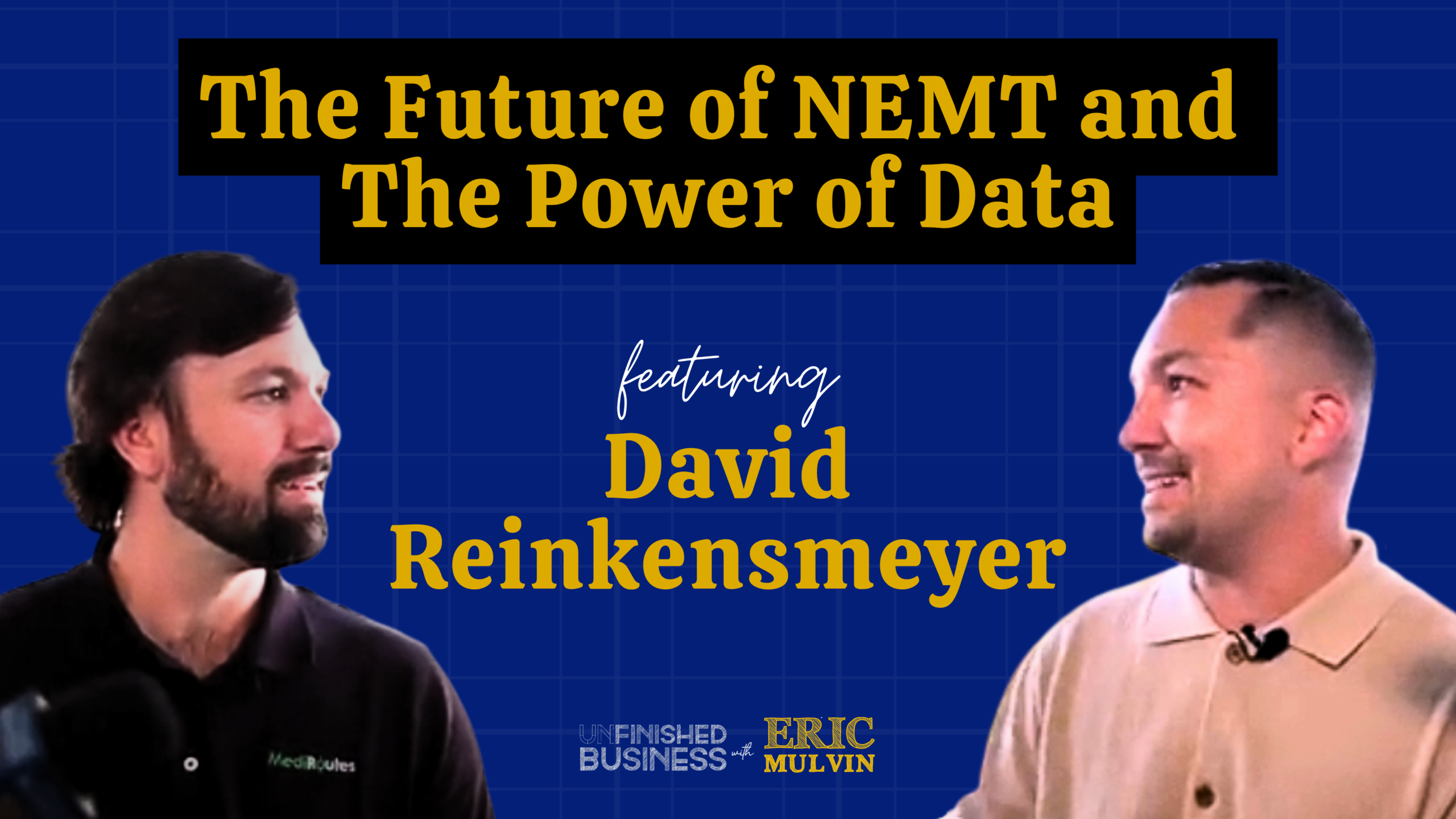
[Transportation Series] The Future of NEMT and the Power of Data | David Reinkensmeyer




Are you running your transportation fleet or is it running you into the ground?
In this episode, Eric Mulvin is joined by David Reinkensmeyer, the CEO of MediRoutes. David shares his “Aha moment” of transitioning from running a Non-Emergency Medical Transportation business to building the software that is now revolutionizing space. They break down the very real ROI of automation, why tech is no longer optional for fleet survival, and the hard truth about work life balance when you are building a new team from scratch. If you are an operator looking to scale or a founder trying to survive the storming phase of your startup, this episode is a masterclass in execution.
Subscribe for More
If you enjoy conversations with leaders who are building businesses and changing communities, make sure to subscribe and turn on notifications.
Episode Highlights
00:00 Host’s Introduction and Setup
03:22 The Aha Moment. David discusses his transition from being a transportation provider to building MediRoutes after realizing the industry lacked efficient scheduling software.
12:15 The ROI of Automation. How moving away from manual dispatching can save thousands of dollars in payroll and drastically reduce human error.
25:40 Adapt or Die. The upcoming shifts in the NEMT industry and why technology is becoming a strict requirement for survival rather than just a convenience.
36:15 The Sine Wave of Balance. The brutal truth about the forming and storming phases of a business. Why you have to work sunrise to sunset before you ever get to take your foot off the gas.
42:10 Real Culture vs Fake Culture. David shares his philosophy on building a company culture that actually retains employees rather than just putting a ping pong table in the breakroom.
58:30 Unfinished Business. David shares his personal vision for the future of MediRoutes and his goal to continue providing accessibility to those who need it most.
Connect with David Reinkensmeyer
- Email: david@mediroutes.com
- Website: MediRoutes.com
Unfinished Business with Eric Mulvin
If you enjoy conversations with leaders who are building businesses and changing communities, make sure to subscribe and turn on notifications.
- Instagram: @bizwitheric
- Facebook: https://www.facebook.com/profile.php?id=61560126743830
- TikTok: https://www.tiktok.com/@bizwitheric
- YouTube: https://www.youtube.com/@BizWithEric
- LinkedIn: https://www.linkedin.com/in/mulvin/
Powered by Pac Biz Outsourcing
Pac Biz helps transportation, SaaS, software, and eCommerce companies scale customer support and back-office operations with dedicated teams in the Philippines.
Learn more: https://pac-biz.com
Email: info@pac-biz.com
Podcast: https://pac-biz.com/podcasts
Resources Mentioned
- MediRoutes. The leading scheduling and dispatch software for the NEMT industry.
- MJ Reliables. Leading logistics and consulting experts specializing in NEMT operational efficiency.
Transcript
Speaker 2: 00:00
Welcome to the Unfinished Business Podcast. I’m your host, Eric Mulvin. This is a show where I interview CEOs, visionaries, leaders, and creatives who are out changing the world through business, through their organization, or through leadership. Because it doesn’t matter who you are or what you have accomplished. Even someone like Henry Ford still had something he wanted to accomplish and do with his business. And so we explore those stories today on Unfinished Business with Eric Mulvin.
Speaker: 00:43
It’s a close, it will learn why.
Speaker 2: 00:49
This episode is brought to you by Pac Biz Outsourcing. Pac Biz helps NEMT providers run more reliable operations with dedicated remote support teams in the Philippines. From scheduling and trip planning to broker calls, writer updates, trip checks, and reports. Pac Biz works within your processes to help cut missed calls, improve dispatch flow, and make better use of your fleet. Pac Biz is also building AI-powered QA tools that help any MT companies respond coaching needs faster and improve call performance with clearer insights. To learn more about how Pac Biz supports any MT companies, visit our website, pack-itiz.com, or you can give us a call Monday through Friday during business hours at Oregon at 771-3009. All right. Without further ado, today’s guest is the CEO of MediRoutes, one of the nation’s leading software providers in non-emergency medical transportation. His career has been built at the intersection of enterprise software and healthcare with a focus on building products, leading teams, and using data to make better decisions. He’s been with MediRoutes for over eight years and has previously worked with Vanguard, Banner Health, and Solomon Consulting, and has served on the NemTech Advisory Board since 2021. Ladies and gentlemen, please help me with welcome. David Reinkensmeyer.
Speaker 3: 02:10
Thanks, Eric. Great to be here, man. It’s a pleasure.
Speaker 2: 02:12
Awesome. I’m so excited. We have been well, we’ve gotten to know each other over the years for a couple years now.
Speaker 3: 02:19
Yeah. I think the first time I met you, you you held a microphone like this up to me, and I took a pair of socks from you with taxi cabs on them. So that was a good day.
Speaker 2: 02:28
That’s yeah, then at least I think it was 2022. Okay. You’re out the date when that was.
Speaker 3: 02:33
Sounds right. Yeah. Well, it’s great to be here, man. Thanks for having me on.
Speaker 2: 02:36
Yeah, absolutely. So for the people who are watching here today and don’t know MediRoutes or much about NEMT possibly, I want you to explain to the audience what is it you do and uh yeah, what is MediRoutes?
Speaker 3: 02:48
Oh, sure. Yeah, just uh for those that don’t know, you know, NEMT, non-emergency medical transport. We like to joke is sort of the redheaded stepchild of healthcare, which, you know, it gives it a tough position. Yeah, it’s really that intersection between, you know, there’s there’s ambulances up here doing a lot of emergency work. There’s there’s Ubers and taxis down here doing, you know, curb-to-curb work, and then this whole world in between where medical patients need to get to a dialysis appointment, a methadone clinic, a preventative care appointment. And, you know, maybe they can take a bus or maybe they can’t. And if they can’t, you know, they may need help with a wheelchair, accessible van, that kind of thing. So we serve about 800 plus transportation providing fleets across the United States who specialize specifically in non-emergency medical transportation. And so we build routing, scheduling, dispatching, billing, and automation software to hopefully, you know, make their days a little bit easier and make it easier for them to serve the riding public, these passengers who many of them are, you know, Medicaid, Medicare recipients or even private health insurance recipients. So all in the name of preventative health care.
Speaker 2: 03:50
Cool. And there’s a lot to go into there, a lot of angles you could talk about from what you guys cover. But I think a lot of people, you know, they’ve been familiar with taxis or familiar with Uber, but I think unless you had to interact with an NEMT company, you probably have no idea there’s a whole world out there, a whole industry that people don’t know exists, right?
Speaker 3: 04:11
Yeah, I mean, even myself, I think back to I was working at Slalom Consulting about eight and a half years ago, and I was actually working on the contract with Banner Health for a year or two, and we were working on a provider, you know, scheduling platform. And it was we were so enthralled with booking the appointment for the provider and getting it all digitized. And I branded this gentleman on the tennis court. We started talking and he introduced me to MediRoutes and actually introduced me to NEMT. I didn’t even know what the concept really was at that point, even though I was working at a you know major healthcare provider, working in software, working on appointment booking. So yeah, I do think it’s a kind of a niche field we’re in and uh really glad to be serving the public doing it.
Speaker 2: 04:46
So that’s an interesting way how you landed in this space, and I didn’t realize that. So because I mean, today you’re CEO, you’re running the company, you got 300 plus customers, but you didn’t start out running the company.
Speaker 3: 04:58
No, no, yeah, I was brought in, was introduced to the founder of would that be 20 early 2018. We got lunch, kind of saw the office so they had a couple developers at, and then I have one support guy uh who’s still with us, Scott Thomas. Hi, Scott, if you’re on, and I think maybe just a couple training staff across the country. So it’s a pretty small outfit at the time. And you know, once I kind of learned a little bit about what Steve Smith, the founder, had been doing, he had worked at Trapeze for a long time, which is the Paratransit software company, and he had uh, you know, kind of, you know, tried to retire from Trapeze, start his own company, and originally I think was doing, you know, pool maintenance scheduling and eventually, you know, got sucked right back into NEMT, uh, which is kind of a sister to paratransit. So yeah, when I met him, you know, I think they had probably 150, 200 clients maybe using the application. So he definitely had proved uh a lot there. Uh and they were really, I think Steve was at the age where he was saying, you know, I’m in my mid to late 50s, I’m ready to get off the keyboard. I’ve been writing code for for 40 years now, 35 years. And so when, you know, I saw the opportunity to jump from the consulting firm, which at the consulting firm I’d had the rug pulled out for me a few times where you’re on a project, and you know, whether it’s your own doing or usually not, right? Just something with a company that is sponsoring it, you know, oh my our CapEx dried up this year, whatever the answer is, you know, your project might get pulled. And so the idea of going to a company where you’re working in healthcare, hopefully helping the world out a little bit, and being able to work in software and and theoretically hang on to a product for many years, which you know, here I am eight years later going strong. So that’s how I came in was the director of product development. And I was tasked with getting Steve off the keyboard. He is off the keyboard now, unless he gets bored and wants to pop in on a project. But yeah, so it’s been a lot of fun. Now we’re about 25 staff, and yeah, like I said, about 800 clients nationwide. And last year, about 16 million NEMT trips went to our software. So about $850 million of non-emergency medical transport was managed using many routes for their routing dispatching. Yeah, it’s it’s been a fun ride, man.
Speaker 2: 06:59
Pretty significant. Well, congrats on that.
Speaker 3: 07:02
Thank you so much. Yeah, it’s really credit to the team. We’re just and and the clients that they’re doing the hard work. We we just get a lot of good feedback from them, put it into action through the software. So we enjoy it every day.
Speaker 2: 07:12
So, what what position did you get in in the company? Where did you get started?
Speaker 3: 07:16
Yeah, so I started like they called it director of product development, which is really more of like a product owner role. Uh, and so my ask to the founder, you know, was basically let me make a few hires, give me a little bit of budget. So every you know, every week we can show you what we built. We call that a sprint with a sprint demo. And when we show you what we build at 9 a.m., then at noon, I want to take the team out. We’re gonna have lunch, we’re gonna go, you know, bowling, top golf, whatever it is, give these programmers a break. And so, yeah, when my job when I came in was really, I think of it as still to this day, but as a servant leader, just try to help out with asking questions, writing documentation, helping test the application, uh, interviewing clients, interviewing staff members, listening to the support calls, working with our support and training team to figure out what are our clients asking for, why are they asking for it? Can we build that in software or or can we give them better documentation or tools to do it easier? And then kind of just feeding that back into a roadmap for the company or, you know, the product side at least of the company. And I was in that position for several years, built the team out to maybe eight or so folks on the development team, and you know, just helped try to get some processes in there and learned a lot along the way. And then, yeah, the founder asked me to just kind of step up and do a little bit more. So worked as a COO for a short stint. I’m I’m not the best operations guy. Shout out to Morgan Landry who’s helping us with that. And then more recently, title change, you know, small company, but yeah, currently serving as a CEO and very, very happy to be at the helm. Yeah.
Speaker 2: 08:40
So did you we’re, you know, a lot of people watching the show, we really target business leaders. Sure. And I think a lot of people maybe end up in positions they never thought that’d be that you as well.
Speaker 3: 08:52
Yeah, I can’t tell you when I was, you know, I don’t know what I was at the time, but working as a consultant at Slalom, got a lunch with uh with Steve, you know, the founder of MediRoutes. I never thought I’d be in a position to call myself CEO. So it’s very humbling to be honest. But yeah, I always knew I just like to ask good questions, learn new things, and then I really do like building out a team. So I think that’s been Steve’s put a lot of trust in me over the years to build out a good team and you know, of course, made some missteps over the years too, but enough of the hires have been well enough thought out. We’ve had good success trying to keep the team together. And so through that, yeah, I think he’s just said, take on more, take on more. And so, yeah, like I said, small company titles are weird. I really haven’t a lot of fun doing it.
Speaker 2: 09:32
That’s awesome. And then talk to me a little bit about the NEMT space because I know that’s been growing dramatically, you know, especially like when I first started my business, my first business was a taxi cab company in 2011.
Speaker 3: 09:45
Oh, yeah.
Speaker 2: 09:45
And I know I actually one of my first mentors, and I I can’t recall the name, I’d give you a shout out, QTS Transport. Oh and it was through score. Yeah, and he was like he was helping me out. It was very early on, but and I didn’t know anything about any MT. I’m just like, man, you got these old vans that uh needed to be updated a little bit at the time. But that was my exposure to it. And I haven’t like it wasn’t until you know, maybe 20 around the time you were got involved with any routes that it started becoming a bigger and bigger deal. So tell me, tell us about what’s been happening in the industry, you know, leading up to like how did it get started? How did this blow up? I guess. Let’s start with that.
Speaker 3: 10:23
Yeah, good question. And I think QTS is a client of ours, if I’m not mistaken. Uh that’s a that’s very small world there.
Speaker 2: 10:30
I want to say his name was Steve. I don’t know that I made another Steve.
Speaker 3: 10:33
Okay, yeah, yeah. I apologize. I don’t know the name off the top of my head either. But yeah, and I still think of myself as a student, uh just in general, and with NEMT as well. You know, coming from the software world with some healthcare experience, it’s been, you know, trial by fire into NEMT, just trying to figure out, you know, you think of it as like, oh, it’s the Uber of healthcare, which I guess there is an Uber health for that. But you know, it’s just so much more complicated. When you take an Uber, somebody pulls out a credit card, they pull out their phone app, put the credit card on the app, they click get me a car. Some driver just drives there and they get an alert. And so you really get you have Uber, you’ve got the driver, and you got the passenger, and Uber’s just kind of making the market as a marketplace. NEMT has just so many layers between who’s you know actually paying for the transportation and who’s receiving it and who’s providing it. And so we see it with our clients, you know, who have fleets and and a team of drivers and maybe some dispatchers to help manage all that and the call center efforts, because it might not be as tech savvy of users as an Uber or a Waymo or a Lyft app is. And so, yeah, to talk about the whole history, I’m not sure if I’m the right guy. But yeah, my my understanding is that as you know, through the Affordable Care Act, as preventative care became a bigger and bigger focus for our government dollars, basically saying, hey, if we could spend money now, you know, and if it’s $30, $50 a ride to get a passenger to a healthcare appointment or a patient really to a healthcare appointment, that might save us a $20,000 ER bill as a society. And so, you know, I think that the social determinants of health, one of them being, you know, can you get to the actual physicals and can you get to your PCP appointments? Can you get to your, you know, whatever it is, oncology appointments? And so my understanding is that that’s kind of when the ball got rolling pretty heavily, not to say there wasn’t any MT prior, but I think a lot more efforts were made towards it at that time. And then frankly, I mean, you bring up the taxi industry, we we we both go to that TTA, the Transportation Alliance annually, and both I think both of us, you know, are involved in that organization to varying degrees. But my understanding, talking to a lot of those taxicab folks, is that once Uber and Lyft came into the market pretty much overnight, you know, their their taxi business was dead. And so that to for them to be able to swim upstream to maybe white glove services like Limos or, you know, higher levels of service, especially in the medical field through non-emergency medical transportation, it was a big opportunity for those folks that had invested a lot of time in drivers, vehicles, you know, operational etiquette.
Speaker 2: 12:48
They have a lot of them run maintenance shops, like a full-on repair shop.
Speaker 3: 12:53
Yeah.
Speaker 2: 12:53
That can fix and maintain all the vehicles. And so yeah. So a lot of the infrastructure to just throw away. So and and I a lot of these guys, I mean, these are I I don’t know how I don’t know if it’s like this in NEMT space as well, but I know in taxi, yeah, but heavily, you know, multi-generation family businesses that have been around 50, 100 years, some of them.
Speaker 1: 13:14
Yeah, yeah.
Speaker 2: 13:15
And so like the last thing you want to do is be the one like killing off that legacy. How can we keep this business going? So pivot into NEMT. And I’ve seen that a lot with some of our clients, where they’ve acquired NEMT companies or just straight entered the space over the last couple of years. What have you seen over the last like couple years? What are some trends happening?
Speaker 3: 13:34
Yeah, I mean, I think maybe from a side that you could view it as negative or just, you know, I think it’s gonna come out on the positive side, but there’s been a lot of focus on fraud waste and abuse. And so as a technology provider, that’s both a challenge to us and an opportunity. And so, you know, we’re seeing more and more in the so that I guess just for those folks at home who might not be super familiar, I mentioned how the money moves, but I didn’t really get into it. You know, NEMT 101, you’ve got federal tax dollars being spent on Medicaid and Medicare. I want to say it’s about two trillion dollars spent annually by the US government on Medicaid and Medicare. And so then that trickles down to the states who then need to pick someone to administer a plan. Those those states typically pick an MCO, a managed care organization. So that could be like Aetna, Humana, Blue Cross, United, Anthem. You know, we would think of them as insurance companies, but they’re technically considered a managed care organization in this case. And they will bid on a request for proposal from the state or from the municipality, which is usually that combination of federal and state tax dollars. And then their job is to, you know, they’ll they’ll win that population of Medicaid or Medicare recipients. And so maybe it’s a million folks in the Phoenix metro area that they win a contract for, then they’ll turn around and sell off, you know, five cents on the dollar of that will be a new request for proposal that’s specifically for NEMT because United Healthcare or Aetna, they don’t want to run their own NEMT fleets. Some of them might, but uh, most of them, that’s not their primary line of business. They want to make sure there are practitioners and health clinics and all that taken care of and all the actual insurance paperwork and all that call centers. And so they’ll outsource the NEMT. And so as the dollars kind of uh move through there, we’re seeing, you know, more of a focus on fraud, waste, and abuse because it it in the past, if you were using, you know, paper 1500 forms, like if you’re trying to get a reimbursement from Aetna, you know, through the federal government for Medicaid or Medicare claims, it would be pretty easy to kind of fake it. You know, and so now through the advent of technology, I think, you know, being adopted more and more, a lot of what our job is is as MediRoutes is to make sure that our clients have the tools they need so that the data that proves that they actually picked up a real passenger and actually took them to a real healthcare appointment that existed at that facility. Um, that’s kind of what our you know breadcrumb GPS would prove and our signature capture that we have and other you know metadata we have about the trip, and getting that over to whether it’s the NEMT broker or the you know the healthcare plan like Aetna directly in real time is a is a is a higher higher stakes. And so I think there’s just been so much focus, focus on fraud, waste, and abuse and trying to mitigate that. And so uh we’re seeing you know just more and more technology adoption in the field. But yeah, that’s just that’s just one that comes to mind. But what are you seeing out there these days, Eric?
Speaker 2: 16:14
Well, for me, I well, one of that conference uh I went to last November at the TTA Transportation Alliance. That was my first time going back since I was holding the mic in front of you, giving out some. Oh, no kidding. Okay. Okay. Uh so for me, it was a lot of new players, a lot of technology companies that weren’t around three years ago, is what I’m seeing.
Speaker 3: 16:39
Good point. Yeah, if I wanted, you know, when I when I joined MediRoutes, I think I want to say we had two or three legacy, you know, competitors that were $100,000 implementation. They were really made for paratransit, like state municipalities and all that to to use for for uh whatever it would be uh bus systems or or rail systems, whatever. And they kind of said, Oh, you can use this for any MT. Or same thing with taxi, cab software. They said, Oh, you could use it for any MT. But we only had probably three to four direct competitors that were NEMT software focused, like us at the time. This was eight years ago. And then, you know, pretty quickly to your point, I think the last conference I went to would have been, yeah, NemTAC in I think it was Dallas in 2025, just this last fall. Yeah. And I want to say there was about 25 competitors there. And frankly, with the advent of you know, vibe coding and then Claude and uh Codex and all this AI coding, which is pretty incredible tooling. I’d love to talk more about today. I think we might have 250 competitors next year. You know, and I think some of our clients are gonna be, you know, building their own apps. I’m sure they will. And so I think it’s it’s it’s cool. You know, you could get freaked out about it, or you could say this is a great opportunity. You know, there’s gonna be a lot of a lot more competition coming, a lot of code to be cleaned up, a lot of integration work to do. Yeah, that’s to your point. I think as more competitors enter the industry, why is that happening? Well, I think it’s getting easier to code. And also I think people are finding out what NEMT is and they think of it as a potentially untapped, you know, market.
Speaker 2: 18:04
Yeah, a lot of attention to pop up here in the US, you know. I mean, AI is a big big market, you know, buzzword thing, but something like NEMT, they’re kind of relatively new. I mean, uh been around, but in it the state is in that. Like for me, the other observation I had was how many brand new companies were there? Like star or people that are like, I just started this up a year or two ago. And we got two cars, some of them have 10 or 12 cars, and so there’s a lot of people that are maybe not too knowledgeable what’s going on, they’re trying to learn, they’re trying to. I mean, it reminds me a lot of when I first started my taxi cab company. We got our fleet to like nine vehicles. The stuff we had to learn going through that was crazy. And I’m like, man, there’s like what how many, like maybe 10,000, 15,000 NET companies in the country?
Speaker 3: 18:52
That’s what they’re saying. Yeah. And I think, you know, we as much as we do love that we are building tools that hopefully help society, healthcare. We also, Steve’s a big proponent of entrepreneurship, right? He’s an entrepreneur himself. I consider myself to have a spirit of an entrepreneur, uh, even though I didn’t start this venture. You know, all of our clients are entrepreneurs. And so some of them, to your point, come from a legacy, a family of entrepreneurs. Honestly, we see a lot of immigrants come over and this is their first, you know, business they start, right? Because maybe the barrier to entry is not incredibly high. You can go get yourself a vehicle and a license, and now legally you are able to, you know, get some certifications, some credentials, and register with whoever it is that is, you know, dulling out the NEMT trips in your area. So yeah, and I think with the advent of the gig economy too, you know, if you are currently working as a driver maybe for DoorDash, Uber, if hostmates, what have you, you know, I think there’s some opportunity in NEMT to feel like, no, this isn’t just, you know, the technofeudal overlords giving me my little pennies for for delivering somebody’s fast food. I can actually start my own business, build my own book of clients, and I could actually expand and I can employ my family and my friends and have my own fleet. And so that’s, you know, again, not to plug many routes, but that’s what our tool helps people do, but really they’re doing the work. And I think to your point, yeah, we’re seeing more transportation management software out there, but there’s a reason for that. And it’s because we’re seeing more transportation flow through the economy, and we’re also seeing more transportation providers and jump right into NEMT. It’s a pretty cool time being it.
Speaker 2: 20:18
I mean, at any time where we have a lot of change happening, a lot of innovation, it’s always exciting. I mean, that’s going back to why did I at 26 years old start a taxicab company?
Speaker 3: 20:28
Yeah, I’d be curious.
Speaker 2: 20:34
In 2011, Uber didn’t exist. There was no apps. You had to hail a cab at the bars on Mill Avenue.
Speaker 3: 20:42
I remember calling them up at two in the morning. I said, I’m on the corner of you know Congress and six that, you know, I was down at U of A.
Speaker 2: 20:48
So And congrats to upcoming uh Marshmallows.
Speaker 3: 20:51
Oh yeah. Oh man, it’s been a it’s been a wild ride. Fingers crossed, uh bear down.
Speaker 2: 20:56
But yeah, like I, you know, the whole scenario of like calling for a cab, uh, we’ll let you know in 20 minutes and like good luck if it even shows up. Then that was the world. I was like, it’s gonna be better. And so I actually came up with like 50 pages of my own idea for my own app. Okay. And we did have the first app in Arizona in 2012 that you could book a taxi.
Speaker 3: 21:16
Really?
Speaker 2: 21:16
Well before like any of the other companies, well before I even heard of Uber. So yeah, it’s pretty legit. Wanted to really get into disrupting things, and that’s what I’m seeing now, you know, in the space is all right, there’s obviously a need. There’s a lot of companies here. I mean, that means probably what there’s PE hasn’t maybe it’s starting to get make its way in here now, but like sure, yeah. There’s opportunity, blood is in the water, the sharks start coming. Yeah, so that means the industry is going to be adapting and changing. You know, maybe the what might have been easier for someone like an immigrant to come in and start with just on his own might need a couple more resources. And now you’re competing against people with a billion dollars, you know, in in their back pocket.
Speaker 3: 21:56
Yeah, and ironically, I don’t know. The competition I think on the provider side is Still there. The transportation providers themselves, you know, on the fleet side, I think they are competing on prices, unfortunately. And that’s where, you know, the part when we’re talking about how the money flows, and you got your federal money going down to your state, who then gives it to an MCO like at Air Humana or whoever, then they dull out that contract to a broker. And that’s ModivCare, MTM, Vayo, Alevi, Access to Care, you know, there’s there’s 50 of these, probably 20 ones you may have heard of, Safe Ride. And so I see that portion of the industry changing because those brokers right now kind of sit in between the managed care organization and the transportation providing fleets who are actually out there doing the work. And, you know, middleman? Yeah, it’s a middleman thing. And I think in every industry where there’s a long-standing middleman, you eventually they get kind of chopped at the needs, usually through technology. And so a lot of these brokers are purporting to be, oh, we’re, you know, we used to be call centers and actuarials, but now we’re a tech company. I just, I I have my skeptic, my skepticism about how they’re going to be able to adopt, you know, and actually become the tech company that the health plans are requiring, right? The health plans are saying, I’m using Uber when I go to a baseball game on the weekend or church or whatever it is, and if I can see where my driver’s at at all times and I know the cost up front and there’s pricing dynamically based on demand and you know, there’s safety procedures and credentialing built into this, like why am I having somebody from my health plan, you know, call the back of a card and wait on hold like they’re back in 2011 trying to hail a cab? So that’s where we see, you know, a lot of potential. I do think that’s where PE might be coming in to say, you know, what’s going on in here? Can we replace the brokers? Are we going to buy a broker? You know, they’re they’re very they’re very interested in the industry as well. So like I said, if we’re doing, yeah, probably this year $900, maybe a trillion dollars worth, or I’m sorry, excuse me, $900 million or a billion dollars worth of NEMT, and we’ve got a lot of competitors, we think we’re one of the bigger ones, but there’s probably, you know, I don’t know, five, ten billion dollars flowing through this industry is my guess. And so yeah, curious to see.
Speaker 2: 23:57
There’s a lot of pie left.
Speaker 3: 23:59
Okay, yeah.
Speaker 2: 23:60
So I mean, your tool is enabling operators to be able to run businesses better, right? And before, because I could imagine like when I first started my taxi cab company, there was, I mean, I don’t know, I don’t know. I had there was no technology, you know, like you were built like I worked with a startup out of Germany that built the dispatch software. And I mean, the the nightmares I’d have on Friday night when that would go down because it was a startup and it was like they’re still trying to, I mean, it was brand, brand new technology. But tell me, do you have any stories about like maybe a particular customer that because they latched onto your software that enabled them to really grow and expand?
Speaker 3: 24:37
Yeah, we kind of, you know, I’m trying to think of a particular client story. Generally speaking, you know, I guess instead of the intro in which you kindly uh spoke about me, I you know, I I try to look at the data, you know, as a whole across the network that we support. And what we see is if clients start off, a lot of clients start off with two to three vehicles. And if you get stuck there, you’re you’re probably not gonna have a good time. The one of the things that we’ve kind of seen through data is that these clients, when they get started as a transportation writer in NEMT, if you start off and it’s you and your cousin and your, you know, your wife in my case, maybe, you know, three vehicles, that’s a tough place to be, right? You’re you’re you’re still doing the back office admin work, you’re still answering the phones, you’re trying to dispatch, you’re trying to learn the technology, but you’re not really at that critical mass. If you can get up to about eight vehicles, we call it a kind of over the hump in our world, then things start to go very smoothly for you. And those clients that do get over that level are able to grow quite quickly, specifically for for our tool, you know. So I guess that’s just more than anything if you have a list, if you’re a listener and you’re thinking about starting an NEMT business, or if you recently have, you know, don’t quit and try to push through that first whatever, it could be three months, could be a year, uh, where you’re at three to four or five vehicles. You’re not alone and it’s very hard. And uh, there’s a lot of cool resources like Eric’s, you know, podcast and some others out there. MJ Reliable, shout out to MJ Reliable. They do a lot of good work teaching people the ins and outs of NEMT and getting them ready, you know, to make that jump up to eight or more vehicles. But aside from that, yeah, once you’re using software like Media Routes, one of the stories I think was kind of interesting, Alex Stathis is one of our clients out in Chicago, and he’s worked with us for, I want to say, he’s been a client for at least 10 years. So he’s come out to our user conference several times in in Arizona. We do one every spring in Scottsdale. And he told a story that I think might resonate with a lot of people. I was mentioning earlier when you’re in NEMT, you know, you end up getting a lot of phone calls, right? And so I know your business can help people with this as well. But if you’re not using something like Pac Biz, that can be pretty overwhelming. And so one of the small tools we have that could supplement something like Pac Biz, which is outsourced call center, whether you’re training, you know, these folks are trained. I ask you, like, I don’t know. We use Erica for uh uh we use Pac Biz for the outsource call center, and it’s great. One more shout out to Ariel who’s helped us out for uh many years. But yeah, if you are just getting going and let’s say you’re in medials, you could use a tool in there called notifications, and it basically gives that same Uber, DoorDash, Domino’s Pizza experience to your passengers that you know, that that they’re used to with other applications. So what does that mean? Instead of getting, you know, 10 calls every morning for, hey, which driver’s gonna be picking me up today, what time are they? You know, they’re late by three minutes, right? You can send a hyperlink out via you can set a text message with a little link in it. And when your passenger sees a text message, it might say, Hey, this is ABC Transport, and click this link to see your vehicle. They’ll be there in 45 minutes, right? And you they click it and they’ll see, you know, a picture of your driver if you want, they’ll see a picture of the car if you want, they’ll see your logo if you want. And then in real time, it’s showing the driver on the map and kind of saying, you know, they’ve got two stops until they pick up to pick you up, right? There’s no HIPAA data in there, so it doesn’t say they pick up Sally, right? It just says two stops, 15 minutes until they pick they’re at the location that you were going to be at. So that can be a really helpful tool. It kind of gives passengers peace of mind as to where they are. I think Alex said that cut down about 60% of his phone calls just by using that.
Speaker 2: 27:59
So we can that’s that’s massive. I mean, 60% of phone calls means if you had a phone of 10 people, now you’re only four.
Speaker 3: 28:06
Yeah, and it’s fine. I mean, that that when you talk about like an evolution of a product, I mean, maybe 10 years ago, that product was simply a robocall out, right? So you could write a script and it would say, like, hi, Eric, this is ABC Transport. And tomorrow you have a ride at 2 p.m. Like, we’ll pick you up at 1 p.m. Click one to confirm, click two to request a cancellation, and it would sound like a robot, you’d know it was a robot, and you’re probably not gonna answer the call anyway. So move fast forward after years of working with clients, asking questions, sitting in their operations, learning, you know, what their dispatchers deal with, what their drivers deal with, and what the owner operator needs, they just want to stop hearing the darn phone ring. And so they’re very happy to say, yeah, turn on the notifications thing, automatically send the text a day ahead, automatically send the text day of and give them the real-time geolocation. So that’s just a small thing that we think has helped out some operators kind of grow and be able to uh release, you know, their staff from kind of mindless work and give them some time back.
Speaker 2: 29:00
Yeah, which we at Pac Biz absolutely support because I don’t want our people doing mindless work. You know, I want us critically thinking, I want us making decisions, you know, having to do stuff that a bot couldn’t do. And if you’re all you’re doing, oh your taxes uh almost there, you know, or your your NEMT vehicle is almost there, that’s that’s not really it’s not really doing much.
Speaker 3: 29:21
So yeah. What what and you guys can do anything. Your folks are dispatching. I know for us you guys handle like we call it tier one support. What else are your folks able to do?
Speaker 2: 29:31
Uh I mean we do yeah, dispatching a lot for NEMT, like checking with I believe, oh man, put me on the spot. Yes, got him. Uh there’s a lot of coordination with the medical facilities, checking with them, checking with the drivers. So when the drivers need support, we’re there to answer. And there’s also like when we’re picking up from a hospital. There’s like making sure we have the you talked about all the people that who includes the one that’s actually paying for the ride. It’s not the person in the car. Right. And so we need to get the right insurance information, we need to get you know broker information and stuff like that, so then it can get charged appropriately. Otherwise, they don’t get reimbursed, and then they’re giving those rides for free. And I want to do that. So there’s a lot of data that needs to be collected. Um, so we help facilitate that. And then your traditional calls, you know, checking in about we work with a lot of medical facilities answering their questions.
Speaker 3: 30:23
Very nice.
Speaker 1: 30:24
Yeah, but thanks for asking. Oh, of course.
Speaker 2: 30:26
Oh, one thing that I always love to talk about uh just as being a business leader is mixing your like personal life, the creative side with business. Because a lot of times business leaders, CEOs, you know, you could work like crazy and never see your family, never have fun. You know, all you do is work, work, work. I know you have a you have a big creative side as well. So talk to me a little bit about that. So what do you do for fun to maybe break out let it let go of some steam? Oh, yeah.
Speaker 3: 30:56
I think uh yeah, you and I I think we share some hobbies for sure. I know we’ve seen each other at some sons games, so that’s always a good time. But yeah, I’d like to honestly try to move my body quite a bit. So if I’m occasionally I will go running, but I play a lot of tennis, hiking, living here in the desert. It’s that’s pretty easy to do, a lot of fun, get on the bike. I’ve started to learn golf, which is like just absolute torture, but for very fun. Someday I will, you know, break 90, maybe. But until then, I’ll just keep saying I need to buy new clubs, which which I’ll I won’t buy. But yeah, and then probably my biggest passion is music, right? So I’m playing really in any instrument that uh well that I can halfway decently play. So I as a kid, I was uh my parents really both were musicians, and my dad still plays a lot of music with me. And he they both instilled in me, you know, hey, you’re gonna take piano from the age of I think we’re eight years old, maybe took piano lessons for a few years, hated it. But you know, you learn the scales, you learn where your fingers go, you learn some basic music theory. And then, you know, they they said, okay, you’re 10 now. What what instrument would you want to play? So I they actually bought me a drum set for my 10th birthday. It was just a little used kit, just beautiful kit. And so I played that, you know, until I could save up enough money to buy a a nicer kit when I was about 18. And I’ve still been, you know, I’ve played been playing drums the last 25 years. So yeah, really love playing drums. And then from there, you know, you you become 15, 16 years old, and you you see these guys playing guitar and they’re getting all the girls in high school. And so I kind of thought, okay, well, maybe I should pick the piano back up, so kind of play that a little bit more, and then eventually learn some basics on on guitar. So uh I’m not a lead guitar player by any means, but I I can mess around on acoustic and yeah. So anyhow, that’s that’s been fun. I’m currently playing a bass in a psychedelic rock band, so don’t ask us our name. We still don’t have one. It’s only been six months, and we just lost our synthesizer player. So we’re if you know any synth players, we’re we’re on the on the lookout. Yeah.
Speaker 2: 32:48
His contact information would be in the show too.
Speaker 3: 32:51
Yeah. But yeah, so I and I think uh before we were getting the podcast going, we were talking, we’ve got a little it’s a little garage detached in my backyard. And so that’s kind of our jam studio back there, and all the instruments are hanging up, and it’s a little mini fridge, and yeah, so we’ll go back there and record or just you know, practice different songs. And yeah, it’s a good way to get out of the office and do something else creative. So yeah.
Speaker 2: 33:14
Like how, because then it means you interact with a lot of business leaders and I’m sure you go to events and stuff. And for you, how important is it to keep that creative side and not not get so pulled into the business that you’re like, ah, you know what? I’m gonna give it a year or two, I’m gonna we’ll focus on the business for now.
Speaker 3: 33:30
Yeah, it’s funny. I think you know, people always talk about work-life balance, and I think it’s a nice phrase, and I think it does exist and you have to find it. But I think there’s just I I think of it more like a sine wave. There’s just seasons where you’re gonna be so incredibly in on the business time-wise. So yeah, like when I was when I first started as a on the product team, I was just, you know, sunrise to sunset, sitting at the office working on things, thinking about it when I was at home, taking notes, watching, you know, podcasts like this from other people that to learn about best practices. And then, you know, once after, I don’t know, for me, it was probably six, eight, nine months, you kind of get your team together, forming, storming, and all of a sudden you’re starting to norm or perform, then you can kind of take your foot off the gas a little bit, get back to normal hours, you know, get more into your hobbies and all that. You know, recently with uh the advent of AI coding, right? I mean, I tried an AI coding app maybe eight months ago. I was like, yeah, it’s not that impressive. It’s okay. It’s something I we’ve, you know, people would have done in college or right after college, kind of junior level. Well, you know, I was urged by a colleague, my hey, try it again. So I went in, was trying some newer tools out the other day. Yeah, so probably over the last eight weeks now, I’ve been spending 50 hours a week just on that with my team because we are just fully, we’ve rebuilt our entire dev process. Like we’ve, you know, uh reconsidered Scrum and all the fundamentals of that, because you know, the iterative process just changed so rapidly. And so you’re almost going back to like a waterfall, more of a requirements design process. So again, now I’m in a season where I’m very heavy into work, but I’m sure in a month, couple months, maybe over the summer, it’ll start to mellow out again. And then you can dive right back into your hobbies. But to answer your original question, I think, yeah, the creative side, the importance of it, and and for me too, just getting a sweat in, you know, is I think my team is happier when I’m happier. And I’m a better leader, I think. I’m a better servant leader to them. I think I’m a better spouse. If I get a little time in the jam room, you know, twice a week, and if I get a little time in the gym or out on the golf course or you know, playing tennis. So yeah, how how are you finding a balance these days? I think you’ve got about 20 things going in all times business-wise.
Speaker 2: 35:33
For me, you know, I I squeeze it in and it’s tough because it’s like sandwiched between something else. Like maybe I’m going out of town the next day. A lot of my um, for those of you guys that are like really into astrophotography. And so that is it’s not something that you can just go out and do any night of the week.
Speaker 1: 35:52
You don’t see stars in the middle of the day.
Speaker 2: 35:55
That’s one problem when the sun’s out. It’s a cloudy day today in Phoenix. Yeah. If it’s cloudy, you can’t see the stars. If there’s a bright moon, there’s about two weeks out of the the month that not really a good time to go out and do astrophotography. And then, you know, like if you go up in July and you look up at the sky in the middle of maybe like 10 o’clock at night, you’re gonna have the Milky Way right overhead if you’re in North America or Northern Hemisphere. But if you go in the the winter, it’s not there, and so it’s constantly moving and changing. So if you wanted to capture something, so I plan out all my astrophotography trips at the beginning of the year, maybe there’s meteor shower happening, maybe there’s a solar eclipse, lunar eclipse. And so I tried those are the planned ones, and then there’s impromptu stuff, you know, like uh just going to Sedona and then oh, we’re gonna go do a photo shoot. So I I squeeze it in, like we’ll drive to Flagstaff and I’ll I’ll pull up, I’ll scout a place off I-17 somewhere where I could take pictures for like 30 minutes, and uh my family’s used to it now, but it’s you know, let’s go pull off into this dark desert road, dirt road in the middle of nowhere. Yeah, but yeah, they’re they’re they’re used to it. It’s an interesting spectrum. But yeah, I I have to cram it in, otherwise, yeah, it’s for me, it’s I’m in that busy season right now with my company.
Speaker 3: 37:09
So I also grew up with a photographer in the house, my father. So yeah, same thing. I got dragged out of the house at four in the morning sometimes to get up to Sedona so he could, you know, shoot sunrise or whatever it would be. But no, it’s a beautiful thing. Do you guys do your you have your kids like do light painting and stuff when you’re out there to paint the rocks with light when you’re doing exposures? Or have you tried any of that?
Speaker 2: 37:28
I haven’t, but I did do a really cool light painting picture with it, and I’ll put them up on the screen here so you can see it.
Speaker 1: 37:34
It was the what is it? It was a Christmas parade. Oh, maybe the uh SRP thing or APS is the EPS Festival Lights Parade in downtown Feeling.
Speaker 2: 37:44
We’re right at Central and Candleback Road. Actually, I mean we’re right by Candleback Road here, but I did I had them doing light painting art in the middle of Central Avenue, which is like when do you get to do that? Wow. It’s only like once a year, I guess they shut the road down to do that. I did someone down, which is really cool. But but yeah, but yeah, getting to share creativity with the kids and and you know, I mean it’s yeah, with your dad. Oh I could go on and on with more questions about that. But I so we don’t make this like a three hour episode. I wanted to talk, you know, you you started getting into like how the how things are changing in coding. And even for you, you know, it it’s really interesting how you stepped away from what was vibe coding you were saying, or yeah, just playing around with codex and claude, and well, codex didn’t exist at the time.
Speaker 3: 38:31
So really I was playing around with that Claude uh through Anthropic, and I thought, oh, this is a pretty junior level output I’m seeing in the in the code and in the output. And I that changed very quickly. Yeah.
Speaker 2: 38:40
So in eight months you saw a shift.
Speaker 3: 38:42
Yeah, yeah. And honestly, it was just that one, I think it was Opus 4.6 came out. I want to say like February 5th, not to be doing an advertisement here for Claude. But and Codex had dropped a new through ChatGPT through OpenAI had dropped a new model as well. I think the same week, maybe even the same day. And I swear some people divide their lives in uh, you know, the A D and B C. You know, this event happened, but yeah, for for our company, I’m wondering for technology in general. I wonder if when those models came out, if it’s uh it just all of a sudden you can build pretty legitimate business enterprise applications and really give it enough context so it’s following your rules, following your best practices, reading through all the, you know, we call them like the wiki, but basically the the handbook or playbook for our developers that we built out over the last eight years. Uh now our AI is using that to write the code, and it actually is doing a pretty darn good job. We could feed it a you know a 50-page business requirements document, and in a couple hours it’ll churn out at least the front end, a prototype with all the hooks and everything ready to be coded on the back end. So we kind of are yeah, spending a lot of time on that because, well, for a lot of reasons. I mean, one, I think it’s it’s making our lives a little more enjoyable as programmers, right? Things are moving so much faster. So that’s nice. And it kind of feels like I think I heard one quote that I don’t know if it’s like a snowplow or a zamboni, but I’m not sure if it matters. But AI is like a Zamboni or a snowplow. You’re either in front of it and you’re about to get run over or you’re driving the thing. And so that’s kind of how we are viewing it. And so we’ve been on all in on it for a little while here and trying to be thoughtful about not putting AI slop out for our clients, but really using it to make our uh coding faster, sharper, better. It’s doing its own self-testing now, self-documenting. I mean, I’ve got my we have frontline support people writing their own applications now through Claude, and they’ll take a call with a client, they’ll record it, they’ll feed that recording into their own app that they vibe coded with Claude, for example, or OpenAI’s codecs, and it’ll check our knowledge base to update the knowledge base automatically and and you know, fill in all, take screenshots. I mean, this is just that’s a front-end support agent, tier one support.
Speaker 1: 40:51
And they created this themselves.
Speaker 3: 40:53
Yes, now they are, you know, full disclosure, living with a programmer. So they they they’ve got a little help, but but I mean that’s you know, that’s a that was an ambitious passion project for that person. And so yeah, I I think it’s yeah, how have you seen it changing, you know, because as a call center world, I gotta think that’s you gotta feel some risk right now, or I don’t know, it’s some changes coming with more AI agents and all this.
Speaker 2: 41:13
Definitely. I mean, for me, I felt the risk two or three years ago, and that’s when we started making changes and pivots and like, okay, we gotta start adapting to what’s happening out there, and that’s where I really started developing this whole concept of AI plus HI. Like great, you need you you could let AI do all this stuff, but you still need a human somewhere in the somewhere in the process, and and that’s where we could put this up. But positioning ourselves, and also how can we take advantage of technology too? So that’s why we’ve been starting to develop our own software on what we know, which is listening to calls. Like we had a QA, we had a QA team of eight people listening to calls all day long, and now I think it’s a team of two or three. And I just from last week to this week, actually, the number of calls that that tool was analyzing, we were able to get it to double. And so that’s that’s a huge change. And so and because we’re not spending so much time listening to calls, we’ve actually took the supervisors and now they’re doing the coaching with agents, and they’re getting some of the feedback on where to coach them from the tools. Analyzing it, here’s what they need to work on. And so I don’t know, it’s stuff that would have taken hours and days, and you know, like so much manpower. And because I I mean some of the stuff you’re saying, like that front-end worker, what is able to build out, and what would that have taken six months ago?
Speaker 3: 42:32
Yeah, just a ton of time and back and forth. And so, yeah, we’re really rethinking like, you know, the roles, not getting rid of anything, but just trying to figure out, you know, it we feel I feel that IT roles are compressing in a sense. You know, I think for for many years, you know, I always joke quickly, anybody that works in IT, anybody that you know will call you and say, like your grandma’s, hey, can you help me with my VCR? It’s like, I guess so, but that’s not really what my job is, right? But I’ll do it, you know, you’re my grandma. And so, but there’s this specialization we’ve seen in IT over the years from, well, that’s a database administrator, and that’s a front-end developer, well, that’s a UI expert, and that’s a UX expert, and they worked in tandem, but they’re slightly different. That’s a business analyst, and that’s a project manager, and that’s a you know, back end full stack, and that’s a yeah. And so, you know, those specializations, not to say they’re going away at all, but as we’re able to, you know, take all the knowledge we’ve learned, document it in like these wikis or for us, you know, these AI, we I call it like the AI factory. I think we’re we’re technically coining it AI platform, but kind of these this book of rules that you can send something in and and it it once it comes out of the factory, it’s going to adhere to all your standards. And so with that being true, I mean, there are going to be people working on the factory, putting in their best practices and inputs to make sure the factory is doing what it’s supposed to be doing. And then there are people who are going to be putting things in the factory and taking things out of the factory. And so I think that does compress the roles down. Or in a sense, it it allows people to play a bigger role, you know, the single person plays a bigger role. So yeah, it’s we’re seeing a lot of changes. There.
Speaker 2: 44:00
Yeah, that’s so fascinating. I’ve I’m wanting to get back into it. I don’t know if you know this. I taught myself HTML when I was in sixth grade and I used to build websites. Oh kidding. Um before WordPress and all that. And so I have this like like so I’m so wanting to jump in and like do the stuff you’re talking about, but I’m afraid I’m gonna get sucked into like down some rabbit hole and I’m gonna start giving directions to my team. Oh, you gotta start doing this, we gotta start, which is maybe not a bad thing.
Speaker 3: 44:26
No, that is a problem. One of the things we are, you know, I joke jokingly or seriously told you about our front-end staff who who are I’m sorry, our person on the front lines as a support agent who built her own tool to help her with her job, which sometimes, you know, if she takes a call and there isn’t a knowledge-based article, it’s her job to create that knowledge-based article. Well, she’s helped automate that so she can take an X call or take a breather or make a coffee, but it is a problem and we’re seeing it all around. You know, it’s a you read about the AI, the advent of AI in these businesses, it’s like, how do you sometimes we’re making our own tools when other tools exist, and that could be good, that could be bad. Sometimes even relying on, you know, like a cloud co-work, if you’re familiar with that yet, you know, that’s anything you do in there, it will do it, but it you’re going to be spending tokens for infinity for it to spin up the tool that it’s being asked to do and produce all that and then bring it back down. Whereas if you just use the cloud code side to actually create the tool and self-host it, you use tokens one time to build the tool, but now you’re using your own infrastructure to run the tool. So just the the governance of all this. It’s like we’re on the wild west edge of, you know, it’s it’s a new frontier trying to figure out what should the rules be, who’s allowed to make apps. Well, we want to encourage everyone to be playing with this stuff. When does an app get used more broadly? And how do we make sure these apps aren’t, you know, taking important whether it’s HIPAA data or PHI or even just our own business, you know, information and confidential information and you know, taking it out of uh, you know, the right governance. So yeah, a lot, a lot to learn still.
Speaker 2: 45:53
And I’m sure as I have seen over the last we’ve been really getting in working with AI now for two or three years. I’m sure you’ve seen some crazy stuff out there, being the wild west where you’re like, Well, what are you guys even doing with this?
Speaker 3: 46:06
Yeah, yeah, yeah. The ClaudeBot episode, that was pretty funny. I don’t know if you saw that. Well, yeah. That’s a if you’re looking for a rabbit hole to dive down, Google that one or ask ChatGPT about it. It’ll tell you. But yeah, you just I feel, yeah, it’s just to me, there’s just been this cosmic shift from using the tools to like write something faster or you know, even producing this bio. It can help with things like that. And it always has been for several years. And then even for code, it would you know, pass a snippet in, or hey, I’m getting this error troubleshooting. But now I we’re starting to have it look at our entire code base and it’s understanding business logic. It’s it’s able to build, you know, soup to nuts applications now, which is kind of yeah, that would have been unheard of. And they don’t look like your kid did it in MS Paint, like they look like they look pretty good, and there’s stuff in there you didn’t even prompt it to do that. You’re like, gosh, that’s a pretty good idea. So anyway, yeah, we could spend all day on that.
Speaker 2: 46:56
But for another future episode, I guess. But I I am curious, though, like big picture with AI. I love asking people about like pull up to crystal ball a little bit. Hopefully optimistic views, but where do you see the world with everything happening in AI? I mean, it’s massive, massive changes. That’s which everyone is talking about. But you’re you’re seeing it, you’re you’re in it. And so where do you where do you see the world in three to five years with AI?
Speaker 3: 47:24
Oh man, Eric. Yeah, that’s a tough one. A good one. So there’s to start in the in the pessimistic viewpoint, there’s AI. There’s a book I was reading over the last, I don’t know, month or two called Technofeudalism. And the guy that wrote it, I think he took over Greeks, he’s a Greek guy, and he took over Greeks, Greece’s excuse me, banking system when they, you know, started defaulting on their credit back. What would that be? Like, I don’t know, 05, 06. I’m not not certain on the dates there. Anyway, so pretty good read. And he’s talking about this concept of these, you know, we thought after the feudal era, we will landed in capitalism, and then the next thing would be even brighter, but it’s almost like we’re reverting back to a new feudalistic era of this these technocrats that kind of own everything, and you spend your bezobucks and your blah, blah, blah. So there is, so I was reading that. Wow, we’re kind of getting hit in the face with all this brand new programming stuff over the last few months that just took a quantum leap, frankly. And it’s not like we haven’t been playing with it for two years, but all of a sudden it’s pretty darn good. You know, full stack software engineers who are 50 years old, been coding for 35 years, telling me, yeah, I’m not sure I’ll ever actually handwrite code anymore. Like I’m just gonna be prompting and fixing things and you know, looking at PRs from a cloud agent or so. That’s kind of the change we’ve seen. But anyway, so as I was reading this book and I’m seeing this, you know, play out in front of me, and and you hear the guy from what is it, Jack Dorsey. You know, he he laid off like 60% of his staff or 40%, whatever it was, and said in the name of AI. Now we all know Jack Dorsey’s probably overstaffed every company he’s ever ran, so it could have been that. Right, right, right. So I do think there is going to be a shift in how people work, but I’ve kind of at least myself and our leadership team at MediRoutes and actually the staff that you know are in that tool all day with us in the trenches, we have kind of come over the hump of any kind of worries with it, frankly. We’re we’re kind of looking at it as like, gosh, this is a huge force multiplier for us. I I do think, you know, for companies that want to get started, like earlier we talked about how there were five competitors, maybe now there’s 25, and I swear next year there’s gonna be 250 of them. You know, I think it gives them the opportunity to get started if it’s a software company or in your case to be able to automate more pieces of your uh the mundane tasks so that your staff can use their higher-level human brains for higher level human tasks and work. And so I think that’s beautiful. And then for some like a company like ours that is in software, and maybe we feel that we have a bit of a market position at least, if if not a bit of a lead, we think it’s just going to accelerate all the roadmap that we’ve you know been looking at, help us squash bugs, help us get more client feedback in real time, help our clients even be able to pretty soon build their own apps either right on top of us or or within our own ecosystem. And so, so that that’s kind of cool.
Speaker 2: 50:03
Amazing because everybody is so customized. Like every client does these little different processes. So if they could do that and customize it to their broker, their insurance systems, their weird things that they have to follow in their state, then that’ll make it so much easier for them.
Speaker 3: 50:18
Yeah, and my hope is that I mean, on a so that’s just like very micro in our our little world, our our businesses, but I think on a macro level, I’m pretty optimistic about it. I do so big picture, you know, zooming out, right? So we spend enough time on our businesses and the little minutiae that that is going to help us with AI. But yeah, big picture, I’m very hopeful about what it could do for society. You know, I think there’s always going to be some fear of displacing a job or fear of, you know, big brother type oversight. But, you know, frankly, I’m also hoping that it’s able to solve problems with us, you know, and for us. And so yeah, I do think it’s gonna be important for us to be regulatorily minded during this period of time as a society. So that’s gonna be a challenge, uh, especially on a world scale, because this is not, you know, a geographically, you know, uh confined uh tools that we are building anymore. So yeah, I’m very optimistic for it. But yeah, we’ve got a couple challenges to to go through as a as a society.
Speaker 2: 51:10
Yeah. Oh, thanks for sharing that because uh I I really so much out there that’s all doom and glue, and I want people to see that there’s a there is an alternative viewpoint, and it’s not all like what the headlines are because that’s what I like the stuff that you guys are able to do today that like six months ago wasn’t possible. Right once we apply those same things to some of the problems we have in the world, and that’s where I’m like we don’t know it yet, we don’t see what’s gonna happen, but there’s some cool stuff happening in the future.
Speaker 1: 51:37
Oh yeah, oh yeah.
Speaker 2: 51:38
So well, to wind this up here, because uh thank you again. This has been a great conversation.
Speaker 3: 51:45
My pleasure, man. Thank you for having me.
Speaker 2: 51:47
Yeah, we always end the show with this one question, and it is with uh where you’re at with many routes, and I mean we’re all pretty young entrepreneurs here, got a lot of career ahead. Yeah, but what’s some unfinished business reviews? What is what’s something that maybe you’re hoping to accomplish in your lifetime? Maybe a big goal or just something with many routes?
Speaker 3: 52:07
Yeah, it’s a good question. I you know, I we see and we’ve talked a lot about the mechanics of NEMT today and then the clients that we serve and all that. I I see fundamentally a system that is a little bit broken and needs to be rebuilt. And we think we can play a huge role in that. We think our clients play the biggest role in that. And so we think being able to give our clients the right tools to do that. So what does that look like? I mean, probably eventually we are seeing more pressure from the healthcare, the payers for them to work directly with the network of NEMT providers to get the absolute best service, right? And they may need to sometimes send a trip to Uber Lyft if the price is right, or or Waymo if if there’s a level of service that allows that. But we think that the vast majority of those NEMT trips are still going to have to go to transportation providers who are trained and credentialed and you know have a loving, caring attitude to pick up somebody in a wheelchair and help them get through their door. And so we see kind of a massive shift happening or the rumblings, uh, beginnings of it. And so I’d like to kind of disrupt the model that’s been going on now where these payers pay a broker and these brokers pay a transportation provider. I think it’s a lot of middlemen, and I think the industry would be better served at a lower cost to us as taxpayers if we could directly connect the demanders of NEMT to the suppliers. And so we think we’re in a unique position with, I think we got 10,000 NEMT drivers on the road every day, you know, doing 60,000 trips a day, right? So that’s kind of, I think Waymo just announced they’re about that size. So I think, you know, if we can provide direct access, and that may be through some tooling like facility portals and other functionality that hopefully your your call center team will be helping us actually implement. You know, I I do see a world where we can lower the cost of NEMT and get the transportation riders paid a more fair wage and get better, more real-time data to the payers. So passengers get their on-time more health plans, pay less for it. We save in tax dollars, and the businesses actually doing the work take a bigger share of the uh the piece of the pie. So that’s that’s a future I see, and I hope to be able to create that with our team. That’s what we’re hyper focused on.
Speaker 2: 54:16
That is incredible. I mean, you even included the drivers in it, everybody, the whole, the whole group, you know, rising everybody and awesome to gear. And I really am excited to see what you guys are able to do with MediRoutes. And this so for you guys watching, maybe if you’re interested in getting into NEMT, or maybe you’re in NEMT and you’re like, I need to learn more about MediRoutes. How do people find out about your company, connect with, or if they want to learn more about working with MediRoutes, where do they go?
Speaker 3: 54:43
Oh, I love it. Well, I’ll just throw my email in there, david@mediroutes.com, hit me up. But also, yeah, we have course mediroutes.com. We’ve got folks that just sit there kind of waiting to talk to people about this, right? Most of them are former clients of ours that either you know decided to sell their fleet or just uh you know wanted to kind of do a soft retirement and now they’re helping train our clients and really uh sell the software, get on the phone, explain how it works, and and see if it’s a good fit for people. But yeah, if it’s a partner or somebody else that sees that same shared vision out there too, we’d we’re all ears. We’d love to talk and love to make new you know connections like this, Eric. So yeah, thanks for asking us. Been a lot of fun today.
Speaker 2: 55:18
Awesome, cool. Well, thank you guys all for watching. I hope you guys learned a lot about NEMT and AI and what’s some of what you could do. I mean, I’m learning here in the show right now with uh David, hearing about some of the stuff. I’m gonna go do some fine coding this afternoon.
Speaker 1: 55:33
Let’s do it.
Speaker 2: 55:34
But uh, thank you guys for watching. If you like what you heard today, please subscribe. We’re at is with Eric social media, or you could look up Unfinished Business with Eric Mulvin, your favorite podcast platform. You can find us there. And thank you guys for watching, and uh, we will see you guys on the next episode. Bye, everybody.
Speaker 1: 55:51
Bye.
Speaker 2: 55:51
Right.
Speaker: 55:57
CEOs and visionaries shaping what’s to come, building more than profit, lifting everyone, every path unique, but it takes a choice to grow. Set your goals and shape the way your future goes. Subscribe to this with every gone line, follow and finish business on Spotify, Apple Podcasts, YouTube, wherever you listen.