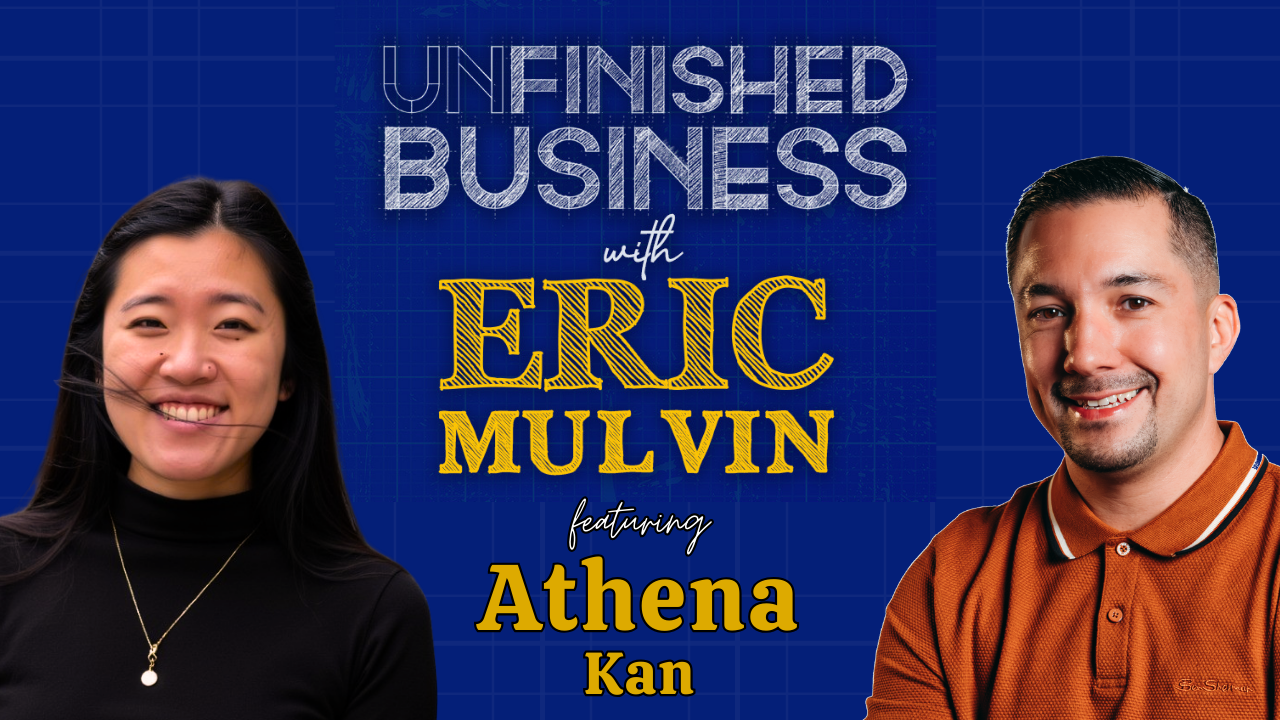
[Asian Leadership Series] AI Will Replace Jobs… Here’s What You Can Do About It | Athena Kan




AI is changing the way we work faster than most people are prepared for. But what happens to the people behind the work?
In this episode of Unfinished Business with Eric Mulvin, Eric sits down with Athena Kan, CEO and co-founder of Dreambound, to talk about one of the biggest challenges no one is really solving, how people stay relevant as AI reshapes entire industries.
Athena shares how her team is helping hundreds of thousands of people transition into new careers across healthcare, trades, and AI-enabled roles. From her time working on Uber’s self-driving car team to building Dreambound, her focus has always been the same: not just advancing technology, but making sure people can keep up with it.
This conversation goes beyond AI tools. It’s about the growing gap between adopting technology and actually training people to use it, and what that means for businesses, leaders, and individuals trying to navigate what’s coming next.
And toward the end, Athena shares a story that brings everything into perspective… reminding us that behind every number is a real person trying to change their life.
What You’ll Hear in This Episode
- Why AI disruption is happening faster than companies can adapt
- What “AI-proof” and AI-enabled careers really look like
- The gap between AI adoption and employee training
- How Dreambound is helping people transition into new careers at scale
- Why focus, not speed alone, is the key to growth in an AI world
- The role of human intelligence alongside AI
Subscribe for More
If you enjoy conversations with leaders who are building businesses and changing communities, make sure to subscribe and turn on notifications.
Episode Highlights
00:00 – Welcome to Unfinished Business
01:27 – Meet Athena Kan and Dreambound
03:49 – What “AI-proof” careers actually mean
05:39 – Training for the AI era and closing the skills gap
08:40 – Why companies struggle to train employees on AI
12:17 – How Dreambound is modernizing career pathways
15:00 – A powerful story of real-world impact
17:25 – Inspiration for Asian entrepreneurs
18:30 – Athena’s background and immigrant roots
21:06 – The Harvard experience and exposure to startups
23:19 – What it really takes to build a business
26:18 – Lessons from Uber’s self-driving car team
29:07 – Building company culture and moving fast
30:32 – Navigating change in today’s business environment
31:28 – Why focus compounds growth
34:46 – AI + Human Intelligence: working together
35:52 – The future of work in an AI-driven economy
39:17 – Learning from customers on the front lines
41:44 – Athena’s unfinished business
About Athena Kan
Athena Kan is the CEO and co-founder of Dreambound, a platform helping people transition into high-demand, AI-resilient careers. She previously worked on Uber’s self-driving car team, was an investor at 8VC, and founded Coding It Forward, a nonprofit focused on bringing technical talent into government. She is a Harvard graduate and a Forbes 30 Under 30 honoree.
Connect with Athena Kan:
Dreambound (Career Platform): https://dreambound.com
MadeThat (AI Training Platform): https://madethat.com
LinkedIn (Athena Kan): https://www.linkedin.com/in/athenakan
Unfinished Business with Eric Mulvin
If you enjoy conversations with leaders who are building businesses and changing communities, make sure to subscribe and turn on notifications.
- Instagram: @bizwitheric
- Facebook: https://www.facebook.com/profile.php?id=61560126743830
- TikTok: https://www.tiktok.com/@bizwitheric
- YouTube: https://www.youtube.com/@BizWithEric
- LinkedIn: https://www.linkedin.com/in/mulvin/
Powered by Pac Biz Outsourcing
Pac Biz helps transportation, SaaS, software, and eCommerce companies scale customer support and back-office operations with dedicated teams in the Philippines.
Learn more: https://pac-biz.com
Email: info@pac-biz.com
Podcast: https://pac-biz.com/podcasts
Transcript
All right, welcome everybody to the Unfinished Business podcast. I am your host Eric Malvin and this is a show where we talk with CEOs, visionaries,
leaders, and creatives who are out there changing the world either through business, through their organization, through leadership or creativity.
Because it doesn’t matter who you are or what you’ve accomplished, even if you’re someone like Ruth Bader Ginberg or John
F. Kennedy, there’s still something those people wanted to accomplish even at the top of their game. And so we explore those stories here on Unfinished Business with Eric Molvin.
Business where people in tech connect to amplify business. Human intelligence plus AI.
Unfinish business. New shot goals that launch you high.
Unfinish business. Listen close and you’ll learn why.
This episode is brought to you by Packbiz Outsourcing. At PAC Biz, we help transportation companies, software companies, and SAS companies outsource
their customer support and back office tasks with a powerful team in the Philippines that are dedicated to you as remote employees, helping your business
improve support, scale faster, and grow while keeping costs in check. For example, we help one client save over
$600,000 a year in payroll costs by using dispatchers from PACIS. So, if you’ve ever thought about outsourcing or taking on a virtual assistant, go to
pack-biz.com to learn more or shoot us an email info@pac-biz.com. All right, today I am really excited.
I’ve been looking forward to this interview for a couple weeks here to introduce you guys to our next guest.
So, she is the CEO and co-founder of Dreambound, which makes people irreplaceable in a post AI world by
training people in healthcare trades and AI powered knowledge work. Dreambound is backed by Union Square Ventures and
Arrive, a Rocknation company. And before founding Dreambound, she was an investor at VC, a software engineer on Uber’s
self-driving car team. She was also a founder of coding it forward, a nonprofit that recruits top technical talent to modernize the federal
government. Very much needed, and work that earned her a medallion from the chief technology officer of the United States. She graduated from Harvard
College and was recognized as a Forbes 30 under30 honore. Ladies and gentlemen, please welcome Athena K.
Thanks so much, Eric. It’s so great to be here.
Awesome to have you here. All right, so to start things off here, I guess you could if you could introduce yourself and uh beside what I just shared in the
intro and uh tell people a little bit about you here.
Oh my gosh. Yeah, you covered a lot of that in the intro, but yeah, I’m CEO and co-founder of Dreambound. We’re working on what I think is the most important
mission today. Just AI is taking over everything. You hear it all over the news. And yet there is no like
optimistic narrative about what is the world going to look like next. Like no one’s thinking about, okay, a lot of people are going to lose jobs, but what
then are they going to do? People paint this really bleak picture of unemployment and yet no company is really working on it. So my team and my
co-founder and I, we’ve decided we’re going to solve this problem. So we help people start careers both in servicesbased industries that we think are incredibly durable like healthcare,
being a plane technician, trades, and then also AI enabled work. So how can you be a video editor who really knows
how to take advantage of AI tools? How can you be a salesperson that uses the best AI tools to close more and more deals? And so we’ve been helping
hundreds of thousands of people every year change careers to do something new that we think will still be around.
That is incredible. And I love the mindset that you guys bring to this. And it’s true. I feel like it’s like a slowm moving car crash that we’re all watching.
Yeah. What the heck? No one’s doing anything.
So you guys are actually doing something about this. So tell us more about like those AI like almost AI proof jobs that you guys are really going after to train people around.
Yeah, we have two different models. So one is we partner with hundreds of different education providers around the country. We work with leading colleges
like Southern New Hampshire University or ASU since you’re from Arizona. But we also work with boot camps, certification providers for more short-term training.
And that is really around that regulated type of work where yeah, you actually need to train and and be hands-on in
order to do that kind of work. And so we partner with these organizations, have a marketplace where anyone can search and sort and filter by anything that they
need. For example, if they need financial aid or if they need like a payment plan, they’re able to sort through all of that. or if they want to study on their own time or in person,
they can also look for all of that. So,
we have a common application on our site where someone can apply for a program that best fits their needs and discover the right program that fits their needs.
And we have a bunch of free career resources and tools including your very own career coach that helps you get through that whole process and actually
enroll. a bunch of career support like resume support, interview support,
connect you with, for example, if you just need a couple hundred dollars in order to get that application fee or put in the first payment towards your school
and we’ll connect you with a side gig or side hustle that can help you get that in a few days. And then the second training model that we provide is where
we offer the training ourselves. So this is really on the AI side where it’s just evolving so quickly that we think
schools are finding it very challenging to have that content adapt as you know a new chat GPT or claw model comes out
every couple weeks a users need like a very up-to-date source of information.
So, we’ve built a new platform called Made That are in private access for right now where people can sign up and both learn the most up-to-date tools,
get certified in how to be an AI enabled salesperson and be able to try out the tools live in the platform, too.
That is incredible. Well, let let’s dig into that tool that you’re talking about there. So, let’s say I’m sitting here listening to this podcast and I’m
stressed out. Like, man, I feel like the world is passing me by. AI is changing things. I don’t know where to begin. I mean, who is the kind of people that
would be good for diving into this AI training? I mean, it’s really everyone, honestly.
And I know that’s not the answer you want to hear, but I talked to, for example, my dad who has been working for
many years. He’s very good at his job and there’s this new tool co-pilot that his company is rolling out and he’s very
smart but at the same time his workplace doesn’t have any training on how to use co-pilot for making sure that he actually is able to use it at his
specific job. At the same time there’s also people who are let’s say junior software engineers who are now entering the job market. They see a completely
different landscape relative to two years ago. So they’re finding it very tough to get those entry- level roles and so the only way to compete is if you
understand these tools like cursor and quad code and that applies for any kind of junior level talent. So we see the
whole range. I would say right now our audience is skewing more like 35 plus people who are professionals who have
that experience in their work but they are honestly getting out competed or outsp
tools. And so they’re trying to stay relevant. They’re trying to use these tools that their companies are holding them accountable to and direct KPIs but
have no training for. And so yeah, we’re helping them both on the enterprise and consumer side.
All right. And I want to touch on something as well because you bring up a really uh really interesting point. The lack of training around these tools and
I think it’s so funny because we’re all expected especially in our jobs now.
Like for me, the expectation of my team to know these tools to use it to like if there’s a task that could be done in 30
minutes with AI versus what might have taken two or three hours like I’m questioning that employees ability to do their job if they’re not taking
advantage of these tools. But companies aren’t training people on this as well.
So I I guess I don’t know. It’s an interesting thing. You know, you guys are really filling a gap in the marketplace. What about business owners
that are listening and they’re like, “My gosh, you’re right. You know, I’ve given my employees some tools or I I know we need to use it, but I don’t know where
to begin.” How can you guys help those companies out?
Yeah. I mean, it’s awesome. You’re you’re actually writing our whole tagline for us. It’s like, you’ve bought the AI tools, but who’s teaching your employees how to use them? And I think it’s such an unreasonable expectation,
too, honestly. Like we’re working right now with like a series C AI enabled company and they’re struggling with getting their sales team to adopt this
AI software because even though their engineers are really AI native because AI is part of their product, it’s just so hard to take a whole organization
pre-AI and totally convert it to a post AI motion where there are new tools coming out every couple weeks, new
products that are changing every single and so the only way to adapt that quickly is to have at least on our side
what we think is a hybrid AI plus human training people on how to use these AI tools. So we built this new product made
that it ingests your company’s tools that you’re already paying for your expense policy the job titles of all
your employees and then employees can then go ask here’s this problem that I’m facing for example I need to automate this Salesforce report or I need to
automate this data analysis and then we’ll teach them in a step-by-step lesson how to actually do all of that.
So it’s custom on demand training for anyone at a fraction of the cost if you want that kind of thing. It typically costs like hundreds of thousands of
dollars on the market right now and you can do it for much less with our new product.
That’s incredible. And as a business leader, I have been implementing things like this, looking for tools, demoing stuff like this. Um, we’re actually
working with one now, but it only is for the top leadership level. So, I like that yours isn’t like there’s only a
small group of people that it’s really built for, where yours is really meant for a whole organization, like multiple
levels of it, which is I think there’s a big gap. I I keep seeing the struggle on my end on like how how do I get some of these
frontline employees like where do they see the value in this AI tool?
And uh so I could see this filling in some of those gaps.
Totally. I mean, we saw that with our own team really, and that’s why we think that sort of bottoms up is important because these are the people who are
doing that day-to-day work. And what better person to work on improving that workflow than the person who’s actually doing it every single day. And so, we’ve
had more junior team members work on things like automated customer support for the first front line of inquiries because they’re the ones answering those
customer support queries every single day. We’ve even had, you know, software engineers on our team who have automated a big chunk of the software development
process that allows the whole team to really reap the rewards of that. And I think that is just not as possible when you have like a top- down approach thinking like department by department,
here’s how you’re going to do it because you know we we don’t know like as leaders we don’t always know how things work.
Very much so true. Cool. Well, I also wanted to go back on now as far as like Dreambound and the core business of
helping connect people to these to the education and the jobs. I kind of was thinking about it here. It’s interesting because you’re working with like a lot
of traditional organizations like these are programs that have been around for a while. So, how is your to like you guys
are bringing the technology in too though I’m guessing. So, tell me more about that. like how are you guys probably helping modernize some of these things, these ongoing challenges?
Because all these schools, they want students, they want good students, and last time I checked, they’re still looking for more students. I know a lot of these programs are like, “Yeah, we need more.”
Yeah.
So, it’s an interesting problem that still hasn’t found a solution, it seems.
Yeah, totally. And I I think that’s what has happened in certain industries over the last like 10 years. As you think about Credit Karma or Nerd Wallet for
picking a credit card or fintech product, it’s like it’s a trusted brand that you know has your sort of best
interest in mind. You tell them a little bit about you and then it matches you to those products based on your credit score, based on your credit profile
history, the types of goals, ways you’re trying to spend. But there’s not really a brand in the US for I feel very lost
in my career. I want to make a change like where should I go? And so that’s what we’re trying to be. And yes, we
partner with really great institutions that have been around for a long time because they have the expertise of delivering a full accredited education,
but you know, the platform also extends to a lot of new and upcoming providers who have just started in the last few years and are able to grow really
quickly because they partner through us and have just a much better product that they’re able to deliver to students as they are interested in certain types of
programs or certain types of um, you know, certifications that a legacy school might not offer.
Yeah. Well, I mean, this is keep you real nimble. Like a new program could come out next week and you could put it on your platform. You could always stay on top of everything.
Yeah, absolutely. I mean, we care a lot about giving people choice. I think for some people, they are only able to make
a certain schedule work because they are working and are only free in the evenings and are looking for this type of program that can wrap up in like 4
months. And so, if you narrow from there, it turns out there only a few options. And so if we can give as much choice to people and un help them
understand like here’s what to expect from the process and we’ll answer questions along the way like I think that’s what it takes in order for someone to start something new.
Cool. And because you guys have like hundreds of thousands of people going through this program and I don’t know maybe over the lifetime could be
millions but what’s a story that comes to mind of like an impact that you guys made from your program? Ooh, good question. And this was kind of crazy,
but I want to say it was a year and a half ago. I was just checking our mail regularly and we got this letter from I
forget exactly. I want to say it was like the some some southern Florida like Department of Corrections and I was like, what is going on? Like why are we
getting a letter from them? And I open the letter and it’s actually like a current inmate who had somehow found
about Dreambound and had asked if we had any tower technician programs in his area that we could help him find. And I
honestly was stunned that he had heard about us in the first place.
it. I was honestly like it it gave me a sense of uh I don’t know like a a deeper
appreciation for like this scale that I didn’t realize we had reached where it was someone who was trying to reinvent his life from you know troubled life and
he was trying to be able to get back into so society reintegrate like start a new career and be able to work as a
tradesman to support his himself and his family and be able to do something new and it came in a moment where I was very
much deep in the numbers of like okay we got to keep growing this percent month over month but yeah sometimes just taking a step back and thinking about
this is a person whose like life we are changing um yeah it was humbling honestly oh that’s incredible and yeah and just
imagining that that’s happening probably every day somewhere that someone’s going through that and and you know being able
to lift their life up uh a little bit more so that’s incredible.
Yeah, absolutely. There is a common story that we get sometimes where someone has already enrolled in a college or program before and they were
in a program that did not serve them well. It was too expensive or they felt scammed because the school wasn’t
delivering them the education that they wanted. Maybe they just like gave them books and sort of let them run on their own as opposed to like actual teaching.
And then they come to Dreambound and they’re like, “Oh my gosh, like here’s a new school that I’m able to transfer my credits to or whatever.” and now I can like, you know, I was going to otherwise drop out and now I have a new option.
So, yeah, it’s it’s kind of stories like that that make me feel like it’s, you know, all worth the the many hours.
Oh my gosh, that that’s life-changing for people, you know? I mean, just that one thing like they think, oh, there’s like I can’t there’s no I can’t get a
better education. This is it. And then turns out no, there is a path. So,
that’s that’s cool. Thanks for sharing that.
Yeah. Um, so this I this uh episode is kicking off my series where I I u we’re going to interview and explore and
connect with people who are out in uh the Asian business community because there’s not too many of us. Uh you know I do a lot of conferences where you know
we get to hear from people to work with the government and they’re not too represented there or in a lot of other places I go. So I guess tell tell the
listeners about this. I’m speaking to the people who are the Asian people who are listening that want to start a business, need some inspiration, and
that part of my motivation here is that there’s not enough people telling their story about how they got started or
where they came from. So, I wanted to go a little bit into that and maybe some of your background. Um, cuz I haven’t confirmed this yet with you, but like for me, my mom is from the Philippines.
You know, I have immigrant half immigrant parents. So, um, and it’s a common story that a lot of American Asians have is like some parent or
grandparent that has immigrated over to the US. So, but yeah, can you tell a little the audience a little bit about your journey here getting to dream?
Yeah, for sure. Yeah, my my parents are also immigrants. They came to the US when they were in their late teens, so actually earlier than I think a lot of
the Chinese immigrant population right now. Um, and you know, it’s it’s funny because I don’t think they ever expected
me to start a business. My dad is literally an insurance actuary, so price is risk. And my mom the opposite of business running a business and no risk.
Exactly. Yeah. And my mom was an accountant. And so they’re both very at the time because that’s what it required is, you know, they they wanted very
stable jobs that allowed them to create a life for me that allowed me to pursue my passions and explore a lot of what I
wanted to do. But ultimately like they yeah, I didn’t get to do as much of that on their own um throughout their career. They have been super supportive though.
My mom was always pushing me from a young age. I think very differently from most other Asian moms to like be taking as much risk as possible. So that is different.
I know. Yeah. And so I feel very grateful for that. But honestly, I would say like college really changed my life for me in terms of starting a business.
I didn’t really know what entrepreneurship was in general. Like when my mom was pushing me to take risks, it was more around like advocating for myself, speaking up for myself and less like professional risk.
But when I got to college, one of my dormates my freshman year like dropped out of college and started a company.
And I was like, whoa, I didn’t know that you could do that. like I thought you needed to go and work for 30 years before you do anything approximate to
that. And in the meantime, go work at Google, you know. And then as I got through college, I started encountering more and more of my friends who were
similarly dropping out or just graduating and starting companies. And I honestly I feel like a big part other than the missiondriven
nature of like my work a lot of it was driven by ego of just like I think I am just as good at that you know as them
and being able to do all these things like I want to start a company because I think I can too and I’m not I’m very competitive so I didn’t didn’t want to
feel like I was losing and so yeah I would say I don’t know good advice but yeah well you need those attributes It’s I
think to be successful in business. I mean, if you’re not if you don’t want to win, it’s kind of hard to get up every day and keep fighting when you kind of need to you need to win that account,
that employee that I mean, every day there’s something that you need need to be able to do. So, I think it’s it’s okay. I mean, we all have what what’s
what’s amazing is everyone has their different path to get there, you know,
to to get to running a business and different influences. So, but I mean you didn’t go to just any regular school.
You you kind of went to one that’s pretty famous.
I mean there’s a lot of people not every school people go into business start dropping out and starting businesses.
That does happen sometimes but I think it happens at a much higher rate at the where you graduate from. So tell me a little bit about your your college
career. Like how did you end up going there and how influential was that for you in your business career?
Totally. Yeah. I went to Harvard and it totally changed my life. I mean even just looking at my the people in my class I mean they are the hottest
companies in AI right now like Cognition Decagon like Exa all these companies were my year and oh man the competition and if you’re
like comparing yourself to these guys they’re Yeah. Some big ones. Exactly. Yeah. Harvard class in 2019.
Best class. Yeah. I mean I only started getting in the venture world because of this organization called Dormant Fund.
It is a student-run venture fund that for some reason let us put in like 20k checks into companies that were run by
students. And so we got to be actual venture capitalists for a couple years and see how those companies did source our own deals, advocate for them in the
investment committee and be able to support them as they were to start their own business. And many of them are actually post IPO or billion dollar
companies now that we got to be in from the very early days. What an amazing opportunity.
I know. Huge. Yeah. Dormant fund. It’s still active. You can still join as college students. So any college students listening to it definitely. Um so you don’t have to only go to Harvard.
You could be a college student at ASU or anywhere else. Right. and that experience that you mentioned a few things there that you got to get exposed
to because of that that is really impactful because I think like for me I’m I’m just hit 11 years in my business
and I’m in a space where although I have no intention of going anywhere there’s a lot of people that are talking about exits and and you know investments and
selling to private equity and so you start getting into that world but it’s like you’re finally getting exposed
opposed to like for me I’ve been in this business yeah for over a decade. It’s amazing for you to know that stuff upfront and I think that unlocks so much
more potential with your business because you know like there’s I think a lot of people like again I’ll go back to the listener that’s thinking about
starting their business. They might be sitting there like I have this amazing idea. How do I get that started? I get that question all the time because
they’re like see I have 200 employees or like how did you get to that? they don’t see the path to get there. But talk to me about that a little bit and uh and that journey and what it takes.
Oh, great question. I mean the first step is feeling like you know everything but actually you know nothing but you
know that’s the first step because if you feel like you know everything that’s when you know you can actually get started and then once you um then
understand you know nothing that’s when you start charting the path of okay first I’m going to learn this one thing and then you feel like you know everything about that one thing and
that’s when you then learn actually you know nothing yet again and then that pattern just keeps repeating until somehow you’re 200 people And then um
you know hire people to go I can tell you this is so true because I was just telling a story yesterday to my
team. My very first business was a taxi company and you know you’re from Bay Areaish. You know we got spring training
happening in Phoenix right now. The Giants are spring training and it reminded me of like the first business I had was a taxi cab company
and I was trying to disrupt the taxi industry. That’s why I was doing that.
We had the first app in Arizona to book a ride, but uh my friend drove around in a taxi during the busiest tourist season
of the year in Phoenix when the weather’s perfect and everybody’s here.
And he’s like, I made so much money driving this taxi. We need to start a taxi company. And I was like, it hits all my boxes. I could disrupt it.
There’s no new technology that’s happened in this space. Like, we could totally make an app. So, I’m like, let’s go. Thinking like that money that you
could make in the peak season, you could make all year. And so that was like I didn’t realize till that summer when we were like where’d all the customers go
and we’re trying to pay bills and there’s no revenue coming in to pay the bills that still have to get paid no matter what. But yeah, so what you said
is spot on true. Hopefully you do some research to uh educate yourself on some of those blind spots. But that’s uh that’s how I got here. I mean, I think
that also touches on another honestly weird but I think very very useful business advice is just like believe
that you can do it and make it happen. I I think there have been times when like I’ve doubted myself and that doubt only
compounds but like reversing that doubt into like okay I can do this that just like sort of escalates into actually you’ve created the thing that you
believe that you could in the first place. So just like yeah knowing that okay I don’t know anything about building a taxi app but I’m going to go and build a taxi app like you did it and
then you did in a way that like a lot of people they don’t believe that they can and so they won’t.
Yeah. Yeah. I think some of that uh not knowing what you don’t think is I don’t know like for me I didn’t know what I couldn’t do. So for I was like yeah I’m
going to go make this. Maybe if I knew more about the situation I pro I might not have done it and maybe I’d have done some other idea. Who knows? cuz I did
start like a bunch of businesses. So, it could have been any one of those that might have taken off. But, um, all
right. Now, wanted to also go back to uh now my background. I mentioned taxi and you have some connection with Uber and
self-driving cars and that I’m in Whimo’s backyard. I’ve been following them closely. You know, we’ve been the the there’s more self-driving cars
driven here in Phoenix than any other city, I think, combined in the world. I always tell people when uh I’m talking
to anybody like even if I just drive to the grocery store five minute drive I’m passing three or four Whimos any given time of the day. So but uh tell me more
about your uh experience with self-driving cars because that ties right in very closely with AI and the shift in technology that’s happening.
Yeah, absolutely. I was working on Uber self-driving car team I want to say 2017. Hopefully not getting the years
wrong. And I mean it was super interesting experience that was like definitely before we’ve gotten to I mean just how perfect essentially the Whimos
are today. It was very much early stages of a lot of things happen and go wrong.
But one thing that I thought that was very interesting when I was first doing that, you know, having not h having not known much about the selfd driving car
industry is that we would be in these self-driving cars as like a test rider and then there’s also like a driver in
front who’s noting every time that like the car makes a mistake. And that’s, you know, data labeling now is is much more common than it was before, but back
then, yeah, it was data labeling to make sure that you understand why the cars are are failing. like labeling here’s a stop sign, here’s like another car,
here’s a bike or whatever. And so it was essentially this person who was like working to automate themselves. And I
was like that’s crazy that like yeah that’s happening and just like there’s not really a plan for what’s going to happen to all these people who are doing
all these things. That said, I mean I I love self-driving cars. I think it’s going to save like millions of lives across the US. But it’s sort of the combination of like okay you know
there’s this other problem that we have and also we have um you know such a gift in advancement of technology too. But yeah it was super fun. It was also like
during a very tumultuous year at Uber that was when like the CEO was like basically fired a lot of different lawsuits happening concurrently like
every time we had an all hands all the all hands information was leaked immediately during the meeting to in real time on Twitter in real time.
Yeah. So it was a great time. I had a very was a low stakes employee you know had a had a very interesting experience.
So this is a this is a topic that’s kind of interesting because uh for me you know I’ve worked at Yelp um preIPO so I
got to see that tech culture and I worked at big corporate jobs like JP Morgan Chase but how did your time at
Uber influence how you shape the company culture of Dreambound today?
Totally great question. I mean I think it was important that I got like a real company experience before starting my own company. Uh I started Dreambound
right out of college and so yeah basically it was like my time at Uber and a couple other places that informed how we were structuring a lot of the
company and Uber has gotten a ton of flack for this but I think they have just a really great value of moving very quickly and just action over inaction.
So, we’ve taken a couple of the values from Uber, although you know, I try not to emulate a lot of the challenges that they’ve had as well. But, yeah, I just
try and like make sure that once we come up with a plan like how do we minimize that time between idea to execution as
much as possible? And so, that’s one of my core values and how I live day-to-day is just like move as fast as possible.
And I think that’s the only thing that can really keep you competitive in like an AI world where you can actually just generate code in a few minutes now or
you know build a whole app like you know less than the time it takes to uh you know go hire someone to do it. And so yeah it’s all about like speed and and prioritizing the right stuff.
Yeah.
So I got I got a great question for you because this is an interesting debate that came up in this uh CEO peer group that I’m in because we’re we’re in a transformation.
We’re deep in it. We brought in a new COO about I don’t know nine months ago.
So, we’re changing a lot of things and uh a lot of things quickly and I have a lot of my CEO friends and they’re like,
“You’re doing too much. You should only change one thing at a time. How are you going to know like what’s working and not working when you’re changing everything?” And I’m like, “I don’t care. We need to change it all. Like,
things are moving so quickly and we could figure this out. Like, we don’t have to move that slow.” But those are those are conversations and debates
happening in businesses and in corporate teams and leadership and family businesses all over the world right now
like how fast do we move how slow do we move what advice would you say and maybe some tips or like I think one thing is
clear we all need to move faster we can’t move at the pace we were moving pre you know 2022 whatever when everything started coming out
so how does someone move faster and like how do you determine that speed, you know, and find some ways to get your
company to maybe move in a way that they didn’t in the past?
Great question. I think and this is a lesson I’ve learned over the past I would say two years now that focus
really compounds and so if something matters to you then focus only on that and that will happen but you have to be
okay with letting go of the other things and that thing will happen very quickly if you focus on it I’ll give you an example last year my co-founder was
pushing really hard for becoming an AI native company and that has been something a lot of other companies have
been vaguely pushing for, but they didn’t make as much progress as we did because we made that our singular focus for like I don’t even know 6 months. And
so now we have a feature that I think otherwise would have taken like a week and a half to build internally with a startup which is already pretty fast
compared to other companies. Like now I I literally just built it in 31 minutes.
I was looking at the time between Yeah. And like that sort of thing was
our number one priority because it would compound. If you can get AI and all of our importantly teammates to adopt AI,
that means that they can move faster going forward. And as models get better,
they can move even faster than they were moving before. So I feel very grateful to my co-founder for making that our number one priority. And that took a lot of time. It was like having hackathons.
We spent like a whole month on what we called AI bingo, which totally changed the company where we had like a bingo grid of like 25 challenges that were AI
related and every employee like was required to do a bingo and they would get a prize if they did the whole board,
but they were required to do that one bingo. And like everyone was addicted to it. They thought it was so fun. We had
our biggest AI haters and detractors then be able to build a whole desktop app like not having you know basically
they went from basically like a chat GPT intermediate beginner to then building like a whole app they were non-technical and I mean that has reaped rewards ever
since and will only continue versus you know I talked to companies now for made that where you know they’ve had other businesses ch business challenges come up and so I can understand why they
haven’t prioritized AI adoption, but now they’re like they’re behind and so, you know, they have to do it at some point,
otherwise they’re just going to keep that gap’s going to keep growing. So, I would say, yeah, focus on one thing. It’s counterintuitive, but yeah,
it does seem like that. But yeah, I that is that’s a cool story. Thank you for sharing. That’s a really great tip for somebody that’s like, how do I implement
this in my company or how do I get everyone on board? It’s coming up with fun interactive ways like that that you know you can’t just do workshops and
just make everyone attend these workshops then what they’re going to leave and not apply anything that they done. This forces them to kind of
actually go through it. So they’re great great advice.
Yeah. Yeah. If they built AI bingo into made that for enterprise and have their own AI bingo internally
if you’re looking to uh find way there’s another example of one of the things that you can get when you uh work with that tool. So cool. Um, now I love the
fact that this like everything you’re doing cuz for us, you know, my background, we got a call center. We’re people based. Like we’re all about
people. And I’ve been on this mission talking about as amazing as AI is. And I’m like one of the first to try to put it into everything. We need people like
this AI plus, in fact, I have this term AI plus HI, human intelligence. And I think you almost said a similar term as you were saying some of your answers,
but you are at the forefront of this,
you know, helping people with the education part of it and bringing people in. And then you’re also like at the cutting edge technology, you know,
putting together apps in 30 minutes,
which to some people listening, it’s a whole other world that doesn’t even seem attainable. But so tell me about that.
like the importance like you’re seeing it all and and despite everything with AI, you’re talking about how important people are and how important humans are.
So tell me more about where do you see the future? Where do you like there’s a lot of people sharing negative viewpoints of the future or not so
positive ones? Let’s give the audience a positive scenario.
Like what are some positive things that could happen with AI? you know, if people embrace things like Dreambound and some of the not just what you guys are doing, but those concepts like let’s get back to people.
Yeah, totally. I mean, a trend that has been happening over centuries is as the economy becomes more developed, it actually becomes more services-based.
The America is something like 60 70%
service-based jobs. And so, I think that trend will only continue. I think that’ll be more and more of where the economy grows. Health care is the
fastest growing, most stable segment of our country’s economy and that will continue to happen. I think a lot of people see the stability in it and want
to transition into it from other more precarious jobs. I think there is also of course the support services around all of those legacy industries that will
need some time to catch up and are also very critical and so having a human eye is very important for something like cyber security for power grids that is
going to be incredibly important and and cannot be limited to AI only. I think people will be AI augmented though I think that’s going to be important for any sort of knowledge work. I know that
there is a lot of fear around is AI going to take over my work but I think or you know a lot of people I’ve talked
to as well they’re worried about what happens to my craft if AI is able to do that you know as a software engineer like AI sloth code is not as good as
like my personal handwritten code and I was just talking to one of my engineers and he was telling me that what made him really see the value in AI was actually
using more of the code reviewing tools at first and just finding crit critical bugs that otherwise would not have been
found and would have caused many issues if not for AI reviewing his work and then you know after that that started
making it easier for him to adopt other AI tooling around like code generation and and now the full AI stack that we
have today. So I think it’s yeah human enabled by AI and I think it’s services-based work. I think that’s going to be a big part of the economy in
the future. I think there will be a few new types of jobs, hopefully a lot more than just a few, but definitely we’re already seeing a few already that have
been very new. AI filmographers is totally new job that like, you know,
previously would not have been a career at all. Like the whole film industry is just very hard to break into. um you need to have certain connections but now
actually you can create AI videos AI ads like UGC type videos all of that from anywhere in the world for a much lower
budget so I think we’ll see a lot of that I think growth and marketing will be even bigger than it was before because we have so many new products
getting released all the time like the only way to stand out is by have excellent go to market and so I think sales and growth type work will only
expand we’ve seen like sales people are able to double revenue per rep just by using AI tools. And so that makes it way
more profitable to have a saleserson on your team. And so all of that stuff I think will also happen.
Yeah, there are so many like a million different directions where AI can definitely change things and uh and and for the better too because there’s what
I always tell people like look, we don’t even know the jobs that are going to be created yet because of a new technology
that AI has enabled. Like there could be an entire industry that we don’t even know exists yet. And so, you know, don’t
count yourself out. It’s so or we’re so early on in this thing. Totally. Yeah.
But I do love though because uh being in the the transportation space uh at least in initially, you know, and I I I guess
we do kind of have this in common like so when I first started, I even drove a taxi. I’d drive a taxi till I remember when my daughter who’s um
about to be 10 soon, but when my wife was pregnant, I was driving around till 3:00 4 in the morning making extra money
just to yeah to like I had a startup. I had, you know, every penny needed to go back into the business, but you too
really dove into your business and went right to the front line as well. So tell me tell us tell the story about that
because you did not have to do that but you went and became a plumbing apprentice right?
That’s right. Yeah. I mean my dad actually kind of inspired this because when my when I was younger, my family
needed electrical work done on the house and they got a quote from a bunch of different electricians. And I’m sure this is a familiar story for many people
these days, but electricians are very expensive. And so my dad decided, you know what, it’s going to be cheaper to
become an electrician instead. So he studied for nights and weekends. He is a really good test taker. And so he became
an electrician after just a few weeks and scored the highest of I think anyone in the county in like a decade or something.
Uh yeah. And then I’m pretty sure my mom might have done the actual electrical work.
Yeah. So, I thought this was hilarious and inspiring and very aligned with our work. So, I went and became an
apprentice plumber, a beekeeper, a caregiver. I was trying to get our whole team to do forklift training for an
offsite, but then co happened and so we weren’t able to make the timing and location work out, but that would have been sick. But yeah, I think customer
empathy is really important. I think it would also be so cool to be able to go to a plumbing school on my part and be like, “Hey, I’m an apprentice plumber,
too.”
Yeah. I thought about getting more, but haven’t been able to make time.
Yeah, with all the things you’re working on. You’re doing so much. It’s amazing that you were even able to do that. Yeah, that was fun.
Cool. Well, I so much appreciate you sharing your stories with us here today.
There’s like so many incredible ones there and I feel like I could uh I could go further into a lot of them, but um I always end the show here with one
question which is and this one is especially unique for for you because some of the people I’ve interviewed a little they’re they’re not too much
older than me. So we haven’t had too many older people but no one’s at the end of their career yet with you. Uh you’re you have a lot ahead of you.
You’re still under 30 or Forbes 30 under 30 here. uh honore. And so what’s some unfinished business for you? What are some things that you want to accomplish
in your career that you haven’t even began to work on yet?
Oh, great question. Yeah, that makes sense. Unfinished business. I should have thought of that.
Or maybe some big audacious goals that you have with Dreambound. I got you stumped, huh?
I know. I mean, I very much believe in the importance of being true to my word.
So, I’m trying to pick something that I can commit to. Okay. Okay. Yeah.
Well, then this brings up an interesting one because I think you would be the youngest guest we had on the show and I don’t think I’ll have a whole bunch of people under 30 on the show because
there’s not too many of you guys running businesses. I remember when I first started my business and I still get this now when I was looking for a new CPA last week. They’re like, “How old are you?”
I’m like, “I started it 11 years ago.”
But yeah, not too many people younger. So maybe the interesting thing for you is you don’t know yet what that is because
you’re still still got a a lot more to figure out.
Yeah. Well, I I I think there’s like some of that that Asian fear in me of like being too afraid to um you know like take too much risk at some level.
Yeah. I mean the goal is to make at least $100 million.
That’s a big goal. Yeah. And then uh I would imagine I mean what about I mean you’re already by you’re by Dreambound existing you’re already making the world
a better place but I mean do you have any like nonprofit or give back or you know any any other thing there that
you’re hoping to see especially with AI you know I maybe maybe one of your AI investments take off and you become a
philanthropist. I don’t know. Yeah, I mean we’re uh planning to change the world with Dreambound and made that we’re going to train everyone into new
careers and so I mean it’s a big mission but that itself like that’s the only thing that matters and if we’re able to do that we’re going to change the world
and I guess we have already but I I feel like we can do like another couple orders of magnitude more than we have already. Yeah. I I mean I I give a lot
now, but honestly, I just like I I I loved my experience starting coding it forward in nonprofit, but I started a
for-profit because I felt I could move just so much faster, have greater access to capital and just being able to, you know, raise a few million dollars in a
couple weeks compared to 9 months like raising 3K at a nonprofit. It’s completely different and just like the
type of scale, capital, talent that you have access to. And so I very much believe in trying to orient my my vision
for a good world through my also ownership in the company that I run today. So yeah, I’m sure I will give a
lot later in life, but I would love to give now in life too by growing the current business. And I really believe that by doing that,
yeah, I think that’s got to be like we need more Dreambound out there. uh you know seeing what again because we’re
we’re providing support to these taxi companies and I mean they’re directly those you can’t see a clear picture of
like the taxi driver in a Whimo like replacing their job.
Yeah. And so like for me, I love that there is something out there that I could tell those drivers like, “Hey, no,
there’s go to this site, go there’s resources there. They could help you out and they could help you find something that you could do while you’re driving.”
And whether Uber driver, whatever driver there is. Yeah.
And that’s just one position. There’s so many jobs out there that are going to be transformed and changed. And you know, you’re giving people hope that hey,
there’s not only hope, but that you’ve helped hundreds of thousands of people already. So, if it has helped all those people, why can’t it help you?
Yeah. Thank you. Oh my gosh, my co-founder and I have this running joke that for whatever reason, like I don’t do anything, but my Uber drivers always
tell me their life stories. And so they I’ve heard just like insane stories of career transition of people trying to be
like cloud engineers or open up their own like suit shop, become real estate developer, transition out of being like
a construction project manager. It’s just huge range and so many very cool stories. And actually I think that’s one of the cool things about Uber is that
like it is a transition or it’s a career that allows a transition to happen on the side. I don’t think people really appreciate that as much. They’re kind of
like, “Oh, Uber steals wages.” And you know, actually, a lot of people like really like driving Uber who if you actually talk to a real driver. So, yeah.
If you actually talk to them. Yeah. And not just stay on your phone in the back seat the whole time. Right. I love it because Yeah. I mean,
for me, being a driver before, I always love hearing the conversations and like,
“Oh, how did you get into this and what do you do?” So, yeah. Um but but those are the people that you know you’re helping helping out
with Dreambound and uh that and it’s amazing that you could have a platform that could reach such a broad audience
and that’s really difficult. So congrats to you for what you’ve been able to build and uh I’m excited to see more and more people go through the program and
uh help change their career because AI is changing things and this is one thing that you could do to to do something about it.
Thank you. Yeah, it’s been awesome. and thanks for letting me share my story.
All right. Well, thank you guys all for listening. And if people wanted to learn more about Dreambound or maybe some of the things you’re working on and what’s
the best way to either get uh connected with you or follow what your journey, what you’re doing? Yeah, dreambound.commade.com.
Those are our uh both our marketplace for career training and then our AI learning product. So, definitely check those out there. You can um also follow
me on LinkedIn just AthenaKN and yeah, I’ll be sharing about our journey as we go through it.
Awesome. And I’ll get some links in the show notes so you can find out really easily as well. Thank you guys all for uh listening and if you like what you
heard today, if you want to hear more stories with really amazing people out there changing the world, make sure you subscribe so you could hear more uh
interviews we have coming up later this year. But thank you guys and we’ll catch you on the next episode.
CEOs and visionaries shaping what’s to come. Building more than profit, lifting everyone. Every path’s unique, but it takes a choice to grow. Set your goals and shape the way your future goes.
Unfinish business. Where people in tech connect to amplify.
Unfinish business.
Human intelligence, but AI business. shot go that launch you high.
Listen close and you’ll learn why
online and follow Unfinished Business on Spotify, Apple Podcast, YouTube, wherever you listen.