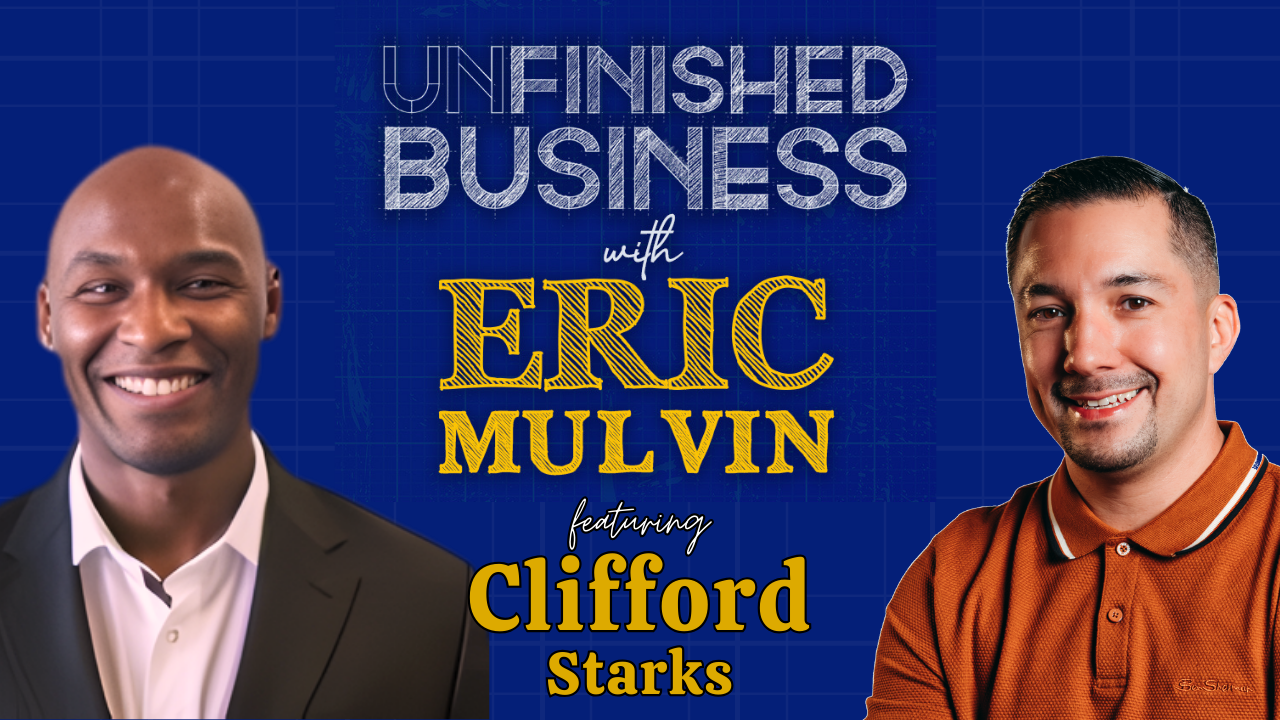
[Vistage Series] From UFC Fighter to Leadership Coach | Clifford Starks




Pressure is something every leader faces. But what if the way we think about pressure is completely backwards?
In this episode of Unfinished Business with Eric Mulvin, Eric sits down with former UFC fighter turned leadership coach Clifford Starks Jr. to talk about what stepping into the cage taught him about leadership, entrepreneurship, and navigating high-pressure decisions.
Clifford’s journey from professional fighting to coaching executives offers a powerful perspective on resilience, mindset, and what it really takes to perform when the stakes are high. Throughout the conversation, he shares stories from inside the arena and how those same lessons apply to the challenges leaders face in business and life.
But the conversation doesn’t stop there.
Toward the end of every episode, Eric asks one question that always reveals something deeper about the person behind the success. It’s the question that gets to the heart of why they keep pushing forward, even after everything they’ve already accomplished.
Clifford’s answer is one you won’t want to miss.
Because for him, the journey is far from finished.
Subscribe for More
If you enjoy conversations with leaders who are building businesses and changing communities, make sure to subscribe and turn on notifications.
Episode Highlights
00:00 Introduction to Unfinished Business Podcast
02:28 Meet Clifford Starks: From Fighter to Coach
03:12 Transitioning from Fighting to Entrepreneurship
08:08 The Reality of Entrepreneurship
12:40 Leadership in Challenging Times
13:53 Navigating Leadership in the Age of AI
19:14 The Importance of Coaching
23:34 Parenting Lessons in Leadership
29:36 Embracing Change and Growth
35:55 Unfinished Business: Future Aspirations
Connect with Clifford Starks:
LinkedIn: linkedin.com/in/clifford-starks/
Website: https://cliffordstarks.com
Unfinished Business with Eric Mulvin
Powered by Pac Biz Outsourcing
If you enjoy conversations with leaders who are building businesses and changing communities, make sure to subscribe and turn on notifications.
- Instagram: bizwitheric
- Facebook: https://www.facebook.com/profile.php?id=61560126743830
- Tiktok: https://www.tiktok.com/@bizwitheric
- Youtube: https://www.youtube.com/@BizWithEric
- LinkedIn: https://www.linkedin.com/in/mulvin/
Pac Biz helps transportation, SaaS, software, and eCommerce companies scale customer support and back-office operations with dedicated teams in the Philippines.
Learn more: https://pac-biz.com
Email: info@pac-biz.com
Transcript
Speaker 1: 00:00
Welcome everybody to the Unfinished Business Podcast. I’m your host, Eric Malvin, and this is a show where we talk with CEOs, visionaries, creatives, leaders who are out changing the world through their business, through nonprofit, through leadership, even creativity. And uh, because it doesn’t matter who you are or what you’ve accomplished, even someone like Muhammad Ali, George Saint Pierre, at the top of their career, and even now, these people still wanted to have something they wanted to accomplish. So it doesn’t matter who you are, you’ve got some unfinished business, and that’s what we explore on the show today. This episode is brought to you by PacBiz Outsourcing. At PacBiz, we help transportation, SaaS, and e-commerce companies outsource their customer support and back office tasks with a powerful team in the Philippines. They are dedicated to you as remote employees, helping your business improve support, scale faster, and grow while keeping costs in check. For example, we even help one client save over $600,000 a year in payroll costs just by using dispatchers from PacBiz. So if you’ve ever thought about outsourcing or taking on a virtual assistant, visit our website pack-biz.com to learn more or shoot us an email info at pack-biz.com. All right. And without further ado, I am really excited to introduce our next guest here today. And he is actually a former UFC fighter who reached the UFC in less than a year after beginning his MMA career. And today he trains leaders to turn pressure into clarity in their arena. So they take fewer bruises in life and business. And I’ve been around now for 10, 12 years. I got a lot of bruises to show. Business owners get a lot of bruises. So there’s a lot of truth in that statement there. But drawing from his experience competing at the highest levels and coaching executives, Clifford helps decision makers sharpen their thinking, align their energy, and use pressure as an advantage. So, ladies and gentlemen, please welcome Clifford Starks Jr.
Speaker: 02:30
Thank you. Thank you. I appreciate you having me and I’m looking forward to it.
Speaker 1: 02:33
Yeah, absolutely. Thank you. And this is uh just like I had mentioned in some of the past episodes, this is one of my uh interviews that has been a long time in the works. I’ve been wanting talking with the Clifford here for like years. I had this really ambitious plan to do this interview in the boxing ring, and I think I was too ambitious and it killed it. So there’s a business lesson somewhere in there, you know, in simplicity and getting things done. But either way, we’re here now, and uh, I’m excited to be sharing your story here, Clifford.
Speaker: 03:02
Yeah, yeah, thank you. Appreciate you, brother.
Speaker 1: 03:04
Yeah, so starting out here, I guess just introduce yourself to the listeners here. Yeah. On who you are, what you do.
Speaker: 03:11
Hey, what’s up? I am Clifford Starks, and uh yeah, I when I went from fighting to entrepreneurship, I didn’t realize I was replacing one arena for another arena. And sometimes you don’t even know you’re getting ready to get bruises. In fighting, at least that was something that I knew was going to come. When I got into entrepreneurship, didn’t know it as much and started learning the lessons along the way. And now I support others in getting fewer of them because when we’re really close to the problem, it’s hard to see it.
Speaker 1: 03:44
Yeah, that is so true. And I mean, I think your path to entrepreneurship sounds pretty common and probably something you could probably relate to the people you’re working with, because I don’t know, I don’t think there’s some people that go out knowing they’re gonna start a business one day. I feel like that was me a little bit, although I didn’t have any background or experience. But I don’t think people go into it saying, like, realizing how tough it’s gonna be. Talk to me a little bit about that.
Speaker: 04:10
Yeah, I will actually relate it back to fighting because even though I knew I was gonna get bruises as a fighter, I didn’t realize how many I was gonna get. And the first time I fought, I’m like, oh, two people hitting each other. Great. And it wasn’t that, it was me missing a lot and me getting hit a lot. Well, entrepreneurship felt kind of the same way. You know, you you you go out and your your focus is on providing value for others, and you think it’s an easy thing to do, like I go provide value for others and I get paid for doing it, and it’s not as easy as you thought.
Speaker 1: 04:44
No, I still tell myself to this day, 11 years into my company, I’m like, man, this is so much harder than I thought it was gonna be.
Speaker: 04:52
Yeah, yeah.
Speaker 1: 04:53
Yeah. So, well, all right. So I know now you’re you’re doing coaching, but like, did you how did you get into fighting? Like, I did you grow up thinking I’m gonna be an athlete or I wanna be a fighter? I’m just kind of curious how you got into that.
Speaker: 05:09
Yeah, yeah. I actually, yeah, it’s it stems back to me being a five-year-old kid. My grandfather passed away, and it scared the living crap out of me, knowing one day I physically would not be here anymore. And I remember being so freaked out by it, and I also remember getting power from it because I asked myself, okay, what do I do now? Now that I know this information, what do I do? And I wanted to live a life worth living. So that’s what I focused on doing was living a life worth living. And to live a life worth living is to step outside of your comfort zone. And so I just focus on stepping outside of my comfort zone and create new comfort zones and then step out of those. And so eventually, like, what got me into fighting was it’s scary. Like it’s not like you don’t say, like, you know, what do I want to do? Ooh, I know what I want to do. I want to go get punched in the face. Like, that’s not where my mind was going. But I wanted to see. I wanted to see. And it’s interesting because Tony Robbins talks about it’s not about being a dabbler. Well, I like to dabble to see if it’s something that I actually want to pursue. I can’t know if I want to pursue it if I don’t dabble it. I I’m not one of those people who says, you gotta go all in and you gotta burn the boats, and yeah, you’ll do those things, but you gotta want to want to do those things too. And so you find out if you want to do those things by dabbling. And so when I got into fighting, I I dabbled in it, and I’m like, wow, this is kind of fun. Like, this really gets you going. Like, talk about pressure, and that’s what got me into it.
Speaker 1: 06:43
So, how old were you when you figured that out? Or did that you decide I’m gonna dabble into it?
Speaker: 06:47
I was 28 at the time. And I I do want to actually give a shout-out to one of my coaches because I didn’t even think about this. But my freshman year in high school, I started wrestling. And my coach he taught me resilience because as a wrestler, like if you don’t have resilience, it’s not gonna work. And so he taught me resilience, my mom taught me discipline, and you you literally are. Steve Jobs talks about you don’t you don’t know the dots connecting forward, you can only see them connecting backward.
Speaker 1: 07:20
Yeah.
Speaker: 07:21
So my resilience, my discipline, my having all of those pieces in place allowed me to step onto that stage at 28 years old and say, okay, do I want to pursue this or not? When I say yes, I can say it with authority and confidence.
Speaker 1: 07:36
Awesome. So 28, to me, that seems a little bit older to be making the decision to getting into fighting, right? Like that’s not people usually are you’re fighting people that are a bit younger than you, I’m guessing, right?
Speaker: 07:48
Yes. Yes, absolutely.
Speaker 1: 07:50
So tell me if like, all right, how does that your journey into fighting and being in the staying out of the comfort zone? How is that being part of you? How did that transition into going into business? Because I’m guessing at that time you were not thinking about being a business owner as well. Like, like you said, the dots connect backward, not forward. So you weren’t thinking, like, if I do this, this is gonna give me the skills and some stories that I could use to be a business coach, right?
Speaker: 08:17
Yeah, no, not at all. The transition happened. I actually got into entrepreneurship because I wanted to play it safe. That’s the funny thing. And yeah, yeah, like right. And I I got into entrepreneurship because I thought it was going to be easier than it was. When my son was born, I had had him for about a year and I realized I was in my last fight because and it goes full circle. Remember that five-year-old kid that felt that terror? Well, I felt that terror again. And I couldn’t pinpoint, like, why am I terrified as I’m getting ready to fight? Like, this isn’t fear, yes, that’s there. Terror, it’s a different feeling. And I’m like, what’s going on? Like, what’s going on? And I didn’t realize it until I got into a cage with a Russian looking to kill me. And I was like, in my head.
Speaker 1: 09:08
That’s when you realize it. That’s what I realized it.
Speaker: 09:11
I’m like, holy crap, I’m thinking about my kid right now. Thinking about, I gotta watch my kid tomorrow.
Speaker 1: 09:17
I gotta make sure this Russian doesn’t kill me. Oh my gosh. Yeah. What a crazy that’s uh something that I cannot relate to.
Speaker: 09:24
Probably or maybe, I don’t know, maybe in business there are some moments. So I talk about, I have something called the fighter’s formula. And in the fighter’s formula, it talks about being aligned in heart, mind, and skill set. So my skills were still there and my mind was still there, but my heart wasn’t in it. My heart was in being a dad. And so that’s where I was it was incongruent and out of alignment, and I still was able to fight. Like I almost knocked that Russian out, not even being in the fight. And so I’m like, oh, that’s interesting. Like when we have certain things and it’s not in perfect alignment, we can almost convince ourselves to stay in things that we really don’t want to stay in.
Speaker 1: 10:03
That is powerful because that happens to a lot of businesses. I think, you know, I don’t know if you’ve ever encountered this in your your coaching career or maybe in conversation, but you ever come across somebody where you’re like, it’s time for you to hang up the gloves. Essentially.
Speaker: 10:20
Yep. It was it was so interesting because there was another fighter who mine and his path were completely different when we retired. I actually had a lot more left in the tank. And my coach knew it and he told me that. Well, the other fighter didn’t have so much left in the tank. In fact, he didn’t have any left in the tank. And the the coach told him that and he took it the wrong way. It’s interesting, like that’s just the way the chips fall sometimes. Where I I was very strategic in getting into the fight game, and so I wanted to protect my mind, because we only get one of them, right? And the the other guy he could fight with reckless abandon and it caught up, caught up to him. I mean, how true is that story for business owners as well? You know, going into something that they shouldn’t be going into or touching something they shouldn’t be touching.
Speaker 1: 11:13
Yeah, it is interesting because for me, I’m thinking back the last year, we lost five clients last year, and these are businesses that were like generational businesses. Some of them have been around 50 years, 20 years, family businesses and wiped out. And so I just makes me wonder like they were able to build it up. Like if you had a business running for 20 years, you think, okay, this guy knows what they’re doing, and then all of a sudden they went out of business, and you’re like, do they know what they’re doing? But I mean, uh, that’s the tricky part about business. And you know, so I guess what like this is a not the angle I was thinking about going, but like, let’s say you’re a business owner listening, and like, because I I think this is a scenario that people are dealing with right now that they could be they’re running their business, and look what’s happening in the economy, look what’s happening in the job market, look what’s happening, prices are going up, margins are getting squeezed, and you know, we’re seeing businesses closing down, shutting down their doors, or laying people off, you know, making changes. What would you say to a business owner that’s questioning, do I keep going? Like, is do I push it? Because I think there’s a lot of people that will push it too far. They’ll risk their family, their, their livelihood, because this is their identity and it’s so much wrapped into them. How do they, how do they get out before it’s too late?
Speaker: 12:37
Yeah, that’s a great question. And the number one thing I can say is, does this align with my leadership? Like, is this aligned to me? Is it worth it? I think that’s the most important question we can ask ourselves is is this worth it? And yeah, is this worth it? Because when we can answer that effectively, we’ll do the things that are necessary. Because we got to communicate with our significant others and our kids and the people we’re connected with and all the like we have our own network of people. And if it’s worth it to us, we’ll find ways to make it work for us and for them. Like, I really think true leadership is more than it’s about being so full in self that you are abundant and you can spill out to everybody else. But you gotta answer that question first. That’s true.
Speaker 1: 13:28
That’s great. All right, so you mentioned leadership. And you know what when we got to know each other before in the networking group there, I don’t think AI was where it’s at today. And obviously there’s this big, big, big, big, big push to put AI in everything. Yet, you know, leadership is all about human connection, it’s about it’s about people, right? Yeah, how are you helping business leaders and and yourself too navigate leadership in the age of AI that’s getting shoved down everyone’s throat right now? And yeah.
Speaker: 14:01
I think it’s a perfect opportunity. And I also look at when I think of leadership, I look at resourcefulness and resources. And how resourceful are you and how many resources do you have? And what’s interesting, we actually get too many resources. Like it’s just a patternistic thing. Like the more stuff we have, the less time we have. I’m like, why is that?
Speaker 1: 14:23
This is why In N Out Burger has a very small menu.
Speaker: 14:26
Yeah, yeah. And so I go, My goodness, the thing with AI is going to be perfect for the people who know how to utilize it, and is going to be terrible for the people who do not know how to utilize it. And it’s not knowing how to utilize it for because of the tool, it’s because of them. It’s the same thing as a golf club. You know, you give me a golf club and you give Tiger Woods a golf club, I have a feeling he’s gonna do it way better than I do it. I just have a feeling. Just a little bit.
Speaker 1: 14:53
Yeah, just a little out of it. He’ll be in a wheelchair swinging better than me in the retirement home better than me.
Speaker: 14:59
You look at the it’s the tool and it is still just a tool. And it’s like, okay, how resourceful am I going to be with this tool? When we ask ourselves proper questions, we look at things properly, and when we can look at them properly, we can take proper action. So we’re not like, I got this new thing, and it’s gonna make my life better. Not if you don’t know how to use the thing effectively or even know what you want. So the clearer you can get, the easier the thing becomes to use.
Speaker 1: 15:27
So when business owners are in this situation, I feel like you know, there’s so much pressure, we’re trying to move quickly. We don’t have time to be, you know, thinking through this stuff when it’s like the paradox, like almost like, well, because you’re moving so fast and you’re not taking the time, now you’re making some bad decisions. How do you coach business leaders through that? You know, like you have to slow down to go fast, right? Like, yeah, and it’s an interesting thing to get business leaders to understand because we want to go so quickly. And especially in today’s world, everything’s instant and so fast. So it’s like, what do you mean I need to spend so much time communicating this with my team or making sure that the team’s heart is in this too before we proceed with this big project, instead of me just dumping it on them and just running forward.
Speaker: 16:17
Yep. The best answer I can give for that being present and asking questions. Because when I can be present and ask questions, I can know the stories that are going on in here. We have stories in here and we believe they’re real. And so if a person’s reality is the faster I go, the more I’m gonna get, I’m just gonna challenge it. And I’m not gonna challenge it like, no, you don’t. Like I’m gonna be like, oh, okay, where is that true? And then I’m just gonna let them point it out to me. Well, I’ve done this, I’ve done this, I’ve done. And I go, if you were to drive a car and it had horrible tread on it, where would it get you?
Speaker 1: 16:53
It reminds me I need to schedule an appointment to change my tires.
unknown: 16:58
Yeah.
Speaker: 16:58
It’s on my list. And that’s the thing. I really think I’m not on this stage telling people what they need to do. I’m in it too. I don’t see my own self in my own problems. I have my own coaches supporting me through my own process. Because if I had lettuce in my teeth, I’m not gonna see it unless someone says, hey, there’s lettuce in your teeth.
Speaker 1: 17:21
Oh, you bring up a great point. It’s something I love telling other people about business. Cause you know, like you come across people, and I’m sure you see this as well, like in just people who find out your background, you know, or like what you did with UFC, where they’re like, How did you do that? Like, how could you how did you become such a great athlete and and fight people in the ring? It just seems like it’s such an unattainable thing. And the same in business too. People like we got 200 plus employees, and people like, how on earth do you have an employee or company with that many employees and it’s been around like you know, over a decade? Yeah, it just seems like impossible. Yeah, although it’s not, but it is it so what I was tell people is like, look, it doesn’t matter who you are, like there’s a whole like the big four, right? There’s a whole consultancy industry, and all they do is consult to the Fortune 500. Why do they need consulting? They’re already the top companies in the world, yet there’s all these people, they spend billions of dollars a year on consultants telling them what to do. So, this is what I always tell business owners. It doesn’t matter who you are, you still need help. You still need someone looking, bringing that outside perspective. And I really appreciate you know, you’re really bringing that coaching mentality because I’m in this group vestige, and that’s a big part of Vistage that we the coaches in there, they they question your answers. They don’t that’s what their their job is, not to give you the answers, not how do I do this and oh my gosh, this disaster is happening. It’s like, well, walk me through that. So the same approach there, but talk to me a little bit about that, like that mentality, like that everybody needs help, right? And it’s I think it’s an interesting thing for business owners to accept sometimes.
Speaker: 19:10
Yeah, so you know, Tony Robbins says success leaves clues. And I also look at everything as, oh, everything’s patternistic. We’re learning nonstop. So so where we got high performance down, well, I believe, as a society, is in athletics. You know, the US team does well in basketball and the Olympics and swimming and all this other stuff. And in athletics, you have a coach. Well, we don’t even have to think about that because it feels so second nature. Like that’s what we’re programmed to, like, yeah, you get a coach. If you want to get to the top, you get a coach. And in business, I think business is just learning, just like everything else. Like at once time, boxing was unbelievably barbarous. Like they would do hundred-round fights with really thin gloves. Yeah, with really thin gloves. Like, sign me up for stepping into your arena. I’m not stepping into that arena. Right.
Speaker 1: 20:02
Some gladiator stuff. Like, I’m like, no, thank you. They’re not leaving, one person’s leaving alive. That’s it.
Speaker: 20:08
Yeah, yeah. So I go, as a society, we have to go through the process. The Fortune 500 companies didn’t just become the Fortune 500 companies. They didn’t go, whoops, so how’d I get here? And Mystery Olympia didn’t like, you know, I think I want to be the best in the world, and I’m gonna do it all by myself. It’s just not gonna happen. It’s it’s not gonna happen. And so when you can start looking at no one’s wrong, people just see what they see. And the society only sees what they see. At one time, only the wealthiest of the wealthiest were able to have cars. Now everybody has a car. And so as as a society, we’re just going through our process. People will see coaching in a higher light as they go through their process and realize like my biggest thing was, oh my goodness, there’s things I think about that I consciously don’t even know that I think about them. Like that was shocking to me. Like I’m like, oh my goodness. Like my mind literally has that they’re called blind spots, and you just can’t even see them. You don’t even know that they’re there. But you think that you see what you see because you see what you see, and you’re like, well, yeah, I see what I see, and that’s the truth. Like, but it’s not.
Speaker 1: 21:23
Yeah. Tell me now, I I I know you got kids, right? So how has being a parent like given you examples that you could use in business? Because I as I hear you explain that, I’m like, man, that sounds like dealing with kids.
Speaker: 21:38
So many. Like, I actually was running late to my own coaching call right before I got on with you. And my kid left his headphones at home so he couldn’t do his work. So I had to hurry home and come back. And I knew I was gonna be late. I was frustrated and I didn’t respond in frustration, but I wanted to because I remember. My mom used to s respond in frustration when I was a kid. And I go, Oh, we pick up patterns everywhere. Everywhere. And I’m driving him and we get back. And I I just I tell him, hey, I know you didn’t mean to do that. Just pay as much attention as you can as you’re going through this process. And here’s one reminder that I always give him. I go, every every action you do matters. Every action. The same is true in business. Every action we do matters. And my son would question it. Well, what about this action? Well, what about this action? I go, yes. And I’ll explain it to him. And he’ll get it as I explain it. And I go, look, we’re all doing the best that we can. Like 80% of people failing, they’re not saying, like, man, you know what I want to do today? I want to fail at my business. Like, sign me up for that. I’m like, okay, everyone’s doing the best that they can. My nine-year-old son’s doing the best that he can. My 44-year-old self is doing the best that I can. And it’s a game of perspective, strategy, and communication.
Speaker 1: 23:05
And man, what you said though is so true. And I think I wonder how challenging is it to get leaders to understand that what you just said, like every action matters because I feel like, you know, there’s a lot of times that leaders, we’re just sometimes we’re we’re very direct and abrupt. Sometimes we might not be delivering the feedback in a manner that is consistent with that, right? Like going off on people on your team, and you’re trying to get something done. There’s a way better way of approaching this. And and I think a lot of times the leaders, if they’re 100% truthful, are they’re the ones at fault for creating the situation to begin with. And they’re going, and I I’m speaking to myself, right? Like this is like stuff I’ve gone through personally, and I’ve had to learn these tough lessons. But I know that that’s a problem for business leaders. Like, we we just want to do our thing, lead, like not be the leader we need to be, but lead it, just get it out of the way so we could focus on our stuff we need to get done. So, how do you get leaders to understand? Like, hey, all those little things, like when you’re going off in front of your employees or you’re reacting to this, you know, like that’s why your team isn’t giving you feedback because every time they do, you go off on them. But how do you get them to understand that stuff?
Speaker: 24:27
Yeah, I love that question. And you get them to understand it by being in the moment with them. I say, be present. One of my gifts is that I’m patient, and my patience is because of my presence. So when I take the time to hear someone and listen to someone, they take the time to hear me and listen to me. And so I ask questions they’re not used to being asked. And I I look through their souls. I do. And I I will say you learn that as a fighter because as a fighter, there’s a it’s heavy pressure. You’re getting ready to step into the arena. The pressure’s heavy. And so you learn the biggest movements that happen is when a person’s in the pressure, and people rather not be in the pressure, but that’s the perfect spot to do it, is in the pressure. When you’re calling someone out and you’re calling them out with love and presence, they actually can take it better. They they can take it like well because you’re there to serve them.
Speaker 1: 25:22
Very true. I think it’s easy easier from someone that has a lot of patience. And it’s funny that I just have no patience. I’m like, let’s get to the point, guys. And I so it’s but I this is great because that’s like the that’s the the challenge that business leaders really face. We’re trying to go a million miles an hour.
Speaker: 25:44
To be a leader, you gotta slow down. Yeah, I’m I’m down to play with you right now if you’re open to it. Sure. Being patient. All right. So can you name a time where you were patient? Well, there’s definitely times I was patient. Uh-huh.
Speaker 1: 25:59
It’s uh I have a wildflower garden in my front yard, so that requires a lot of patience because it starts growing when it rained a lot in October, so it started growing then, but there’s no flowers, and you gotta be out there pulling grass and weeds and all the stuff you don’t want growing. And now it’s finally blooming, but it took nice, took a while. Maybe that’s not the best example, but it does take some patience. It’s a good practice for getting me zening out when I have a frustrating day with business.
Speaker: 26:25
Yeah. And I want to ask you when it did grow, how did how did it make you feel?
Speaker 1: 26:30
Man, I’m out there every day looking for like when’s that first uh bloom? There’s these poppies that I look for, these bright orange flowers, and this weekend was the first bloom. And I’ll a fun story to share since we were talking about kids. Yeah, I’ve created this tradition. So California desert poppies, if you see them, they’re orange, bright orange. They open up in the day, close at night, they last about a day or two and fade away and more grow. But in the morning, there’s a little like kind of like cover on it when it’s ready to open. And you could actually just lift that off, and then it pops off on its own as the flower opens up when it’s ready to open. But anyway, so my kids’ tradition is like running out there and pulling off those poppy tops.
Speaker: 27:13
Yeah.
Speaker 1: 27:13
And now that’s something I look forward to. We just started doing that this week. So that’s one of the things I look forward to. It’s like, come on, poppy. They’re the last flower to bloom out of all the wildflowers. So that’s super cool. Yeah.
Speaker: 27:25
Yeah. And when we find moments where we have done something and we can express why we were able to do that, and we remember those moments, we stand in that. Because it’s just a feeling. Like that’s the thing. Yeah. Our feelings can move us in the right way and they can move us in the wrong way. You know, when I was a fighter, I had to figure out how to find that feeling that would serve me, not the feeling that wouldn’t. Because under that pressure, yeah, there’s times I I could go to that feeling that wouldn’t serve me. And it’s like, well, that’s not gonna make me do what I want to do inside the arena. So let me find like, okay, how do I hold on to the feeling that will actually serve me as I’m navigating this? Because when I hold on to that feeling, I feel bigger. And when I feel bigger, I help other people feel bigger around me.
Speaker 1: 28:18
Man, that takes some growth to be able to recognize those uh emotions. And again, slowing down, being present. Like I don’t think you’d be able to even recognize that’s happening if you’re not present, if you’re constantly like going from phone to Zoom to, you know, working all crazy. So it goes back to that again.
Speaker: 28:37
Yeah, every time. And here’s another good opportunity. I am taking intentional time not to be on my phone so that I can be with my wife, so that I can be with my kids. And I’m being very intentional, like I’m saying, okay, what action am I going to actually do so that I can be present? We’re all going through it. Every one of us. That’s the beauty of the game, is just to say we’re all on the same side. We just need to get the numbers that work and serve us.
Speaker 1: 29:06
Yep, exactly. And I think that’s great motivation and inspiration for the ones that are sitting on the sidelines thinking about jumping into the game, thinking about starting a business. It’s, you know, we’re all in the same journey. We’re all trying to figure this out all together. And that’s another one of the favorite things I like to tell people is no one knows again what they’re doing. We’re just figuring it out as we go. Yeah. And why not you jump in and figure it out too, along with the rest of us?
Speaker: 29:34
Might as well be doing it for yourself. Yeah. I call it, and I I got it from Russell Brunson, just in time learning. Lots of that.
Speaker 1: 29:45
Oh my gosh. The crazy thing is when you’re doing just in time learning because you’re getting ready to present a training on a topic that you just learned, sometimes you end up like in that position in business, which is interesting. I wanted to switch gears a little bit, go back to like we touched a little bit on AI, but tell me more, like, what are some of the challenges you’re seeing business leaders deal with now in 2026 that maybe they didn’t have to deal with when you first started doing coaching?
Speaker: 30:14
It’s a great question. It’s a great question, and I still feel it’s the same answer. That’s crazy. It’s not outside of us, it’s inside of us. Like we look outside. Yeah, we look outside to see like, okay, when I have this, when I do this, when I get this thing, but it’s not an outside game, it’s an inside game. Because if you can think effectively, then you can be effective. If you can’t think effective, it doesn’t matter what you have. You can have whatever you want. You take a little kid, like, hey, here’s this cool Ferrari. These this is what you needed. No, they’re a kid. They don’t know how to use it, they don’t have the skills, like they’re gonna crash.
Speaker 1: 30:50
Yeah, that is true. And so are you feeling like for some people this is like their Ferrari, like it’s the AI is a distraction more than uh goodness.
Speaker: 30:59
This is the next gold rush, for sure. It’s happening all over again. Yeah, there’s gonna be everyone’s jumping on AI. You got people talking about how it’s so amazing, how it makes your business better. Marketers are marketing the heck out of this stuff. How it’s like when you get this, when it’s tactics is what they’re talking about. And a tactic will not fix your business, it just won’t.
Speaker 1: 31:22
Mm-hmm. Tactics are rigid, things are changing constantly. Yeah, lots of moving variables. Yep. Yeah. So all right. Well, and you talked about getting out of the comfort zone. And as we were gearing up to get ready to hit record earlier, we’re talking about a big move that you’ve been making, getting yourself out of the comfort zone, and uh you’re getting ready to start speaking to vestige groups. So tell the audience about that, and then maybe if for people who don’t know what vestige is, maybe you could do a little quick explanation of what that is. Yeah, yeah.
Speaker: 31:55
So I’m very honored to be speaking with leaders in Vistage. And Vistage is it’s a space with senior executives and it’s a peer group where people come together and support one another. And what I love so much about it, there’s a saying iron sharpens iron. And I get to be in a room with a bunch of people who that have they’re going in the same direction as me and they have different perspectives because our perspectives are the most powerful things that we can have. Like you have perspective around working with way more VAs than I’ve ever worked with. So if I yeah, if I work with one and I start telling you a pattern that I’m seeing, you could, oh, I’ve seen that. I’ve seen that a hundred times, even like or more. Yeah. And you can help me through that process, and I don’t have to know all the answers. Like, that’s the beauty of the game. So speaking with these vestige readers, like I’m I’m so grateful because there’s something about being authentic, and you actually have to train yourself to be authentic. It’s a trained skill, just like anything else. Where you like when the pressure’s hot, are you gonna be you? Are you gonna be something that the society wants you to be? And we go through that all the time without even realizing that we’re going through it.
Speaker 1: 33:10
Well, you were on TV, you know, like I’m sure you probably felt it in ways that we would never feel it, right?
Speaker: 33:15
I felt the pressure. I felt the pressure. And I and I will also say everyone feels their pressure at the level that they feel it. So my nine-year-old kid, right? I could have yelled at him and said, Why would I do that to a nine-year-old? Like that doesn’t serve me or him. So, so yeah, it it’s one of those things is whenever you’re stepping into something, you’re learning, you’re growing, you’re figuring it out, and then you get to go do it some more, or you get to go support someone going through their journey too.
Speaker 1: 33:45
Yeah. Yep. And uh so I’m excited to hear more about as you launch your speaking career there with uh Vista. Because I’ve been part of that group now for I think it’s we’re going on six and a half years, and I have had some of the most amazing people come and speak to our group. And I should probably name some of the people. I I have yeah, I there’s some there’s some people whose notes I go back to actually, even like two, three years later, uh, I will go back to those notes and review that or use that. Like, how can I apply this tactic or this strategy, this framework, this approach? And so, yeah, you never, it’s it’s really amazing how how long how how long that that knowledge lasts, right? And how long it can continue to make an impact. Because I could tell you our group, you know, there’s there’s about 12 of us, and I think most of us have we’ve been all together now for some of us been work like in the same group for three, four, or five years, and we talk about like I know the people that are still using that framework to this day from something that someone came in and taught four or five years ago, and it’s still a big part of their business, so it’s it’s pretty cool. And I I so that’s a powerful thing, and so thank you for taking your experiences and sharing it with the community too, because again, that’s you getting out of your comfort zone and you gotta travel now. You’ve got kids. I know how this works. This isn’t on this isn’t a Zoom thing. You fly to that city and you speak to those people, so you’re gonna be on the road a bit away from the family. So, again, outside of the comfort zone. So, Prophets too, kudos to you for that.
Speaker: 35:26
Thank you, my brother. I appreciate it.
Speaker 1: 35:28
Now, with everything you’ve accomplished in the ring, knocking people out, and then also now helping businesses and helping leaders become the real leader they need to be to hit the goals that they’re trying to achieve. So, for you, you know, we’re both early 40s here, and we got a lot more time left to go. What’s some unfinished business for you? What are some things that you still want to accomplish in your career in your lifetime?
Speaker: 35:53
Yep. So I set out to influence one billion people when I when I started this business journey. And again, I did not realize how hard it was going to be until I got into it and started navigating. Yeah, I was like, I got this thing. So goal is still intact. One billion people to be loving, kind, and abundant. Off of what I was talking about, it’s not outside of me, it’s inside of me. Me learning how to communicate, how to ask better questions, how to be effective, me learning how to influence more effectively and close the gap. And so I’m really grateful because to me, I’ll be influenced one billion times as well as I’m navigating this. I’m gonna be a one billion times leader that I was than when I first started.
Speaker 1: 36:44
Yeah, that is incredible. And hopefully inspirational to the people out there. Like, look how much growth that you could do in from within yourself. You know, you feel like, oh, I need this to make that change or that. And you’re sitting here saying, No, it’s all within you. I believe, and I think I know you believe everyone’s capable of that change.
Speaker: 37:04
Like, I’ll share with everybody what even got me started on this journey. I was an overweight kid. I was counted out, and I remember seeing myself and looking at myself in the mirror and not liking what I saw. And so I I was like, Well, I’m not gonna stay like this. And I focused on changing it. And the first time there weren’t so m I didn’t have so many supporters. But looking back at it, I realized it’s all support. You get to choose on what you look at and how you see it. And my haters and my doubters became clients of mine. I would have never guessed that. Oh shoot. Wow.
Speaker 1: 37:39
That’s a that’s another we don’t have time to unpack that one. Yeah. But that’s awesome.
Speaker: 37:47
Thank you. Thank you. Yeah. Cool. Well look in the mirror, everybody, and just remember the greatness that you have inside of yourself and go surround yourself with people that lift you up.
Speaker 1: 37:57
Great, great advice. And I think that’s something that everybody can apply a little bit somewhere in their life, or a lot, maybe. Yeah. But all right, well, Clifford, we’re at time. I wish I could keep asking you more questions, but I know we gotta run. So I thank you very much for being on the show, for sharing your your background, your knowledge and experience from the ring to coaching business leaders on how to navigate the world and the crazy challenges we all have. So for people that, you know, if they want to connect with you, maybe they I know there’s you obviously go out and speak, you you coach. So if they wanted to learn more about you, connect with you. What’s the best way to do that?
Speaker: 38:36
Yeah, best way is on LinkedIn under Clifford Starks.
Speaker 1: 38:40
All right. And then we’ll get that in the show notes below so you could also find that really easily as well. But again, thank you guys for all listening and watching. This is another episode of Unfinished Business with Eric Malvin. And until next time, we’ll uh catch you on the next episode. See you guys later.
Speaker: 38:55
Awesome. Have a great one, brother. Take care, everyone.
Speaker 2: 39:03
CEOs and visionaries shaping what’s to come, building more than profit, lifting everyone. Every path is unique, but it takes a choice to grow. Set your goals and shape the way your future goes. And you’ll learn why. Subscribe, look, jump, jump, jump, jump, subscribe, look for this with Derek online, and follow unfinished business on Spotify, Apple Podcasts, YouTube, wherever you listen.