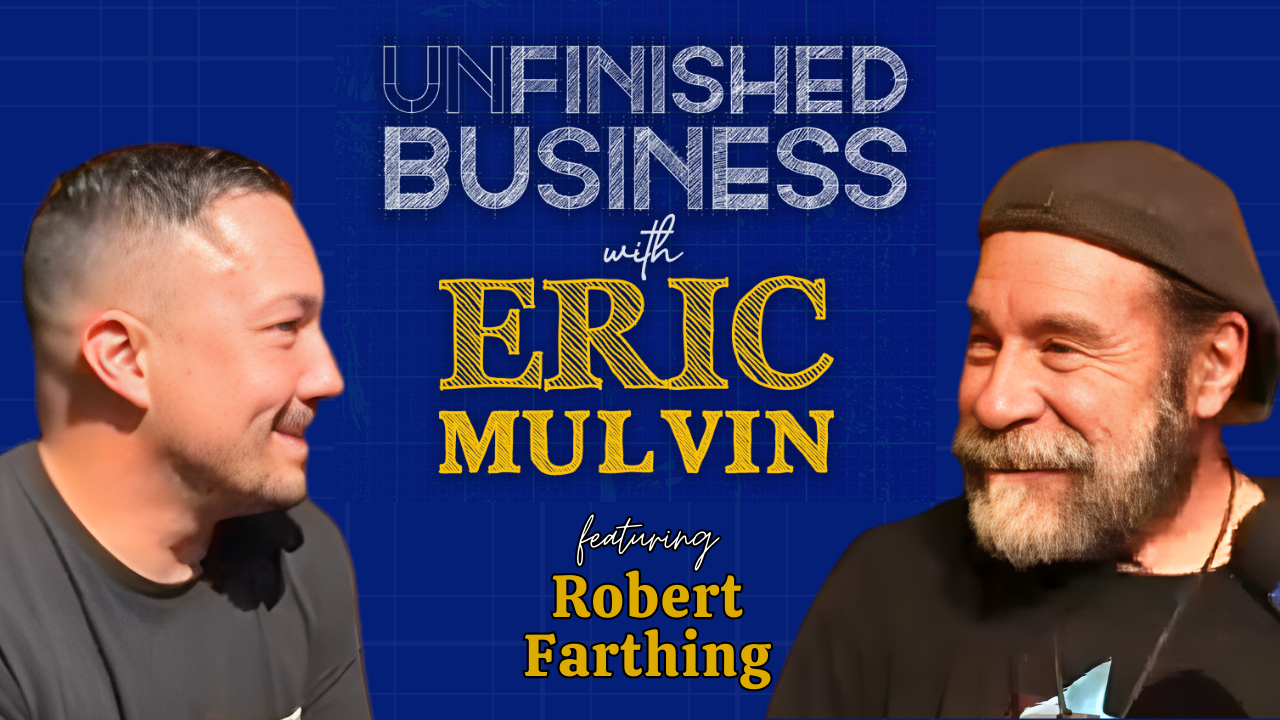
[Make an Impact Series] From Video Producer to Champion for Peace | Robert Farthing




How One Dream Sparked a Worldwide Call for Peace
In this episode of Unfinished Business, Eric Mulvin sits down with Robert Farthing — creative producer, entrepreneur, and founder of Peace Pi.
After a 30-year career in television, advertising, and running his own theme manufacturing business, Robert found himself unexpectedly reinventing his life. What started as a dream about hosting a pie fight for his 50th birthday evolved into the World’s Largest Pie Fight for Peace and ultimately the Peace Pi Broadcasting Network.
This conversation dives into entrepreneurship, reinvention after failure, collective consciousness, leadership, legacy, and what it truly means to follow your bliss without attachment to expectations.
If you’re a business owner, creative, or leader navigating change and searching for deeper purpose, this episode is for you.
Subscribe for More
If you enjoy conversations with leaders who are building businesses and changing communities, make sure to subscribe and turn on notifications.
Episode Highlights
00:00 – Navigating Career Changes and Ageism
04:28 – The Journey of Entrepreneurship
10:36 – Building Lasting Relationships in Business
13:08 – The Power of Relationships in Production
17:06 – The Birth of Peace Pie: A Creative Journey
22:41 – The Evolution of Peace Pie: From Idea to Movement
27:54 – Legacy and the Impact of Peace Pie
31:11 – Full Circle: The Peace Pie Broadcasting Network
35:13 – Embracing Opportunities and Peace-Centric Initiatives
36:21 – The Impact of COVID-19 on Collective Experiences
38:09 – Global Connectivity and the Butterfly Effect
40:52 – Navigating Reactions in a Connected World
44:40 – The Three Rs: React, Respond, Reflect
47:55 – Empowering Leadership and Team Dynamics
49:59 – Following Your Passion and Letting Go of Expectations
About Peace Pi
Unfinished Business with Eric Mulvin
Powered by Pac Biz Outsourcing
Peace Pi is a global movement dedicated to inspiring collective intention for peace each year on March 14 (Pi Day).
What began as a pie fight for peace has evolved into:
- The Peace Pi Traveling Medicine Show
• Immersive live music & meditation experiences
• The Peace Pi Broadcasting Network
• A growing global community centered around conscious awareness and unity
Learn more or attend the upcoming event:
Event: March 14, 2026 – First Studio, Downtown Phoenix
Register Here: https://tinyurl.com/yd7fns7d
Livestream: Peace Pi Broadcasting Network (YouTube)
Website: https://peacepi.com
Instagram: @peacepitravelingmedicineshow
Facebook: https://www.facebook.com/peacepitravellingmedicineshow
YouTube:@peacepitravelingmedicinesh6630
TikTok: @peace_pi_medicineshow
If you enjoy conversations with leaders who are building businesses and changing communities, make sure to subscribe and turn on notifications.
- Instagram: bizwitheric
- Facebook: https://www.facebook.com/profile.php?id=61560126743830
- Tiktok: https://www.tiktok.com/@bizwitheric
- Youtube: https://www.youtube.com/@BizWithEric
- LinkedIn: https://www.linkedin.com/in/mulvin/
Pac Biz helps transportation, SaaS, software, and eCommerce companies scale customer support and back-office operations with dedicated teams in the Philippines.
Learn more: https://pac-biz.com
Email: info@pac-biz.com
Transcript
00:01
Speaker 1
Welcome to the Unfinished Business Podcast. I’m your host, Eric Malvin, and this is a show where we explore the stories behind the leaders, the visionaries, the people who are out there changing the world through their creativity, through their organizations. And because it doesn’t matter who you are or what you’ve accomplished, even if you’re someone like the Dalai Lama, there’s still something out there that they want to do that they want to see done.
00:28
Speaker 2
Where people in tech connect to amplify human intelligence plus AI new shot goals that launch you high. Listen close and you’ll learn why.
00:55
Speaker 1
This episode is brought to you by Pac Biz Outsourcing At Pac Biz, we help transportation software and SaaS companies outsource their customer support back office tasks with a powerful team in the Philippines that are dedicated to you as remote employees, helping your business improve, support, scale faster and grow while keeping costs in check. For example, we even help one client save over $600,000 a year in payroll costs just by using dispatchers from pacus. If you’ve ever thought about outsourcing or taking on a virtual assistant, visit pack-biz.com to learn more. All right, today’s guest I’m really excited about having on the show here today. They have built over a 30 year career in television advertising working with brands like Thunderbird, School of Global Management, AZ Lottery, Mid First bank and Citizens Clean Election, among others.
01:49
Speaker 1
He is also a business owner with a theme manufacturing company Scene Art and Associates, specializing in children’s playgrounds and exhibits in museums. But over the last 10 to 15 years, his focus has been around peace and that has led to the launching of the World Peace Pie Festival back in 2013, turning PI Day into a global celebration of joy and collective intention. And in 2013 he was able to bring together people from as far away as Australia, Hawaii, Germany and across the US. Now, today, in 2026, Peacebuy has become the Peace By Broadcasting Network operating out of the Peace Pie Sound Lab located in First Studios in downtown Phoenix, the oldest live television broadcasting station in Arizona, established in 1949.
02:38
Speaker 1
And he’s also co founder of the Peace Pie Traveling Medicine show which is a flow ensemble of sound engineers, musicians and vocalists who bring voice and intention of peace in support of the Peace Pie mission. Ladies and gentlemen, please help me welcome Robert Farthing.
02:57
Speaker 3
Thank you Eric. It’s a pleasure this with you man.
03:00
Speaker 1
Yeah, absolutely. I’m excited to be here. I did not expect that today would be like this and I think just like a lot of things in our lives I don’t think we expect anything that’s going to happen.
03:11
Speaker 3
Expect the unexpected.
03:12
Speaker 1
Yeah.
03:14
Speaker 3
Capitalize on those surprises.
03:16
Speaker 1
So for the audience here today, I gave a little bit of introduction, but just tell the people, like, what.
03:22
Speaker 3
Who.
03:22
Speaker 1
Who are you? What do you do?
03:24
Speaker 3
Yeah, well, I mean, I think the first thing would be at the age of 63, I’ve done a lot in my life. Like, there are so many chapters of my life that were feel like different lifetimes ago, all associated with different types of jobs or work. And right now, today, I’m actually a rideshare driver for Uber to keep the roof over my head after sort of having the rug ganked out from underneath me on my career job. You know, a series of events that just the way the industry has changed over the last several years, the downsizing of marketing and advertising organizations like that. I was at the top tier of our agency as a senior content producer and it was time to, you know, be let free. So that came as a bit of a surprise.
04:15
Speaker 3
You’re like, oh, crap, now what do I do? Kind of landing in the cusp between not being able to retire yet, not having fully invested the best way in my retirement. What do you do next? You know, I went out and bumped into ageism first and foremost of like trying to go out and find a job with a little bit of gray in your hair and a little bit of crow’s feet around your eyes. Ageism is real, you know, you hear about it all the time. But I bumped into it face first and decided, you know what, I’m going to do this Uber thing for a while. And to be honest, I’ve made it work, enjoy it. I’m a people person. I get the beautiful mess of humanity in my car every day.
04:52
Speaker 3
And I’m making it work, you know, and it also affords me now the flexibility and time to do the passion projects like Peace Pie and all the other things. So I’m in this process of rebuilding my life again. It’s not the first time, and I hope it’s the last time I can land on something that sticks for a while. But change is constant and so are jobs in my world, you know.
05:18
Speaker 1
Yeah. And, you know, I think, you know, a lot of people listening, they’re business owners or maybe hoping to become business owners. And part of being a business owner, for better or for worse, is, you know, you, A lot of people have to go through that transformation. You know, like, businesses don’t last forever and many of them fail. And so you have to, if that’s what you’re passionate about. You’re going to try again and you have to reinvent yourself. And so you actually owned a business as well. So I mean, you can relate to that whole experience already. And that kind of is, that’s kind of the earlier in your career, right?
05:52
Speaker 3
Like you talk about like entrepreneurship, right? And you just, when you started talking, I was like, I’m flashing back to like, oh my God. I’ve been an entrepreneur or had an entrepreneurial spirit basically my entire life. Starting back as a kid, right? I was the kid that walked around with the lawnmower and the rake in my, in a wagon going from door to door to like knock on the doors like, hey, you want me to mow your lawn and do that kind of stuff. My very first business that I would say, you know, I created an actual business card for was out on a limb tree service. And I was trimming palm trees at 15 years old. So I’ve always gotten myself into things that was my own business for the most part freelance.
06:38
Speaker 3
You know, I was a freelance art director and production designer for television commercials when I started off my career. So everything was freelance up until like my first job outside of restaurants and things you do like that. But my first job working for somebody else was a teacher. I taught vocational stagecraft class for high school kids. Then I had my own business, created a theme manufacturing business. Because my career path was one of being an art director and a production designer for television commercials. Always had an interest in set design and production design. And you know, there’s this opportunity came up to have own business creating theme environments. And I did that for about little less than 10 years. And it was a complete manufacturing facility, employees and 20,000 square foot warehouse and all the things.
07:30
Speaker 3
Oh my gosh, it was a big business that kind of crashed right alongside 9 11. Shifted everything for, you know, 911 caused a big ripple effect that I got caught sort of swept up in my business ended up failing after a couple years right at the collapse of the economy in 2008, I think it was, you know, and after that cataclysmic venture sort of failed. And I don’t think any of these are failures, right? I don’t, I don’t look at anything I’ve ever done that didn’t go the way I wanted it to go as a failure. It was just, in hindsight is such a beautiful experience of looking back on something going that happened because you needed to be to at this place, at this point in your life, when did.
08:16
Speaker 1
You start making that shift to this isn’t a bad thing, this is just learning?
08:22
Speaker 3
I kind of think that perspective has always sort of followed me. I’ve always kind of had that sort of open ended idea. But, you know, I’m sure if I dug a little deeper in my memory banks, I would find sort of the first experiences of not have having an expectation met of first, your first reaction is like, I failed. Oh, that was horrible. Oh, it was so bad. You know, I’m sure I’ve got that there. And then time and time again, you just sort of realize like, oh, okay, once you’ve had enough failures or things that didn’t work out happen, and enough. Enough positive responses to that, eventually you go, this is just a shift. This is just a change.
09:04
Speaker 3
So, like, when the rug got pulled out from underneath me last year, it didn’t take me very long at all to sort of get over the initial grief experience, which you have to have. That’s healthy to be like, oh, this is a loss, this is a death, this is a whatever. You get through that. I was ready to go. Let’s pack it up and go, you know? Yeah, what’s next? Next, I would say I was saying, well, it’s just an opportunity for the next greatest thing to happen.
09:30
Speaker 1
That’s cool. And that’s great that you were able to have that perspective for so long. Like, I know for me, my whole, like, business journey really started when I was let go from Yelp and I was in that grieving process. And then it took. Yeah, it took me like a month or two before I was like, I need to get my stuff together. And then what happens? I started the taxi business. Nine days later, I met my wife.
09:51
Speaker 3
So.
09:51
Speaker 1
But I always think, like, man, none of that stuff would have happened if I wasn’t fired.
09:56
Speaker 3
Exactly, exactly. And you and I go way back. I mean, you know, came into the agency as an intern.
10:05
Speaker 1
My gosh.
10:05
Speaker 3
Yeah. And. And I remember I identifying you right away as like, oh, this kid’s got something. And so you were sort of the first and really only interned in that I was like, come on over here, let’s work this out. Because you had such a drive and such an ambition and such a vision and. And all of the things that make a good entrepreneur. And then when our time together went apart, then from afar, I got to watch you do the taxi thing, do the Yelp thing, do the, you know, go through all the things. And I’ve watched you never stop and always Keep the same activated motivational kind of thing that you got going. And it’s like, you’re brilliant. You know, keep going, man. You’ve got lots of, you got a big future ahead of you.
10:53
Speaker 1
Well, I, I, I wanted to say, you know, like, thank you on camera here because I consider you one of my first mentors. You know, at that time when I started, like I didn’t own a business yet when I was at Rester and you guys, you and Linda, like were really encouraging me like once I was let go, you know, from there too, which is agency life. You know, everyone bounces around. Yeah, you guys are like, go start a business and become freelance. And, and I went and did that and that was One of my six LLCs I started was Monsoon Marketing back in 2012 and that paid the bills while the taxi business sucked up all my money. That’s what kept everything going.
11:39
Speaker 1
So, and, but that was all because you guys encouraged me and you know, I was able to get the experience I got, you know, getting to work with you guys. I, one of my favorite stories to tell people is like, you guys gave me the title of content creator in 2009 and I don’t think that was like a term. Yeah, you should have copyrighted it or something. You could be sitting on some money there licensing that out. But, but it’s been cool to, yeah, like both of us like from that point on because I was still like early 20s at that point and I didn’t know much about the world.
12:12
Speaker 1
And then, you know, that, hey, these connections and relationships that you build at, in these different, you know, periods of your life, at a career, at a job, employees, you know, then some of those stick on with you forever like this.
12:25
Speaker 3
And that’s the way you have to approach every business relationship is, at least in my experience of working with somebody in a positive, respectful. You never know when that person’s going to come back into your life. This might be a gig or where you’re working with somebody, but if you suit up and you show up and you do the work and you’re just authentic and you’re real, you’re creating an imprint with the person and the people that you’re working for and it might be 5, 10, 6, whatever, years later and you pop back up on the radar screen and you’re working with that person again, it’s time and time again those full circle relationships come back around. I, I’m working with people now that I’VE worked with my entire career in between 10 or 12 or 15 years. Like, you know, how you doing?
13:20
Speaker 3
You got to want to do this. Absolutely. You know.
13:23
Speaker 1
Yeah. So do you. Is there a story that comes to mind, an example where you were like, man, that was crazy that we. I never thought we’d get connected again and we’re. Look at us working on this thing.
13:36
Speaker 3
Well, I, I mean, I, sure, I could probably dig up a whole bunch of different relationships. The closest and nearest one is actually an event that I just finished. You know, I’m gigging now. I’m. I’m freelancing. And I was invited to produce Ambassador’s Ball at the Biltmore recently with the Diplomatic Corps of Arizona. And, you know, as the producer, I had to pull my crew together and I went to a really good friend of mine, Katherine Dragon. We went to high school together in theater together. And our lives over the years has done this interesting crisscrossing of. We were both in production and whenever I would get a gig, I’d always chat, would always be my first call. So that kind of a partnership, when you’re building relationships behind you and you’re. Then this is a producer’s trait. Right.
14:34
Speaker 3
This is something that I really tapped in on when I became a producer. A producer’s job is resourcefulness first and foremost. Like, somebody’s going to come to you and they’re going to say, we need to build a castle. And we only have one week to build that castle. My job as producer is to make sure that castle gets built in a week, because we’ve got something to do in a week. So you’re in this whirlwind of stuff, so you need to have a full arsen of people ready to go be like, hey, can we do it? Boom, boom, boom, and get things put in place and then just activate your team, empower your team and let those creative people do that job. So that’s a great example of like, yeah, I’ve got lots of old relationships that I could call on.
15:20
Speaker 3
And it’s important to keep those relationships healthy. You know, do a good relationship, walk through the initiation, fire with them. Sometimes the hard jobs that you build with somebody are the best relationships you’re going to walk out with. So I work like that a lot.
15:34
Speaker 1
Yeah. And that’s great advice. So if you guys watching, maybe starting out in their business and you know, you got that client that frustrates you, don’t burn those bridges because you never know what could end up happening in the future where you might need that person or they might be reaching out to you.
15:49
Speaker 3
Don’t burn the bridge. You don’t necessarily have to ever cross it again. You don’t have to go back there if the circumstances were. Were horrible. But never walk out the door shredding the opportunities that can come from that. Because your perception of the experience might not be their perception of the experience. Right. You might not have liked working there, but that person might. Thought you were brilliant. And they might not be the next job you have, but they might go, yeah, call. Call this guy Eric. Bring Eric in. And now you’re working through that networked kind of things. Yeah, don’t. Don’t ever burn a bridge.
16:27
Speaker 1
Yeah. Switching gears a little bit, you know, because we could talk about advertising and marketing all day. You know, as I mentioned in the intro, over the last, you know, 15 years or so, you’ve been on this path, you know, and. And another cool story I do have to share that is one of the ones I love to share is because of this event that you put on my wife and I, were like on the front homepage of the Phoenix New Times, kissing with like pie all over our face. Like, that’s crazy. But it’s because of this event, this crazy idea that you had, and you brought to life that entrepreneurial spirit coming back over and over again. So, like, what transition? How did you go from working television, doing, making commercials to that?
17:13
Speaker 3
Well, so what you’re talking about is peace piece PI. Right? And I know that we have very limited time and this is a long, nuanced story, but was a peace pie is. Was established in 2013, was the world’s largest pie fight for peace. And it all came about because I was turning 50 and I’m like, you know, my life was pretty thin as far as relationships went and stuff. Like, I should really do something for my 50th birthday. And I went to sleep that night and I woke up from a dream laughing, like, literally, like, oh, you know, a little chuckle in the middle of the night. And in this dream, this little voice was like, have a pie fight. Like, you know, a Laurel and Hardy slap you in the face pie fight for my birthday. And I’m like, oh, that’s brilliant.
18:06
Speaker 3
Now, I also have a strong spiritual thread within me. I practice shamanic healing and I’ve done that for 20, 25 plus years. So, you know, this idea of dreams and frequencies and how to really kind of navigate in that manifestation zone of dreaming and things. And there’s a certain frequency that I heard, like, oh, this silly little voice says, have a pie fight. Was at a certain frequency. Whereas, like, if I don’t pay attention to that inner voice, that inner guidance, then it’s going to harass you until you do something about it. And I knew, oh, okay, I’m going to have a pie fight. Off I go into this, the strangest odyssey ever of, like, the creative spirit, the energy that came out of just that idea of, oh, now I’ve got six months to pull off this pie fight.
18:57
Speaker 3
And it was honest, like having a conversation with God, for lack of a better word. Like, I’m talking to some higher inspired voice that was like, okay, I’m supposed to do a pie fight. Why am I supposed to do this pie fight? Well, for peace, of course. I’m like, oh, okay, I’m doing a pie fight for peace. Well, when am I supposed to do it? You’re supposed to do it on PI Day, March 14th. And then my marketing brain would fall off because I’m like, oh, that’s a brilliant tag. Peace on PI day, having a pie fight. So from a marketing perspective, my brain instantly went into that zone of like, oh, I can market sell this. This will be brilliant. But it went so much deeper than that of like, okay, how do we do this?
19:39
Speaker 3
So peace pie became within this first inspired world’s largest pie fight for peace. Which is silly, right? It was like. And the intention being to celebrate peace. And so as this thing evolved, it became a holly festival inspired pie fight with, like, blue pies and green pies and pink pies. And each of these colors of pies was a cause for humanity. So when people came to the. To the pie fight, you know, you had a little paper plate and you had. You would write on the plate your intention for peace. You would write on your plate your cause for humanity. And then you would go into this pie arena and you would just have this ridiculous fight with every covering each other with your attention for peace. And you’re shouting out your cause for humanity. That’s how it evolved.
20:32
Speaker 3
And I was getting all this information to do this. But what was so remarkable to me about the how peace pie started was a. I partnered up with Kirk Straughan, with Walter Productions, you know, into big things, into peace. When I told him my idea, he’s like, yeah, that’s brilliant. Let’s do it. So there was this kind of burner burning man community around that. And when we started talking about peace, pie people Just came out of the woodworks. Like we would say, hey, we’re going to have a meeting. And all of a sudden we’re having a meeting and there’s a hundred people in there wanting to have a pie fight. And so I was just sort of like holding space around the energy of the people that all wanted to invest in. Yeah, peace on PI Day sounds like a great idea.
21:20
Speaker 3
Now, little did I know at the time, the event was a success. The event was great. I couldn’t have asked for it to happen any other way. 500 people in an old dirt lot opening up the brand new warehouse for Walter Studios is at now bringing all those people together. The vision at the time was the very next year was 3.14, 2015, with the first six numbers of PI, which only happens every thousand years.
21:48
Speaker 1
Yeah.
21:48
Speaker 3
So the vision was to do this, launch this, and then have a bigger festival the next year at Hants park with two days and three days, like. But the problem with the business model of that was that it grew. The idea was way bigger than I could even begin to support. So it kind of just self imploded at that point. Which then every year after that, I would just always around. This season, I call it the pie season. It usually starts to trigger in October. Rain goes off. It’s like, oh, it’s coming up. And then January, February, you’re in this intense creative flow of what am I going to do? So every year there’s been a different expression of peace pie.
22:30
Speaker 3
Whether it was a tiny little event, me standing all by myself in the middle of nowhere, just holding space and praying to whatever. Hey, peace today. So there’s been all these different iterations of that message, but all basically the fundamental mission is simply this. What I’m trying to inspire is a collective conscious global experiment to inspire as many people as possible to simply recognize and be aware and hold space for peace on this day. It’s science. Collective conscious people. When people sit together and they are focused one thing, we can actually shift things in that direction. It’s science. It’s been proven. We can see this. And I’m like, I’m. I’m the Pied Piper. Hey, can we try this? Hey folks, let’s try this. And that’s basically where I’m still at today. Every year on PI Day, we try to do something.
23:34
Speaker 3
And this year it’s pretty big.
23:37
Speaker 1
Yeah. There is so much we could unpack from this. Seeing the journey of like, from the birth of this idea to making it happen, to trying to make it so big that it imploded because that’s. That so many people, I think, can connect to that. But that didn’t stop you know? It didn’t. It didn’t. You kept going and 26 now, 13 years later.
24:05
Speaker 3
Right? Yeah.
24:06
Speaker 1
We’re sitting here talking about celebrating it again, and you’re bringing people back in two and a half weeks very soon from now.
24:14
Speaker 3
Yeah.
24:15
Speaker 1
So obviously, as we’ve been saying, 3.14. So March 14th is coming up. But what inspired you this year, this time?
24:24
Speaker 3
Well, I want to tap back into something that maybe entrepreneurs or people that are doing their business. You know, I’m. I’m 13 years in on this thing now, and there are times when I’m just like, you know, the. The. The voice comes in, it’s just like, what in the heck are you doing? Who. Who do you think you are that wants to just beat you down and say, the world’s largest day of peace? You’re just a single person in this world. Who in the world do you think you are to try to do something this big? And I always, you know, and that can drive you into some little dark places where you just want to give up. Just, like, screw it. I’m out, you know? No, who. Yeah.
25:07
Speaker 3
And you let that voice get in there to push the get off button, the, you know, the quit button. I do have battles with that. With that voice sometimes. But again, 13 years in, it’s like something always happens that just like, okay, I got to. I have to. I can’t stop. No matter what, I can’t stop.
25:29
Speaker 1
So when you hear that voice, is it. Does something happen or what do you do to also quiet that voice?
25:35
Speaker 3
I just sit still. I just, you know, I just sit still. I know that the voice will go away if I just, you know, give it some time to breathe, you know, just like, okay, I hear you. I make an ally of those voices and just say, oh, okay. I know you’re afraid. I know you’re scared. I know you think that this is stupid and who are you? But it’s okay. We got this. Just let’s take a rest. Let’s take a break and invite the other opportunities. Because when you’re in that zone, you’re cutting out opportunities to snap out of it if you go too deep into that. I can’t. I won’t. All you’re doing is shutting yourself down where nobody is going to recognize the light within you that is trying to get out to do the thing you’re trying to do.
26:20
Speaker 3
You know, so you have to, you just have to relax. Just relax.
26:24
Speaker 1
You know, that’s great advice because I know, I mean, over my 15 year career running my own businesses and I’ve heard it from a lot of others or people who are trying to start it. Yeah, that voice, it could be killer. I mean, just in the last week I’ve interviewed someone, their goal is to reach a billion people with their message. And another person, like, I think it was like maybe hundreds or I don’t know, tens of millions of people as well.
26:50
Speaker 3
Yeah.
26:51
Speaker 1
So massive crazy goals which I think align perfectly with you.
26:55
Speaker 3
I mean that seems to be the nature of how we are seeing business evolve these days. It’s like, it’s the reach, how do we reach our audience? And that’s the challenge, that’s the full on challenge that I know nothing about. I’m just the content creator here. I’m just the guy with the idea and get so frustrated with. I call it my message in a bottle, right. I’ve got this beautiful message in a bottle for peace, world peace on the planet. And I use that metaphor all the time. I’m just putting a little message in the bottle and I’m trying to throw it out there into the social oceans, hoping that somebody’s going to see it, only to get like, you got 35 thumbs up on that message in a bottle.
27:39
Speaker 3
I’m like, come on man, how do you reach your audience when you don’t have the massive resources that people often have to reach a million or a billion people? So it’s simply one person at a time. That’s all I’m doing.
27:54
Speaker 1
There is this concept of legacy and with business owners and so, you know, I got younger people here. That thought is so far out of their mind. I’m like, even for me too, I’d like, I’ve got probably five more things, like five more major chapters. I like that’s going to take my life in a completely different direction before I even think about that. But I don’t know, talk to me a little bit about legacy. You know, you’re thinking now about not just keeping this thing going, but keeping it going beyond your life. And that’s a crazy thing to think about.
28:28
Speaker 3
I mean, I think there I it, I think there is a stage of life that you reach me, right? I’m, I’m on the back nine of life now, not saying I’m going anywhere.
28:45
Speaker 1
And I, you know, you’re almost on the back, you’re not that far.
28:48
Speaker 3
I mean, but there is you kind of, you put your foot into your. Into different decades, right? Yeah. And so now I’m in the 60s, moving into the. And potentially into the 80s. And there’s something that triggers at this stage when you are starting to age where, oh, it could be tomorrow, you know, or it could be the next day, or, you know, I got an ache and a pain that turns into the ache and pain that you now live with for the rest of your life. So you automatically start to think about your legacy. What is it that I want to leave behind? What is it that I want? What is the purpose of being here? It’s the existential question of life, you know, and it really starts to. I’m observing, I’m watching this because I’ve never experienced it before.
29:32
Speaker 3
This is all new to me. I’ve watched other elders move through these stages and now I’m in that stage. So I get to experience for myself what it’s like to think about what am I leaving behind? What is the legacy? And I’ve determined that the legacy is not for me to write, it’s for you to perceive and say, oh, the legacy of Robert was this. Somebody else is going to say, the legacy of Robert was that it’s all based off of your experience, our experience together. That my legacy could be 500,000 different little legacies. Because the legacy is the way in which you touch somebody else’s life, you know, framed by the big project or the big job or the big personality that you have created for people to view you through. But how that legacy works is really not mine to choose.
30:29
Speaker 3
I can only say I’m creating an experience where peace is my core value, my core intention, and that’s the life that I live in, everything I do. So that the legacy I’m carving out for people to see is one of a man who tried to make a difference for peace. And so that’s that. I would say that. But there’s also 20 other things that are like, well, that’d be a good legacy too. Yeah, all the things. But, but so there’s that, you know.
31:00
Speaker 1
Yeah, that is fascinating, you know, and I mean, you got this really amazing thing here though, that you’ve helped build and you know, over time, because it has been time. And I’ve been thinking about this a bit myself. You know, my business, we just hit 11 year anniversary and it’s like, that’s a long time. That’s like a quarter of my life I’ve spent building this thing, you know, I mean, same with you. Not, not a quarter of your life, but a big chunk of your life now has been Peace Pie.
31:30
Speaker 3
Right?
31:30
Speaker 1
And, and it’s become part of your identity as well. Was there any. I mean, did you. Let me see how to think I could ask this question. Did you think you’d end up where you’re at today being an ambassador for peace?
31:48
Speaker 3
Absolutely not. I, and I say that all the time. So many nuances of the very blessed life that I really feel like I’ve had an opportunity to experience. I mean, I’m just. When I pull myself away from myself and I look down at this person named Robert that’s running around down here on Earth. I’m just fascinated with that little character down there, you know, and that’s. There’s no ego attached to that. It’s just watching how a human being is trying to make a difference. I’m getting emotional all of a sudden, which is really kind of curious.
32:20
Speaker 3
But so I look down and I watch Robert and I say, hey, Robert, would you have ever guessed that you would be a shaman or that you would be living off grid and having earth that retreat or that you were this Peace Pie thing, whatever this thing is as of right now, today. Could I have ever imagined being in a studio where we’re at, we’re 32 track live stream recording studio called the Peace Pie Broadcasting Network. And the reason that all came up was a series of coincidences or synchronicities where you know, the music we do, the showmanship that we do as Peace Pie. Now the evolution of PI moved from a pie fight for peace to sort of this integration of my spiritual sound healing practice into, well, what if we turned that into music?
33:14
Speaker 3
And that’s what became the Peace by Traveling Medicine show, which has been the last five years or so of Peace Pie really kind of focusing in on. We are Peace Pie. The mission is peace broadcast through the Peace by Traveling Medicine Show. So there’s all these Peace Pie arms that are out there, but the broadcasting network that wasn’t didn’t exist last year at this time. This is only a new venture since June. And it happened because we got. We’re in first studio downtown Phoenix. This building is the first live television broadcast station in Arizona back in 1949. It just so happens that it was also the stage for the Wallace and Ladmo Show. If you were a kid growing up in Arizona, there was this longest running kids television program called Wallace and Ladmo Cartoons. And if you were a kid growing up here.
34:04
Speaker 3
You did everything in your power to get on this show and get a ladmo bag. I was a kid on this stage at the age of seven.
34:12
Speaker 1
Oh, cool.
34:13
Speaker 3
So I’m. This. This where we’re sitting right now was the director’s and editor’s bay looking down on the stage. So there’s this really kind of.
34:22
Speaker 1
Oh, is that the stage behind this curtain? Yeah, there’s doors back there.
34:26
Speaker 3
Exactly. Well, it is. It’s like doors that opened up into a little balcony that looks down onto the stage below. So, Eric, at this very powerful and potent. I recognize that. What. How my life has started. Started to come full circle. No coincidence. Pie. Right. How all these different things have. Full circle. Have come around to land me in this place in time to say, oldest live television broadcast station. Let’s ride in on the legacy and the spirit of what this building was as the Peace Pie Broadcasting Network. To interrupt your regularly scheduled programming out there in the world. That social media and all of this nonsense that’s being pushed on us through our social media. The idea behind the Peace by Broadcasting Network is we need to disrupt that with something that is intentionally peace centric.
35:16
Speaker 3
And the fact that I’ve landed in a building where my child, my. My. My. My boy, my young, you know, the inner child is down there on the floor getting his labo bag, and I’m up here doing this. Yeah, that’s pretty big. To identify how the universe in some way has agreed and given me all these opportunities through life to be here right now doing what I’m doing. And it’s as crazy to you as it’s crazy to me. I think this is the most insane thing I’ve ever done in my life. And you just keep doing it. So there’s that. Did I answer your question?
35:59
Speaker 1
Yeah, that does.
36:00
Speaker 3
Coming up, March 14, 2026. We’re activating the space. We’re bringing our Peace by Traveling Medicine show down. Music. We’re opening the doors. It’s free. People can come. And we got vendors and we’ve got. You know, we’re creating another little festival inside of this building, and it is the first official peace piece event on the stage since we’ve taken the studio. It’s not the first event. The first event we did was in 2020 where we launched the Peace by Traveling Medicine show for the first time. And we did that show in 2020. And the next day, Covid shutdown happened.
36:38
Speaker 1
Yeah.
36:38
Speaker 3
So again, the universe matching a frequency or, you know, providing a contrariness to like, hey, we did peace on Friday in 2020. And the next day the world said, well yeah, here’s a version of peace in the middle of the chaos. Nobody in the streets, no planes in the air, people behind their doors. Absolute stillness and silence in places where you’ve never heard stillness. And silence is a form of peace. But it was very uncomfortable.
37:07
Speaker 1
Yeah, right. I was joking about with you earlier, like you gotta be careful, you gotta be more specific on what your ask is. You got your piece you were asking.
37:16
Speaker 3
For, but yeah, well be careful what you wish for, right?
37:19
Speaker 1
Yeah. But you know, talking about long term, you know, and you never know what could happen. I mean I think about the younger generation that got to experience that and got to see, oh there was a different alternative out there to this crazy world that we live in. It’s possible, might take crazy effort to make it happen. But that’s what I, I look and I think about that like you know, for. But everyone around the world really experienced it differently. But it was a. The interesting thing. I’ll tie it back to peace pie. There’s not too many experiences in our lifetime that we collectively as a planet experience together. And Covid was one of those things. I don’t know actually. I can’t think of too many things where there was something like that.
38:09
Speaker 3
This actually taps into something that I’ve recognized and really sort of like oh, okay. And that is for me, 911 was a profound experiential wake up call, for lack of a better word. And for me during that experience I recognized that was the very first time that were so connected with our devices and with our social networks and everything was in place to that the butterfly effect could happen. That something could happen at some place on the world and within seconds, within minutes, the entire world, if they had this in their hand, could hear, see and experience that at the same time. So I recognize that as the first major global event where this crumbled and everybody went yeah. And this reaction, it wasn’t. So I always associate that visualization with an atomic bomb that got dropped and it just went poom. A reaction.
39:19
Speaker 3
Now we, and that’s the trick about this thing now is that we’re connected. We’re absolutely connected. We’re talking to somebody right now in, in the Philippines and we’re so connected right now that when something happens it triggers our instant reactionary emotions like we’re seeing things and it’s actually sometimes feels almost designed. Oh yeah, let’s piss people Off. King, king, king. And all of a sudden everybody’s stressed.
39:48
Speaker 1
Out about something happening on the other side of the world that I have no control over, can’t do anything about. I. People around the world are being impacted by that and we’re spreading this fear, this. That’s right. These perceptions that aren’t necessarily there that tragedy did happen, but absolutely, you know, those happen every day.
40:07
Speaker 3
And I think we’re sort of, you know, again, metaphorically speaking, we’re sort of in preschool right now on what we have created in our lives.
40:15
Speaker 1
Yeah.
40:15
Speaker 3
You know, and how to, how. How to use this tool for good. And it’s there. It’s all there. It’s like for something crappy over here, there is something equally dynamic good over here for everything. You know, that’s the way the world works. Positive and negative forces and vibrations. It’s like, yeah, for this horrible thing over here, there is somewhere else that. And a different frequency that’s going to counteract that. And it’s like, well, where do you want to. Where do you want to put your attention? You know, so to that end. Yeah, this device does trigger, you know, that’s when were all connected and that’s now when we’re still in the ripple effect of that Covid. Same thing. Right. So we keep having these big major events now because we recognize the power of this thing to react to that.
41:07
Speaker 3
And that’s what we’re doing. We have to learn how to respond. We have to relearn how to respond. Don’t react. You see something, we don’t know if it’s true anymore. Right. We’re in that phase of things now where things like AIs and all that stuff come into play. We don’t know what’s true anymore. So now we have to stop reacting to such triggers and just sit back, respond. That’s a much more measured approach to how to navigate what we’ve gotten ourselves into.
41:38
Speaker 1
Yeah. There’s a quote and I’m going to butcher it. So I’m trying to look it up really quick that kind of touches on what you were just saying here. But Victor Frankl and I like this quote, and it says between stimulus and response, there is a space. In that space is our power to choose our response. And I think with, since the cell phone, you know, and the instant reaction to instant everything gratification, you know, the. That that space is shrunk, like we have no more patience to even think about reacting. It’s just like react. And how does that Interfere with the goal of trying to get peace spread throughout the world.
42:28
Speaker 3
Well, you know, seems also to me, in my experience, within the last five or so years, right? So in 2020, Covid happened, September 2020. Politics and pandemic at their height, right? We were in that just very chaotic place. And like we’re about to decide who’s going to sit at the king’s chair next or, you know, all that nonsense. And I was so very triggered by all of this that I just had to unplug. I knew that the only way for me to fix what was happening for me was to go someplace where this thing didn’t work. And again, long, compressed story short, I ended up going off grid. I ended up finding a piece of property that was beautiful and sacred and indigenous stuff. I bought it, I’ve been protecting it. I’ve been building a retreat center out there.
43:20
Speaker 3
And in the course of the last five years of having this opportunity to have two worlds, right, I’ve got the plugged in world, the business, and everything I have to do over here. But I also now had this other unplug space that was beautiful and sacred and so I could retreat. But what I also recognized is that as within the shamanic path, you know, what is a shaman, right? A shaman is a master of the liminal space in between two worlds or two spaces, right? The shaman is somebody who has mastered this ability to put one foot in ordinary reality and one foot in non ordinary reality, dream space or whatever, and walk in those two worlds to be able to bridge between.
44:07
Speaker 3
And you can take that same symbolism and metaphor and say, okay, from a shamanic perspective, it’s dreamland and, you know, realms and all that stuff. In the real world, you could say the polarities of the situations. We got ourselves the red hat and the blue hat, or the this side and that side, and you can walk in there. And the shamanic perspective is one of sitting in between that liminal space and bridging back and forth, holding a space and an opportunity for things to cross over and write themselves if we’re too heavy one side or the other, right? It’s like you have to have those bridge builders that understand the space in between things. So to get back to your question or metaphor, reaction versus response, right? It’s like I used to have this thing I called the three R’s.
45:04
Speaker 3
Like react, respond and reflect, right? That’s how I would react, reflect, respond. Anyway, it was the three Rs. Instant, see, react, the lizard brain emotion comes out and you’re like, you’re angry instantly. You have to let go of that reaction and reflect. Give yourself time, give yourself space. Sit in that liminal space of no judgment and just be in your truth, in your space, doing some ordinary thing. Give yourself that breathing room to reflect on what you saw. And then you can form a response that’s more in alignment with what you really feel, because you don’t. The reaction is not the real feeling. The reaction is the emotional shock.
45:54
Speaker 1
Yeah. Like you said, the lizard brain. You’re. You’re instant because give yourself a couple seconds and you collect your thoughts. You’re like, no, that’s actually not how I want to respond. But. And to tie it back to business, you know, all of us here, we have to be leaders, you know, and even when you are running, you know, you’re. It doesn’t matter what position you. We have to influence and lead people. Being producer organizing hundreds of people to get together to celebrate pie. But the. In leadership, like, it’s very tough. Like, you need other people to do things and many times they’ve got their own world and they might not hear that communication right. And they don’t do the thing that you want them to do or need them to do. And now there’s conflict.
46:42
Speaker 1
And now here’s your opportunity to show your leadership skills and your, you know, how good of a leader are you? Because the things that I’ve learned over the last, like 15 years of being a leader in my own company is, you know, the fast shortcut to getting the communicating to that person, at least for a business owner, very low patience. It’s like, you need to do this better next time. And for the business owner, like, all right, I told them, they know how I feel about it, and you move on and you walk away. But that’s not the best way to get things done. In fact, it’s probably going to slow things down and they’re going to, you know, quiet quit on you and probably not put their best effort or no effort in next time.
47:27
Speaker 1
So it’s as interesting as in leadership thinking about that. Like, it’s such an important skill to have that’s very difficult for people to be able to master, is not reacting like taking time to think. And it’s an interesting thing to.
47:44
Speaker 3
Reaction is never the truth. It’s raw and authentic in the moment, but it’s never the truth. Yeah, you know, it doesn’t align with that, you know, and I’ve always said from you know whatever. I. I’ve been a leader since I was a kid, you know, always, always kind of finding my way to help motivate people. And I recognize that the strongest leadership skills that I fostered over the years was one of empowering everybody that was with me to be the very best that they could be at their job. If I could help motivate you to be the best version of yourself as my cohort or my employee or whatever that is, and you feel good about what you’re doing, you’re going to perform fantastically. And that’s my job as a leader, was only to inspire people to be the very best they could.
48:36
Speaker 3
Because everybody doing the job wants to do the very best they can. Right. And help them be the best they can. And you will not fail.
48:47
Speaker 1
Yeah, that. And I got to live that. You know, it’s what’s cool is I. I got to experience that, you know, being the person working hard as an intern, you know, then trying to. Trying, like, busting my butt, like, I got to impress these people, you know, I want to. I don’t want to make this a career. And because of that, I mean, again, some of the crazy. Like another one of my favorite stories, like, I got to produce a halftime show for the Phoenix Suns because one of the clients was a sponsor for the Suns. And, you know, like, but I. If I wasn’t, I don’t know, you just created these opportunities. And I, I’m so grateful for that because, like, I don’t know. I don’t know many people who would. They would keep those opportunities for themselves.
49:31
Speaker 1
Like, oh, a halftime show for NBA team. I’m going to do that one. I’m not going to give that to somebody else to work on. But, I mean, because of that, I mean, that was able to give me the confidence to go on and, you know, how many more times did I have to say yes to things to get to where I’m at today? And, and to go again, full circle here on a story because again, you know, people listening might be thinking about what they want to do in their future, and they might have crazy potential. Like, that is unharnessed and with the right message, with the right person, it’s going to get unleashed. Right? And so what advice would you have to those people that it’s in there somewhere?
50:13
Speaker 1
Maybe they might have heard that voice, but then they’re hearing the other voices. They don’t know which ones to listen to, you know, when. So what. What would you say to those people that need to hear that message to start doing the thing. Start the thing, start the business, start the idea.
50:27
Speaker 3
You know, Joseph Campbell, follow your bliss. Follow your bliss. Follow your bliss. Follow your passion. You know, if it really, truly is your passion, just keep your head down, keep going, and just follow that. It will not fail you. It might guide you. And that’s the other thing is let go of expectations. I have this wonderful way of navigating that, of just like, no expectations. No matter what happens, everything is perfect. When we burden ourselves with an expectation that, oh, I’ve got this goal in mind and I’m going to do plan A, plan B, plan C, plan D to get to there. And you’re setting an expectation that if I do this is going to happen. And if I do this is going to happen. And when you set an expectation and it doesn’t meet, then you’ve instant disappointment, which then creates fall points.
51:18
Speaker 3
And it takes longer to get to that. Without expectation, you’re allowing more forces of the universe, for lack of a better word, to follow along with you. No expectations. Well, I thought it was going to go this way, but it went this other way instead. And you go, okay, move. Perfect. That’s, that’s great. You just. No expectations. No matter what happens, it will fall through if you just keep going. Does that make any sense?
51:44
Speaker 1
Oh, it makes perfect sense because I wouldn’t be where I’m at today if I didn’t think the same way, you know, and business is. So you, you make strategic plans, you make three year goals for your business. One year goal, six. But you know what? You have to be flexible. And if I wasn’t flexible, I’d be running a taxi company still, which was losing money, so I couldn’t. But I mean, like, there’s so many things that I went and started and even this podcast here, Right. You know, it’s me following my passions. Like, I’m passionate about interviewing people, storytelling, I want to make documentaries.
52:21
Speaker 1
And I was thinking about it today, again, going like full circle because we worked to get like so many things I learned about storytelling from working with you on some of the projects we worked on, like with Arizona Department of Health, you know, going out. Like, I felt like I learned how to tell stories in a way that today still work, like, still are with me and, you know, evidenced here.
52:44
Speaker 3
Yeah.
52:44
Speaker 1
With this. Which is cool. So.
52:46
Speaker 3
And the reason you were there was because you are your own natural storyteller. That’s why you were like, oh, I’m bringing Eric on this because you already had inherently within you an ability to capture and tell a story, or at least a passion to want to do that. You just needed the opportunity to discover it even more. Were you the best storyteller back then? No, probably not. But you had the drive and the passion, and all you just needed was the opportunity. And if somebody can’t create that opportunity for you create it for yourself. You invent it yourself, you know?
53:21
Speaker 1
Yeah. So, yeah, absolutely. Well, to wrap things up here, is there anything out there, any, like, unfulfilled dreams about. Yeah, it’d be cool if I could ever, you know, maybe this thing too.
53:32
Speaker 3
When you say, what’s your unfinished business? You know, unfinished business. What is my unfinished business? Or the business of the person you’re talking to reach as many people as possible, that’s going to be unfinished business. And I’ve come to the fact it’s like what I’m doing is one person at a time.
53:49
Speaker 3
I’m planting a tree for shade that I’ll never see that the legacy that I’m leaving behind is not necessarily that I might ever see a billion people celebrating peace on PI Day, but when it’s time for me to, you know, jump off the planet and go do whatever next, I’ll know that the spirit of what we’re trying to do will live on in people like Eric that got to meet his wife and be on the front cover of the newspaper, because you will always know and carry for as long as you live. Peace on PI Day is a thing. Right. And that’s how it’s going to go. And I might never see that. And that’s okay.
54:27
Speaker 1
Yeah. And that’s incredible. Like the. One of the ultimate sacrifices, right? Like plant doing something for the next generation or for others that you’ll never even see the benefit of. Like. Like I said, planting a tree for, you know, you’ll never be able to see the shade of. But, you know, again, tying things back to entrepreneurship. I work with a lot of family businesses. It’s a core value of pac biz. Family work with my wife. There’s this. This whole family component.
54:54
Speaker 3
And at whatever point is the. Is it’s time to punch the clock and move on that I have some kind of inherent trust that I will have accomplished everything I was supposed to accomplish in this lifetime. So I don’t put a lot of energy and effort into unfinished business, you know? Yeah, it’s. It’s. It’s. It’s always. It’s all. It’s going to be complete by the time it’s done.
55:23
Speaker 1
That’s a great way to look at it because then, no matter what.
55:27
Speaker 3
Yeah. I did what I was assigned to do.
55:31
Speaker 1
Yeah. And even if you take away all that stuff, I mean, what you’ve been able to accomplish here with Peace Pie and with your career too, people like me and I’m sure countless others, with all the lives you’ve touched, with everything you’ve worked on, I’m sure there’s a whole bunch of people out there that have a piece of Robert with them.
55:53
Speaker 3
I’m not crying.
55:54
Speaker 1
You’re crying so. Well. Coming up, March 14, March 14, 6th.
56:00
Speaker 3
First Studio Downtown Phoenix, 631 North First Avenue. Parking sucks out here, so ride share. Take the bus.
56:08
Speaker 1
Light rail stop is right outside.
56:10
Speaker 3
Is right outside. We are trying to fill the building with 314 people. This is a headset experience. It’s live, immersive sound. We’re really trying to hit that magic 314 for this particular event. So music, we’ve got vendors, we’ve got a guided meditation. It’s all online. Eventbrite Peace Pie Traveling medicine show, Peace by Traveling Medicine on Instagram. We got a broad we. If you can’t make it, we’re going to be doing a live stream on YouTube at peace by Broadcasting Network. And you can find all of this information on peacepie.com perfect.
56:45
Speaker 1
And then we’ll get links to everything he just mentioned in the show notes. So you could easily find that wherever you’re at in Apple podcasts, Spotify. So. Yeah. And I know, well, there’s a lot more we want to explore. Like, every time he said answer, I’m like, man, there’s a whole episode right here.
57:04
Speaker 3
It’d be an honor to come back and just chat with you, Eric. You’re doing a fantastic job. I look forward to supporting you in any way I can.
57:11
Speaker 1
I appreciate that. Well, thanks for being on the show and we hope to see you out there this march and maybe let’s blow it up. Let’s get more than 314 people out there.
57:22
Speaker 3
Let’s do 314 in the building, which is capacity, by the way.
57:25
Speaker 1
Okay.
57:26
Speaker 3
Throw the rest of them online. And if we can start our way to that million billion people, then let’s do it today.
57:31
Speaker 1
I say let’s get the fire marshal out here warning Robert the streets.
57:36
Speaker 3
Right.
57:37
Speaker 1
That’d be great, but cool. Well, thank you guys for watching the show today. If you like what you heard, you want to hear more inspiring stories from people who are out there changing the world, creating the world that we all live in. Follow us BizWitherick on social media and the show Unfinished Business with Eric Malvin on Spotify, Apple Podcasts Wherever you listen to podcasts, thanks for watching and we’ll see you. See you later.
58:05
Speaker 2
CEO’s and visionaries shaping what’s to come. Building more than profit Lifting everyone Every path’s unique, but it takes a choice to grow, set your goals and shape the way your future goes. Where people in tech connect to amplify human intelligence plus AI. That launch you high. Listen close and you’ll learn why. Subscribe subscribe.
58:44
Speaker 3
Look for.
58:46
Speaker 2
Eric online and follow Unfinished Business on Spotify, Apple Podcast, YouTube wherever you listen.