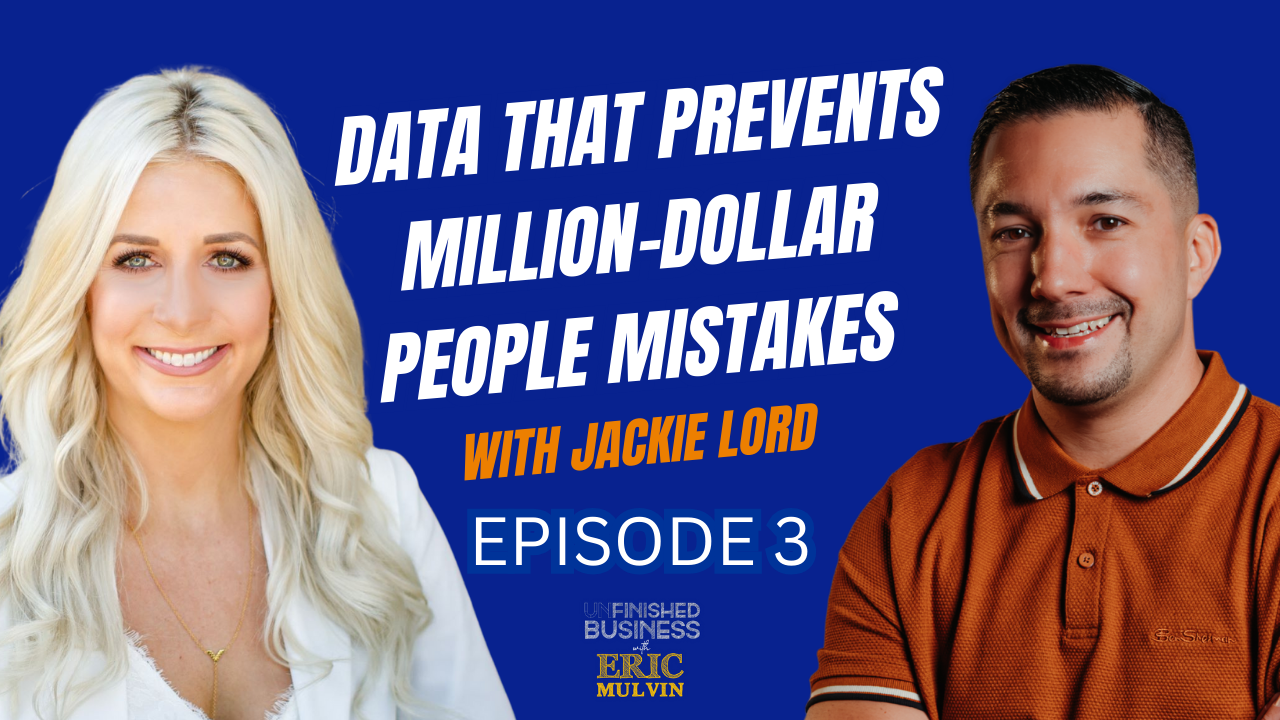
[Growth Strategy Series] Data That Prevents Million-Dollar People Mistakes with Jackie Lord




What Happens When Business Success Meets Community Responsibility
In this episode of the Unfinished Business Podcast, Eric Mulvin sits down with Jackie Lord, CEO of Elevate Consulting Group and Executive Advisor at Culture Index, to uncover how leaders can use behavioral data to fix their hiring strategy, retain top talent, and scale with confidence—even in the age of AI.
Jackie brings years of executive experience from companies like Amazon, Boeing, and Make-A-Wish, now helping CEOs align their people with their mission. Together, they explore how to turn painful lessons and people problems into a competitive advantage using data.
Beyond tools like Culture Index, Jackie shares the real cost of misalignment, the mistakes leaders make when implementing new systems, and how to get ROI from your team before you make your next hire.
Subscribe for More
If you enjoy conversations with leaders who are building businesses and changing communities, make sure to subscribe and turn on notifications.
Episode Highlights
(00:00) Introduction to Unfinished Business Podcast
(03:35) Understanding Culture Index and Elevate Consulting
(06:08) The Importance of Employee Happiness
(11:09) Hiring Challenges for Small Businesses
(14:24) The Role of Data in Leadership
(17:45) AI and People Strategy in Business
(26:10) The Role of AI in Decision Making
(28:13) Understanding Personality Assessments
(30:53) The Importance of Accurate Data
(32:40) Challenges in Implementing Tools
(35:51) The Impact of Proper Implementation
(38:20) Quantifying the Cost of Misalignment
(40:34) The Value of Continuous Support
About Jackie
Jackie Lord is the CEO of Elevate Consulting Group and a licensed Executive Advisor with Culture Index. She brings two decades of experience in corporate and startup settings, now helping CEOs build proactive talent strategies using behavioral analytics. Her mission? Aligning people with purpose to drive growth and happiness inside organizations.
Connect with Jackie Lord
Email: jackie@elevateconsulting.llc
LinkedIn: linkedin.com/in/jackielord
Connect with Eric Mulvin
Website: https://pac-biz.com/
LinkedIn: https://www.linkedin.com/in/mulvin/
Follow the Unfinished Business Podcast:
YouTube: https://www.youtube.com/@BizWithEric
Instagram: https://www.instagram.com/bizwitheric/
Facebook: https://www.facebook.com/profile.php?id=61560126743830
Threads:https://www.threads.com/@bizwitheric
TikTok: tiktok.com/@bizwitheric
Sponsor:
Pac Biz Outsourcing – https://pac-biz.com/
Below is in relation to how a link will show up in show notes – so for youtube it would be: https://www.youtube.com/@BizWithEric
Unfinished Business with Eric Mulvin
Powered by Pac Biz Outsourcing
If you enjoy conversations with leaders who are building businesses and changing communities, make sure to subscribe and turn on notifications.
- Instagram: bizwitheric
- Facebook: https://www.facebook.com/profile.php?id=61560126743830
- Tiktok: https://www.tiktok.com/@bizwitheric
- Youtube: https://www.youtube.com/@BizWithEric
- LinkedIn: https://www.linkedin.com/in/mulvin/
Pac Biz helps transportation, SaaS, software, and eCommerce companies scale customer support and back-office operations with dedicated teams in the Philippines.
Learn more: https://pac-biz.com
Email: info@pac-biz.com
Transcript
00:02
Speaker 1
All right, welcome everybody to the Unfinished Business podcast. I’m your host, Eric Mulvin, and it is episode three. Happy December to everybody. This is a show where I talk to CEOs, visionaries, creatives, business leaders about what are they doing in their organization and their business in 2025, 2026, what are they doing with AI and automation and. And how are you growing your company? Because it doesn’t matter who you are or what you’re doing out there, even if you’re Michael Jordan, I guarantee you there is some unfinished business out there that you have and you want to accomplish. And so that’s what we explore in this show. And so let’s get started.
00:42
Speaker 2
Unfinished Business, where people in tech connect to amplify unfinished business. Human intelligence plus AI Unfinished business. New shot goes the launch.
00:56
Speaker 1
You high?
01:00
Speaker 2
Listen close and you’ll learn why.
01:06
Speaker 1
This episode is brought to you by Pac Biz Outsourcing. At Pac Biz, we help transportation Companies, software and SaaS companies outsource their customer experience back office tasks with a powerful team in the Philippines that are dedicated to your business with remote employees, helping your businesses improve, support, scale faster and grow while keeping costs in check. For example, we help one client save over 600,000 a year in payroll costs by using dispatchers from Pac Biz. If you’ve ever thought about outsourcing or even taking on a virtual Assistant, go to pac-biz.com to learn more or email us your questions at infoac-biz.com all right, today I am really excited to introduce to you guys our first business guest ever on the show for episode number three.
01:55
Speaker 1
And she has worked at company such as Boeing, Amazon, Make a Wish, among others, before striking out on her own as CEO of Elevate Consulting Group, where she works with CEOs and their leadership teams to identify key areas for improvement and implement effective strategies. And most importantly to me, anyway, she’s an executive advisor with Culture Index for almost five years where she’s helped leaders like me and our leadership team in the Philippines, helping us and our companies align our people strategy with our business goals. So ladies and gentlemen, please welcome Jackie Lord.
02:34
Speaker 3
Hi, Eric. Thank you for having me here. I’m truly humbled. Thank you.
02:38
Speaker 1
Yeah, absolutely. Thanks for being on. So being the first business guest on the show here. Yes, now I get to talk about what do you do for your business. So tell everybody here, what exactly do you do? What’s Culture Index and Elevate.
02:53
Speaker 3
Yeah, absolutely. So what we actually do is we apply data to human behavior to ensure really that CEOs or any C suites or leaders inside a business not only have the right people strategy, but also to ensure that they have the right people in the right seats to accomplish their goals. Mostly P and L based at a faster rate. At the end of the day though, you know, we are talking about data, we are talking about P and L and we are talking about kind of creating this moneyball concept of people inside businesses. But what we’re kind of like really doing at the end of the day is that we’re making it so that people love their lives inside of the business. This allows maximum productivity. This allows a culture and a morale to really thrive and grow.
03:38
Speaker 3
And as I’ve seen over and over again, this continues to be the winning equation inside every single business.
03:44
Speaker 1
Awesome. And now you said help people love their business. Like, what happened? What goes wrong there? Why do people stop loving their business?
03:54
Speaker 3
So the way I actually approach when I teach this information to my leaders and managers is, you know, we are talking about employees inside a business, but I actually flip the terminology and I mention it as lives inside of the business. Right? Because we need to understand every single human that makes up the business. We need to understand what they need, what their strengths are, what their shortcomings are, how to effectively lead and manage them. That creates true love of the life, love of their business, love of the work inside the business that they’re doing. And then I’ll tell you, every single day I see this translate outside of work as well. So it’s really impacting.
04:34
Speaker 3
And you know, I’ll tell leaders, you know, you have an obligation to make sure your employees are happy and you sometimes don’t realize how much impact you have on them as a human being, both inside and outside of work. So really, at the end of the day, I do say that, you know, we are using this data to not only change the trajectory of business through, right, the largest asset, which is people, but it’s also the win equation because we’re improving lives. We’re making employees happier, engaged and productive.
05:04
Speaker 1
Yeah, the people part is so funny. Most of us not I know yourself, you know, we all had careers before we started our business, so we all knew what it was like to be an employee, to have a manager, but somewhere along the way you lose that and you forget and now you’re the boss. And all those things you mentioned, I’m like, that’s a lot to keep track of. And why is that? Why do business owners, when they get to the other Side and they’re the business owner. Like, why do they forget all those things? Because it’s a lot.
05:37
Speaker 3
Yeah, well, you know, kind of responsible for growing an entire business, wearing every single hat inside of the business, taking care of personal life. Right. Kind of. You’re working a lot of. In the business, we forget how to be on the business. Also an outside perspective, also using data are other key factors that need to be included. But you know, you’re just, you’re in it, you’re so deep in it. And it’s hard to think about the data behind the people equation. We often will always resort to emotion and personal bias. And so it’s natural, a human element to do so. So having this sort of information helps keep your eye on the ball, helps keep your eye on what is the right trajectory, what is the right strategy. And is every human inside the business happy? Right.
06:21
Speaker 3
I always say, you know, one of the key requirements of a leader, really an obligation, is to define their reality. Right. And it’s impossible to do this without data. And you know, Eric, we’ve talked even people are the hardest part of the business and the most important part of the business.
06:38
Speaker 1
Oh my gosh. Yeah. Because they’ll tell you one thing and they’ll say, yeah, this is all great, and then they’ll go to their co workers and colleagues and family and complain and not be happy. And unless you have the data and you’re going off of those narratives and those stories, you think everything’s great in my company. And then all of a sudden, boom, you got a bunch of layoffs or you got a bunch of issues popping up because people not being managed properly. Yeah. So it’s so true, the challenges you face there.
07:09
Speaker 3
Yep. So I always really, truly find this data to be a gift. And it’s a gift I share with the CEO and the C Suite team to really say, understand, say, hey, here’s a definition of reality. How do we get to the next layer? How do you grow your mission? How do you grow your service? How do you grow your value proposition? Right. That’s, that’s why we’re in business. We’re in business to grow. And we want to do so by utilizing humans, ensuring that they’re happy. And that is the quickest way to achieve that growth.
07:40
Speaker 1
Yeah. And now I want to talk about a little interesting angle here. Now, is there a certain size company that Culture Index works with? Like let’s. Is there too small of a company?
07:51
Speaker 3
Yeah, great question. I actually have a one person startup as big as my current client is 6,000 employees globally. So I will tell you again, I think this is a blessing because we’re not specific to a certain size, industry, revenue dollars, or employee count. I’m just in the business of people. Every single thing I do is custom to that unique business and the hardwired traits of that owner. So even if I have two companies within the same industry, I will completely customize the model because we need to create the right Moneyball concept within in the same company. I do love working with smaller businesses. I love working with smaller businesses. The benefit there is we’re building a proactive talent strategy. It’s not a lot of, you know, three steps forward, two steps back mentality. We’re able to get ahead of the hiring challenges.
08:41
Speaker 3
We all know how challenging those can be. And also just kind of trialing people out on the dime of, you know, the P and L within the business. So I do love. So that is one aspect. You know, I’m also a solopreneur or. Right. So having every single hire is so key inside a startup or inside a small business. On the flip side, the blessing that I feel with working with some of my larger clients is that now, you know, instead of helping 10 people within a business, we’re now able to really use this data to positively impact, you know, over 6,000 employees inside. So that scale and that outreach still gives me goosebumps just talking about it right now. Because again, you’ll hear me say again and again, this is a gift and is to as many people as we can give.
09:28
Speaker 3
You know, obviously, we want to do it more proactively than reactively. That is really the ultimate strategy here.
09:35
Speaker 1
Yeah. And it is a gift. You know, I was talking about the, you know what, like the. The fear that business owners have around all those different parts of the employees that we need to be paying attention to. But this takes away some of those fears, you know, and it helps translate that into data. And I think that, you know, one thing I wanted touch on here too, because I’ve been thinking back before the interview about the challenges that businesses have. Like, there’s these milestones that people hit along the way as their business grows.
10:07
Speaker 1
And I think one of the big ones that people hit early on that can make or break their business is when they first have to hire people and they need to, like you mentioned those first hires, like when you’re a smaller company and you got one employee or five or 10, each hire is so critical. We have over 200. I was talking about this with someone else. Like, if we make a bad hire, it’s not going to tank us, you know, it’s not going to bring the whole company down. We’ll move on. Like, oh, that was a bad idea, or that was a bad move. Let’s. Let’s go back and try it again. But if you’re a small company, like, that might set you back a year. It might set you back permanently.
10:48
Speaker 3
Exactly.
10:49
Speaker 1
So talk to me about the conflict that business owners have. Because they’re maybe a little smaller, they’re a little afraid to spend the money, but now they’re going out and they’re making that first hire without all the data, which I think too often they might be coming back after the fact, like, oh, my gosh, that cost me 10 times more than your software or your service would have cost. So I want to talk about that because it’s an interesting position to be in when you’re a business owner trying to grow. You’re like, I know I need to hire. I’m afraid to hire the wrong person. Culture index can help with that.
11:20
Speaker 3
Yeah. And I do encounter that conversation weekly. Right. Again, there’s a lot of small business. 99.5% of businesses in Arizona, where I’m located, are small businesses. So this is a weekly conversation for me. But the flip side is, and again, this is an investment, and your cash flow is limited, especially in a startup model. Right. But if you have to make one investment, right. If you have to make one single investment to start your business, it needs to be in the people. The people drive the AI, the people. Right. Build the relationships. And so I always say, at the end of the day, a P now is your people assets. Your people are contributing to that outcome. Right. It all comes from humans. And a lot of times we sometimes say, oh, you know, we, you know, we’re a tech company.
12:08
Speaker 3
I want to invest in the tech. Right. I want to. I want to invest in a facility. Right. So, I mean, there are so many aspects, but without that human equation, the entire business, your entire model, your entire possibly worldwide social impact idea can tank and never become a reality without the right people equation. And what I see most often is a lot of this entrepreneurial, spiritual, right? They are the number one successful and the number one failed entrepreneur profiles on the planet. And the reason why they’re the number one failed is because they don’t have the right people around them to execute and build it out to make sure that it becomes a scalable, profitable reality.
12:49
Speaker 1
Yep. And everything you’re saying, I Can feel it in my bones because I’ve been living this the last like five years, going through this with a Jackie here culture index. Some of the lessons learned the hard way where she’s like, this is just gonna happen. And I’m like, no, we’re gonna do our own thing anyways. And then a year or two. Sometimes it takes years for these to actually come and bubble up. But yeah, they really do happen. So it’s all those things she’s talked about. So true.
13:19
Speaker 3
And actually just for the sake of, you know, our audience, Eric and I were just kind of chit chatting briefly before we got going and were talking about the value of the data inside the business is so strong and so valid. But the key difference is the companies and the leaders that actually use the data to make the tough people decisions every single day. I was training a leader a couple weeks ago in North Carolina and we’re looking at some of his people, right. To define his reality of who is on his team. And there were going to be some tough people decisions he was going to have to make. And he goes, woo. Like this is tough. And I said, welcome to leadership. Right. It is making.
14:02
Speaker 3
The definition of leadership is to make tough people decisions every single day, to hire slowly, to fire kindly, to understand the humans that make up your entire business. And again, very difficult to do without data. But being a leader is a big job, has a severe amount of impact on every single human in your life. It’s amazing what it can accomplish. It’s amazing the change, positive, the growth that can be achieved. And I’ve also seen it go the other way. So it’s a huge responsibility, it’s extremely meaningful, it’s extremely impactful. And then on top of that, it’s what really contributes to your P and L growth.
14:40
Speaker 1
Yeah. And it’s the answer is all in our faces. It’s obvious. But you know, and we talk about this all the time and it’s still like the most difficult thing to do, you know, and dealing with people. But also, you know, if that’s the roadblock that you’re facing in your business right now, maybe you’re listening like, oh my gosh, this is exactly what I’m dealing with. Well, these are the things you have to overcome to be a successful business. You know, I know there was a lot of hype, especially a year or two ago. There’s a lot of people I knew that are like, AI is gonna, like, there’s gonna be these one people employing companies on the stock market and all this and you know, I don’t know.
15:21
Speaker 1
I think there are some companies that have one employee but I don’t know, I’d be curious to see their lifestyle of like how can they manage any successful business with just them. Like you need a team and to like I’ve been doing my business now I actually I just hit 14 years of when I first started my first company and yeah like the challenge after challenge around people. But when you get that town and you have the confidence to know that you can handle that now you realize hey there’s data where before you were guessing and now you actually can see some of this stuff before so powerful and gives you a lot more confidence as a business leader when you’re trying to make these crazy decisions you’re making.
16:11
Speaker 3
Exactly. And you know, I will never undermine or discount the value of tech of AI. Right. It’s incredible in regards to our productivity, our efficiency, what we can actually accomplish. But at the end of the day I always say your people strategy is your best tech strategy. Right. And again it’s going to come down to the people utilizing. It’s going to be to the building relationships. It’s going to be the leadership inside the business. And every single time I continue to see the people equation will win.
16:42
Speaker 1
Yeah. And you really, I don’t know, you’re not lucked out but you’re. It’s funny like there’s all the AI hype are like oh we don’t need people anymore and now it’s disappearing and it’s like oh actually we need people more than ever. So you’re exactly right.
16:57
Speaker 3
It’s almost, it’s almost done a reversed emphasis on the importance of people. Right. We all kind of started to move away and understand the power of AI and some, you know, we, there will be some elimination of some tasks and right processes but now it’s created this reverse where we need more people, more community, more leadership. It’s created this reverse trend. And you know even I see it every single day working with the companies that I work with. I also see it in articles. I follow this pretty heavily to understand the environment out especially in the US based companies. And so I just read another article this week about the most successful wealth advisory businesses who I also have a handful of those. They are focusing on their people strategy more than their AI strategy.
17:41
Speaker 1
Root financial. Right. I think you sent over to me.
17:44
Speaker 3
Yes.
17:44
Speaker 1
Yeah, so and that’s really fascinating too because I was looking at their story and how they’ve been able to go from was it 25 million in client assets to like over a billion in a crazy short amount of time. And most like, I don’t know, I think you’d consider them fintech, but most of these companies, you know, it’s all about the tech stack and like what technology, what software are you using? And with them they’re like in their stack are people and they talk about how people are so important. And so it’s great to hear you talking about it, but I’m sure it’s really validating to hear big companies in the news also saying the same things you’re saying, right?
18:24
Speaker 3
It is. And again, right when we got so heavily AI focused, these human stories are starting to come out even more. We need to find that balance. And I will tell you, even as a company, you know, we’re growing 40% every single year on average. So this continues to tell, you know, even though we’ve got a lot of articles and news and information and some different focuses out there, every CEO who’s being successful is understanding the importance of the people equation still.
18:53
Speaker 1
Yeah, that’s crazy. I’m sure people listening here would love to have 40% growth year over year. That’s some great numbers there.
19:00
Speaker 3
We’ll have a people based focus.
19:03
Speaker 1
Yeah, it’s right. Doing a lot of the stuff that you guys are teaching, implying that you’re implementing itself. So you know, we touched a little bit about AI, but I want to go more into that here because this is what we talk about here on the show too. What are companies doing with AI these days? And with. What I’d like to start with though is now we’re talking about Culture Index and this people tool. But how does that play into businesses that are implementing AI? Because you think we need software, we need technology, people stuff isn’t important. We’re going to focus on the capabilities when that’s actually the wrong approach.
19:45
Speaker 3
So just like were kind of referencing, you know, the power of the data, the power of the tool is not valuable unless. Right. And in how you’re using it. So you know, do we have the right strategy on how we’re implementing AI into our business? Right. That strategy comes from a human. Right. Do we have the folks to now maintain, build constantly problem solve within the existing AI strategy inside the business that takes entire different set of hardwired traits to be successful with that. So the power and the strategy tied into the business model is going to come from Humans. Right. And again, this is even with operational systems, this is even with other tools inside a business. It’s. You can. Even with Culture Index. Culture Index, at the end of the day, is a piece of data. It is a tool.
20:33
Speaker 3
But if you’re going to use the program, if you’re going to now use this to build the business most effectively and actually make the hard, not only hard decisions, but also the right decisions. Right. Then that’s where that crossroad really comes in to maximizing the productivity and efficiency here. So it still takes humans to design all of that around AI inside the business.
20:57
Speaker 1
Yep, very true. And if you just rely on ChatGPT.
21:00
Speaker 3
Preaching to the choir here, Mulvin.
21:02
Speaker 1
Yeah, but I was gonna say if you just rely on Chat GPT to create your strategy, you’re missing out and you’re gonna have some big failures. So you need a human driving that strategy and you need the people to. To help execute that. And one thing I wanted to ask too, because you mentioned you’re. You’re working with an organization as big as 6,000 employees and then as small as 1. Now because of that puts you in touch with a lot of businesses and gives you a really unique perspective. So the companies, I’m curious, like, for the ones that you see are doing AI right, or maybe seeing some success. And by that I mean, like, you know, we’re December 2025, they’re still actually trying. They haven’t given up. Oh, this isn’t working anymore for me.
21:48
Speaker 1
Or, you know, we’ve failed at this or this is causing all these disasters. Who’s out there doing it? Right. And is there anything you could share that. That they’re doing that’s working?
21:59
Speaker 3
Yeah. So to kind of take a step back, I wanted to share a little bit of my journey and how I got here, because this will fold into the answer to this question. So I consider, you know, I consider myself a recovering corporate executive. I was the right person in the wrong seat for 17 years. I was completely successful and completely miserable. I had 17 jobs with seven different companies in 17 years. And it was because I was unhappy. I can’t imagine what my data would show in my culture index on my disengagement. Right. I would find ways to make sure I was not at my desk because I am not a desk individual. I am a strategist and I’m obsessed with people. Sometimes I wish I’ve done hobby. That is right. So that is. That is the world I live in.
22:50
Speaker 3
And what it. The beauty of A lot of that pain, so to speak, brought me so much experience, so much perspective. Right. You’ve already listed the Boeings, right? The, the Amazon, the JP Morgan Chase, the Make a Wish all the way to a handful of startups. So it gave me this breadth of knowledge and very, I feel like a very compounded experience. Even when I was at Amazon for two years, I always say I learned more in Amazon in two years than I did at Boeing in eight years. Right. It’s a very fast paced, fast growing, relevant company. We all know their story. So taking all of this knowledge and experience still is very important. I will, I had this conversation yesterday with one of my leadership teams.
23:36
Speaker 3
They just hired to the dots to the hardwired traits and they this individual did not have any knowledge and experience and it failed. Right? So this people equation is just one part of the equation. You still have to have the right knowledge and experience to be able to apply the hardwired traits. And you also have to have the right culture fit, I call it the right morals and values. Right. I don’t measure that. You need to understand through this kind of interview process the fact that people fit. So, you know, working with all these different companies, different industries, different size businesses, I feel like I have a blessing through a very challenging career that I’ve been in for 17 years because I have so much experience that I can now apply.
24:21
Speaker 3
I’ve also been the right person in the wrong seat, in a lot of pain. So when I see this inside employees, inside of the business, I can more effectively explain that we’re not only holding them back from their own happiness, but also holding them back for the opportunity to be happy. You know, outside of AI, there’s just a lot of knowledge and experience that is so critical. Right. You know this, it’s not just hardwired traits is you have to have the knowledge and experience to apply the value of your kind of natural instinct behavior to maximize whatever we’re doing. So let’s just say we found the perfect, you know, implementer of AI strategy, right? But they’ve never touched AI, they know nothing about it. It is going to fall short. So this is not the end all, be all.
25:05
Speaker 3
This is a huge aspect to make people decisions. But there is more to humans that I never want to discount as well. So a lot of times, you know, when I go into these businesses, there’s not a lot of experience and knowledge on AI. A lot of it is learning about AI through using AI. Right? So to really have specialists for AI combined with the right traits and make sure we’re using this power of this tool for good things, not bad things. Right. Making good decisions and not bad decisions with the data, any data you can do that with. That’s where I’ve seen companies be successful. But it’s gotta be a combination of the three. And what’s usually missing is the data on the person. Right.
25:51
Speaker 3
In regards to the hardwired behavior to even be successful, but do never undermine the value of knowledge and experience and actually subject matter experts in AI.
26:02
Speaker 1
So thank you for sharing and bringing it full circle from it’s full circle.
26:07
Speaker 3
One moment.
26:09
Speaker 1
Yeah. So people who are implementing AI, they’re bringing in, they’re hiring implementers. Right. And they’re looking for the right people, but they also have to have some kind of experience. They’re not going to just drop someone in with no experience and say, all right, you’re the right person, you got the right traits, good luck.
26:30
Speaker 3
Yeah, right. We’ve got the right hardware, but there’s no software. Yeah, right. So I don’t want to discount the value of that part of the equation.
26:39
Speaker 1
Yeah. And I’ll share a personal example too. You know, as we’ve been working with Culture Index all these years, you know, there’s different perceptions especially, and maybe we could talk about that too, you know, around these personality testing things that even I had that I think get in the way of really being able to use this tool properly in your company. Talk to me about, like, what are the biggest misconceptions that you see with the personality testing tools like Culture Index and others out there?
27:08
Speaker 3
Well, thank you for asking this question because I have to address it every day and it’s hugely important. So there’s no actual way to measure somebody’s personality. So it’s really unfortunate that the 1200 assessments out there are labeled as personality tests. So there’s about 30 dimensions to a personality. We’re only measuring six of them that are behavior based. Okay. So really at the end of the day there is seven. Right. So we have six dots and one EU number, a total of seven. But I’m just measuring how somebody is hardwired to behaviorally navigate the world. So this is actually the goal of every single other assessment out there. They’re trying to measure hardwired behavior. And it’s not actually a test. So the way that we’re approaching it now, it’s a survey. There’s no right or wrong answers.
27:59
Speaker 3
I’m not measuring if you’re a good person or not. Right. I’m I’m just measuring what is your gift and what are your shortcomings. We all have them. How do we align your gift inside a business? This is personal as much as professional, but we apply this inside the business. So every personality test is trying to measure hardwired behavior and what the key difference here is our twofold movement. Number one is going to be the accuracy of the tool. Okay, so thank goodness for Disk was created in 1920s by William M. Marston. Complete genius. I’m so grateful for him because he started this entire trend of applying data. But there’s over 200 different versions of DISC has never been patent, and the estimation is at 62% accurate. That is not enough data. Right.
28:50
Speaker 3
Would you be comfortable using 62% accurate data to make any kind of decision in your business? So it terrifies me. I’m so grateful for disc. Right. And William M. Marston because he started this entire trend. But we have so much technology and data since 1920s, so as of today, we are the most accurate tool on the market. So what matters here is accuracy. Okay? From there it matters. What are you doing with the data? So there are only 90 of us, we’re global now, that are licensed on how to use and read this data, to consult inside businesses as executive advisors to CEOs, because, right, there’s one thing just to have the data, we can just have the AI, but what are we actually doing with it? What are we doing with this data? What are we doing with this tech?
29:39
Speaker 3
And that’s the beauty. That. And this is why I use this as a sole tool in my practice because the data is so strong. And now we’re using this strategically. Anybody else using another tool, Number one, I love it because they do see the value of adding data, a layer of data to people. So kudos, you’re in the right direction. But I want to make sure you understand the accuracy. And is this actually changing the trajectory of your pno? Are you actually getting out of your growth phase or are you still stuck there? So those are the questions that I want to ask with my CEOs. And is this actually moving the needle or are we kind of, Are we still having hiring issues? Are we still having turnover issues? Are we still having growth issues? Right.
30:20
Speaker 3
And so we want to look at the larger picture on is this investment actually working for us?
30:26
Speaker 1
Yeah. No. That is great. It is interesting. Again, thinking of my own perspective, putting myself in the shoes of people listening that might be thinking about using something like this. What are the common challenges that people have like, because they’re getting in their own way, they come in, they see this tool and I think, I’m guessing I’m not alone in this example here where business owners, we see a software and we’re like, boom, this is a solution to all my problems. I’m going to pay for this tool and I’m going to move on to the next stuff and I forget about it. And then six months later, a year later, you’re like, oh, it’s time to pay for this tool again. What the heck? Like, it’s not working. These people aren’t using it, this department isn’t using it.
31:14
Speaker 1
They don’t even know that they have a login. So like you’ve, you see people go through all these different scenarios. That’s probably a common one. What goes wrong? And how do companies not fall into that trap and get themselves out of that whole, like, thinking this is a magic band aid that’s going to solve their problem and they could walk away.
31:33
Speaker 3
Exactly. So there’s two aspects with this tool that make it successful and sticky inside a business, and this applies to every single other investment or process inside a business, is that you have to have an individual who is hardwired to use this data to build the strategy in the business and you have to have somebody utilizing this data in this program that’s hardwired to execute it, to make it sticky. So, you know, starting off in my career early, I, I did not properly train the right people to make sure that this is going to be sticky inside a business. Right. And what that includes is, again, that includes, you know, we can go into all the traits, but I measure a trade of vision and strategy and then I measure a different trait that defines execution, accuracy and follow through.
32:22
Speaker 3
So if you don’t have strategy or follow through for every single aspect of your business, whether that’s a people, you know, culture index tool, whether that’s AI, whether that’s a CR system, whether that’s trainual. Right. Whether there’s all of these beautiful systems. A lot of entrepreneurs can see the value, the roi, but it doesn’t get achieved because you don’t have enough people with the right hardwired traits executing it and making it sticky inside a business. So there are scenarios where I will tell a very small leadership team or I will tell just a startup CEO that I cannot work with them until they hire this trait because this, I’m not going to take your money and this will not stick and be worth it. Right. And again, I want to make. I luckily have the data to make them successful just as much as.
33:09
Speaker 3
Right. They can use this data to make their own internal business successful. But I see it time and time again, without the right combination of traits on any program, any tool, it will never be sticky inside a business. You’ll never get the ROI that you saw from the right initial presentation or the value of the data.
33:29
Speaker 1
Now you bring up really something interesting I’m thinking about here. So how many businesses out there have tried to implement a software, tried to implement a solution, maybe a CRM, a new sales process, something, and it didn’t work. And they blame the person, they blame the process, the software, and they’re like, it’s the software. I’m going to go back and find a different software. And then like you’re talking about stuff that takes years to figure out, like a year or two. And then, oh, let’s try again with a different software. Rinse and repeat, another year or two. Five years later, you’re like, what the heck happened? I haven’t experienced any growth in my business. We’ve been so busy doing all this stuff, turning the wheels, and were still in the same spot. We were.
34:16
Speaker 1
But what I’m hearing is sometimes it’s the person that’s implementing that, like you don’t have the right person implementing it. So yeah, Culture Index, you know, you don’t have the right person implementing it here. You’re not going to be able to utilize Culture Index. But what about all the other tools in your business? Every business is out there trying to implement a new software, a new something. Right? Like what? Tell me about that. Like, talk to me about the impact this could have on the other parts of your company. Just outside of the whole people thing.
34:47
Speaker 3
Yeah. And this is, you know, when I onboard a new client, I, I will say I will not implement this without somebody who’s hardwired to execute and follow through, somebody to make it sticky in the business. And I said, this has to. This principle applies to every single aspect of your business as well. So not only are we getting this aligned to make sure we’re maximizing the value of this data inside your business, but this is also going to make every other process, system, strategy be more seamless and more productive as well. Because the reason, I guarantee you, the reason why it isn’t working right now is because you don’t have the right combination of traits on the strategy, on the execution plan. So the beauty of this and a lot. Right.
35:30
Speaker 3
So a lot of folks I talk with, they’re on an operational system. Right. And it’s, you know, they’re making it, they’re making investments in the business. They see the value of these programs or the data and the consulting needs and they’re there. But you know, what if you got 90% ROI from it instead of 20 and they almost don’t know what they’re missing. A lot of times we’ll even talk about people, they’re like, oh, this person is good. And I said, you know, you have a team of C players. You don’t even know what a looks like or feels like. So they’re missing that relative aspect. You know, they don’t have a compare a comparison model here. So I provide that comparison. I explain, you know, buckle up. You don’t even like. Right.
36:12
Speaker 3
If you hire this sales individual, we, you don’t even know what’s coming in. We got to get the operational team ready to be able to handle what these profiles can bring in. And so it’s a lot of the unknown. We just don’t even have a relative piece of information. A lot of my business owners. Right. To say, Am I getting 100% ROI on this program? Am I getting 5% ROI on this program?
36:34
Speaker 1
Yeah. Yep. That is lessons I’ve learned over the last five years. Yeah.
36:41
Speaker 3
Right. And Wolven, how expensive is it when you know, a million dollar investment, you know, especially some of my larger companies, doesn’t come to fruition, it’s $1,000 plus all the man hours down the drain.
36:52
Speaker 1
And instead of profits that you were hoping to get, that now profit, there.
36:56
Speaker 3
Goes your profit margin.
36:57
Speaker 1
Yeah.
36:59
Speaker 3
It becomes very expensive. And now your whole team is stressed out. They weren’t even hardwired to be able to handle it in the first place. And then there goes your profit margins. And how frustrated are you as a business leader and business owner?
37:09
Speaker 1
Yeah. Extremely frustrating.
37:11
Speaker 3
Yeah.
37:12
Speaker 1
Which we want people to love their business, you know.
37:15
Speaker 3
Yes. We want the humans to love their lives. We want the, you know, even sometimes. A very interesting concept that I’ve adopted along the way woven is that I will ask leaders, how much is this personally and physically and mentally costing you to have some of these people in these seats? And I make them put a dollar amount to it.
37:37
Speaker 1
I’ve done this before. Yeah, yeah.
37:39
Speaker 3
Right.
37:40
Speaker 1
I know this.
37:40
Speaker 3
So. And I will even ask one question. You know, your CEO, you know, you may have outgrown them or they could be in the wrong seat or we could utilizing, you know, we could be utilizing them in sales because they’re actually sales profile Right. And I will ask the leader, you know, what is this costing you? And when I asked them to actually quantify the pain or the dollars, they go between, you know, 500,000 to multiple millions just one person in the wrong seat.
38:07
Speaker 1
Yep. And you’re like, how much is this costing you again for Culture Index?
38:10
Speaker 3
Right, right. And then we kind of laugh when we talk about the investment for Culture Index.
38:17
Speaker 1
We didn’t talk about it too much here, but it is really one of the biggest assets is when you’re working with Culture Index. Yeah, you get the data, you get to get insight on your business and you could make better hiring decisions and better promotions. But you also get, you get, you know, and I tell my clients, I tell people, prospective clients all the time when they get to work with the account manager. I’m like, these guys have been working with me, some of them, over 10 years of all these clients all over the country, some of them in different continents. And the stuff they see, like they, these guys are the experts, they’re the ones seeing it every day. And so I think of the same for you. You’re the expert out there talking to the businesses every day.
39:03
Speaker 1
The experience that you bring. Talk to me a little bit about that because you said you had the 17 years. I think you said 17 years. Right. And the corporate world, I never added up my time, but it’s, it was a lot too. So that you’ve been doing this now, is it over five years yet or over five.
39:22
Speaker 3
Yeah, five years.
39:22
Speaker 1
Yeah, five years. So what do you bring to the table?
39:27
Speaker 3
Yeah. And you know, I always say it’s not kind of what you buy, it’s who you buy. Like, right. It’s. And what I mean by that, it’s not about necessarily focusing on the word buy, it’s about how are we continuously using this data to pivot and plow your people strategy. Constantly. This is not a one time, you know, pulse check. I’m working with my leaders and managers every single week. Sometimes I get daily emails, sometimes I get texts. Right. To say, hey, we’re making people decisions all day long whether that’s maximizing productivity. Right. And I have a PhD in this stuff. Right. I have, I don’t have a lot of other strengths. Right. I have a lot of focus and a lot of strengths.
40:06
Speaker 3
In my experience in the business world working for some very big companies, I’ve seen a lot, I’ve been around a lot. Right. Just means I’m the, I’ve had a lot of experience. In regards to people, business and strategy. And so again, a lot of times we think of we’re using this data as a one time hire, but I teach leaders and managers to use this every single day. So because of that. Right. And this is not necessarily a simple tool. I kind of equate this to learning a new language. So, you know, it takes about on average kind of three years to be kind of an expert in this data. It is, we’re still dealing with humans. We’re still. Right. We still have all these different scenarios and Moneyball equations inside teams.
40:48
Speaker 3
And so this is complex stuff and these are huge decisions we’re making every single day that do impact the P and L and impact their happiness inside of your business. So I take it very seriously. I tell them, make sure they reach out to me. I respond immediately because these are very important people decisions in human lives. I take it seriously. They do as well. And again, it’s just that layer of experience and knowledge that. Right. That’s why you hire somebody. And that’s what I love about this is that I never leave. Right. I am a constant resource consultant guide coach on every single people decision Whether you have one employee or 6,000, it is still there for every single leader and manager.
41:29
Speaker 1
Yep. And yeah, either whether you work with Jackie or whoever else out there, hopefully get to work with Jackie because it makes a big difference. You know, I’ll bring this up too. You know, we’re talking about implementing software and every business you’re working with, like you’re trying to. A lot of businesses you work with, when you try to implement their software, they have someone that works with you that like Jackie, you know, like we’ve done consulting for sales, we’ve done consulting for operations. And one of the things, I would never even think to look for that thanks to Jackie, were looking out for it and we got the right person was the personality type of the consultants you’re working with.
42:15
Speaker 1
And there’s actually people that Jackie steered me away from I was thinking about working with because their personality type wasn’t for sales yet they were consulting for sales. And you want to get the best of the best if you’re doing this for your business and they might say that they’re the best of the best and they might look like that on social media. But again, you know, when you go down to the data and what really matters, that’s where the difference is. So yeah, hopefully you guys.
42:43
Speaker 3
Yeah, every single. Right. Every single consultant, every employee, every 1099. I mean if it’s hitting your P and L, you should be using data to make decisions, which then.
42:53
Speaker 1
Is about everything in your business. So. Well, we’re getting close to the end of time here. And so the tradition on the show is to always ask our guests, what is your unfinished business? What is it out there that you still want to accomplish, whether it’s within your current business, maybe a future business or anything else. So for you, Jackie, what is it that you still want to do out there?
43:14
Speaker 3
Yeah, so I measure success and impact by the number of leaders and managers I get to work with and the number of employees they get to impact using this data. So I’m on a pretty big mission to impact as many lives as I can. It doesn’t matter truly, you know, the number of clients or what this looks like or the industries. Obviously I have some passion around a lot of nonprofits, a lot of sports related industries, a lot of students and colleges. There’s a lot of passions I have to help people at an earlier stage in life. And then also. Right. Just kind of being an athlete myself.
43:47
Speaker 3
Of course I have my passions, but my goal and my unfinished business is really, you know, the number of lives I can impact and help with this data, not only from a leadership perspective, making leaders more effective and self aware, but also, you know, how cool is this really impacting the lives of every single human inside a business? I mean, that is. That’s a bit surreal.
44:09
Speaker 1
That is. And it’s fun to talk about and it makes you feel all warm and fuzzy. But when you actually get to experience it and experience the impact of the changes that, you know, we’ve been able to make in our company to see, like, yeah, everything that we’re doing in our company, if you have employees, it’s impacting your employees lives from the schedule that you’re setting, making them work from the office or not, you know, do they have to be on duty even though they’re off shift? So many things go into their life and the decisions that we make might take five seconds making some decision that seems relatively minor and it ends up being a big deal and a big, you know, impacting these people’s lives in our company.
44:53
Speaker 3
So understand your audience, understand your employees.
44:57
Speaker 1
Yeah, exactly. So, yeah, really awesome. So, Jackie, I want to thank you so much again for being on the show. This is the second time I’ve got to interview her. She was a guest on my last podcast, which had the highest number of views out of all of the episodes, several thousand on YouTube. And I don’t know about the other platforms, but really grateful that you got to take some time to share with our audience here about Culture Index, about the insight and the data that you can get on the people that you’re working with and why it’s so important for people.
45:30
Speaker 3
So thank you, Mauve. I’m truly humbled. I. And I, you know, I’m obsessed with this stuff, so thank you for allowing me to share it.
45:39
Speaker 1
Yeah. And if people want to connect with you, if they want to learn more about Culture Index or possibly working with you for their business, what’s the best way people can get in touch with you?
45:50
Speaker 3
Yeah, the easiest way is my email, which is jackielevateconsulting. Ll.
45:57
Speaker 1
All right. And we’ll get that on the screen for everyone. All right, so thank you very much, Jackie.
46:02
Speaker 3
Thank you, Mulvin. Have a blessed day.
46:04
Speaker 1
Yeah. Thanks, everyone for listening. And we’ll catch you guys on the next episode of Unfinished Business with Eric Mulvin. Until next time. See you guys,
46:17
Speaker 2
CEO’s and visionaries shaping what’s to come. Building more than profit. Lifting everyone. Every path’s unique, but it takes a choice to grow, set your goals and shape the way your future goes. Where people in tech connect to amplify human intelligence for air AI goals that launch you high. Listen close and you’ll learn why. Subscribe, subscribe.
46:56
Speaker 1
Look for.
46:58
Speaker 2
Eric online and follow Unfinished Business on Spotify, Apple, Podcast, YouTube. Wherever you listen.
Transcribed by https://fireflies.ai/