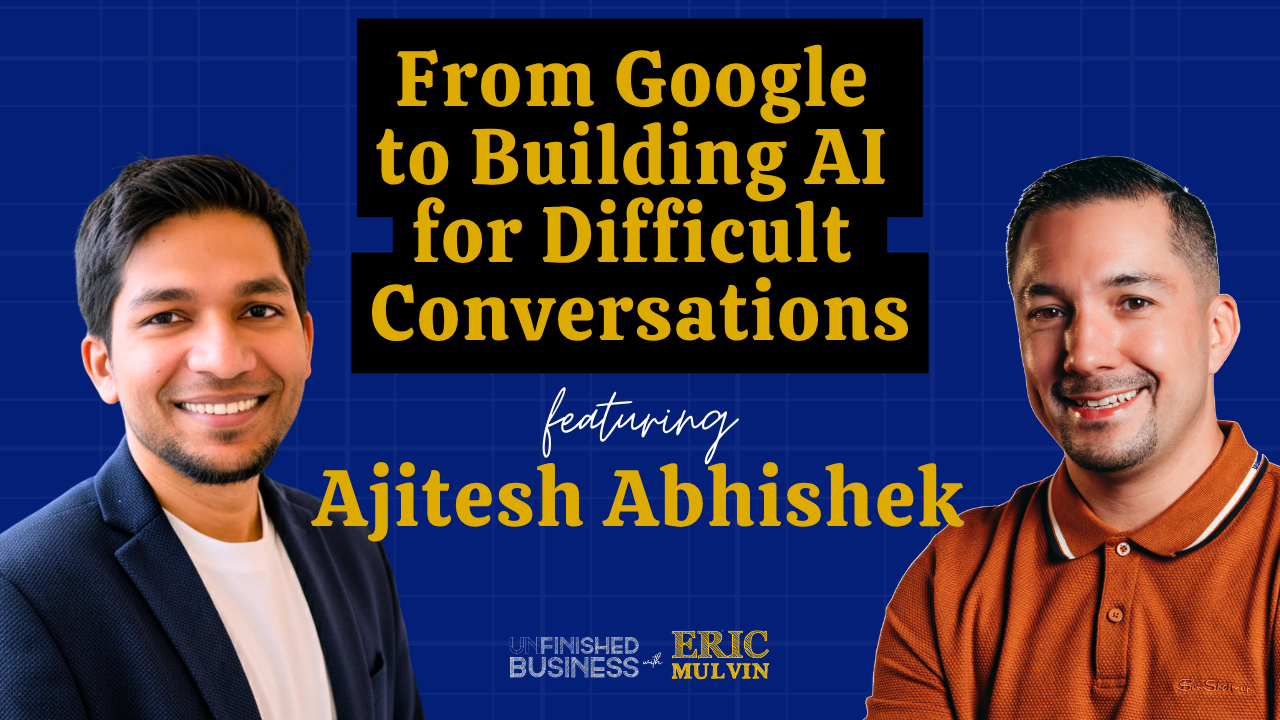
[A.I. + H.I. Series] Most People Avoid This Skill. It Started at Google | Ajitesh Abhishek




What if AI could help you have better conversations instead of replacing them?
Most AI tools promise to automate, but this episode reveals a different approach. One that uses voice AI to actually improve how people communicate. If you’re a leader, entrepreneur, or someone working to get better at difficult conversations, this is worth paying attention to. Imagine practicing your toughest sales pitch, interview, or high-stakes conversation with an AI agent that responds like a real person. It reacts, adapts, and gives feedback in real time.
Ajitesh, CEO of Tough Tongue AI, shares how he built this starting from a personal need, not a pitch, not a market gap but a real conversation he needed help with. From there, it evolved into something bigger. A tool designed to help people rehearse and improve the conversations that actually matter.
In this episode, we break down:
- How AI can improve human performance instead of replacing it
- Why most AI products focus on features instead of real problems
- The pivots that shaped Tough Tongue into a focused solution
- Lessons from Google on simplicity, iteration, and product thinking
- Why slowing down and making better decisions matters more than moving fast
We also talk about where this is going. AI in education, business, and personal development: not as a replacement, but as a tool to make people better.
If you’re thinking about how AI fits into your business or leadership, this is a practical conversation.
Subscribe for More
If you enjoy conversations with leaders who are building businesses and changing communities, make sure to subscribe and turn on notifications.
Episode Highlights
00:00 – Introduction to Unfinished Business Podcast
01:49 – The Journey of Building a Customer-Centric Product
09:55 – Navigating Business Challenges and Pivots
13:46 – Insights from Google: Shaping Product Management
17:38 – Balancing Speed and Thoughtfulness in AI Development
22:28 – Future Trends in AI and Development
26:14 – Advice for Aspiring Developers and Entrepreneurs
30:06 – The Skills Gap in Education and Employment
32:38 – Exploring the Positive Potential of AI
36:57 – The Role of AI in Personalized Learning
41:01 – Balancing Work and Personal Life
47:49 – Insights from Google’s AI Journey
54:32 – Unfinished Business: The Future of Learning with AI
About Ajitesh Abhishek
Ajitesh Abhishek is the CEO of Tough Tongue AI, a voice AI platform designed to help people practice and improve difficult conversations. Before founding Tough Tongue, he worked at Google as part of the Gemini application team in Google Cloud. Earlier in his career, he was part of the founding team at Fitso, a consumer fitness startup recognized by both Apple and Google. He studied engineering at IIT Delhi and later earned his MBA from the Kellogg School of Management. His work focuses on building products that are both technically strong and deeply customer-centric.
Connect with Ajitesh Abhishek
Email: ajabhish@gmail.com
Website: www.toughtongueai.com/
LinkedIn: www.linkedin.com/in/ajiteshnandan/
Blog: www.xupler.com
Unfinished Business with Eric Mulvin
If you enjoy conversations with leaders who are building businesses and changing communities, make sure to subscribe and turn on notifications.
- Instagram: @bizwitheric
- Facebook: https://www.facebook.com/profile.php?id=61560126743830
- TikTok: https://www.tiktok.com/@bizwitheric
- YouTube: https://www.youtube.com/@BizWithEric
- LinkedIn: https://www.linkedin.com/in/mulvin/
Powered by Pac Biz Outsourcing
Pac Biz helps transportation, SaaS, software, and eCommerce companies scale customer support and back-office operations with dedicated teams in the Philippines.
Learn more: https://pac-biz.com
Email: info@pac-biz.com
Podcast: https://pac-biz.com/podcasts
Transcript
Eric Mulvin (00:00)
All right, welcome to the Unfinished Business Podcast. I am your host, Eric Mulvin, and this is a show where we talk with CEOs, visionaries, leaders, and creatives who are out changing the world through business, through their organization, through leadership, or through creativity, because it doesn’t matter who you are or what you’ve accomplished. Even someone who maybe you thought have accomplished it all, like Larry Page, Reid Hoffman, they still want to accomplish something out there.
And so we explore those stories here on Unfinished Business with Eric Mulvin
This episode is brought to you by Pac Biz Outsourcing. At Pac Biz, we help transportation, SaaS, and e-commerce companies outsource their customer support with back office tasks and back office tasks with a powerful team in the Philippines that are dedicated to you as remote employees, helping your business improve support while scaling faster and growing while keeping costs in check. For example, we even help one client save over $600,000 a year in payroll costs just by using dispatchers from Pac Biz.
So if you’ve ever thought about outsourcing, taking on a virtual assistant, visit pac-biz.com to learn more. All right, without further ado, I’m really excited for this next guest and someone that I got to meet somewhat recently and got introduced to their company. So I’m really excited to share this with you guys, but he is the CEO of Tough Tongue AI where they’re building voice AI agents that help people improve and practice difficult conversations.
His mission is to build the world’s best agent for training and coaching. Before this, he worked at Google, most recently as part of the Gemini application team in Google Cloud. And earlier in his career, he was part of the founding team at Fitso, a consumer fitness startup whose app went on to win Apple’s best app of the App Store and Google’s editor’s choice. He also studied engineering at IIT Delhi and later earned his MBA from the Kellogg School of Management. And across his career,
He’s been fascinated by the crafts of building products that are deeply customer centric and technically grounded. And outside of work, he enjoys long distance running, discovering a coffee and writing about his products and startups on his blog, xupler.com, which we’ll have a link for in the show notes. So please help me welcome Ajitesh Abhishek. All right. Hey, how you doing? Welcome to the show and excited that you’re here.
Ajitesh (02:37)
Hi everyone.
Hi, Eric. Thank you so much for having me. It’s pretty exciting to speak to you and to your community here.
Eric Mulvin (02:47)
Awesome. Yeah. Well, thank you for taking some time to share with our audience here more about you guys. And actually, interesting story that came across from one of your colleagues who reached out ⁓ as connecting on LinkedIn. And that was only a couple of weeks ago. And here we are. So it’s cool to get you on the show. But let’s start out. Yeah. Talk to me right now. Your big product is Tough Tongue AI.
Ajitesh (03:07)
Yeah. Yeah, it’s pretty new.
Eric Mulvin (03:15)
and the big thing you’re working on. So we can start there. Tell us about Tough Tongue and this ⁓ business that you’ve been starting on.
Ajitesh (03:22)
Right, so Tough Tongue is a voice AI platform where anyone can ⁓ build agent by just typing in natural language. And we are pretty great at building agent for training and coaching. So basic idea is that let’s say you have your next interview, your sales call, or ⁓ meeting with your manager, business leader, you could just say that this is my conversation and it can create a voice AI agent that helps you rehearse. And it’s just not only chat, it can use slides, images.
to make it more engaging. Like what we thought is if just chatting then ⁓ people lose interest. And if you don’t engage like learning outcome, it’s very hard to drive. ⁓ So that’s what mostly it’s us at Tough Tongue AI
Eric Mulvin (04:02)
Awesome. And you know, I think all of us, if you’re a business leader and you have a LinkedIn profile, you are getting inundated with messages of people trying to reach out to you about their product, their software, why they should be using their service for something. But your guys’ products stood out because I obviously I get a lot of those messages and most of them I can’t respond to. But with this show here, one thing we really like to highlight are companies that are not just building AI.
but building AI to help enhance humans, to help make us better and better at our jobs, better performance, and not focused on replacing people. And that’s a big focus of mine here. And that’s why I really loved what you guys have, because that’s 100 % your core focus, your focus on the human. And in the intro, you talked about this customer- centric ⁓ approach to your products. And I believe those two go hand in hand. So talk to me more about that. How did you decide to go down this path?
Ajitesh (04:59)
Right. So lot of time in my career, ⁓ I have been in situation where ⁓ it was really critical conversations. for example, let’s say there is a Google interview or an MBA application and like practice or rehearsal is sort of a very, is a thing with a very low downside. Like you’ll practice, maybe you will spend like five, 10 or 30 minutes and the upside is huge. And I always used to hire coaches and lot of time coaches do role plays and other.
And when I was leaving Google at that time, voice and multimodal was on its path where it was just getting production ready. So I built an agent for myself to just have a conversation about a difficult moment I had in personal life at that time. And I sold it to my co-founder that, okay, I built it. How did you like it? And he also enjoyed having chat with it. And from there on, we have been trying to find like what aspect of this difficult conversation we should focus on as a GTM and other aspect.
But the basic goal has always been that it’s more broadly in all the difficult conversation it becomes useful. We will find a way for business model side to figure that where exactly business could pay and make a business out of it. But the goal is that ⁓ make it available a tool that people can build and rehearse these conversations that I had to ⁓ in some ways do in my life.
Eric Mulvin (06:20)
Yeah, and that’s super fascinating. I wanted to zero in on that a bit because for people that are listening here, business leaders, people who are thinking about starting a business, running companies, you have a very unique challenge here and one that if you get wrong could change the trajectory of your business. And if you get right, could also change your life and many others out there forever. ⁓ So you have this really amazing idea, like, hey, this tool can help
with difficult conversations. But the challenge is, how do you sell it? You can’t just go out into the world and say, hey, we’ve got this AI and it could do this. In sales and in business, that’s not going to work. You have to be really specific. You’ve got to narrow down on your product. so ⁓ I’d like to, folks, tell me a little bit more about your journey on how you started out of this big idea and then you’ve narrowed it down. And right now, you’re laser focused on
like the sales approach and the difficult conversations you have in sales.
Ajitesh (07:18)
Right, yeah, it has been sort of tiresome in that way that we initially just had an idea that broadly rehearsal could be useful. Now, the first idea was that, okay, manager conversation and all that I had tough time doing that when you become manager, you have to give feedback and you’re generally uncomfortable in giving feedback. So let’s create a persona and you could take train manager. So we went into the market and tried selling it to the large companies and
Generally, it’s not a burning pain point. It’s like, okay, we have current system that is working. If you become big enough like Coursera and all, we’ll add you as one of the vendor. ⁓ So it was not enough for us to build a business there. So we focused on that like couple of months realized that ⁓ we will not be able to find a buyer ⁓ or very hard at the first stock to do that. So we pivoted to doing consumer because I had the previous background in building consumer business. I thought let’s make it in a…
interview training app. ⁓ And basic idea would be that a lot of interview is just currently voice AI. So we will add like code editors, ⁓ slides and other and that’s why you look at lot of these tools that we are using now in sales. But it’s ⁓ Genesis isn’t because it was an interview prep tool, we had to add code editor and other. We got some traction like consumers started purchasing it. ⁓ But we never could figure out how to stand out versus YouTube channels or like people physically sort of helping you and
There are so many sources available and the students like as me also, I would have a hard time buying it, right? Unless my university does a tie up or a deal. And organically during that time, some of the businesses had started using it. Like there was one company in Southeast Asia, Bukku Varun was the first customer I remember. So they came and they tested all of the website and they came to the meeting and like we have tried it out and these are our questions. I was like, wow.
⁓ I just answered those questions and they did a trial. And that was the first sales training scenario that we ran into where they did for 30 days and they clearly saw it left in the 30 day close rate. So they’re like, okay, there is some bad customer value that we could see that in this product could deliver. ⁓ And that’s from last six months. That’s what we have been focused on like from September last year that okay, in sales, are multiple aspects, different vertical, try to zone in more on that.
⁓ but stay focused on solving the business problem. have kept our app open, like consumer can come and try and basic idea always has been that anyone can come and use it, but likely we will not be able to monetize there. It’s like a subscription and focus our energy on business ⁓ B2B Sale case.
Eric Mulvin (09:55)
Yeah, thanks for sharing that journey because I think that too common in business, know, people have this one idea that, this is what I’m going to take out to the world and they get stuck with it. And because you can’t be flexible, things change constantly. know, like look at today, we’re I’m not, we’ll probably get this episode out here in the next couple of weeks, but it’s middle of March right now, 2026. And I think if you would have said 30 days ago, you know, what
what you could be building around. The world is a lot different from what it was 30 days ago. And so if you’re not pivoting, if you’re not changing, you’re building something for a world that doesn’t exist anymore. And so where did you get the idea, the mindset and knowledge to be able to be that flexible?
Ajitesh (10:27)
Okay. So.
Right, and it has always been like I was thinking that maybe I’ll watch YC videos or speak to someone and I’ll get this idea where the perceiver or perceiverance, right? Like that is a framework everyone talks about. And I spoke to one investor ⁓ who is a friend and he was like, if you are thinking about pivoting, you should already pivot in some ways because you have been like, ⁓ you are not getting the conviction that ⁓ you need. ⁓ But that was also not very helpful. Like it took me some time that
Pivoting also has to be, there are multiple kinds of pivot that I learned. One is that you do in the same product, you just do a customer pivot, like a segment from here to there. There is a customer problem pivot and there is a whole product pivot. What we have been trying to do is to do like one segment of pivot that if we see some signal there, just do a small pivot and do like a leadership was not working, product remained same, just a customer segment pivot.
that you are now selling to like consumer, but although big pivot in some ways, in the consumer now in the sales of when we pivoted, ⁓ it was again the same product and the problem just the segment is what we pivoted. So that way it has been ⁓ tech wise, we did not have to change much slowly it has come into there. But that is one framework I rely on that how like this is two degree pivot or a three degree pivot, try to avoid that. And second is the segment I’m pivoting to likely
have more signal than before in the first one. When I started in leadership, it was just gut, like speak to people and other. While in the second segment, at least 10 people should have said me yes so that I’m not starting from day zero there. also, I have matured, think, a year that now I’m OK not building for a while and collecting evidence. Initially, there was a lot more.
excitement just to build something and get it out and now LLM has made it so easy that you can be on a very wrong path and just continue building. So it has become a lot more important to like question that is it on the right path for the long term or not. So that has been how I have been thinking but still yeah it has been ⁓ conundrum does not go away in some ways.
Eric Mulvin (12:51)
Wow, thank you for sharing that because I mean, everybody should be on some kind of pivot with their business, ⁓ some way, either little or big. And I never really thought about, you know, there’s different degrees of pivoting as well. It doesn’t have to be a major shift. know, like for us, ⁓ we started out as a taxi business. We went to a call center. That’s a dramatic shift. But sometimes it’s just a small tweak and that small tweak makes a big difference.
For you, you started seeing signals and traction. ⁓ Let me see. So I want to tie this back actually to your background a bit. Google, right? So you worked at Google. And that’s a very customer-centric product that they’ve been building. And how has your time at Google helped shape and inspire the product that you’re making here now today?
Ajitesh (13:46)
Right, Google was a long-time dream company because I wanted to make work at a global product, which impacts a lot of people. And Fitso was, an extent, also had users across the globe. And we like that aspect, that you build so much consumer centric and lot of these problems are across. And ⁓ Google has figured out, like any features that we used to release, you have to think about billions of users. My role was in the Google Cloud there.
and I had never done B2B before joining Google. So to a large extent, understanding the playbook that, how do you acquire? There is a discovery meeting. There is a qualifying meeting. There is a closer. Like the whole dance that happens was first time that I got exposure to. And second sort of unique aspect that I learned at Google is anything that you make is complicated business-wise. You just write a doc, and everybody
Like you meet your manager and you will say that I’m worried about this. He will say, let’s try to talk. You meet an engineer and you’ll say this feature, they will say, try to talk about it. And once you put down things and writing, so many things become clear. ⁓ I think that also prepared me for the abstract world in the startup world that, okay, tomorrow I have to make this decision. Let me just write it down. And even if someone is not reviewing it, just the process of writing makes it so much clearer. ⁓
I’m trying not to use LLM in doing that writing because it’s almost like you’re thinking and delegating that process. And in Google, for example, you would have a lot of people like commenting back and forth and comment chains. And it’s very easy to make a decision across the globe, like remote teams and other. So that I enjoyed a lot as an aspect of product building there. There are a bunch of other things. I’ll just go through other things there.
The aspect like Google was one of the first companies to have product management as a function also. I think famously the CEO wrote about like MBA should not be product manager and it became a thing. They started hiring MBA plus engineer combination. So inside the company there is a lot of documents and things on how a PM should be including like how the product decisions you should take, how to communicate with engineer, up the leader.
So learning the craft of this, which to an extent I feel that my role here as a CEO is also a product manager ⁓ to large extent. ⁓ I derive a lot of insights from Google that way. And lastly, there is a culture that promotes being nice, which is also really good to be at a place where everyone is hardworking, ⁓ but you can still not be ⁓ a jerk in doing that. You can define the process. Anytime some mistake will happen,
People will question what process was broken, not like who to blame. ⁓ So there is a concept of blameless post-mortem, that you don’t blame it, you figure out ⁓ what went wrong in the process, what we could have done right. That I would try to bring that in my company also.
Eric Mulvin (16:32)
Huh.
That is incredible. Thanks for sharing some of the culture there. ⁓ And I really like that example you gave at the end about the blameless, like focusing on the process. And that’s something I’ve been really trying to teach my team as well. That’s difficult. Like you so like it, think, I don’t know if it’s human nature or we’re just like society has caused us to like just go after the person causing the problem, not looking at.
Ajitesh (17:01)
They are.
Eric Mulvin (17:10)
Maybe it was the process. Maybe it was the direction and the communication. Without that debrief that you’re doing at the end, ⁓ you don’t get to dig into that. And I think that’s something that a lot of companies, so many people are trying to move too fast. And especially in the AI space, you’re in the middle of this. Stuff that happens this week is outdated the next week. what’s the challenge for a CEO like you that has to move so quickly?
Ajitesh (17:26)
Yeah.
Eric Mulvin (17:38)
but to also be able to slow down and say, we need to have these conversations. As a lot of companies aren’t having them, right?
Ajitesh (17:45)
True, true, we are. And we are also learning because the playbook has completely changed. Like me, as a product manager also, we are not in the world where developers are not reading the code they are writing. And this has been one of the havoc of the current process, that if you don’t put the processes in place, you are pushing out the code that ⁓ has not been checked. And you can’t completely not do it because…
everyone else is moving fast and this is the paradigm you have to imbibe. So one aspect that we have been sort of internally trying to figure out is how to code with agent with guardrails in place. So we have like internal structure of code review that human review has to happen, for example, like there is no alternative to it. Similarly, like having framework on agent written code has to follow certain rules and pattern. So like coding is one of the things that has changed so much.
⁓ And from the time I was building the, I was in the company to build product and now that we are still figuring that piece out ⁓ to an extent. The second thing is that it has become so easy to build that and every day like your competition or everyone would be launching so many features, but you need to have conversation that the idea that you have in the night does not mean that it’s a, it was a breakthrough.
Like you have to in morning go and speak to 10 customer and then only write the code and do that. So that discipline ⁓ has become much more important to bring in. Like just because it has become easy to build things, you can be just building the wrong thing. And I keep telling that to myself also ⁓ that, okay, because as a product manager and developer, you get a lot of joy in just pushing out code or launching a feature, but
Now that is not an advantage to an extent or has an advantage, but if you are on the right track. ⁓ So like telling myself that and my team also has been a challenge or something that we collectively are reaching into consensus how to go about it. These are the two main things in the current AI context I can think of, of course, like there would be more so.
Eric Mulvin (19:51)
Yeah, that is fascinating. Yeah, I love hearing the perspective you have on AI. ⁓ Even earlier, you you mentioned when you’re writing down all your notes, you know, trying to get your thoughts down on paper, just the process of writing it. But you specifically mentioned you don’t bring AI, you don’t bring LLMs into it. ⁓ And I think that’s really important. Like everyone, all the leaders are getting beat over their head and everybody like we got to use AI, you got to use AI. And I think people
Ajitesh (20:07)
Okay.
Eric Mulvin (20:17)
A lot of people are experimenting. So I love hearing from people that have been in it. Probably like you’ve been in the AI space longer than most people even realize where it’s at. And so it’s cool to hear, you know, some of what you’re doing and to the people listening. Hey, AI is in everything like the human mind and what you I just went through this workshop and I’ll maybe I plug this guy really quick because there’s Larry Olson. ⁓ He did a workshop brain hacks for success.
And it was really fascinating. was all based on neuroscience, how the brain works and how to get your mind thinking differently. And like the little stuff like, I’m not little, it’s huge actually. The stuff you’re talking about is so critical. and again, it’s the, can’t get this thought out of my head where like we really all need to slow down so that we can go faster. And I think because of the world that we’re living in, the news, like we feel like we have to run and there’s someone chasing so we can’t slow down.
And, but we’re missing these critical steps. We’re missing like as leaders, we’re not slowing down looking, checking with our team, talking with your team, having those conversations, you know, talking with your customers. ⁓ I’ve been because of some of the books I’ve been reading on the own software we’ve been working on. It’s pushed me to have more conversations lately with my customers. And I have in years, which is obviously a bad thing. Don’t do that. People talk to your customers all the time, but when you’re working with them for years,
Ajitesh (21:12)
Yeah, yeah.
Eric Mulvin (21:41)
You you get like that. So going back to you and your AI thing, so what trends are you seeing in AI? I wanted to get some predictions out of you. Where do you see things going? If you can. Because I have some predictions, but I don’t know. Things have changed so much this year that I think it might change my predictions more. I got to tweak them. But let’s just say the development space, because that’s broad.
Ajitesh (21:59)
Thank you.
Eric Mulvin (22:09)
the whole world in AI. But where do you see things changing and development with AI? Especially with like, you got the vibe coding, you got people that can code apps, you could code stuff in the morning and you’re talking about, is this even necessary? You should talk to your customers to see before you go down this path. Where do you see things going in the next, just a year or two?
Ajitesh (22:29)
Right, yeah. And it does, like, everyone knows that we should speak to customer, like, I knew, you knew, but it’s very hard. And it becomes easy to not do that. Like, you can just keep a metric that you can follow ⁓ and not do that. In terms of where I see, like, my role or developers role in my day when all changing a lot ⁓ is that we have to tell ourselves now that our job has, like, writing code has not, is slowly not being our job to an extent.
It’s like, the code that has been written, is it clean enough? Is it aligned with our business value and customer value? Like cleaning it, reading it. ⁓ In some ways we have read, some boring aspect of the role as well. a lot of people enjoyed like writing code, the process of it. But now you have to enjoy reading the code because that’s where you are spending most of your time or like, because reading code has become so easy. So that skill was earlier just for senior engineer.
Eric Mulvin (23:15)
You
Ajitesh (23:25)
if you become engineering manager or team lead, only they were reviewing the right? Or like some peer reviewer. So that has, like even now a junior should become better at reading the code. So I think that’s one change. On the PM side, I think ⁓ the bar has become ⁓ more so on taking the right decision that you are doing the research and not getting pulled into ⁓ new trends, hacks, or like what competition is doing, because there’s so much noise out.
So deriving signal out of it, like the people who could do this consistently and stay in their lane, like you could also go out and code, right, as a PM, but why will you wipe code when you have team of six engineer, like doing your job where you could find the right signal and stay focused on finding that ⁓ is super critical. Like even as me, as a CEO who used to write code, like there is a temptation to jump into things, ⁓ into weeds. ⁓ And so that I think has become
more important. I think third aspect is that we have to be okay with discarding lot of things like earlier ⁓ feature or thing module that you wrote likely would have lasted two years or three years. Now with things changing fast likely you should be okay discarding also things that you wrote faster like to keep the interface cleaner if because the speed has increased but consumers
willingness to not being overwhelmed by the system, right? You can’t have 10 features on the same page. ⁓ So how to declutter to do that, ⁓ like in the product aspect, I think is super useful. ⁓ As a product builder, think UX is still catching up like in AI, there are some trends like streaming, the text has become helpful, like the canvas model, like the agents. ⁓
Eric Mulvin (24:52)
Hahaha
Ajitesh (25:13)
putting things on the site along with the chat has become helpful, but there are more patterns that has to come with the UX and some of these are slowly gancing up like Anthropic came up with this Canvas model while a lot of latest innovation has been Anthropic, right? Like the terminal based and things. But what more can be done from the UX side because if you speak to a lot of people, they still find it lot overwhelming to consume what’s happening or taking advantage of it. So that
I would see as one of the things that would catch up in the next one or two years.
Eric Mulvin (25:46)
OK, cool. Well, that’s a lot of changes if you’re in the development space. ⁓ definitely, I like what you’re sharing about taking features out. And I think it’s really difficult for leaders. also, actually, want to the biggest thing, I think, that a lot of listeners, maybe not everyone’s a coder here or a developing product, but getting pulled into the weeds in your business. And I think a lot of people, they start their business, doesn’t matter,
Maybe it’s a restaurant. Maybe it’s a manufacturing shop. I mean, whatever it is, plumbing company. You start out maybe as a plumber, but that doesn’t mean you’re a success for your business. You shouldn’t be the one plumbing still if you have like 20 trucks and all these people. You got to get out. And ⁓ it doesn’t change. As you level up, when you’re the leader, you shouldn’t be doing the manager’s job too and getting pulled into that. And that’s a…
Ajitesh (26:28)
Yeah.
Eric Mulvin (26:41)
Same thing happens in coding too. looks like the temptation to get into the coding. What advice would you give? ⁓ Like I think back to my younger days, I taught myself HTML and I built websites and I had these big dreams. I always said, I knew I’m gonna start a business one day, I just don’t know what, but it’s gonna do with computers. I just don’t know what with computers. Now you got people like that are high school, early college.
Ajitesh (26:47)
Yeah.
Eric Mulvin (27:09)
getting exposed to all this stuff, building tools, building products, but they don’t maybe have the educational background or the experience and they’re just out doing it. What advice would you give to some of those people that, ⁓ how do they, what can they do to level themselves up so that they could actually pull this off? Because I think they’re gonna, there’s some skills and pieces missing that they’re going to need to become successful, right?
Ajitesh (27:36)
True, yeah. And I think, yeah, there has been a of different perspective to it. One is that the manual aspect of the labor or the physical part of your job has become a lot more critical because robotics is lagging behind the software, right? So that way, maybe your value that you are giving out has increased to that extent. So that is a good news on that side. I think in the second aspect,
A wrong thing would be to just go and get into weeds of things and learn everything from the scratch there. Because that will consume a lot of your time and maybe not align with the long term trend. Long term trend is likely nobody is writing code or going deep into and just understanding higher level system, although they understand the basics really well. ⁓ I think the time better spent would be like any softer aspect of this.
skills in their job where the coordination is or convincing influence those skills are ⁓ involved if they get really good at it I think that will be super important and would be lot of value and continue to be like really good salesperson right really good UX developer who understand human a product manager who understand deeply about their business speak to customer someone who is running a shop and can have relationship right like those skills are really important
Finding the tools that could help them do this job better would be where they should spend time. And that’s where it has become very tricky because the cost of failure has not reduced. You pay $20, $100 subscription, maybe a month of your time and you have not learned anything. Which tools to try? There are hundreds of tools. Maybe there will be a race and after a year there will be a clear winner and you just learn that. But do you have time to wait until a year? So we are in a period where you might have to just experiment, try five tools.
And if something works out, might give you an advantage. And I don’t have a clear answer there because I’m also figuring out like, should you try five tools and spend 100 hours or should you wait two months for some influencer to tell you that this has worked out? Like there is a trade off there. But that is the cost of learning at this point that are you taking willing to take some amount of risk in putting the hours and money to learn these new tools ⁓ and using it in your job?
Eric Mulvin (29:37)
You
Ajitesh (29:55)
more effectively ⁓ because not influencers have not learned in universities have not learned the courses have not come out yet those are bit lagging at this point. ⁓
Eric Mulvin (30:06)
Yeah, you’re right. The education has a long way to catch up and it is going to be interesting to see. And I’ve been watching closely, you know, especially as an employer, got hundreds of employees. I’m like, what’s going on with the schools? What are you teaching the kids? So the students, I want to be able to hire them. But if they don’t have these skills, like if they’re coming out not knowing how to use AI, that’s going to be a problem or not knowing how to use these tools.
or how to work with them. So yeah, you bring up a great point. But as an employer, you and maybe you haven’t encountered this yet, you have a smaller team. ⁓ Well, your team has to learn as well. What are you doing as a leader to help make sure that your team isn’t falling behind, that they’re staying on top of the two? Because it’s not just you, it’s you you need your developers to stay on top of this too. And you don’t want them wasting 100 hours testing out five products as well.
You want them focused on getting the job done.
Ajitesh (31:03)
Yeah. True, true. Yeah, I mean, one of the things is that we at this stage also have the budgets to explore. Like you don’t have to be 100 % certain to like a POC successful to try your tool. And like being early into trying this is a competitive strength. I don’t know how much evidence it is, but yeah, not doing it is maybe it’s a form of but yeah, whole industry currently is that if you don’t do it.
maybe you are at a bigger disadvantage. So for example, ⁓ using tokens and making ⁓ in the coding, even if burns your money and all, like you should do it because ⁓ you might learn things and you could improve ⁓ and optimize later. But if you don’t go into that route, you will not do. Secondly, like AU and things have changed, for example. Earlier we used to just do SEO, now AU and things. So should you spend on this or not? Most likely, yes, right?
even if it’s just like 10 % of business is likely to grow. So you should spend some money, figure that out is one area where we are in ⁓ sort of taking tools. then like software tech stack has changed so much, like even code review and other there are tools and we are spending ⁓ in many cases. ⁓ So yeah, the tools wise, I think in our case also one of the things if I would have run this company before the AI wave, I would have been careful that okay, don’t use so many SaaS tools.
Can we do something later like this? But currently you want to err on the side of too many and then rationalize later on is how I see things. Yeah. So yeah. Yeah. All in all, I’ll say that lots of product out there and you can’t POC everything. So you might have to take some gut call that, okay, it sounds useful. Do you try? Let’s try it and we’ll see.
Eric Mulvin (32:38)
Yeah, lots of products out there.
OK, so for you guys listening, go try out some tools. Don’t be afraid. You got to spend a little bit of budget on it and experiment. And you bring up another idea that is one of my my thinking’s around AI that I really try to tell a lot of people because if you read the headlines and the news, data centers are sucking up all the water. know, AI is taking all the jobs. What are we going to do? But there’s a whole positive side to this, too, that
I know without us talking about this aspect, I know you’ve thought about it, which is like, what are the things that we have no idea about that can make the world a better place? ⁓ without knowing your viewpoint, I’m curious to see like, ⁓ do you have any thoughts about some positive, like what scenarios you might see happen in the world with AI and where like, let’s put some positive things out in the world to counter some of the stuff that the doom and gloom of what AI could do.
Like you mentioned the tokens and testing things out. Like that could open up a whole new product or service for your business that you didn’t even know existed. So what can happen? Where else in the world can we take that idea and fix things that are broken, which is a lot.
Ajitesh (33:59)
Couple of things that I’ll say are one ⁓ would be like testing has become a more ⁓ easier, like new idea, going out, doing things. So that way, like more entrepreneurship, people should try out building the business and like taking a leap. ⁓ That way the risk has gone down to that. think it’s a really good news. The second aspect is that a lot of interesting ⁓ doors will open, right? Like the software skills have become a lot more important.
⁓ So let’s say you make a really good food experience business or you provide an experience oriented business like those things have really good opportunity because overall economy has expanded as a result of it, right? So I think that way I think engagement entertainment and all of these fields which might ⁓ will benefit from it to an extent and like all these creative tools that have also come up
Right? Like if you are making movies and others, so creative talent, people who had and but could not afford building a movie or real sort of things could find it easier to do that. Expressing themselves. I think that is pretty amazing. ⁓ And third, which a lot of companies are doing like ⁓ drug research, cancer, like those things which currently we software people are not doing. ⁓ But
these products will help do all of these things a lot more better. And that means again, more economic data, more things to do in the world. So I think a lot of positive, think if we just like what we are trying to do is making sense of so much change that has happened. But long term, like these things are pretty great that has happened. I do like this idea of being human, like to an extent like
always taking the human side, like to an extent possible. For example, if you have a choice between doing the service that human is doing and AI is doing, like you will anyway want to pay, like hire the human because of the touch and feel, but making that conscious choice is also a good idea. I think ⁓ in this world, sort of supporting ⁓ people like sales call and all, right? Likely you would want to have conversation with human anyway, but like using those relationships and network.
would also be something that I would like that’s what our business is to an extent about like how do you train people to do better how they can learn ⁓ and do better in their job rehearse for the conversation but there’s so many other business like that right like therapy for example that is coming so many people could not use to afford therapy to extend like chat jpd is not that bad right or provide companion sip and maybe new things will emerge there so I think those and
Even in education, I see like AI tutor promise has not been delivered yet, but likely in one or two years, there’ll be really good AI tutor that you should be able to learn anything, which would be super interesting to see how that unfolds.
Eric Mulvin (36:57)
All right, I got a random question for you because I have this thought you mentioned about the AI tutor. You know, we’ve already had all of this information at our fingertips. Like if you want to learn something, you could pull up YouTube. You can go, you know, search it online, find documentation. I’m curious where like, will this change anything? You know, like, I guess it makes it easier to to be educated because you could tailor it, you know, instead of watching some YouTube video that a million people watch.
You could have it tailored specifically to you. ⁓ But I don’t know. There’s no question there. Just a thought about ⁓ the world and will they take advantage of this? Because we’ve had it all this time. And I don’t know. A lot of people aren’t stepping up. What can you do just watching YouTube? You could do anything if you wanted to, I would imagine.
Ajitesh (37:32)
Yeah.
Yeah.
Yeah, I think learning has been very like bandwidth constraint on attention is one of the things that I generally ⁓ think about. And for example, when you sit one on one with a teacher who is really good at his job, right, and you learn calculus from them, right, they will write it down, they will quote example from your world, they will understand where you are weak, they will encourage you when you don’t do good, they will also hold you accountable. Like all of this aspect makes ⁓
gets a learning outcome a lot better. Right. And AI will have a hard time doing this, right? There’s a lot of human aspect of empathy, motivating someone, making someone accountable. But even like having the memory, understanding your world, explaining in the way you want, keeping it slightly entertaining, keeping the level of difficulty to the extent that just challenges you, but does not make you hopeless. There is a high bar there, but if AI can do like 60, 80 % of that.
Lot of people who are even slightly interested in that topic will be able to learn that really well, right? Currently you need a lot of discipline not watch that ads or don’t go to the movie website Go to YouTube only right like there’s a lot of self-discipline that is required Plus like keeping yourself accountable and that’s why like paid courses work better Like you have committed something home tutoring has delivered more outcome. So there are some evidence that why these have worked and
AI tutor could do these promise ⁓ if done really right but the bar is really high like humans do such a good job in teaching at least 101 like but let’s see how this goes
Eric Mulvin (39:18)
It was an interesting conversation though about education. Because I really like I have talked to people and it’s crazy like they have tutors and they charge like $80 an hour for tutoring for high school students. And there’s not enough to they don’t have enough tutors.
And who can afford that? You know, so like you’re really limited, like the people who need help can’t afford it. And I thought, man, like that’s so actually ⁓ someone, a good friend of mine, was a videographer for me for several years in the Philippines. He’s working at Khan Academy in the Philippines. And I know they’ve been doing a lot there ⁓ with the Department of Education and trying to bring
⁓ There’s this AI tutor they’ve been developing for the schools and they’ve been rolling it out to the different schools out there But it is really that’s one of the areas to like yeah If you’re getting down about AI go spend some time reading articles about AI and education and hype yourself up because there’s a lot of really great stuff that I think will hopefully Counteract some of the negative out there that you’re seeing in the AI
Ajitesh (40:22)
Right, yeah, even AI for just learning guitar, music, right? So many people want, I wanted to, did some lessons, but yeah, you drop off, right? Like, but if you had really good tutor, I mean, lot of things could change.
Eric Mulvin (40:34)
Yeah, and I do want to learn guitar. I’m guessing there’s some AI involved. have one of those apps where you could play the piano and it’ll show you if you’re playing the right note and it won’t move to the next note unless you play the right note. that’s technology that, yeah, you couldn’t have an app doing that a couple of years ago. That’s fairly new. And I don’t even know it’s using AI, but what can you do when you start throwing AI into the music lessons?
⁓ So that’s some fun ideas there. Well, you mentioned ⁓ guitar. I know in the intro ⁓ there’s a bit in there about some of your hobbies. You like to go out and run. You do writing. Talk to me about the importance of having an outside life, outside of business. Why is that so critical to business owners? Because I think so many times founders, we get pulled into our business and we forget.
You know, like, oh, you know what? Right now for the next couple of years, I’m just going to put my head down and I’m just going to work and I’m not going to be the person I normally am. I’m not going to go, you know, do my three workouts a week or whatever it is you’re doing. You know, I’m not going to do all the creative stuff. I’m just going to focus on business. So why is all that important to you to still do that while you’re in the middle of this huge startup?
Ajitesh (41:50)
You know, and I think you could totally relate to, it’s very easy to get pulled out into, pulled into like ⁓ as much as possible, right? And I think there is a book by this Harvard professor, which is about how do I measure my life? ⁓ And that book is like, if you would have read that, ⁓ the extra that you put in the book, like you, it’s very easy to. ⁓
measure it, right? Like maybe someone will say, yes, that’s nice feature. Ajit, I love that. Or you earn that extra income. But it’s very hard to measure investing the same in your personal life and pursuit. So we have to be really intentional that like putting in goals that I ⁓ to make sure like you are following that for.
That’s one of the things that I have lately done is to put goals for myself of doing travel or taking out time for a run in the evening. And if I don’t have that goal of doing that so that I feel bad if I don’t do, I will get pulled into work a lot more because it’s measurable. It’s giving outcome. you.
can invest a lot of time there. The second thing that why it’s more important is that whenever I have realized that I have put a lot of time into something, after a point there is a very diminishing return, right? Like you start taking wrong choices. Like you maybe will not qualify the customer because you are doing so many conversation and you could have better off qualifying and not going into that deal that overall is not sustainable on the both sides. Similarly, like feature, like is it so important to launch
that today, like what will happen if it happens on Monday, like making that critical choices forcing you to have some scarcity, like you have this much R makes your decision quality also better. And that’s why I think a lot of people have said that people who set clear boundaries generally take good decisions, right? Because you are not caffeinated in you when you are taking the decision or overworked, right? And you start taking every decision as almost same.
So I think ⁓ I have to get more disciplined into it, but ⁓ I do realize the value, right? Like my decision quality suffers if I am sort of overworked and not taking breaks. ⁓ And it has become, again, like AI will make you like, say, yes, you are doing good. This is the right part. You are right, Ajitesh. ⁓
but or the feature or the things advice you take from there. And if you are into just chatting with LLM. So taking that time out and doing that is lot more critical. Would love to know like Eric, like what you do in that direction.
Eric Mulvin (44:20)
Yeah, I am a huge believer in being yourself one. And then when you cut those parts out of your life to really focus on business, just like you said, you’re not making the right decisions anymore. your brain, you need that. If you’re a creative person, you like to sing or play guitar or whatever, the thoughts that come up, even when I’m on a run.
⁓ The idea or on a hike or something. ⁓ Now I have my Apple Watch and I’ll be like talking into it with an idea like, set a reminder for ⁓ this idea an hour from now so I could work on it. But I don’t know if I’d have those ideas popping in my head if I slowed down. ⁓ then also like, all right, like I love photography and as much as I try there is like maybe zero connection I could do between photography and like running a call center.
As much as I maybe I’ll take pictures of the staff. I do a photo walk when I’m out in the Philippines with my staff, but that’s like the only connection I could make. There’s there’s none else, but for me I don’t know. It’s so important to go out and and one thing I’d say. I love sharing like I’m talking about it with you right now for my photography. I love sharing it and when you’re in these conversations with like a business owner.
and it’s all business, business, business, business, you let some of your personality come out and who you are. I think it makes you more attractive to the people you’re talking to because, then they’re like, this person seems human. Like I like this guy, not everything’s about numbers and stuff. So I mean, I try not to overdo it, but I will slip it in. In fact, I mean, I will say this. did for all my clients these last two years in a row, I’ve been making these calendars ⁓ with my photography.
that I send out to them and it has all the pictures that I’ve taken like over the last year or two or some, I’ve been doing photography for many years. So I love sharing that with people. So that’s how I tie it all together. So I’ve actually found ways to tie it into the business and expose it to the clients in ways. the feedback I get from the clients now has been really amazing. I guess the interesting challenge for business owners is how do you work your personality into who
are in your business and not hide it because yeah whether it’s doing music so maybe you invite the client out to go you’re in town and you decide hey let’s go to a concert together let’s go see a live band ⁓ or a sporting event or I don’t know how can you how can you mix that into your business and I think you know be more human like you’re like what tough tongue does you know it helps people become better humans better having those conversations and so yeah that’s a little bit on my on my side
Ajitesh (47:06)
No, super use. Yeah.
Eric Mulvin (47:06)
But ⁓
I had one other question a little bit off of the path we were going on here. But I was really curious. You were at Google early on, before the whole world knew about, obviously people knew about AI. ChatGPT’s been around a bit. But it wasn’t mainstream. People didn’t have any idea what was going on. You did, though, a little bit. Maybe. I don’t know.
How much like I’m curious ⁓ how much do the people working behind the scenes knew how much the world was about to change as you guys are working on this thing like man when this comes out when this technology gets out there nothing is going to be ever the same. I don’t know if you had those feelings or discussions internally.
Ajitesh (47:50)
Yeah. Yeah, to an extent, like when the chat GPD moment came, ⁓ discussion in Google chambers was pretty different. Like we were clearly behind and like how do we like everyone. And if you remember just after that, there was Bard launch. Gemini used to be called Bard then and that went bad. ⁓
throughout it was not clear like we have the, like how will Google pull it together? Like it has been a very distributed team, COVID had just happened, like not just happened, but like there was one already struggle and after that, like there is a big thing. So there was a lot of skepticism that how things will move. ⁓
So but it’s a wonder that how leadership and everyone put like strategy aspect is also as important. Like Google combined three, four teams. We were in product teams given freedom to launch. And it is OK to have bad press about it. Like those were just making ⁓ people enable. I remember going into VP meeting and not being questioned that, OK, this could go wrong. And that’s OK. Right? Like Google would not.
likely release a product like that. And ⁓ so a lot of cultural change happened for this feature. And a lot of time, it was not very clear that outside of… ⁓
these domains. by the way, 2021, there was a chat bot inside Google that was called M-E-E-N-A, that was multi-language sum bot. And we used to chat with that and it was pretty interesting, has like, you could say 80 % of chat JPD kind of. But it used to say offensive things at times and it was never released ⁓ outside. like, ⁓ and that was one of the sort of ⁓ odd thing that has happened internally. And ⁓ you…
Eric Mulvin (49:29)
You
Ajitesh (49:39)
And it’s very hard to see at that time that how this thing, ⁓ because we used to think in terms of our product, like how it will help in search or how it will help in cloud and other. So it did not used to fit very well. So I don’t know how much like chat, GPD team, and these teams also knew that the things exploded in the way that consumers started using it on writing email and doing things, which gave people idea. So I think the builders also learned from the consumer behavior a lot that, okay, this is how it’s being used. Let’s make it easier.
Aw.
when extend. People used to dream and has been dreaming for five years that drug discovery will happen or code will be written this way. But individual product enhancement that has happened at the pace has a lot to do with how consumers have adopted it. that was very different from previous technical waves. Consumers would not have adopted bitcoins and others so easily and you don’t see cultural trend associated.
So long way of telling you that, like, I did not feel that people had very clear idea, like VP, research scientist, that what will happen, like, we were just trying to make sense. Like, we used to ask how to have model, like, how should I think about the LLM? And the research scientist would say, that, okay, think about it as a glorified intern, right? And that’s how you should write around it. And we were trying to make sense of it, that this is the black box and how it could behave and where we exactly should fit it, that it should work.
Eric Mulvin (50:53)
Hahaha
Ajitesh (51:03)
But maybe some people had like ⁓ these visions and all. ⁓
Eric Mulvin (51:08)
Yeah, that makes sense. do remember the early days. We’ve been a Google for Business customer for many, many years. And I remember being frustrated when ChatGPD came out. like, where the heck are you, Google? You have all these resources, all this computing power. You have these crazy supercomputers. Why haven’t you figured this out? I remember specifically, Bard, who named this thing?
Thinking back, because now Gemini has been what it is for a while now, but yeah, I completely forgot about the messy early days. And I think a lot of consumers have. Now we’re just like, it’s here. I got ChatGPT. I got Anthropic. I got Cloud. got Gemini. But it was messy in the very beginning. And it’s interesting to hear the challenges inside Google of, what do we do with this? Because I do remember seeing it being bolted onto different
products that existed. And I guess the thought wasn’t really realizing, hey, this could be its own product. Because you guys are good. And I it makes sense, right? Like, especially with products like search, and docs and things. It’s like a no brainer, like, okay, what can you do with this? But it’s funny how the how the pivot has happened, even at a big company like Google, which goes to tell you, don’t be afraid to pivot, because even companies like Google have done huge pivots.
Ajitesh (52:31)
⁓ And a lot of bets that was taken high up was pretty good. There was a research paper written by one, Jeff Dean, who is the only L10 in Google, pretty well known. So he wrote the talk about combining team. ⁓
brain and all that was pretty critical like taking a bet on multimodal which Google I think was the first one to do versus like even charge GPT and also and unlimited context although it’s like 10 million only internal version but some of the bets it took there was ambitious and pretty well done that it’s there now
Eric Mulvin (53:04)
Yep, and I mean, some of those bets are the reason why we are switching over to Gemini from, I know you’re not there anymore, so there’s no brownie points here for it, but yeah, switching away from chat GBT. Because it makes a difference, and these are the things that you really got to get into these tools to understand in your company, the differences, because on a surface level, you throw in a document, have it converted for something for you, like, OK, good enough.
And you don’t realize until you start working deep into it and you’re like, your chat ends because you’ve reached the limit of the chat. And you’re like, what the heck is this? You know, we’re, which only, I only know a few people that have hit that limit and some of the different tools out there, but, well, I wanted to wrap this up. I so much appreciate you sharing your experience and some of your journey here on going through Google, getting your startup going and just through life. ⁓
man, there was some more, I had a bunch of questions I didn’t even get to. ⁓ But I definitely appreciate you sharing everything. we always end the show with a question about unfinished business. so for you, you know, I think like me as well, we’re, we’re young entrepreneurs, we got a lot probably ahead of us here. I doubt that tough tongue is your final product that you’ll retire on. ⁓ But like,
for you, what unfinished business do you have? are some goals that you’ve that you want to see in your career and in your life?
Ajitesh (54:32)
It is such a good question, by the way. It ⁓ makes you introspect so much. And ⁓ to me personally, what I have seen in my career, so I come from, ⁓ I grew up in an eastern part of India, which is a small sort of town where infrastructure and all was not great. But it had higher per capita than India for literacy level. And people used to focus so much about education and learning. ⁓
which was something that helped me a lot, right? Like in my engineering at Kellogg and Google, and all of these is a pretty good culture of growth mindset, feeling, and learning. So to an extent, I’m very much drawn to this idea of learning and training to be ⁓ really important for human and us.
One of the aspects that I’m doing currently is a very small part of it, which is that, if you just rehearse about something that comes, it’s helpful ⁓ when you face it. ⁓ But more for me as well personally and for people around me, I want that we make really good use. AI should be pretty phenomenal when it comes to learning and training, engaging and best there. And if we could do something in that direction, like my product or later product in that direction. ⁓
that people enjoy learning on this. think that, and in the way that business model innovate, like you could do just for 2 % top rich people or make a B2B SaaS vertical product and go, but not in these cookie cutter way, but in a way that you can broadly make it available to people while having a business that is sustainable would be something that I want to get it right. And that’s what my unfinished business is.
Eric Mulvin (56:18)
I love it. That’s awesome. And I really hope you get to that because I mean, that’ll make the world a better place. And we need more leaders out there thinking like that, with that mindset and not building for the 2%, like the whole world. There’s billions of people on this planet that could benefit from the technology we have in our hands. And it’s people like you that are out there helping make that happen. So appreciate that. ⁓
Thank you so much, Ajitesh for being on the show and taking some time to be with us here today. And I want to give you a little bit of time to, ⁓ if people wanted to learn more about your product, you mentioned you have a blog that you have as well. Just share a little bit about how people can connect with you and what are the stuff, what’s some of the stuff that you’re doing right now.
Ajitesh (57:06)
Right, yeah, so.
Tough Tongue AI is the product that I’m currently focused on. It helps you prepare for difficult conversation, interview, check it out, any feedback, especially welcome. I have been writing about product management and startup for 10 years now on xupler.com. Generally share about my building journey at Google and all. So that could be helpful. I also maintain case studies, interview prep material for product management. So that’s in the blog.
So, it would be helpful for you to follow. That’s mostly it. Thank you so much Eric for having me. I really enjoyed speaking to you today.
Eric Mulvin (57:42)
Yeah, all right, awesome. we’ll get links in the show notes so you can connect with him and connect with his blog and his company. Highly recommend you go check it out. Literally, the cost is so low. I mean, there’s no reason not to. If you’re in sales, if you’re having, can you use this outside of sales? I mean, it’s pretty built for sales, right? Or can you tweak it a little bit for some other kind of conversations?
Ajitesh (58:04)
Yeah, very easily you can, the engine that we have designed in a way that for interview, like having conversation, it should be, but for sales, it’s pre-made, a lot of things, so very easy to get started.
Eric Mulvin (58:16)
Yeah, so if you’re a business owner, you got salespeople, you want them to have better conversations. I literally spent just a few dollars for my staff to practice a new call that we have on a mock call. Like there’s, think it was cheaper than my Starbucks coffee that morning. So there’s no excuse. And if you have longer pitches, it’s such a low cost for your business to level up. And again, we’re always here talking about AI plus HI. This is one of those really great tools that helps make people better.
And so we need to look for stuff like that in your business, not just replacing people. So thank you, Adjitaest, again. ⁓ And go check out Tough Tongue AI. hope you guys like what you heard today. If you want to hear more amazing interviews, please subscribe. We’re @BizwithEric on social media. And you could also look for Unfinished Business with Eric Mulvin on Spotify, YouTube, Apple Podcasts, anywhere that you listen to podcasts.
Until then, we’ll catch you guys on the next episode. See you later. Bye, everybody.